Roon vs Ultra Pouches: Which Nootropic Pouch Is Better?
Roon Team
Roon vs Ultra Pouches: Which Nootropic Pouch Is Better?
Two sublingual pouches. Two different formulas. Both claim to sharpen your focus without nicotine. If you're weighing roon vs ultra pouches, the decision comes down to what's actually inside each pouch, how long it works, and whether the science backs up the marketing.
This breakdown covers every ingredient, the delivery mechanism, duration of effect, and price point so you can make a decision based on data, not branding, and if you're also weighing Roon vs Alpha Brain, that comparison follows a similar approach.
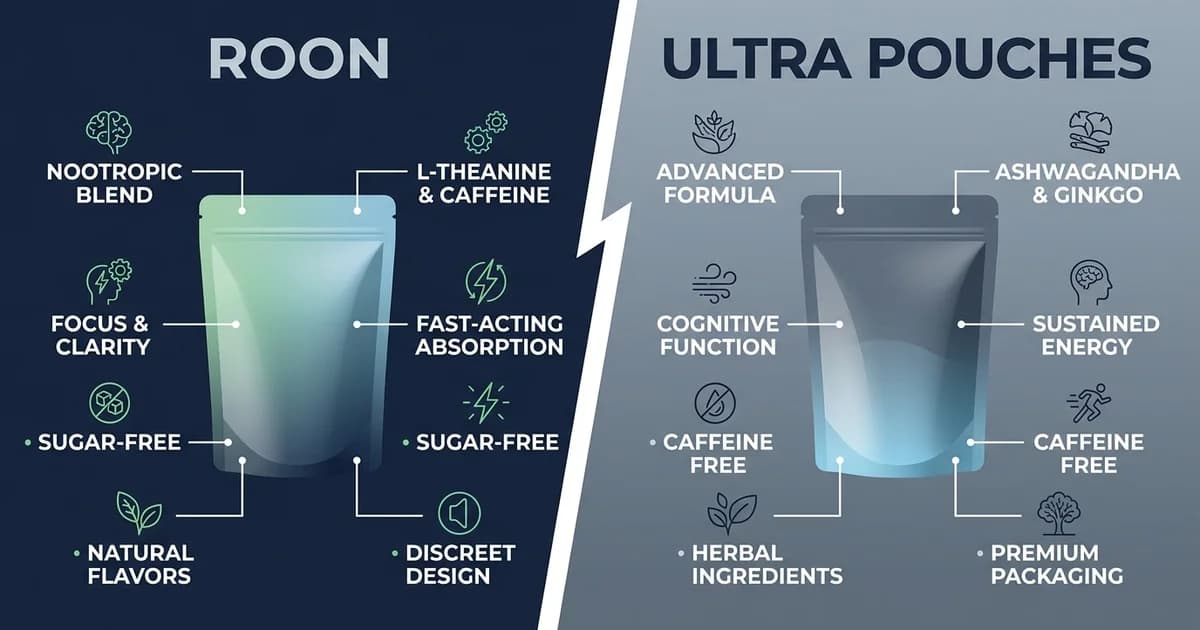
Roon and Ultra are both nicotine-free oral pouches. They are not the same stimulant. Roon uses 80 mg caffeine plus 60 mg L-theanine, 25 mg Dynamine (methylliberine), and 5 mg TeaCrine (theacrine). Ultra uses paraxanthine, in an amount it does not publish, and contains no caffeine. Roon does not contain paraxanthine.
| Spec | Roon Cool Mint | Ultra Focus |
|---|---|---|
| Nicotine | None | None |
| Caffeine | 80 mg | 0 mg |
| Paraxanthine | None | Yes, amount not published |
| Other published actives | 60 mg L-theanine, 25 mg Dynamine, 5 mg TeaCrine | L-theanine, Alpha-GPC, ginseng, B vitamins (doses undisclosed) |
| Onset | 5 to 10 minutes | About 10 minutes |
| Claimed duration | 6 to 8 hours | 1 to 2 hours |
| Price (August 2026) | $60 for 4 tins one-time ($15/tin), $9.16/tin subscribed | $48.00 for 3 cans one-time, $36.00/month subscribed |
Key Takeaways
- Ultra Pouches use enfinity® paraxanthine as their primary stimulant, a caffeine metabolite with emerging research behind it. Ultra does not publish how much is in a pouch.
- Roon uses a four-compound stack: 80 mg caffeine, 60 mg L-theanine, 25 mg methylliberine (Dynamine), and 5 mg theacrine (TeaCrine), designed for sustained focus over 6 to 8 hours. Roon contains no paraxanthine.
- The roon vs ultra pouches debate often centers on caffeine content: Ultra is caffeine-free but relies on a single stimulant, while Roon uses 80mg of caffeine (comparable to a cup of coffee) paired with compounds that smooth and extend its effects to 6-8 hours with no jitters, no crash, and no tolerance buildup.
- The biggest differences in this nootropic pouch comparison are in duration of effect and tolerance buildup.
The Contenders: A Quick Overview
Ultra Pouches
Ultra Pouches market themselves as a nicotine-free, caffeine-free focus pouch. Their formula centers on enfinity® paraxanthine, a primary metabolite of caffeine that your liver naturally produces when you drink coffee. Takeultra.com publishes no milligram amount for it, or for any of the other five actives, so there is no label figure to compare against. The rest of the formula includes L-Theanine, Alpha GPC, Panax Ginseng, Vitamin B6, and Vitamin B12.
Ultra positions itself as a cleaner alternative to both caffeine and nicotine. According to their site, each pouch delivers focus lasting 1-2 hours, with peak cognitive performance hitting around the one-hour mark. They recommend using 3-4 pouches per day and advise not exceeding 5. That shorter active window is one of the key factors in the roon vs ultra pouches decision.
Roon
Roon takes a different approach. Rather than replacing caffeine entirely, it uses 80mg of caffeine (comparable to a cup of coffee) and pairs it with three other compounds: L-Theanine, Theacrine, and Methylliberine. This four-ingredient stack is designed so each compound plays a specific role in the focus curve, from onset speed to sustained duration.
Roon's four-compound nootropic pouches are designed around a Caffeine, L-Theanine, Theacrine, and Methylliberine stack intended to cover an extended focus window per pouch. That duration advantage is a major reason many users land on Roon in the roon vs ultra pouches matchup.
Roon vs Ultra Pouches: Ingredient Breakdown
Here's where the roon vs ultra pouches comparison gets interesting. Both products share L-Theanine, but the rest of their formulas diverge sharply.
| Feature | Roon | Ultra Pouches |
|---|---|---|
| Primary Stimulant | Caffeine (80mg) | enfinity® Paraxanthine (amount not published) |
| L-Theanine | ✅ Yes | ✅ Yes |
| Theacrine | ✅ Yes | ❌ No |
| Methylliberine | ✅ Yes | ❌ No |
| Alpha GPC | ❌ No | ✅ Yes |
| Panax Ginseng | ❌ No | ✅ Yes |
| Vitamins B6/B12 | ❌ No | ✅ Yes |
| Nicotine-Free | ✅ Yes | ✅ Yes |
| Caffeine-Free | ❌ No (80mg) | ✅ Yes |
| Claimed Duration | 6-8 hours | 1-2 hours |
| Delivery | Sublingual pouch | Sublingual pouch |
Ultra's Formula: Paraxanthine as the Engine
Ultra's bet is on paraxanthine. There's real science here. A 2024 study published in the Journal of the International Society of Sports Nutrition found that paraxanthine provided greater improvement in cognitive function than caffeine after exercise. Preclinical research from Experimental Brain Research showed paraxanthine enhanced memory and neuroplasticity more effectively than caffeine in animal models.
The supporting cast in Ultra's formula, Alpha GPC and Panax Ginseng, adds acetylcholine support and adaptogenic properties. B vitamins round things out for general energy metabolism. It's a solid formula if your primary goal is a caffeine-free experience. Still, anyone doing a thorough roon vs ultra pouches analysis should look beyond the ingredient list and consider how those ingredients perform over time.
But paraxanthine has a shorter half-life than caffeine. According to enfinity's own research page, paraxanthine "clears from the body more rapidly" than caffeine. That's pitched as a feature (less sleep disruption), but it also means the active window per pouch is shorter. Ultra's own FAQ confirms their focus duration at 1-2 hours per pouch.
Roon's Formula: The Extended-Release Stack
Roon's approach is pharmacological stacking. Each of the four ingredients serves a specific timing function:
- Caffeine (80mg) provides the initial onset. At 80mg (comparable to a cup of coffee), it activates adenosine receptor antagonism, while L-Theanine smooths the response and Theacrine and Methylliberine extend the effect over a longer window.
- L-Theanine modulates the caffeine response, promoting alpha brain wave activity. The caffeine-L-Theanine combination is one of the most studied nootropic pairings in the literature.
- Theacrine extends the duration curve. It acts on similar pathways to caffeine but with a longer half-life, and research from Nootropics Depot describes it as "about as potent as caffeine" but longer lasting with slower tolerance development.
- Methylliberine accelerates onset. It's a fast-acting purine alkaloid from the kucha tea leaf. According to Compound Solutions research, combining Theacrine and Methylliberine creates a quick onset from the Methylliberine while Theacrine sustains the effect over a longer window.
The result is a designed focus curve: fast start, smooth middle, gradual taper. One pouch. 6-8 hours. This stacking strategy is what sets Roon apart in any roon vs ultra pouches evaluation.
Duration and Tolerance: The Practical Roon vs Ultra Pouches Difference
This is where the ultra pouches vs roon comparison gets most relevant for daily users.
Ultra's 1-2 hour window means you'll likely use 3-4 pouches across a workday. That is three or four doses of paraxanthine daily, and because Ultra publishes no amount per pouch, you cannot total up what you have taken. While paraxanthine appears to have a favorable safety profile based on current research, the long-term data on daily paraxanthine use at these doses is still limited. Most published studies have examined single doses or short supplementation periods of up to 7 days.
Roon's longer duration means one or two pouches can cover an entire workday. The total caffeine intake stays at 80-160mg, well below the FDA's general guideline of 400mg per day. And the Theacrine component is specifically notable for its resistance to tolerance. Unlike caffeine, where your body adapts and demands higher doses over time, Theacrine appears to maintain its efficacy with repeated use.
For someone who needs focus from 9 AM to 5 PM, the roon vs ultra pouches gap in duration creates a meaningful difference in both convenience and total compound consumption.
Flavor and Experience
Both products use sublingual delivery, meaning you tuck the pouch between your lip and gum and let the ingredients absorb through the oral mucosa. This bypasses the digestive system and delivers compounds to the bloodstream faster than a capsule or drink.
Ultra offers flavors including Cool Mint, Wintergreen, Watermelon, and Tropical. They recommend keeping the pouch in for 30-60 minutes for maximum absorption. User reviews on Amazon and Junip are generally positive, with a 4.79 average rating across 200+ reviews.
Roon's pouch format is similar in delivery method. Both brands are zero-nicotine and designed for the same use case: focus on demand, without the baggage of stimulant dependency. The user experience is comparable, so the roon vs ultra pouches decision really comes down to formula and duration.
Pricing
Ultra Pouches are sold in 3-can bundles. According to their product page, a one-time purchase of 3 cans runs $48.00, with a subscription option at $36.00 per month. Each can contains 15 pouches, so a 3-can bundle gives you 45 pouches. At the recommended 3-4 pouches per day, a 45-pouch bundle does not last long.
Roon Cool Mint is $60 for 4 tins one-time ($15 per tin), or $9.16 per tin on the 12-tin subscription, at takeroon.com. There is no single-tin checkout. Because Roon's 6 to 8 hour window typically means 1 to 2 pouches per day, the cost per hour of focus is lower than a 1 to 2 hour pouch you redose three or four times. When you run the numbers on Roon vs Ultra pouches, cost-per-focus-hour often favors the product that lasts longer per pouch.
What's Missing from Each Product
No product is perfect. Here's where each formula leaves gaps in this nootropic pouch comparison.
What Ultra Pouches lack:
- No tolerance-mitigation compounds. Paraxanthine acts on similar neural pathways to caffeine. Without Theacrine or another compound that resists habituation, daily users may still see diminishing returns over weeks of consistent use.
- Short active window. 1-2 hours per pouch means frequent redosing. For deep work sessions or long meetings, you're swapping pouches multiple times.
- Limited research at daily-use doses. Paraxanthine research is promising but young. Most studies are acute or short-term. The long-term profile of taking paraxanthine three or four times a day hasn't been thoroughly established.
What Roon lacks:
- No cholinergic support. Ultra's Alpha GPC provides acetylcholine precursors, which support memory and learning. Roon's formula doesn't include a direct cholinergic compound.
- Not caffeine-free. If you're specifically trying to eliminate all caffeine from your life, Roon's 80mg per pouch won't fit that goal. It's comparable to a cup of coffee, but the stack is designed to smooth and extend the effect over 6-8 hours.
- No adaptogenic herbs. Ultra includes Panax Ginseng for stress modulation. Roon's formula is purely focused on the stimulant-focus axis.
Understanding these trade-offs is essential to making the right roon vs ultra pouches choice for your needs.
Which Nootropic Pouch Should You Choose?
The honest answer in the ultra pouches vs roon debate depends on what you're optimizing for.
Choose Ultra Pouches if:
- You want zero caffeine, period
- You're interested in paraxanthine as a newer stimulant compound
- You prefer a broader ingredient list with adaptogens and B vitamins
- You don't mind using 3-4 pouches per day
Choose Roon if:
- You want the longest possible focus window from a single pouch
- Tolerance resistance matters to you (daily, long-term use)
- You prefer a pharmacologically designed stack where each ingredient serves a specific timing function
- You want to keep your total stimulant intake low
The Case for the Four-Compound Stack
If you've read this far through this roon vs ultra pouches breakdown, you probably care about sustained cognitive performance, not a quick hit. And that's exactly the problem Roon was designed to solve.
Most nootropic pouches, and even personalized nootropic stacks, rely on a single primary stimulant and pad the formula with supporting ingredients. Roon's approach is different. The Caffeine-L-Theanine-Theacrine-Methylliberine stack isn't four random ingredients thrown together. It's a sequence: Methylliberine for fast onset, Caffeine and L-Theanine for the smooth core of the focus window, and Theacrine to extend the tail end without building tolerance.
The result is 6-8 hours of clean, sustained focus from one pouch. No redosing. No jitters. No crash at hour two. That's the bottom line in the roon vs ultra pouches comparison, and it's why the four-compound stack stands out in any nootropic pouch comparison you'll find.
If that sounds like what your workday actually demands, check out Roon at takeroon.com and see the full ingredient breakdown for yourself.
<!-- batch19-fasting-hub-links -->Related: fasting and appetite cluster
Dedicated pages for the fasting / appetite queries that currently land on Ultra reviews: