Velo vs Zyn: Strength, Price, and Ingredients Compared
Roon Team
Is Velo Healthier Than Zyn? What the Ingredients Actually Show
Short answer: no. Neither Velo nor Zyn is a meaningfully "healthier" nicotine pouch. Both are tobacco-free, both deliver nicotine through the gum, and both create dependence. The differences that do exist are in strength, pouch feel, and price, not in health. This page looks at what is actually in each pouch. If you want the full side-by-side on strengths, flavors, and cost, see our complete Velo vs Zyn comparison. If you're weighing these two brands, you're already asking the right question: which one actually fits the way you use nicotine? Both are tobacco leaf-free, and if you're also researching other tobacco-free Zyn alternatives, the field is wider than these two brands. Both are smoke-free and spit-free. But the similarities end faster than most comparison articles would have you believe.
Here's what actually separates them in the zyn vs velo matchup, and how they differ in strength, feel, and use experience.
Key Takeaways
- Zyn offers drier pouches with a slower, steadier nicotine release. Its product pages list 1.5mg, 3mg and 6mg, and the separate ZYN Ultra line reaches 9mg and 11mg.
- Velo is really two lines: the original dry pouch at 4mg and 7mg, and the moister VELO PLUS at 3mg, 6mg and 9mg.
- Zyn dominates market share at over 74%, while Velo is gaining ground with its reformulated Plus line.
- If you're comparing zyn vs on vs velo, each brand fills a different niche in strength, format, and flavor.
- Neither brand addresses the core issue: nicotine dependency itself.
Who Makes These Pouches?
Zyn is a product of Swedish Match, a subsidiary of Philip Morris International since 2022. The brand launched in Sweden and scaled aggressively in the U.S., where it now commands the largest share of the nicotine pouch category. According to a 2025 analysis published in Tobacco Control, 131.6 million cans of Zyn were shipped in the U.S. during Q1 2024 alone, with market share surpassing 74%.
Velo comes from R.J. Reynolds Vapor Company, part of the British American Tobacco Group. It launched in 2019 and has since evolved through multiple product iterations, the most recent being the Velo Plus line.
Both are backed by tobacco industry giants. That context matters when you're evaluating what these products are designed to do: keep you using nicotine. Whether you frame it as velo vs zyn or the other way around, you're choosing between two different nicotine delivery systems from two of the largest tobacco companies on the planet.
Zyn vs Velo: Strength and Nicotine Delivery
This is where the zyn vs velo comparison diverges the most.
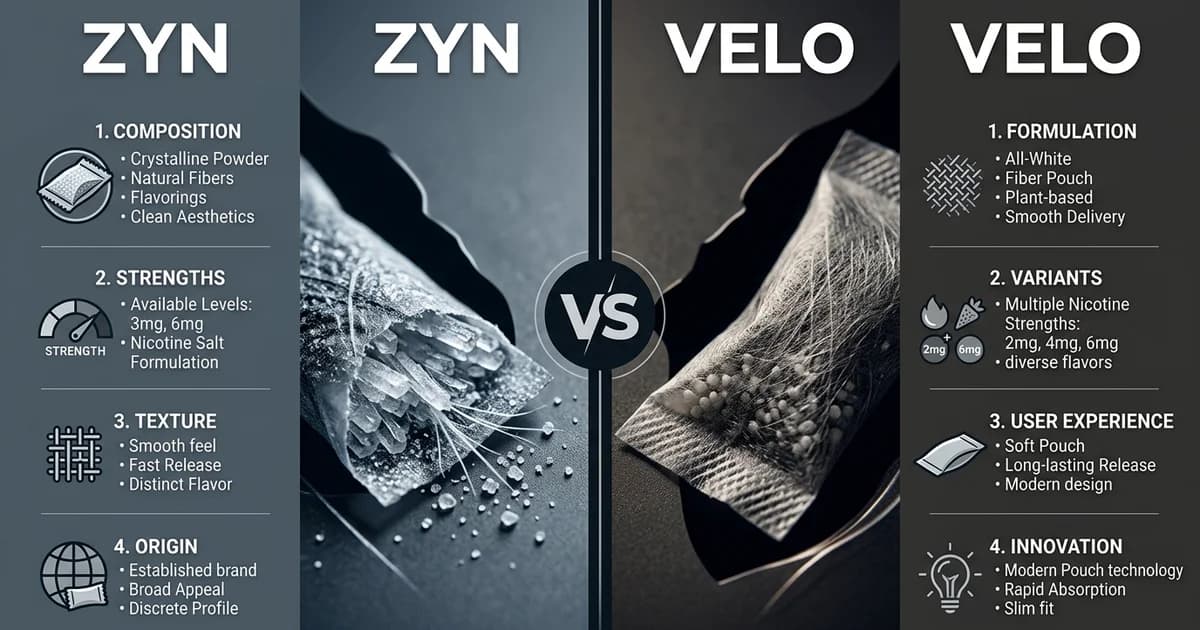
Zyn's U.S. product pages list 1.5mg, 3mg and 6mg per pouch, and its separate ZYN Ultra line adds 9mg and 11mg. Zyn's own FAQ still names only two strengths, 3mg and 6mg, so the site disagrees with itself; the product pages are the more specific source. The pouches are dry, which means nicotine releases slowly and steadily. Most users report roughly 30 to 40 minutes of consistent delivery, though Zyn's own instructions say to keep a pouch in for up to one hour. The full brand-by-brand duration breakdown covers where that number comes from and how strength and placement shift it.
Velo plays a different game, and it is really two products. Velo's own product page labels the original line Dry, sold at 4mg and 7mg. The newer Velo Plus pouches are the moist ones, at 3mg, 6mg and 9mg. That extra moisture accelerates absorption, so Plus gives a faster onset with a stronger initial hit, but the effect tapers more quickly.
| Feature | Zyn | Velo |
|---|---|---|
| Strengths (U.S.) | 1.5mg, 3mg, 6mg; Ultra 9mg, 11mg | Original 4mg, 7mg; Plus 3mg, 6mg, 9mg |
| Pouch Moisture | Dry | Original dry; Plus moist |
| Nicotine Onset | Gradual | Fast |
| Duration | ~30-40 min | ~20-30 min |
| Manufacturer | Swedish Match (PMI) | R.J. Reynolds (BAT) |
In terms of upper nicotine strength, Velo Plus tops out at 9mg while ZYN Ultra reaches 11mg, so the higher published U.S. ceiling now belongs to Zyn. If you prefer a longer, more even experience, Zyn has the edge there too.
Flavor Lineups Compared
Both brands offer around 10 flavors in the U.S. market, with heavy overlap in the mint and menthol categories. Flavor is another area where the velo vs zyn decision gets personal.
Zyn's lineup includes Wintergreen, Cool Mint, Spearmint, Peppermint, Menthol, Citrus, Coffee, Cinnamon, Smooth, and Chill. The flavor profile tends to be clean and subtle, matching the drier pouch format.
Velo's lineup leans bolder. The Plus range features Wintergreen, Spearmint, Peppermint, Mint, Wild Berry, Citrus Chill, Dragon Fruit, Tropical Heat, Cappuccino, and Smooth. According to Northerner, the moist format delivers a more intense flavor experience out of the gate.
The real differentiator in the zyn vs velo flavor contest is Velo's fruit and tropical options. If you're bored by mint and want something like Dragon Fruit or Tropical Heat, Velo is the only one of the two offering that.
Flavor preference in the broader market skews heavily toward mint. Industry data from 2024 shows mint flavors account for roughly 33% of all pouch sales in North America, followed by fruit flavors at 27%.
Comfort and Discretion
Comfort is an underrated factor in the zyn vs velo decision. Zyn pouches are thinner, drier, and produce almost no drip. This makes them easier to use without anyone noticing. The soft, discreet format with minimal drip sits flush against the gum and stays put.
Velo Plus pouches are slightly larger and moister. That moisture drives the faster nicotine release, but it also means more oral sensation and a bit more drip. Some users prefer that tactile feedback. Others find it distracting during meetings or calls.
If discretion matters most, the smaller, drier pouch format may appeal more to some users. If you want to feel the pouch working, Velo delivers more sensory feedback.
Price and Availability
Both Zyn and Velo are widely available at gas stations, convenience stores, and online retailers across the U.S. Per can, pricing is roughly comparable, with most cans falling in the $4 to $6 range depending on your state and retailer. The counts differ, though. A standard ZYN can holds 15 pouches; a VELO or VELO PLUS can holds 20. The same shelf price therefore works out cheaper per pouch on Velo. Online bulk purchases from sites like Nicokick or Northerner can bring the per-can cost down.
Zyn's sheer market dominance means it's easier to find in stock. Velo can be spottier at physical retail locations, though the Plus line is expanding distribution fast. If you order online, availability is a non-issue for either brand, making the zyn vs velo choice purely about product preference.
Where Does On! Fit In?
If you're comparing zyn vs on vs velo and want to weigh Velo side effects compared to other brands, On! occupies the budget-friendly, low-profile end of the spectrum. On! pouches are the smallest of the three, using a mini format that's nearly invisible under the lip. They come in strengths from 2mg up to 8mg and use a thinner pouch material that delivers nicotine quickly despite the small size.
On! ranked as the second most purchased nicotine pouch brand on Nicokick in 2024, behind Zyn. In the zyn vs on vs velo three-way comparison, On! is a solid middle ground if Zyn feels too mild and Velo feels too intense.
The Bigger Question Nobody Asks
Every zyn vs velo comparison focuses on strength, flavor, and format. Almost none of them address the obvious: both products deliver nicotine, and nicotine builds tolerance fast.
Research shows that tolerance to nicotine's effects can develop within 2 to 4 days of consistent use. That's not a typo. Within a week, the same pouch delivers less of the effect you started using it for. So you reach for a stronger one. Or you use them more frequently. This is the cycle these products are designed around.
A 2025 review published in Frontiers in Public Health flagged concerns about the high nicotine content in modern pouches and their efficient bloodstream delivery, especially regarding dependency formation.
If what you're actually after is sustained focus, better concentration, or a clean mental edge during long work sessions, nicotine is a blunt instrument for a precision job. The velo vs zyn debate misses this point entirely.
A Different Approach to the Pouch Format
This is where Roon enters the conversation. It's a sublingual pouch, same format you're already used to. But instead of nicotine, it uses a stack of caffeine (80mg), L-Theanine (60mg), Theacrine (5mg), and Methylliberine (25mg), all compounds studied for their effects on cognitive performance.
The caffeine and L-Theanine combination is well-documented. A study published in Nutritional Neuroscience found that the pairing improved cognitive performance and subjective alertness compared to placebo. A 2025 crossover study published in the British Journal of Nutrition confirmed that L-Theanine and caffeine together improved selective attention even in sleep-deprived subjects.
The Theacrine and Methylliberine extend the effect to 6 to 8 hours without the tolerance buildup that nicotine creates. No jitters. No crash. No dependency cycle.
Most Zyn vs Velo comparisons stop at flavor and strength. A better one also asks what role nicotine is actually playing and whether the product is being used for satisfaction, habit, or focus. If you've been using pouches for focus and you're tired of chasing the same effect with higher doses, Roon is worth a look. See how it compares.
Zyn vs Velo vs Roon: Three-Brand Comparison
Nicotine pouches and focus pouches serve different purposes. This table puts all three side by side so you can see exactly what you're getting.
| Brand | Active Compounds + Exact mg | Nicotine-Free | Duration | Price/Pouch (est.) | Label Transparency |
|---|---|---|---|---|---|
| Zyn | Nicotine: 1.5mg, 3mg or 6mg (ZYN Ultra 9mg, 11mg) | No | 30-40 min | ~$0.27 to $0.40 (15 per can) | Nicotine mg listed; no full ingredient breakdown |
| Velo | Nicotine: 4mg or 7mg (original); 3mg, 6mg or 9mg (Plus) | No | 20-30 min | ~$0.20 to $0.30 (20 per can) | Nicotine mg listed; no full ingredient breakdown |
| Roon | Caffeine 80mg, L-Theanine 60mg, Methylliberine (Dynamine) 25mg, Theacrine (TeaCrine) 5mg | Yes | 6-8 hours | $0.61 to $1.00 | Full ingredient panel published; exact mg per compound |
Roon is not a nicotine replacement and is not positioned as one. It occupies a separate category: a sublingual cognitive performance pouch for people who want sustained focus without a dependency cycle. If you're trying to quit nicotine, that's a different need and a different conversation. If you're reaching for a Zyn or Velo to get through a long work session, Roon addresses the same underlying goal through a different mechanism.
Frequently Asked Questions
What is the main difference between Zyn and Velo?
Zyn uses dry pouches that release nicotine slowly over 30 to 40 minutes, listed at 1.5mg, 3mg and 6mg, with a separate ZYN Ultra line at 9mg and 11mg. Velo's original line is dry at 4mg and 7mg; Velo Plus is the moist one at 3mg, 6mg and 9mg, with a faster, stronger hit. Velo offers more flavor variety. Zyn is thinner, drier, and easier to use discreetly.
Which is stronger, Zyn or Velo?
It depends which Zyn. Velo Plus goes up to 9mg per pouch. Zyn's standard line stops at 6mg, but its ZYN Ultra line reaches 9mg and 11mg, which is the higher published figure of the two. If you prefer a milder, longer-lasting experience, Zyn's 6mg option delivers a steadier feel over a longer window.
How does Roon compare to Zyn and Velo?
Roon is a zero-nicotine sublingual pouch, which puts it in a separate category from Zyn and Velo. Instead of nicotine, each Roon pouch contains 80mg caffeine, 60mg L-Theanine, 25mg Methylliberine (Dynamine), and 5mg Theacrine (TeaCrine). It is designed for 6 to 8 hours of sustained focus without jitters, crash, or tolerance buildup. It is not a nicotine replacement product.
Does nicotine tolerance develop quickly with products like Zyn and Velo?
Yes. Research shows nicotine tolerance can develop within 2 to 4 days of consistent use. That means the same pouch delivers less of the effect you started using it for within a single week. Over time, users tend to reach for higher strengths or use more pouches per day to achieve the same result.
Are Zyn and Velo available without a prescription?
Yes. Both Zyn and Velo are sold over the counter at gas stations, convenience stores, and online retailers across the U.S. No prescription is required. Both products are regulated as tobacco products by the FDA, even though they contain no tobacco leaf.
Which nicotine pouch is best for discretion at work?
Zyn is generally considered more discreet. Its slim, dry pouch sits flush against the gum with minimal drip. Velo Plus pouches are slightly larger and moister, which some users find more noticeable. For office or meeting settings where you want zero distraction, Zyn's format tends to stay out of the way more reliably.
Built for the Tolerance Problem, Not Around It
The zyn vs velo comparison gives you what you need to pick a nicotine pouch. But it doesn't give you a way out of the pattern those pouches create.
Roon is not a nicotine replacement. It is a separate product category: a sublingual cognitive performance pouch with a four-ingredient stack (80mg caffeine, 60mg L-Theanine, 25mg Methylliberine, 5mg Theacrine) designed for people who want 6 to 8 hours of focused output without the dependency cycle nicotine builds. No escalating doses. No chasing a baseline that keeps moving.
If your reason for reaching for Zyn or Velo is focus, not habit, Roon addresses that directly. Same format, different mechanism.
By Roon Team