Alpha vs Ultra Pouches: Three Nicotine-Free Options Compared
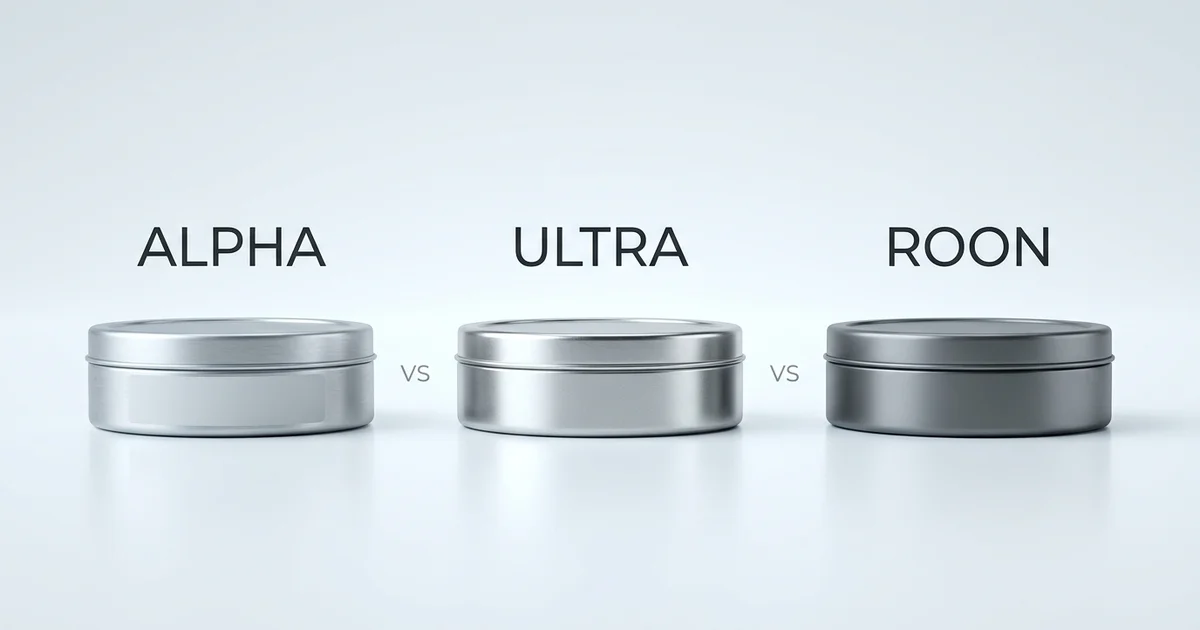
Alpha vs Ultra vs Roon: Comparing Three Nicotine-Free Focus Pouches (2026)
In the alpha vs ultra pouches debate, the deciding factor is dose transparency. Alpha (Fully Loaded Alpha Fuel) packs six ingredients into a proprietary blend, but its headline nootropic, Alpha-GPC, sits at 50mg, well below the 300 to 600mg used in clinical research. Ultra runs on paraxanthine and zero caffeine, which is a genuinely different stimulant pathway, though it prints its doses only on its Amazon supplement facts panel (100mg paraxanthine, 30mg Alpha-GPC), not on its own site. Roon discloses every milligram on the tin: 80mg caffeine, 60mg L-theanine, 25mg methylliberine, and 5mg theacrine. All three are nicotine-free. Only Roon prints every exact amount on its own site.
This article is for informational purposes only and is not medical advice. If you have health concerns, are pregnant or breastfeeding, or are trying to cut down on caffeine or quit nicotine, talk to a healthcare provider.
Key Takeaways
- Alpha Fuel (Fully Loaded) uses 50mg added caffeine plus 20mg guarana, with 50mg Alpha-GPC and 50mg L-tyrosine inside a proprietary blend. Several of its nootropics are micro-dosed. The separate caffeine-free ALPHA pouch carries 60mg Alpha-GPC.
- Ultra is caffeine-free and built on paraxanthine (enfinity), caffeine's primary metabolite, which carries a shorter plasma half-life. Ultra's own site prints no milligram amount; its Amazon supplement facts panel lists 100mg.
- Ultra Energy, on sale since September 14, 2026, is the exception: 180mg of caffeine per pouch, and Ultra advises no more than 2 a day (Ultra Energy; our Ultra Energy pouches review).
- Roon is the only one of the three with a fully disclosed, non-proprietary label: 80mg caffeine, 60mg L-theanine, 25mg methylliberine (Dynamine), 5mg theacrine (TeaCrine).
- "Alpha pouches" (Fully Loaded) are not the same as "Alpha Brain" (Onnit). Different company, different product, different format.
- If you care about knowing your exact stimulant load, proprietary blends are the problem to solve.
The fastest way to compare alpha vs ultra pouches: read the label
The single biggest difference across these three products is whether you can see the dose at all. Alpha uses a proprietary blend, which lists a total weight but not the split between ingredients. Ultra prints no amounts on its own site, only on the supplement facts panel on its Amazon listing. Roon lists each ingredient at an exact milligram.
That matters because dose is the entire game in stimulant and nootropic science. A 50mg Alpha-GPC pouch and a 600mg Alpha-GPC capsule are different doses with different expected effects, not the same product in two packages.
| Brand | Stimulant source | Exact mg per pouch | Caffeine mg | Nicotine-free? | Doses vs clinical research | Price per pouch (approx.) |
|---|---|---|---|---|---|---|
| Alpha (Fully Loaded Alpha Fuel) | Added caffeine + guarana + theobromine | 50mg caffeine, 50mg Alpha-GPC, 50mg L-tyrosine, 20mg taurine, 20mg guarana, 15mg theobromine (proprietary blend) | 50mg (plus guarana-derived) | Yes | Alpha-GPC 50mg is roughly 8 to 17% of the 300 to 600mg clinical range; L-tyrosine and guarana are sub-clinical | $5.29 a can or $25.19 for five ($5.04/can), or $0.295 a pouch in the 200-pouch bulk pack ($59.00); Fully Loaded does not publish a can count |
| Ultra | Paraxanthine (enfinity), caffeine-free | 100mg paraxanthine, 10mg L-theanine, 30mg Alpha-GPC, 1mg ginseng extract, B6, B12 (Amazon supplement facts panel; none printed on takeultra.com) | 0mg (Focus); Ultra Energy has 180mg | Yes | Alpha-GPC 30mg is 5 to 10% of the 300 to 600mg clinical range; 10mg L-theanine is small next to Roon's 60mg | ~$1.07 one-time; $0.69 to $0.80 on subscription |
| Roon | Caffeine + methylxanthine stack | 80mg caffeine, 60mg L-theanine, 25mg methylliberine (Dynamine), 5mg theacrine (TeaCrine), fully disclosed | 80mg | Yes | Caffeine and L-theanine doses match the ratio used in attention research; every ingredient disclosed | From $0.61 (from $9.16 per tin subscribed) |
Prices are approximate and vary by retailer, pack size, and subscription status. Treat them as directional, not exact.
Why 80 mg, not more. Ultra Energy carries 180 mg, but extra milligrams mostly raise the peak. Roon's lever is the clearance rate. Its 25 mg of methylliberine (Dynamine) comes from research where methylliberine plus caffeine stretched caffeine's half-life from 7.2 to 15 hours with no higher peak (PK study, n=12). That study used 100 mg methylliberine and 150 mg caffeine, roughly 4x and 1.9x Roon's doses, so the direction carries over, not the figures. What Roon claims is a 6 to 8 hour window from one pouch. If one isn't enough, double up to 160 mg or take another later, within 4 pouches a day.
Alpha's micro-dosing problem is real, and the math is simple
Alpha Fuel's formula looks impressive on paper because it lists six active ingredients, but several of them appear at fractions of a research-relevant dose. The clearest example is Alpha-GPC. Fully Loaded lists 50mg of Alpha-GPC in an Alpha Fuel pouch, and 60mg in its caffeine-free ALPHA pouch, while the studies people cite for cognition and power output use far more.
Studies on Alpha-GPC use far more than 50mg. A 2024 randomized crossover trial published in Nutrients (PMC11644786) gave healthy young men either 315mg or 630mg of Alpha-GPC and found both doses measurably improved Stroop test scores compared to placebo. Research on power output uses the same 300 to 600mg range, taken 30 to 60 minutes before exercise. Against that backdrop, 50mg lands at roughly 8 to 17% of the studied amount.
L-tyrosine tells a similar story. Research on tyrosine and cognitive performance under stress typically uses doses measured in grams, not the 50mg Alpha offers, and the 20mg of guarana is a flavoring-level inclusion rather than a real stimulant on its own.
None of this makes Alpha useless. The 50mg of added caffeine is a functional dose. But if you bought Alpha for the Alpha-GPC, you are paying for a label, not a clinically studied amount.
Ultra's paraxanthine is a legitimately different pathway, not just marketing
Ultra is the most chemically distinct of the three because it skips caffeine entirely and runs on paraxanthine. This is not a gimmick. Paraxanthine is the compound your liver converts most caffeine into, and it behaves differently in the body.
Paraxanthine carries a plasma half-life of roughly 3 hours, compared with caffeine's mean of about 4 hours in healthy adults, according to pharmacokinetic data compiled on Wikipedia's Paraxanthine article citing Lelo et al. (1986, British Journal of Clinical Pharmacology). Using paraxanthine directly also sidesteps caffeine's other metabolites, theobromine and theophylline, which clear more slowly. For people who metabolize caffeine slowly, that shorter tail is the main selling point.
The catch is where the numbers live. Ultra names its actives on its own site and prints a milligram amount for none of them there. The supplement facts panel on its Amazon listing fills the gap: 100mg paraxanthine, 30mg Alpha-GPC, 10mg L-theanine and 1mg ginseng extract per pouch. The engine is a real dose. The supporting cast, like Alpha's, sits well under research amounts.
Roon's case is the disclosed dose, not a longer ingredient list
Roon does not try to win on ingredient count. It runs four actives and prints all of them: 80mg caffeine, 60mg L-theanine, 25mg methylliberine (Dynamine), and 5mg theacrine (TeaCrine). The argument is that a short, fully disclosed label beats a long, partly hidden one.
The caffeine and L-theanine pairing is the most studied combination in the focus category. A 2021 systematic review in Cureus (PMC8794723) found that the two together support improvements in sustained attention and alertness, with L-theanine improving attention-switching accuracy alongside caffeine's stimulation. The studies in that review used higher caffeine doses of 150 to 160mg, but Roon's 80mg to 60mg ratio preserves the same approximate caffeine-to-L-theanine proportion the research identifies as synergistic.
Methylliberine and theacrine are caffeine relatives that extend the active window, which is why Roon positions itself around sustained focus rather than a single sharp spike. The format also differs. Roon is sublingual, so the actives absorb through the tissue under your lip rather than being swallowed. That is a different delivery route than a standard chewed or swallowed pouch.
Guarana vs synthetic caffeine vs paraxanthine: three roads to the same receptor
These three products reach alertness through related but distinct chemistry. Understanding the route helps you predict how each one feels.
- Synthetic or added caffeine (Alpha, Roon): This is caffeine in its direct form. It absorbs quickly and your body still converts much of it into paraxanthine downstream. Guarana, which Alpha also includes, is simply a plant source of caffeine that tends to release a little more gradually.
- Guarana (Alpha): A caffeine-bearing seed extract. At 20mg per pouch, Alpha's guarana is a minor contributor stacked on top of the 50mg of added caffeine, not the primary engine.
- Paraxanthine (Ultra): The metabolite itself, delivered directly. Because you skip the conversion step and the slower-clearing byproducts, the experience can feel cleaner for slow metabolizers, with a shorter half-life of roughly 3 hours as documented in the Lelo et al. 1986 pharmacokinetics study.
The practical takeaway: Alpha and Roon are caffeine products that differ mostly in dose and disclosure, while Ultra is the true outlier that changes the molecule.
Which pouch fits which user
Choose Alpha if you want the lowest caffeine dose of the three and you are comfortable with a proprietary blend where most nootropics are micro-dosed. Choose Ultra if you specifically want a caffeine-free experience and the shorter paraxanthine half-life appeals to you, knowing the doses sit on the Amazon panel rather than Ultra's own site, and that Ultra Energy (180mg caffeine) is a different product. Choose Roon if your priority is knowing exactly what you take, with a moderate 80mg caffeine dose paired with L-theanine and two caffeine relatives, all printed on the label.
For more head-to-heads, see NZE vs Ultra and our Ultra pouches review.
Conclusion: in a proprietary-blend category, the disclosed label wins
The honest read on nicotine-free focus pouches in 2026 is that the category hides more than it shows. Alpha lists six ingredients but micro-doses several of them inside a proprietary blend. Ultra makes a real chemical bet on paraxanthine but prints its amounts only on its Amazon panel, not on its own site.
If you are comparing these products, the question that actually protects you is not "how many ingredients" but "how much of each, and can I see it." Dose is what produces effect, and a label you can read is the only way to verify dose. Whichever pouch you pick, pick the one whose math you can check.
Frequently Asked Questions
Are Alpha pouches the same as Alpha Brain by Onnit?
No. Alpha pouches are Fully Loaded's ALPHA and Alpha Fuel, sublingual nootropic pouches sold by Fully Loaded LLC. Alpha Brain is a swallowed capsule supplement made by Onnit. They share a word in the name and nothing else. Different company, different format, different formula. If you searched "Alpha" and landed on a capsule, you are looking at the Onnit product, not the pouch.
Is paraxanthine safer or better than caffeine?
Paraxanthine is caffeine's primary active metabolite, and it carries a shorter plasma half-life of roughly 3 hours versus caffeine's mean of about 4 hours in healthy adults, per Lelo et al. (1986, British Journal of Clinical Pharmacology). "Better" depends on you. Slow caffeine metabolizers may prefer paraxanthine's shorter tail and the fact that it sidesteps slower-clearing byproducts. For most people, well-dosed caffeine remains effective and far more studied.
Why does Alpha Fuel's 50mg Alpha-GPC matter?
Because dose drives effect. Clinical studies on Alpha-GPC for cognition and power output generally use 300 to 600mg, so 50mg is roughly 8 to 17% of that range. The ingredient is real, but the amount in one Alpha Fuel pouch, or the 60mg in the caffeine-free ALPHA pouch, is well below what the research used. If Alpha-GPC was your reason for buying, the label may promise more than the dose delivers.
Are all three pouches nicotine-free?
Yes. Alpha, Ultra, and Roon are all zero-nicotine products. None of them contains tobacco-derived nicotine or synthetic nicotine. They are marketed as focus and energy pouches rather than nicotine replacements, and they rely on caffeine, paraxanthine, and various nootropics for their effect instead.
What does "proprietary blend" mean and why is it a downside?
A proprietary blend lists the total weight of a group of ingredients without disclosing how much of each one is inside. It is legal and common, but it prevents you from verifying dose. You might see "Nootropic Blend 205mg" without knowing whether the active you care about is 5mg or 100mg. Fully disclosed labels, where every ingredient shows its own milligram amount, remove that guesswork.
How is a sublingual pouch different from a regular energy pouch?
A sublingual pouch is designed so the actives absorb through the thin tissue under your lip rather than being swallowed and processed through the gut. This can change onset speed and feel. Roon uses this format, while many energy pouches are chewed or simply parked in the cheek. The delivery route is part of why two pouches with similar ingredients can feel different.
Why Disclosed Doses Beat Long Ingredient Lists
This comparison kept circling back to one issue: you cannot evaluate a pouch you cannot read. Alpha buries its nootropics in a proprietary blend and micro-doses the headline ingredient. Ultra makes an interesting paraxanthine bet but keeps every amount off its own website. The thing both leave out is the exact number that determines whether a dose does anything.
Roon was built around that gap. Each pouch lists 80mg caffeine, 60mg L-theanine, 25mg methylliberine (Dynamine), and 5mg theacrine (TeaCrine), with nothing hidden in a blend. The caffeine-to-L-theanine ratio follows the pairing used in attention research, and the format is sublingual, designed for a steady focus window rather than a spike and crash.
Roon is a zero-nicotine focus pouch, not a medicine, not a nicotine replacement, and not a substitute for sleep or a sound routine. If the alpha vs ultra question left you wanting a label you can actually verify, try Roon's clinically-dosed focus pouch and check the math yourself.
By Roon Team