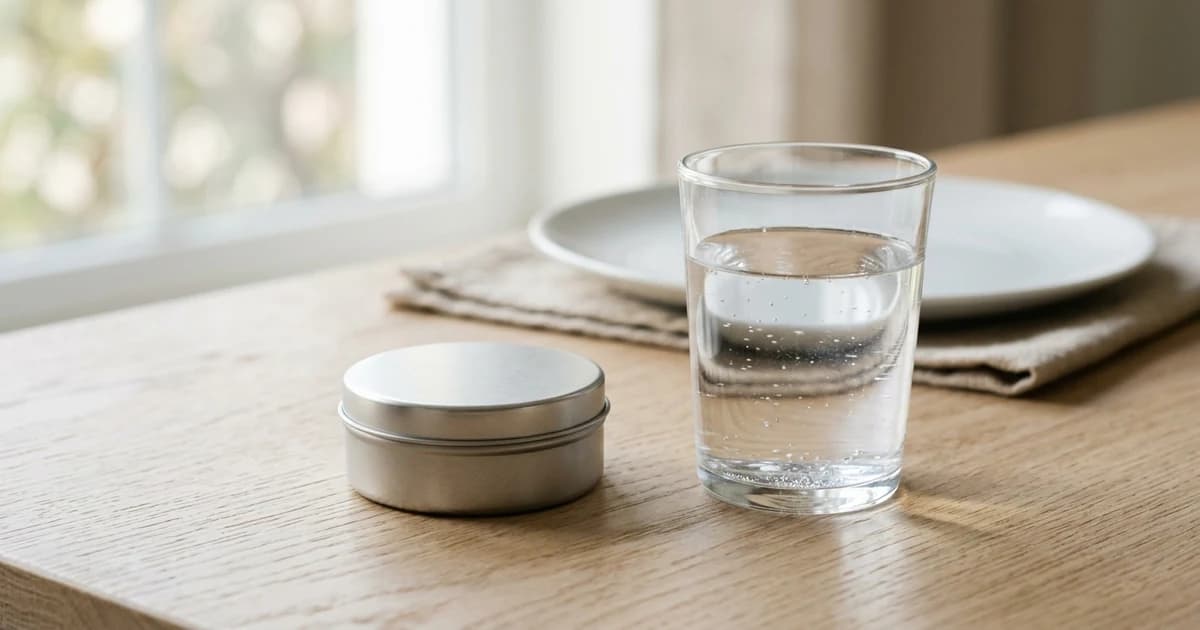
Your alarm goes off at 6:30. Breakfast is at noon. Somewhere around 9 a.m., the fog rolls in. Not real hunger, not the kind that doubles you over. More like a dull pull toward the kitchen, a shorter attention span, and a creeping sense that your best thinking window already closed. You know how to stay sharp while fasting in theory. The practice keeps falling apart in the same two-hour stretch every morning.
The problem is rarely willpower. It is timing: the tools most people reach for either kick in too late, wear off too early, or quietly break the fast they are trying to protect.
This guide covers why that mid-morning dip happens, what actually breaks a fast (and what does not), and a delivery mechanism that lines up caffeine's onset and duration with a 16:8 eating window instead of against it.
Key takeaways
- Fasting fog is mostly a timing and fuel-transition problem, not a calorie deficit. A 2025 meta-analysis in Psychological Bulletin (222 effect sizes, 3,484 participants) found no meaningful difference in cognitive performance between fasted and fed states at a median 12-hour fast.
- Black coffee and plain tea are generally accepted during a 16:8 fast, but anything with calories, protein, or fat will trigger an insulin response and break it.
- Oral mucosal caffeine (pouches, gums) absorbs through the mouth lining, bypassing the gut entirely. That means faster onset and zero calories passing through the digestive tract.
- Duration matters as much as onset. A single source of caffeine that lasts 6 to 8 hours can cover the entire fasting window without re-dosing, which matters when every extra product is another label to check.
Why the mid-morning fog hits harder than it should
If you follow a 16:8 protocol, your eating window typically runs from noon to 8 p.m. That puts the tail end of your fast squarely over the first half of your workday. And that is where things get difficult.
Your brain runs on glucose by default. After 12 to 16 hours without food, it begins transitioning to ketones as a fuel source, a shift that is metabolically normal but subjectively rough for the first few days or weeks of a new fasting habit. Research on this transition shows that ketones actually generate more ATP per oxygen molecule than glucose, which is why experienced fasters often describe sharper clarity once adapted. But during the transition period, the brain is running on a mix of depleted glycogen and not-yet-sufficient ketones. The result is the fog.
Then there is boredom-hunger. Much of what feels like hunger before noon is not a physiological need for calories. It is a conditioned response: your body expects food at the time you have always eaten, and it sends a signal that reads more as restlessness than starvation. Caffeine can blunt this. Research reviewed by GoodRx notes that in one study, participants who drank coffee 30 minutes before a meal ate less at that meal, though the effect did not persist across the full day. The mechanism works through short-term changes in gut hormones like ghrelin, not through any sustained metabolic suppression. Caffeine can take the edge off morning appetite, but calling any caffeine product an "appetite suppressant" overstates the evidence.
The practical question is not whether you can survive until noon. You can. The question is whether you can do your best thinking between 8 a.m. and noon on nothing but water, and if not, what you can add without breaking the fast.
What breaks a fast, and what does not
The short answer: calories break a fast. Specifically, anything that triggers a meaningful insulin response. Healthline's review of fasting protocols puts it plainly: sugar, protein, and fat all count. Gummy vitamins, protein shakes, BCAAs, and milk in your coffee all break the fast by this standard.
What stays on the safe side for most 16:8 practitioners:
| Allowed during a fast | Breaks a fast |
|---|---|
| Water, sparkling water | Milk, cream, half-and-half |
| Black coffee (no sugar, no cream) | Bulletproof coffee (contains fat) |
| Plain tea | Sweetened tea or chai lattes |
| Zero-calorie electrolytes | Protein shakes, BCAAs |
| Zero-calorie oral pouches | Gummy vitamins (contain sugar) |
Black coffee is widely accepted as fasting-compatible because a standard cup contains roughly 2 to 5 calories, not enough to trigger an insulin response. Plain tea falls into the same category. The line gets blurry with artificial sweeteners; some fasting researchers are cautious about them, but the general consensus for a 16:8 time-restricted eating protocol is that zero-calorie sweeteners do not break the fast in a metabolically meaningful way.
A sublingual or buccal caffeine pouch that contains zero calories and zero sugar sits on the "allowed" side of that table. Nothing enters the stomach. For a deeper look at this question, this analysis covers it in detail: Do Caffeine Pouches Break a Fast?
The delivery route problem: gut vs. mouth lining
Most people reach for coffee first thing in the morning. It works. But coffee has two timing limitations that are worth understanding if fasting focus is the goal.
Onset: 20 to 45 minutes through the gut
When you drink coffee, the caffeine passes through your stomach, enters the small intestine, and absorbs into the bloodstream from there. According to NCBI pharmacology data cited by researchers, 99% of ingested caffeine is absorbed within 45 minutes, with peak plasma concentrations landing between 15 and 120 minutes. Most people feel it around the 30-minute mark.
A caffeine pouch placed against the gum or under the lip absorbs through the oral mucosa, the thin, capillary-rich tissue inside your mouth. A study published in the British Journal of Clinical Pharmacology found that caffeine delivered via buccal absorption reached detectable blood levels within 5 minutes and achieved significant plasma concentrations by 15 minutes, substantially faster than oral ingestion.
Duration: 3 to 4 hours from coffee vs. 6 to 8 from a multi-compound stack
Plain caffeine, whether from coffee, a pill, or a single-ingredient pouch, has a half-life of roughly 5 hours in most adults, but the felt window of alertness is shorter: typically 3 to 4 hours before the effect tapers. For a fasting window that runs from 7 a.m. to noon or later, that means one cup of coffee runs out around 10 or 11 a.m., right when you need it most.
This is where ingredient stacking changes the math. A randomized, double-blind, crossover pharmacokinetic study (n=12) found that co-administration of 100 mg methylliberine (Dynamine) with 150 mg caffeine cut caffeine's oral clearance from 41.9 to 17.1 L/hr and extended its half-life from 7.2 to 15 hours, with no increase in peak concentration. Same peak, longer tail. The dose gap matters here: that study used 4x the methylliberine and roughly 1.9x the caffeine compared to what any consumer pouch contains at 25 mg methylliberine and 80 mg caffeine. The direction of the effect, slower clearance and longer duration, is consistent, but the magnitude at a lower dose has not been measured in a controlled PK trial.
The practical result of this mechanism, confirmed by reported user experience, is a felt window of 6 to 8 hours. That covers an entire fasting morning and then some.
The re-dosing problem
Short-acting focus pouches highlight this gap. Ultra pouches, for example, recommend 3 to 4 pouches per day, with each pouch lasting 1 to 2 hours. That is fine for their use case (Ultra uses paraxanthine, not caffeine), but it means cycling through multiple pouches across a single fasting morning. Every re-dose is a decision point, another moment where you break flow to reach for a tin. For fasted deep work, a single application that lasts the full window is a simpler solve.
Roon: one pouch, one fasting window
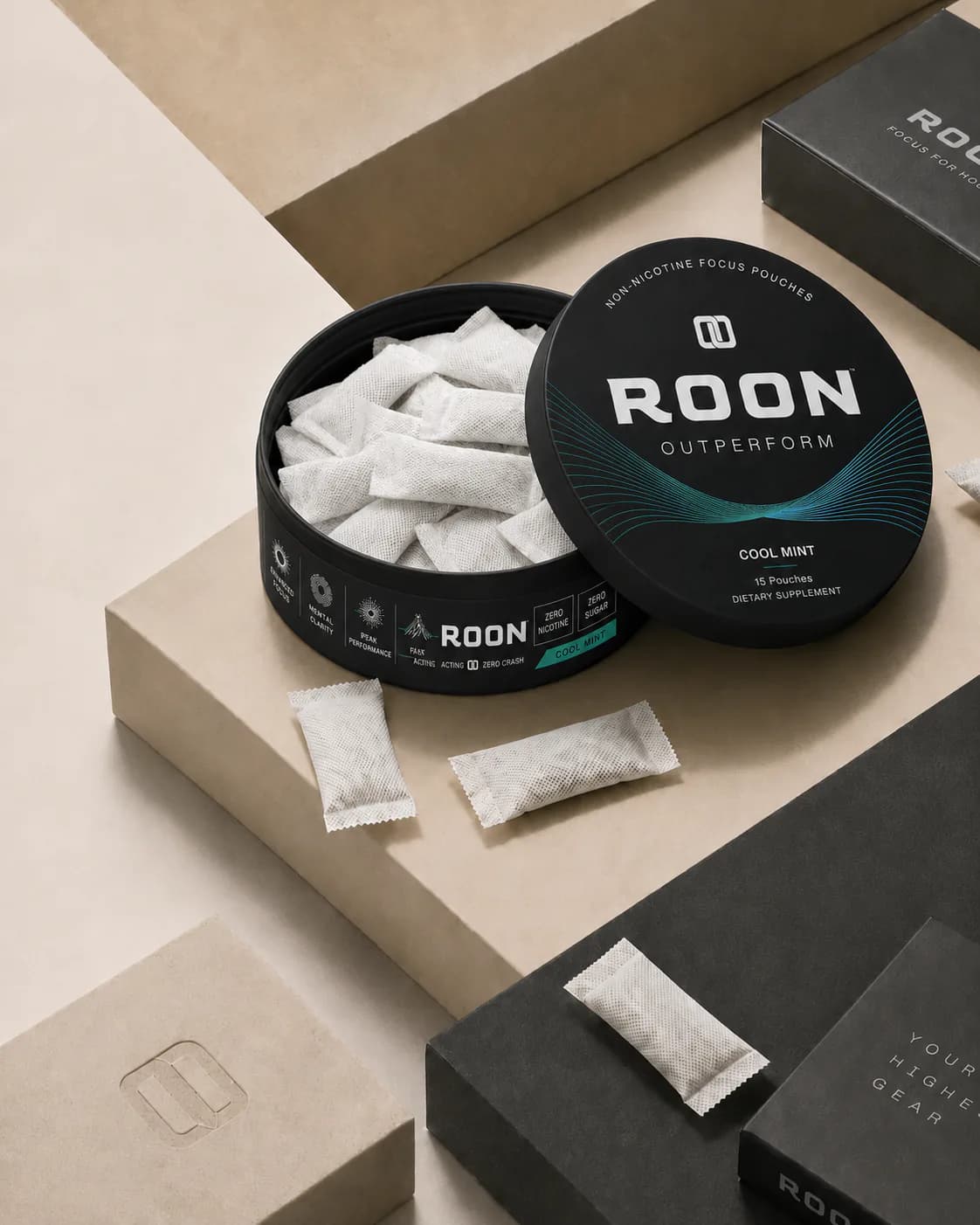
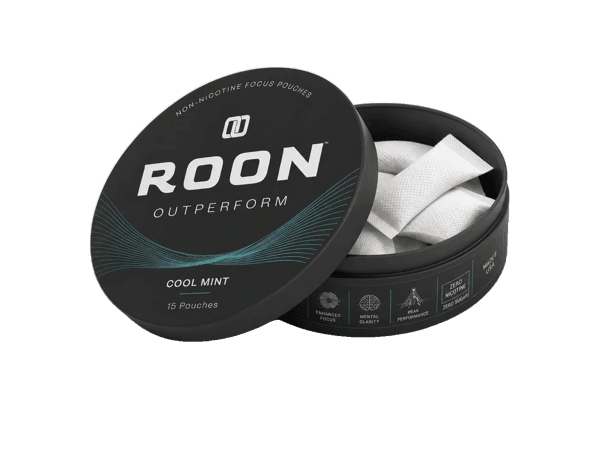
Everything above, the buccal absorption route, the multi-compound duration extension, the zero-calorie format, describes the engineering behind Roon.
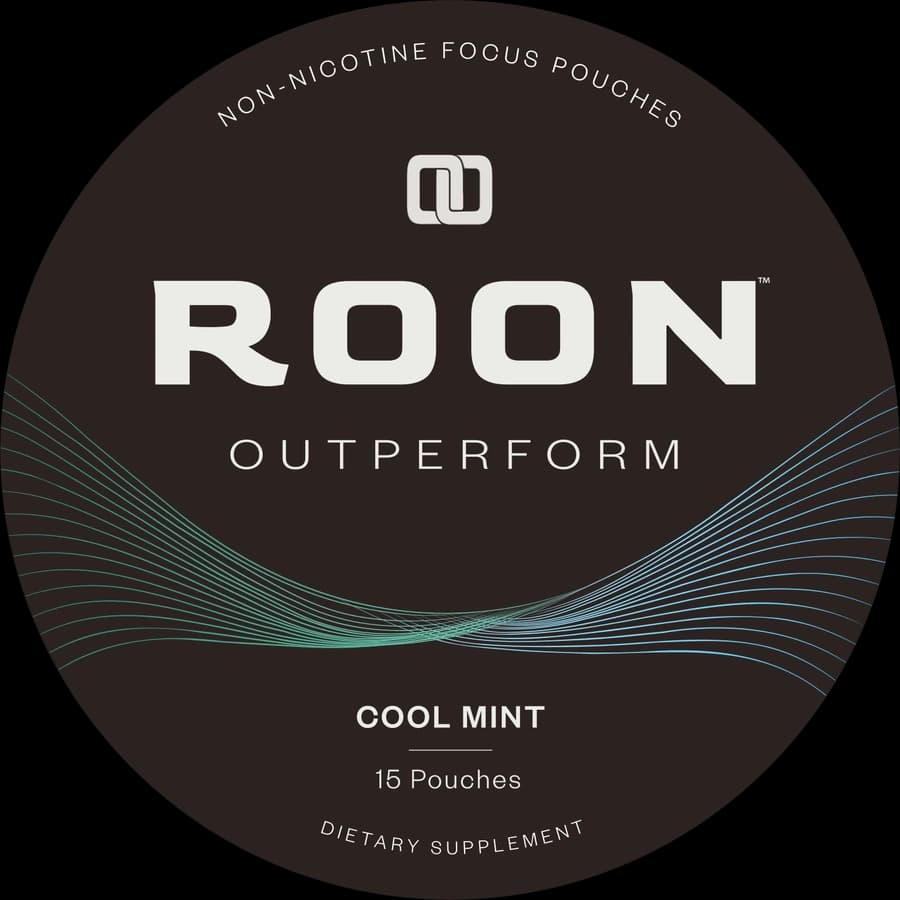
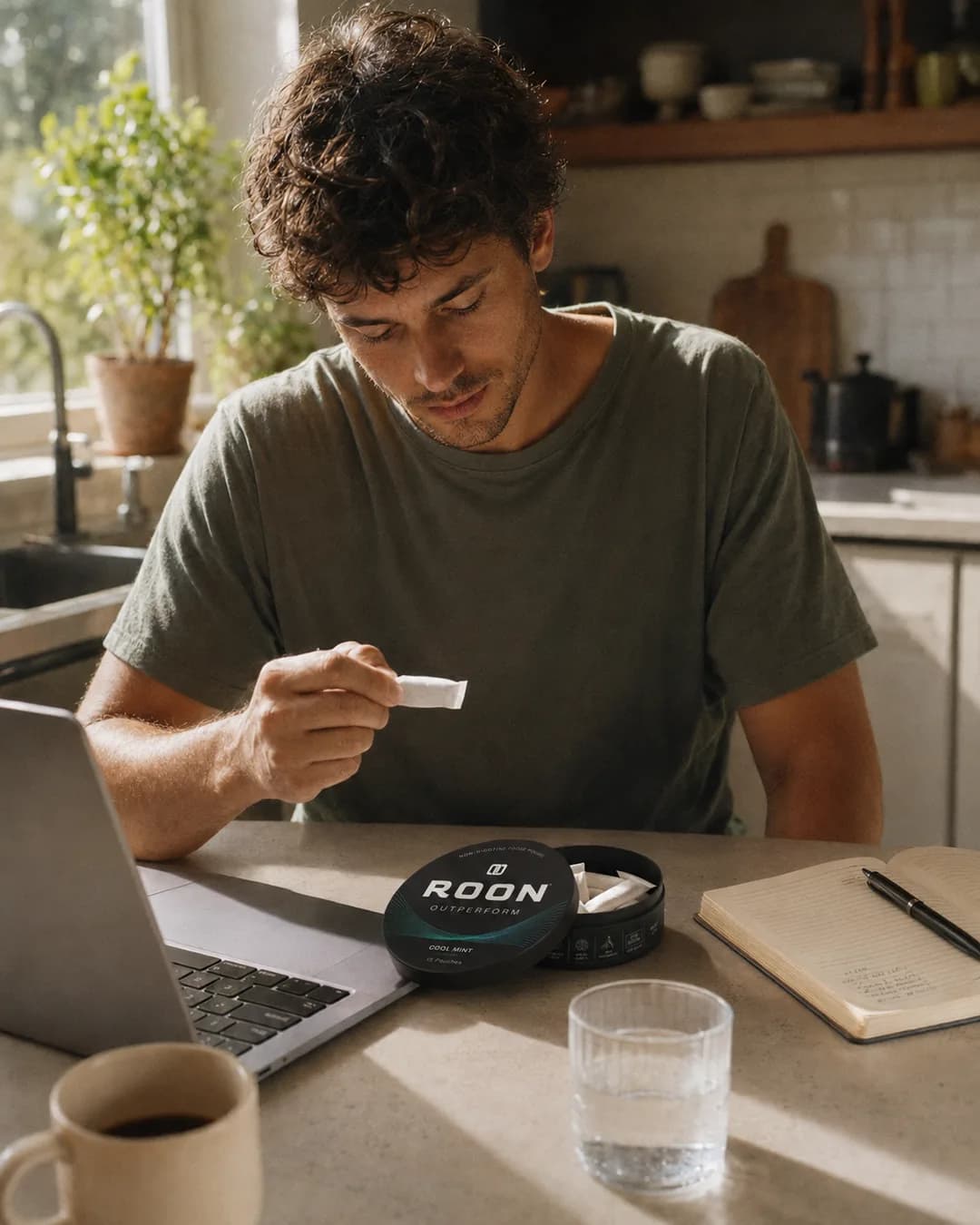
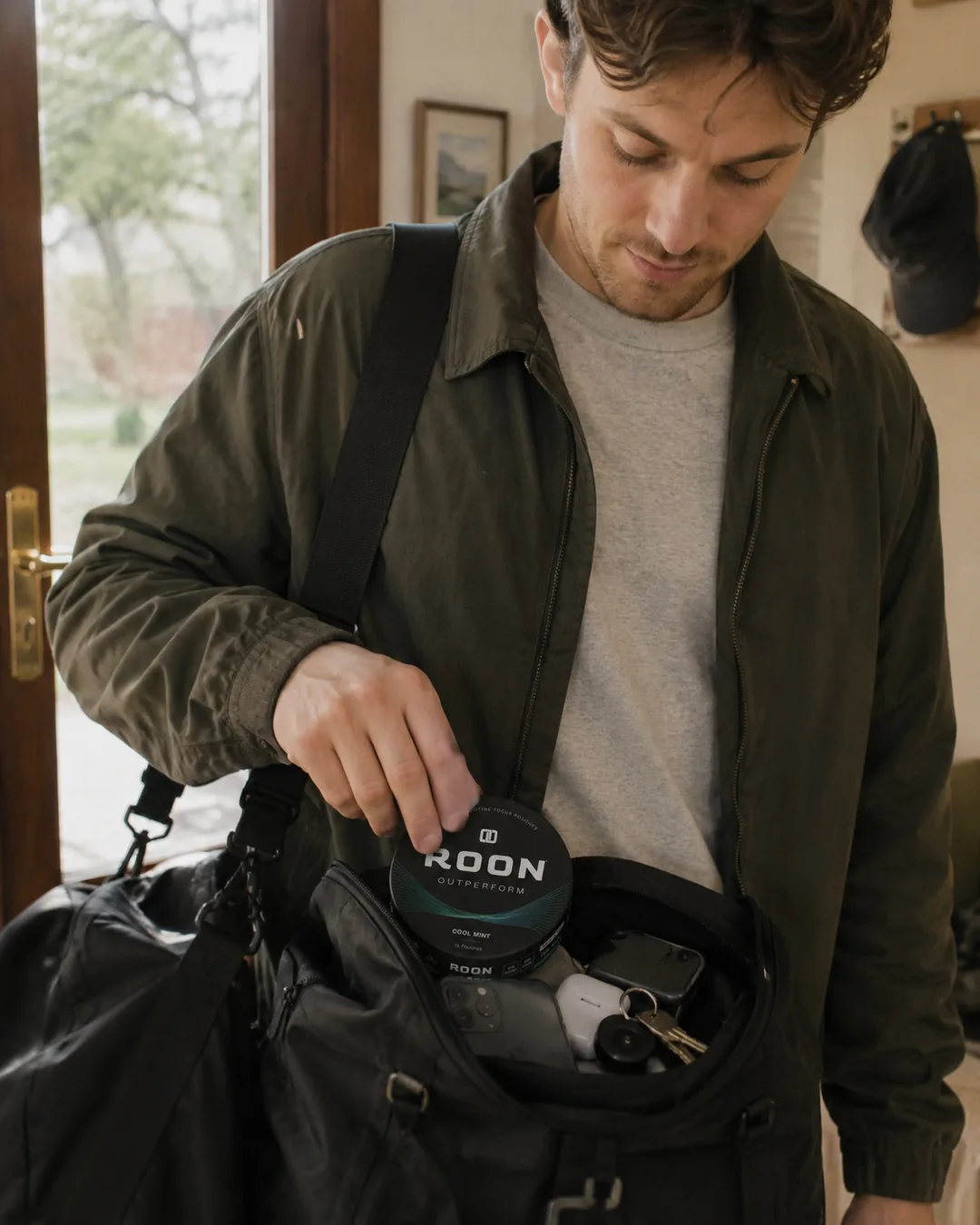
Each Roon pouch contains 80 mg caffeine (about one small cup of coffee), 60 mg L-theanine, 25 mg methylliberine (Dynamine), and 5 mg theacrine (TeaCrine). 15 pouches per tin, Cool Mint, zero nicotine, zero tobacco, zero sugar.
Here is how the stack maps to a fasting morning:
Fast onset without the gut. The pouch sits against your gum and absorbs through the oral mucosa. Nothing enters the stomach. Felt onset is 5 to 10 minutes. You place it when you sit down to work; by the time you have opened your first document, it is active.
Refined alertness, not a jolt. L-theanine does not cancel the caffeine. It refines it: smoothing the jitter and the scattered feeling while leaving the alertness intact. A 2010 study in Nutritional Neuroscience (Giesbrecht et al.) found that the combination of L-theanine and caffeine improved cognitive performance and subjective alertness more than either compound alone. For fasting focus, where you are already running on lower glycogen, that smoothing effect matters. You want steady output, not a spike-and-crash.
6 to 8 hours of felt effect. Dynamine slows caffeine's clearance (the pharmacokinetic mechanism described above), and theacrine adds a mild, sustained stimulant layer of its own. One pouch at 7 a.m. carries through to 1 or 2 p.m., well past most people's first meal. No re-dosing, no second cup, no decision fatigue at 10 a.m.
A slow taper, not a crash. The extended half-life means the effect fades gradually instead of dropping off a cliff. There is a trade-off to name here: do not take Roon late in the day. The same mechanism that extends the felt window means caffeine clears more slowly. Roon's own guidance is to stop at least 8 hours before bed.
Nothing that breaks the fast. Zero calories. Zero sugar (sweetened with sucralose). Nothing passes through the digestive tract. For readers who want the full breakdown of fasting compatibility across multiple pouch brands, Best Pouches for Fasting 2026 compares them side by side.
Roon is not a meal replacement, a diet tool, or a substitute for sleep. It is 80 mg of caffeine delivered through the mouth lining instead of the gut, with three compounds that extend and refine the effect. For people who fast until noon and need their best hours before then, it lines up the caffeine curve with the fasting window instead of against it.
Pricing starts from $9.16 per tin (as low as $0.61 per pouch) on the subscribe-and-save plans. One-time purchase is $14.99 per tin ($1.00 per pouch). The product page with full pricing, 120 reviews averaging 4.9 out of 5, and the ingredient breakdown is directly below.
<!-- batch20-fasting-gaps-hub-links -->Related: coffee, nicotine, and fasting
Head FAQs and product pages for the coffee / nicotine fasting queries: