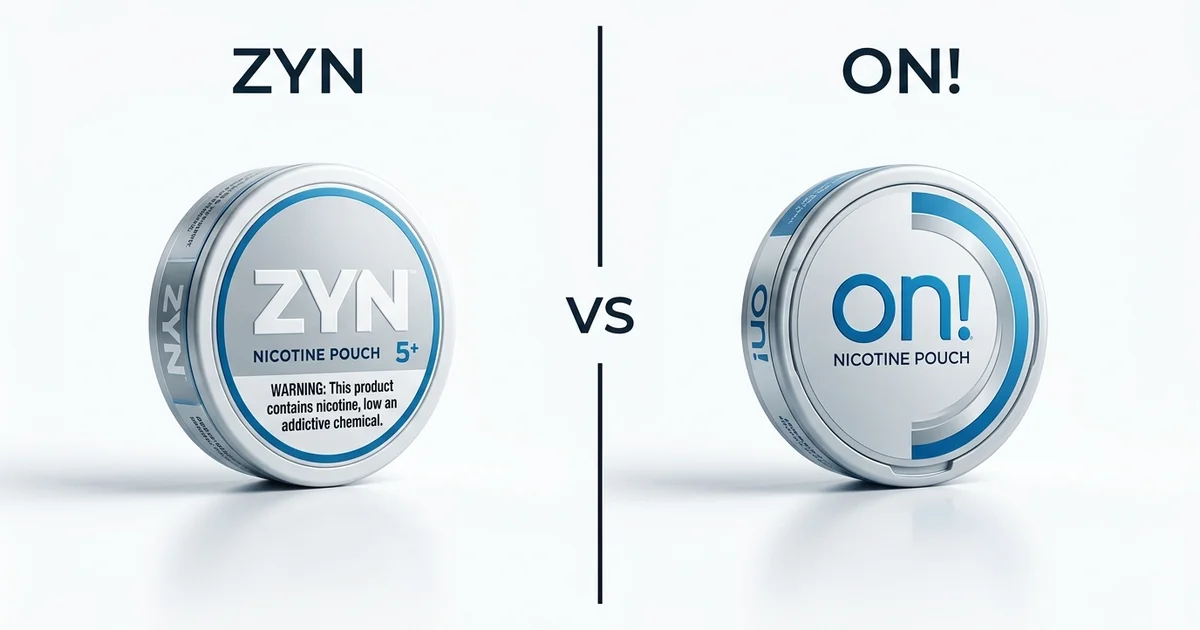
Ultra Pouches vs ZYN and ZYN Ultra: What's Different
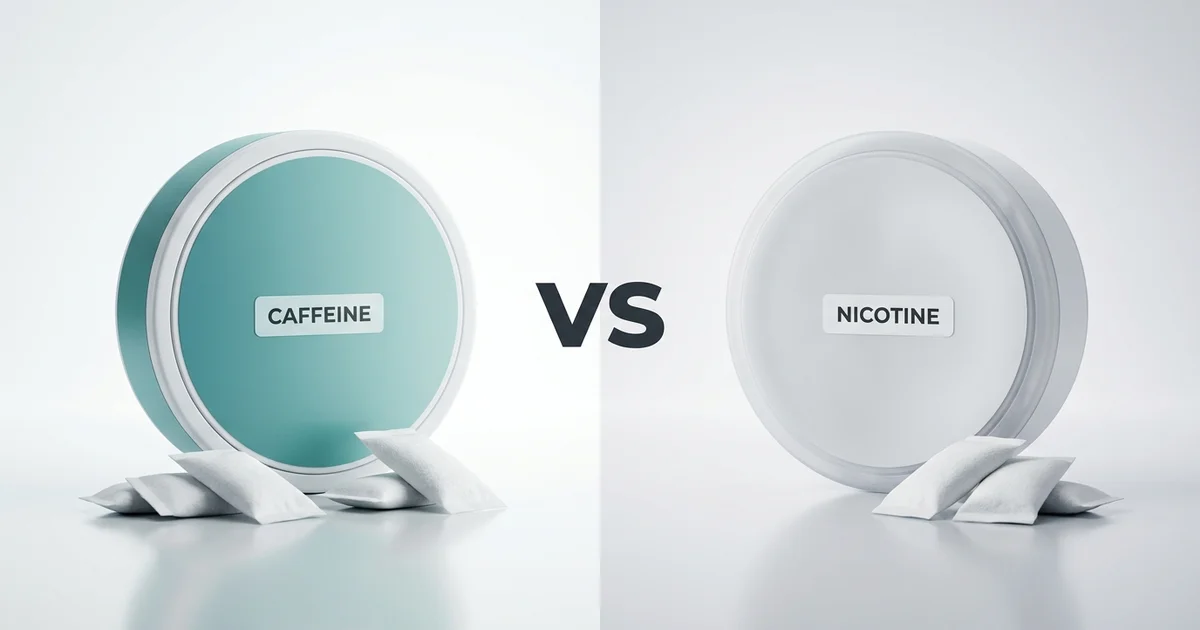
Ultra Pouches vs Zyn: Caffeine vs Nicotine, Compared Honestly
Short answer: Ultra and ZYN do different jobs. ZYN is a nicotine pouch (1.5, 3, 6 or 8 mg; ZYN Ultra 9 or 11 mg). Ultra has zero nicotine: Ultra Focus runs on 100 mg paraxanthine with no caffeine, and Ultra Energy has 180 mg caffeine. ZYN Ultra is a ZYN product, not made by Ultra.
The ultra pouches vs Zyn question sounds like one debate, but it is really two products doing two unrelated jobs. Ultra pouches deliver a stimulant with zero nicotine: paraxanthine in Ultra Focus, 180 mg of caffeine in Ultra Energy. Zyn delivers 3 to 6 mg of nicotine per pouch and no caffeine. One targets alertness and focus. The other targets a nicotine receptor with a well-documented dependence profile.
So the honest comparison is not "which pouch is better." It is "which drug do you actually want in your mouth, and what does that drug do to your brain over time."
This article is for informational purposes only and is not medical advice. If you have health concerns, are pregnant or breastfeeding, or are trying to cut down on caffeine or quit nicotine, talk to a healthcare provider.
Key Takeaways
- Different active drugs. Caffeine pouches run on caffeine and its metabolite paraxanthine. Zyn runs on nicotine. There is no overlap.
- Different addiction profiles. Nicotine acts on nicotinic acetylcholine receptors and is recognized as addictive. Caffeine and paraxanthine work through adenosine receptors and carry a much milder dependence profile.
- Different goals. Caffeine pouches target focus and energy. Zyn targets a nicotine craving or a tobacco-replacement habit.
- A third option exists. Roon is a zero-nicotine focus pouch with a fully disclosed four-ingredient formula, sitting in the caffeine-pouch category, not the nicotine one.
The Fast Answer: Caffeine Pouches and Zyn Are Not Substitutes
Caffeine pouches and Zyn share a delivery format and almost nothing else. The format is sublingual or buccal: you park the pouch under your lip, and the active compound absorbs through the tissue in your mouth instead of going through your stomach first. That is where the similarity ends.
A caffeine pouch is a stimulant. Its job is alertness, reaction time, and focus. Zyn is a nicotine pouch, and nicotine is the same psychoactive compound found in cigarettes and vapes, just without the smoke or vapor. People reach for Zyn to manage a nicotine craving, not to study or finish a workout. Treating them as interchangeable is the central mistake this comparison exists to fix.
Is ZYN Ultra the same thing as Ultra pouches?
No. They are two unrelated products from two unrelated companies that happen to share the word "Ultra," and mixing them up is extremely easy to do. ZYN Ultra is a nicotine pouch made by ZYN, sold in 9mg and 11mg strengths with 20 pouches per can. Ultra pouches are nicotine-free nootropic pouches from a separate startup at takeultra.com, built on paraxanthine with no nicotine and no caffeine in the Focus line (the newer Ultra Energy has 180 mg of caffeine). One is the strongest nicotine product in ZYN's lineup, restricted to adults 21 and over. The other contains no nicotine at all.
If you arrived here searching "ultra zyn" or "zyn ultra vs zyn," this is the split:
| ZYN (classic) | ZYN Ultra | Ultra (takeultra.com) | |
|---|---|---|---|
| Company | ZYN | ZYN | Ultra, an unrelated brand |
| Nicotine per pouch | 1.5mg to 8mg | 9mg or 11mg | None |
| Caffeine per pouch | None | None | None in Focus; 180mg in Energy |
| Active compound | Nicotine | Nicotine | Paraxanthine, 100mg (Focus, Amazon label); caffeine (Energy) |
| Pouches per can | 15 | 20 | 15 |
| Pouch style | Dry | Hydro-boosted, softer material | Dry nootropic pouch |
| Age restricted | Yes, 21+ | Yes, 21+ | Not a nicotine product |
ZYN describes ZYN Ultra as taking "the quality, consistency and convenience of our classic ZYN products" and turning it up, with a higher-moisture pouch and a disposal compartment built into the lid. In ZYN's own words: "Classic ZYN varieties come in 3 mg and 6 mg in a dry pouch, while ZYN Ultra offers 9 mg and 11 mg strengths in a hydro-boosted pouch."
So if the question behind your search was whether ZYN Ultra is a nicotine-free version of ZYN, the answer is the exact opposite. ZYN Ultra is the highest-nicotine option ZYN sells.
Ultra Pouches vs Zyn: The Side-by-Side Table
Here is the comparison with the variables that actually matter: what is in each pouch, what it does, and what it costs you over time.
| Product | Active + mg | Nicotine? | Caffeine? | Primary mechanism | Addiction/dependence risk | Best for |
|---|---|---|---|---|---|---|
| Zyn | Nicotine, 3 mg or 6 mg | Yes | No | Binds nicotinic acetylcholine (nACh) receptors; drives dopamine release | Recognized as addictive; established dependence profile | A nicotine craving or nicotine-replacement habit |
| Generic "ultra" caffeine pouch | Caffeine, commonly 100 to 200 mg; sometimes added taurine or B-vitamins | No | Yes | Caffeine antagonizes adenosine receptors | Mild dependence; tolerance and withdrawal possible, far lower than nicotine | A quick energy hit, often a coffee or energy-drink swap |
| Roon | 80 mg caffeine, 60 mg L-theanine, 25 mg methylliberine (Dynamine), 5 mg theacrine (TeaCrine) | No | Yes | Caffeine and methylliberine act on adenosine signaling; L-theanine paired with caffeine improves attention-switching accuracy and promotes calm alertness | Mild; no nicotine, no nicotinic-receptor involvement | Sustained focus without the jitter-and-crash pattern of high-dose caffeine alone |
The table makes the real split obvious. The nicotine column is the entire conversation. Either a product contains nicotine, with everything that follows from that, or it does not.
Does ZYN have caffeine, and how much caffeine is in an Ultra pouch?
ZYN contains no caffeine, and neither does Ultra Focus, but Ultra Energy, on sale since September 14, 2026, has 180 mg per pouch (see our Ultra Energy pouches review). ZYN and ZYN Ultra are nicotine products; their ingredient list is built around nicotine bitartrate dihydrate along with fillers, sweeteners and flavoring, and caffeine is not among the ingredients. Ultra Focus pouches contain no caffeine either, which surprises almost everyone: the Ultra Focus product page states the pouches contain "zero nicotine or caffeine", and the Amazon listings are labeled "Nicotine and Caffeine Free."
This is worth pausing on, because "caffeine pouch" is the category label Ultra usually gets filed under, and applied to Ultra Focus it is simply inaccurate. Ultra Focus runs on enfinity® paraxanthine; Ultra prints no milligram figure on its own pages, but the supplement facts panel on its Amazon listing gives 100 mg per pouch. Paraxanthine is what your body produces from caffeine, not caffeine itself.
| Product | Caffeine per pouch | Nicotine per pouch | Actual active compound |
|---|---|---|---|
| ZYN | 0mg | 1.5mg to 8mg | Nicotine |
| ZYN Ultra | 0mg | 9mg or 11mg | Nicotine |
| Ultra Focus | 0mg | 0mg | Paraxanthine, 100mg (Amazon label) |
| Ultra Energy | 180mg | 0mg | Caffeine, L-theanine, B vitamins |
| Roon | 80mg | 0mg | Caffeine, L-theanine, methylliberine, theacrine |
Of these, only Roon (80mg, roughly one small cup of coffee) and Ultra Energy (180mg) contain caffeine. Roon contains no paraxanthine and Ultra Focus contains no caffeine, so Roon and Ultra Focus are not variations on a single idea. They are opposite bets on the same problem: Ultra Focus's bet is that skipping caffeine entirely is the advantage, and Roon's is that a moderate, fully disclosed caffeine dose paired with L-theanine is.
Why Roon uses 80 mg rather than 180 mg. More caffeine per pouch mostly means a higher peak. Roon keeps the peak at small-coffee size and stretches the back end with 25 mg of methylliberine (Dynamine), which slowed caffeine's clearance in a small crossover PK study (half-life 7.2 to 15 hours, no higher peak). That study used 100 mg methylliberine and 150 mg caffeine, about 4x and 1.9x Roon's amounts, so it supports the direction rather than exact figures. If one pouch isn't enough, plenty of people double up (160 mg) or take a second later; do what suits you, within 4 pouches and 400 mg of caffeine a day.
The Mechanism: nAChR Dependence vs Adenosine Signaling
Nicotine and caffeine do not share a target, a pathway, or a risk class. This is the single most important fact in the comparison, and it is biochemical, not opinion.
Nicotine binds nicotinic acetylcholine receptors (nAChRs) in the brain and triggers dopamine release in the reward system. That dopamine signal is what makes nicotine reinforcing, and repeated exposure drives the receptor changes that produce tolerance, craving, and withdrawal. This is why nicotine is classified as an addictive substance by public-health authorities, and why nicotine products carry addiction warnings.
Caffeine works through a different door. It blocks adenosine receptors, the receptors that normally make you feel sleepy as adenosine builds up across the day. Caffeine's main human metabolite is paraxanthine, and according to a 2023 review in Frontiers in Toxicology (PMC9932512), paraxanthine accounts for the majority of caffeine's metabolism in the body and shares caffeine's adenosine receptor antagonism, specifically at adenosine A1 and A2A receptors. As the Wikipedia entry on paraxanthine summarizes, it is the dominant metabolite formed after you ingest caffeine. The dependence profile of caffeine and its metabolites is real but mild, and it does not run through the nicotinic reward pathway that defines nicotine addiction.
Two different receptors. Two different risk tiers. That is the science underneath the marketing.
The Addiction Profile: Why the Comparison Gets Misframed
The reason "ultra pouches vs Zyn" trends as a search is that caffeine pouches are more and more marketed as a Zyn alternative, and that framing deserves scrutiny. NBC Boston reported in July 2025 that caffeine pouches are being promoted to young people on social media as a nicotine-free swap for products like Zyn, with school officials noting students use them as a cover for or alongside nicotine pouches, and clinicians raising concerns about pouches delivering up to 200 mg of caffeine in a single use.
Here is the honest read. Removing nicotine removes nicotine's specific addiction risk. It does not remove caffeine's own profile, and it does not make any pouch a health product. A 150 mg caffeine pouch used several times a day is still a meaningful stimulant load, and caffeine has documented tolerance and withdrawal effects of its own, milder than nicotine but real. For the side effects Ultra users report, see our Ultra pouches safety guide.
This is a topic, not a treatment. Caffeine pouches are not a nicotine-cessation tool, and no honest article should imply they help you quit anything. If quitting nicotine is your goal, that is a conversation for an evidence-based program and a clinician, not a flavor of mint pouch.
What are the pros and cons of Ultra pouches versus ZYN?
The short version: Ultra's main advantage is that it carries no nicotine, so it avoids nicotine's dependence profile completely, and its main drawbacks are a short 1 to 2 hour effect per pouch, Focus doses printed only on its Amazon supplement facts panel rather than its own site, and almost no retail availability. ZYN's main advantage is availability and consistency, and its central drawback is the thing that defines it: nicotine is addictive, and ZYN Ultra delivers it at 9mg to 11mg per pouch. These are not two grades of the same product, so a pros and cons list is only useful once you have already decided which compound you want.
| Ultra pouches | ZYN and ZYN Ultra | |
|---|---|---|
| Pros | No nicotine or tobacco; no caffeine in Focus for people avoiding it; five Focus flavors plus a variety pack | Sold almost everywhere; consistent and well established; clear strength tiers from 3mg to 11mg; 20 pouches per can on ZYN Ultra |
| Cons | Effects run 1 to 2 hours per pouch; Focus doses only on the Amazon panel, not takeultra.com; Ultra Energy carries 180 mg caffeine; online only in practice; no third-party testing disclosed | Nicotine is addictive; restricted to 21+; nicotine pouch use is linked to oral mucosal changes in early research |
On that last point, precision matters. A 2024 systematic review found the evidence base thin, only three eligible human studies across 190 participants and all at high risk of bias, while a case series documented white lesions at pouch placement sites. "Linked to in early research" is the accurate strength of claim here, not "causes."
For completeness: Roon sits in the no-nicotine column alongside Ultra, and differs mainly in publishing all four of its doses (80mg caffeine, 60mg L-theanine, 25mg methylliberine, 5mg theacrine) and in using caffeine where Ultra uses paraxanthine. Like Ultra, it is a stimulant product, not a nicotine cessation aid, and it is not a substitute for one.
Where Roon Fits in the Caffeine-Pouch Category
Roon sits squarely on the caffeine side of this comparison, with zero nicotine and a fully disclosed formula. It is not a nicotine product and is not positioned as a way to quit one.
What sets Roon apart from a generic "ultra" caffeine pouch is dose discipline and formulation. Each pouch contains 80 mg caffeine (roughly a strong cup of coffee, not a megadose), 60 mg L-theanine, 25 mg methylliberine (Dynamine), and 5 mg theacrine (TeaCrine). L-theanine is included to promote calm alertness and improve attention-switching accuracy alongside the caffeine. The format is sublingual, so the compounds absorb through the tissue under your lip.
The point is transparency. You know exactly what is in the pouch, at what dose, with no nicotine and no proprietary-blend hand-waving. That is the comparison that actually helps you choose.
Where can you buy Ultra pouches and ZYN in stores?
This is where the two products diverge most sharply, and it is the practical answer this comparison usually skips. ZYN is a mass-distributed nicotine product, stocked in convenience stores, gas stations and tobacco retailers across the country, with age verification and a 21+ requirement, and ZYN states that ZYN Ultra is available at stores nationwide. Ultra has effectively no chain retail presence. It sells direct at takeultra.com and on Amazon, publishes no store locator, and we could not verify stocking at Target, Walmart or any national chain.
The one caveat is that Ultra wholesales to independent shops through Faire, listing cases for retailers to stock, so an individual store may carry it entirely at the owner's discretion. There is no published way to check before you go.
| ZYN and ZYN Ultra | Ultra pouches | |
|---|---|---|
| Convenience stores and gas stations | Widely available | Not verified |
| National chains | Widely available | Not verified |
| Brand website | Yes | Yes |
| Store locator published | Yes | No |
| Age restriction | Yes, 21+ | Not a nicotine product |
The asymmetry is not really about brand size. It is about category: nicotine has a mature retail distribution system built over decades, and nicotine-free functional pouches do not have one yet. Roon is direct-to-consumer for the same reason, so on availability alone Ultra and Roon are in the same position and ZYN is in a different one entirely.
We cover Ultra's buying options in more depth in our Ultra pouches review.
Conclusion: Pick the Drug, Not the Pouch
The pouch is just packaging. The decision that matters is which compound you are putting into your system and what it does over months and years.
If you want a stimulant for alertness and focus, you are shopping in the caffeine category, and your job is to check the dose and how often you plan to use it. If you are managing a nicotine habit, you are in an entirely different category with an entirely different risk profile, and the right move is an evidence-based plan with professional guidance. The two are not interchangeable, and anyone selling them as if they were is skipping the part that matters most. Read the active ingredient first. Everything else is flavor.
Frequently Asked Questions
Is a caffeine pouch the same as Zyn?
No. They share a sublingual pouch format and nothing else. Zyn delivers 3 to 6 mg of nicotine and no caffeine. Caffeine pouches deliver caffeine, often 100 to 200 mg, and no nicotine. Nicotine and caffeine act on different brain receptors with different dependence profiles, so the two products serve different goals and carry different risks.
Which is more addictive, caffeine or nicotine?
Nicotine. It binds nicotinic acetylcholine receptors and drives dopamine release in the reward system, which is why public-health authorities classify it as addictive and require addiction warnings on nicotine products. Caffeine works by blocking adenosine receptors and has a much milder dependence profile, though tolerance and withdrawal can still occur with regular use.
Can caffeine pouches help me quit nicotine?
There is no credible evidence that caffeine pouches help anyone quit nicotine, and they should not be used as a cessation tool. As NBC Boston reported in July 2025, they are marketed as a nicotine-free alternative, but marketing is not medicine. If quitting nicotine is your goal, talk to a clinician about an evidence-based program rather than swapping one oral pouch for another.
What is paraxanthine and why does it matter?
Paraxanthine is the primary compound your body produces when it metabolizes caffeine. A 2023 review in Frontiers in Toxicology (PMC9932512) describes it as accounting for most of caffeine's metabolism, sharing caffeine's adenosine A1 and A2A receptor antagonism and showing higher binding potency than caffeine at those receptors. In plain terms, much of what you feel from caffeine is actually paraxanthine working downstream, which is why it appears in discussions of caffeine pharmacology.
How much caffeine is in Roon compared to a coffee?
Each Roon pouch contains 80 mg of caffeine, which is roughly comparable to a strong cup of brewed coffee. It also includes 60 mg L-theanine, 25 mg methylliberine, and 5 mg theacrine. The dose is intentionally moderate rather than a megadose, and the L-theanine is added to sharpen attention-switching accuracy and support calm alertness alongside the caffeine.
Does Roon contain any nicotine?
No. Roon contains zero nicotine. It sits in the caffeine-pouch category and is built around caffeine, L-theanine, methylliberine, and theacrine. It is not a nicotine product, not a tobacco product, and not a nicotine-replacement aid. If you want a nicotine-free focus pouch with a fully disclosed formula, that is the category Roon belongs to.
Are caffeine pouches safe?
Caffeine is well studied, but dose and frequency still matter. A high-caffeine pouch used several times a day adds up to a large daily stimulant load, and caffeine has its own tolerance and withdrawal effects. Moderate doses are generally well tolerated by healthy adults, but anyone sensitive to caffeine, pregnant, or managing a heart condition should consult a clinician before regular use.
The Real Choice Is Caffeine or Nicotine, and Roon Sits Firmly on One Side
This whole comparison comes down to one question: which drug do you want, and what does it do to your brain over time. If your answer is "a stimulant for focus, with no nicotine," then you have already ruled out the entire nicotine category, Zyn included.
That is the lane Roon was built for. It is a zero-nicotine sublingual focus pouch with a fully disclosed formula: 80 mg caffeine, 60 mg L-theanine, 25 mg methylliberine, and 5 mg theacrine, designed to support sustained focus without the jitter-and-crash pattern of high-dose caffeine alone. You always know exactly what is in it and at what dose.
To be clear about what Roon is not: it is not a nicotine product, not a tobacco-replacement aid, and not a tool for quitting nicotine. It is a caffeine-based focus pouch, nothing more. If that is what you were actually looking for in this comparison, you can see the full formula on the Roon product page and decide from there.
By Roon Team