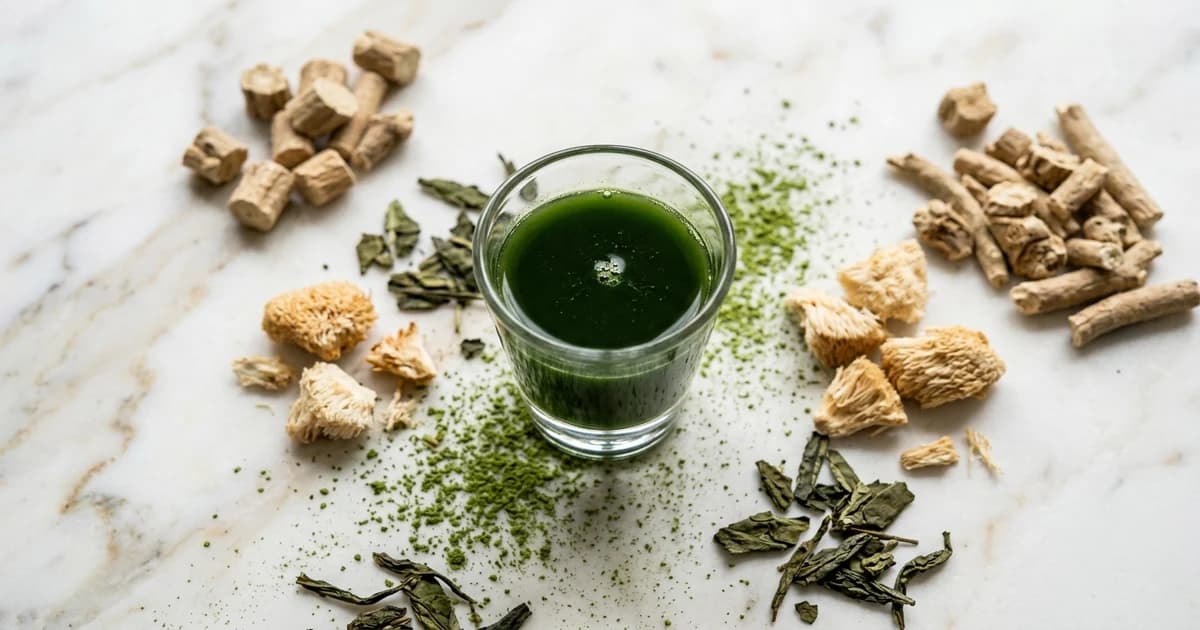
Caloric Restriction Mimetics: The Supplements That Imitate Fasting in the Brain
Caloric restriction mimetics like spermidine and resveratrol mimic fasting in the brain. Here's what the science actually supports—and what's overhyped.
Free U.S. shipping on orders $45+ · Subscribe & save
Nootropics
Deep dives on nootropic ingredients, stacks, and the science of cognitive enhancement, from caffeine to Alpha-GPC to Bacopa.

Caloric restriction mimetics like spermidine and resveratrol mimic fasting in the brain. Here's what the science actually supports—and what's overhyped.

Discover the 145-year methylene blue history—from textile dye to the first synthetic drug, and now a promising compound for memory and brain health.

High choline intake raises TMAO, a compound linked to heart disease and clotting. Learn the safe intake range and why megadosing choline backfires.

Can you stack adaptogens with caffeine? Learn what the research actually supports, which adaptogens pair best, and how to avoid wasting your money.

Panax ginseng vs rhodiola—which adaptogen actually boosts mental energy? See what the research says about cognitive performance, fatigue, and dosing.

Sulbutiamine vs caffeine compared: how they work, what the evidence says, and which is better for focus, energy, and motivation. Make an informed choice.

Honokiol and apigenin both target GABA-A receptors, but work differently. Compare their binding, effects, and which suits sleep vs. daytime calm.

The Ratamess study tested synephrine and caffeine on squat performance. See what the data actually shows about reps, power, and effort—without the hype.

Discover how NMN affects brain blood flow by restoring neurovascular coupling in aging brains. Breaking down the key 2019 University of Oklahoma study.

Discover the landmark lemon balm stress study that revealed dose-dependent effects on calm and cognition. What 300mg vs 600mg actually did in lab trials.

A single 25mg dose of Zembrin quieted amygdala reactivity in MRI scans. Here's what the zembrin amygdala study really showed—and where the hype falls

The affron saffron study tested 28mg of saffron extract on healthy adults with low mood. See what a 4-week trial found on validated mood scales.

The blueberry memory study by Krikorian (2010) was the first human trial linking blueberry juice to improved recall. Here's what the data actually shows.

Discover why theacrine has no tolerance buildup while caffeine does. Learn the receptor science behind adenosine, dopamine, and 8-week human study results.

Is coffee good for you? Large studies say yes—moderate intake lowers mortality and reduces Parkinson's risk. Here's what the data actually shows.

Caffeine withdrawal headaches start within 12–24 hours and peak by day 2. Learn why they happen, how long they last, and how to quit without the pain.

Discover why nature improves focus better than caffeine. Learn how Attention Restoration Theory explains why a short walk outside recharges your brain.

Does multitasking work? Science proves your brain switches tasks, not juggles them. Learn why multitasking kills productivity and what to do instead.

Discover how breathwork for focus works. Learn the science behind cyclic sighing and box breathing to reduce stress and sharpen attention fast.

Does caffeine cancel out cocoa flavanols? Combination trials reveal the truth behind the cancellation myth and what actually happens in your brain.

Most smart drugs are overhyped. We cut through the marketing to show which research nootropics have real human data—and which ones to skip.

Discover the top spermidine-rich foods that trigger autophagy and support longevity. Learn what the science says and how to eat for cellular health

Not all nootropics build tolerance the same way. Learn which compounds require cycling, which don't, and how long your breaks should actually be.

Is your focus supplement actually working—or is belief doing the heavy lifting? Explore the nootropics placebo effect and what the science really shows.