On vs Zyn vs Velo: All Three Brands Compared
On vs. Zyn vs. Velo: A Head-to-Head Comparison
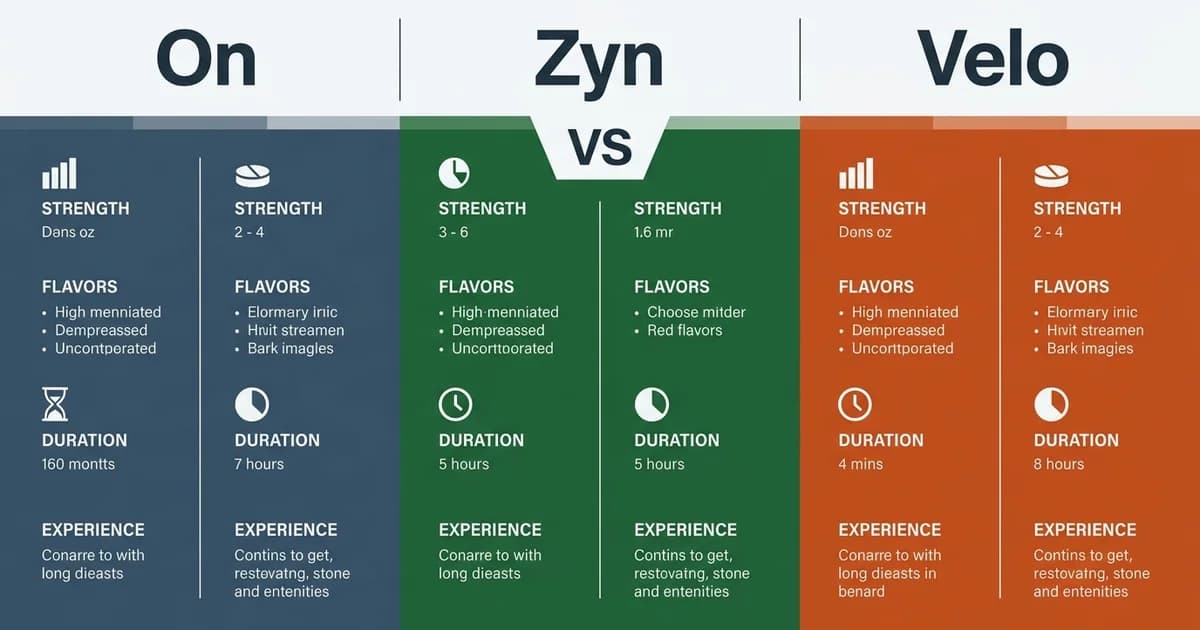
Short answer: ZYN is the most available and holds the most FDA authorizations; VELO has the most strength tiers (about 4 to 12 mg across VELO, VELO Plus and VELO Max, 20 per can); on! is the smallest, driest pouch, and on! PLUS now reaches 12 mg. Pick ZYN for consistency, VELO Plus for a moist fast-release pouch, on! for discretion.
The debate around on vs zyn vs velo has grown louder as the nicotine pouch market has exploded. According to CDC data cited by Grand View Research, total monthly U.S. nicotine pouch sales jumped roughly 250% between January 2023 and August 2025. Three brands dominate the shelf space: On!, Zyn, and Velo. If you're comparing on vs zyn vs velo, you're probably trying to figure out which one actually delivers the best experience, the cleanest nicotine hit, and the fewest downsides.
Here's what the data says.
Key Takeaways
- Zyn leads the market in sales and holds the most FDA marketing orders, with a drier pouch and slower nicotine release.
- Velo hits harder and faster, thanks to a moister pouch format, but tapers off sooner.
- On! is the smallest and most discreet pouch of the three, and on! PLUS now reaches 12 mg.
- All three deliver nicotine, which is highly addictive according to the CDC. None of them are "safe." If you want the focus without nicotine, a nicotine-free option like Roon exists.
How On vs Zyn vs Velo Stacks Up in Every Category
The Basics
All three brands are tobacco leaf-free nicotine pouches. You tuck one between your upper lip and gum, and the nicotine absorbs through your oral mucosa. No smoke, no spit, no vapor.
But the similarities end there. Any honest on vs zyn vs velo comparison has to account for pouch format, moisture level, strength options, and flavor profiles, because those differences affect how each one actually feels in your mouth.
| Feature | Zyn | Velo | On! |
|---|---|---|---|
| Manufacturer | Swedish Match (Philip Morris) | R.J. Reynolds (BAT) | Altria |
| Nicotine Strengths (US) | 1.5mg, 3mg, 6mg, 8mg (9mg and 11mg in ZYN Ultra) | VELO (dry) about 4mg, 7mg; VELO Plus (moist) 3mg, 6mg, 9mg; VELO Max about 8mg, 12mg | 2mg, 4mg, 8mg (6mg, 9mg and 12mg in On! Plus) |
| Pouch Format | Mini dry (ZYN Ultra moist) | VELO dry; VELO Plus slim, moist | Mini dry; On! Plus slim |
| Nicotine Type | Tobacco-derived | Synthetic (Plus) / Tobacco-derived | Tobacco-derived |
| Approx. Duration | Up to one hour in the mouth (Zyn's own placement guidance) | 20–30 min | 20–25 min |
| Pouch Feel | Soft, slim | Slightly bulkier, wetter | Smallest, driest |
| Pouches per can | 15 (ZYN Ultra 20) | 20 (all three lines) | Not published |
| Price per can (Northerner, Oct 2026) | $4.49 (ZYN Ultra $4.69) | $4.49 (VELO Plus and VELO Max) | $4.39 (On! Plus $4.99) |
| FDA marketing orders | 20 ZYN + 11 ZYN Ultra products | None | 6 on! + 6 On! Plus products |
Sources: Zyn FAQ (us.zyn.com), Velo FAQ (velo.com), On! on Nicokick, Zylo Pouch comparison, Northerner, FDA authorized list. Source: brand labels and product pages, prices checked Oct 2026.
How this comparison was put together
Strengths, flavors, pouch counts and FDA status come from each brand's US site or FAQ, Altria's Q2 2026 filing and the FDA's authorized-products list; prices are single-can listings at Northerner, checked in October 2026, divided by pouch count where the count is published. No pouch was lab-tested or trialed by us. Roon makes a competing caffeine pouch with no nicotine, and this page links to it.
Nicotine Strength and Delivery
This is where most people start their on vs zyn vs velo research, and it's where the three brands differ the most.
Zyn keeps it simple. Its U.S. product pages list 1.5mg, 3mg, 6mg and 8mg, and the separate ZYN Ultra line adds 9mg and 11mg. The pouches are relatively dry, which means the nicotine releases slowly and steadily. Zyn tells users to place a pouch under the upper lip for up to one hour, and delivery is even rather than a sharp spike up front. For people who want predictable, even delivery, Zyn's format works well.
Velo runs three US lines: original VELO at approximately 4mg and 7mg per pouch, VELO Plus at 3mg, 6mg and 9mg, and VELO Max at about 8mg and 12mg. The Velo Plus line uses a moist, slim pouch that releases nicotine faster. According to Prilla's comparison, the moist contents provide a more intense initial hit. The tradeoff? It tapers off quicker. You'll feel it sooner, but you'll reach for another pouch sooner too.
On! sells 2mg, 4mg, and 8mg for the original line, plus 6mg, 9mg and 12mg for On! Plus. That 8mg tier now matches standard ZYN's top strength, while On! Plus and VELO Max reach 12mg and ZYN Ultra 11mg. The pouch itself is the smallest and driest of the bunch, which makes it extremely discreet but also means the flavor and nicotine can feel muted compared to Velo's wetter format. All three brands now cover a similar span, so format matters more than the ceiling in the on vs zyn vs velo matchup.
Flavor Range
Zyn has the deepest bench here. The U.S. lineup includes Cool Mint, Spearmint, Wintergreen, Peppermint, Coffee, Cinnamon, Citrus, and the newer Black Cherry, Dragonberry and Peach: 13 standard flavors on zyn.com, plus 8 in ZYN Ultra. Flavors like Lemon Spritz and Mojito are sold outside the US. If flavor variety matters to your on vs zyn vs velo decision, ZYN leads: 13 standard flavors plus 8 in ZYN Ultra, against 11 for VELO Plus.
VELO Plus, the line US retailers actually stock, has 11 flavors, from Spearmint and Wintergreen to Watermelon Chill, Cappuccino and Smooth Tobacco. Dragon Fruit and Black Cherry appear on the original line's list, and VELO Max adds 4 more. The Velo Plus relaunch in 2024 sharpened the flavor intensity with its moister format, which users have noted makes the flavors hit harder.
On! sits in the middle. You'll find Wintergreen, Cinnamon, Coffee, Mint, Citrus, and Berry, while On! Plus has three (Mint, Tobacco, Wintergreen). The flavor release is subtler thanks to the dry mini format. If you want something quiet that doesn't announce itself, that works. If you want bold flavor that fills your mouth, On! will probably underwhelm you.
Pouch Comfort and Discretion
This is subjective, but patterns emerge from user feedback, and comfort is a factor many people overlook in the on vs zyn vs velo conversation.
Zyn pouches are soft, slim, and sit comfortably under the lip. The dry format means minimal drip, so you won't get that initial rush of saliva that some people find off-putting. According to NicPouches.com, the drier format also means the pouch holds its shape better throughout the session.
Velo Plus pouches are slightly larger and noticeably moister. That moisture is what drives the faster nicotine and flavor release, but it also means more drip in the first few minutes. Some users prefer this because it signals the pouch is "working." Others find it distracting.
On! is the most discreet option, period. The mini format is tiny. You can use one in a meeting or on a call and nobody will know. The downside is that the small size limits how much flavor and nicotine the pouch can deliver before it's spent.
Price
Pricing varies by retailer, but across major online shops and convenience stores, the three brands in the on vs zyn vs velo comparison land in a similar range. A can typically costs between $4 and $6, but can counts differ, so run the per-pouch math before comparing sticker prices. Every ZYN can holds 15 pouches, except ZYN Ultra at 20, though PMI says the 3 and 6 mg cans move to 20 pouches in Q4 2026, so check the count on your can. At Northerner in October 2026, a single can of ZYN or VELO Plus was $4.49, ZYN Ultra $4.69, on! $4.39 and On! Plus $4.99.
None of them are expensive on a per-pouch basis. But nicotine pouches are a recurring purchase. If you're using 5 to 10 pouches a day, that $5 can adds up to $150 or more per month, and cutting down on nicotine pouches becomes worth considering.
Which is cheapest per pouch?
VELO Plus and ZYN Ultra are the cheapest per pouch at Northerner, at $0.22 and $0.23, because their cans hold 20. Standard ZYN costs the same per can but holds 15, so it works out to $0.30.
| Product | Price per can (Northerner) | Pouches per can | Price per pouch |
|---|---|---|---|
| VELO Plus | $4.49 | 20 | $0.22 |
| VELO Max | $4.49 | 20 | $0.22 |
| ZYN Ultra | $4.69 | 20 | $0.23 |
| ZYN | $4.49 | 15 | $0.30 |
| on! | $4.39 | Not published | Not published |
| On! Plus | $4.99 | Not published | Not published |
Price per pouch = price per can / pouches per can. So yes, VELO is cheaper than ZYN per pouch, though not per can.
On! Plus vs VELO Plus: the two newer slim lines
On! Plus goes higher (12 mg) and VELO Plus offers more flavors (11 vs 3). Both are slim, newer lines aimed at people who find the original mini pouches too mild.
| On! Plus | VELO Plus | |
|---|---|---|
| Strengths | 6, 9, 12 mg | 3, 6, 9 mg |
| Flavors | 3 (Mint, Tobacco, Wintergreen); two more planned for Q4 2026 | 11 |
| Pouches per can | Not published | 20 |
| Nicotine source | Not stated | Synthetic |
| Price per can (Northerner) | $4.99 | $4.49 |
| FDA marketing order | Yes, 6 products at 6 and 9 mg (12 mg not on the list) | No |
Source: brand labels and product pages, prices checked Oct 2026 (Altria Q2 2026, VELO FAQ, FDA). If FDA authorization matters to you, On! Plus at 6 or 9 mg is the only authorized option of the two.
The Elephant in the Room: Nicotine Dependency
No matter where you land on the on vs zyn vs velo question, all three products contain nicotine. That's the point of them, and it's also the problem.
Nicotine is highly addictive. The CDC has flagged concerns about nicotine pouch use, particularly among younger adults. According to the CDC Foundation, nicotine pouch use among youth and young adults nearly quadrupled between 2022 and 2025.
The "cleaner than cigarettes" framing is accurate in one narrow sense: these pouches don't contain tobacco leaf, tar, or combustion byproducts. But "cleaner" doesn't mean "consequence-free." Nicotine constricts blood vessels, raises heart rate, and rewires your brain's reward circuitry over time. Once you're dependent, quitting is genuinely difficult. Free, confidential help is available at 1-800-QUIT-NOW.
If you started using pouches because you wanted a performance edge, sharper focus, or a way to get through long work sessions, it's worth asking whether nicotine is actually the right tool for the job.
What If You Want the Focus Without the Nicotine?
Most people don't reach for a pouch because they love nicotine. They reach for one because they want to feel dialed in. Alert. Locked on a task for the next few hours.
That's a reasonable goal. But nicotine is a blunt instrument for achieving it. The tolerance curve is steep, the dependency risk is real, and the half-life is short enough that you're reaching for another pouch before lunch.
Roon was built around a different question: what if you could get that same locked-in feeling without nicotine at all? It's a sublingual pouch (same format, tuck it and forget it) powered by a stack of Caffeine (80mg), L-Theanine, Theacrine, and Methylliberine. The combination supports 6 to 8 hours of sustained focus with no jitters, no crash, and no tolerance buildup.
No nicotine, so no nicotine withdrawal. Theacrine, one of the four actives, does not build tolerance the way caffeine does; the 80mg of caffeine still can.
If you've been weighing on vs zyn vs velo looking for the "best" pouch, it might be worth considering nicotine-free alternatives before settling on an answer. The best pouch might be one with no nicotine in it at all.