NZE vs Ultra Pouches: Ingredients, Caffeine, Doses (2026)
NZE vs Ultra Pouches: Which Nicotine-Free Nootropic Pouch Wins in 2026
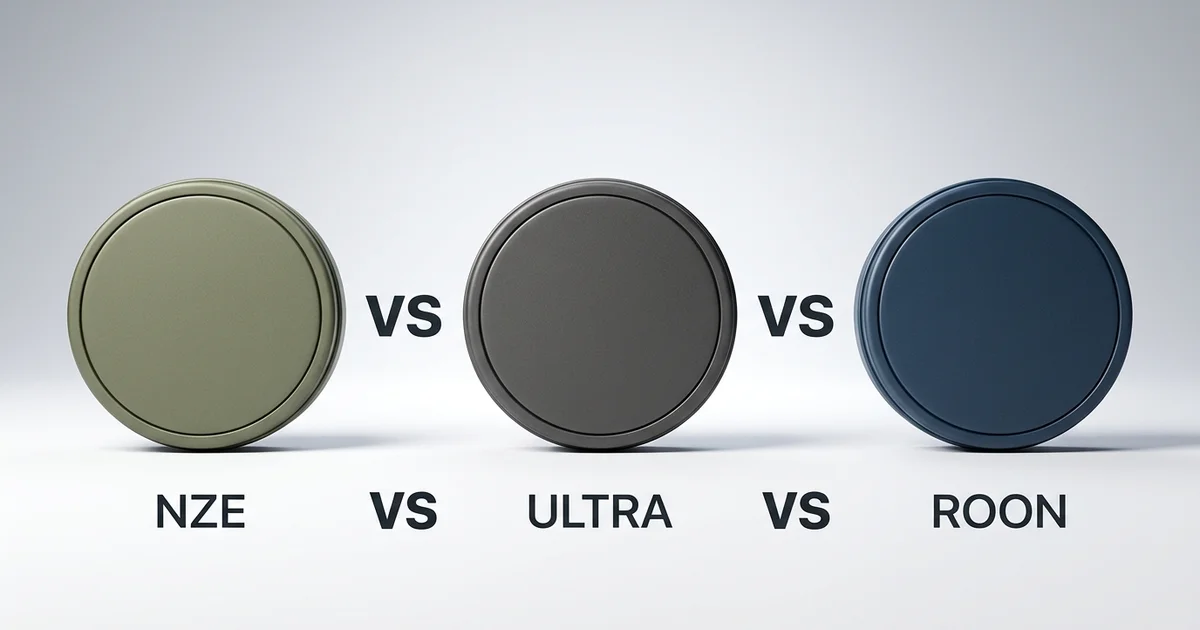
If you are comparing nze vs ultra pouches, the decision comes down to one variable: what stimulant you want and how honestly the brand tells you how much you are getting. Ultra Focus runs on 100 mg of enfinity paraxanthine and zero caffeine (Ultra's newer Energy pouch has 180 mg of caffeine). NZE runs on either 50mg of caffeine or a caffeine-free Focus blend. Roon takes a third route, a fully-disclosed 80mg caffeine stack paired with three companion compounds and every milligram printed on the tin.
All three are nicotine-free oral pouches. The differences that matter are dose transparency, the stimulant model, and whether you can actually audit what you are putting under your lip.
This article is for informational purposes only and is not medical advice. If you have health concerns, are pregnant or breastfeeding, or are trying to cut down on caffeine or quit nicotine, talk to a healthcare provider.
Key Takeaways
- Roon Cool Mint: 80mg caffeine, 60mg L-theanine, 25mg Dynamine®, 5mg TeaCrine®, zero nicotine, onset 5-10 min, ~6-8h focus.
- Ultra uses enfinity paraxanthine (caffeine-free) plus a five-ingredient nootropic blend, and prints no milligram amounts on takeultra.com, but the supplement facts panel on its Amazon listing gives all of them: 100mg paraxanthine, 30mg Alpha-GPC, 10mg L-theanine, 1mg ginseng extract, 2mg vitamin B6 and vitamin B12.
- Ultra Energy, on sale since September 14, 2026, is the exception: 180mg of caffeine per pouch, and Ultra advises no more than 2 a day (Ultra Energy; our Ultra Energy pouches review).
- NZE sells two lines: a 50mg caffeine Energy pouch and a caffeine-free Focus pouch, both nicotine-free, both built on L-theanine, Alpha-GPC, and L-tyrosine.
- Roon publishes its full formula: 80mg caffeine, 60mg L-theanine, 25mg methylliberine (Dynamine), 5mg theacrine (TeaCrine), nicotine-free.
- Paraxanthine is the metabolite your liver makes from most of the caffeine you drink, with roughly 84% of caffeine converted to it via the CYP1A2 enzyme.
- The honest tiebreaker is dosing transparency: a pouch that lists every active in milligrams lets you control your own intake.
The Transparency Table: NZE vs Ultra vs Roon
Here is the side-by-side that the rest of the internet keeps leaving incomplete. Every figure below reflects each brand's published product information as of 2026.
| Brand | Named active ingredients | Exact mg per pouch | Caffeine mg | Nicotine-free? | Price per pouch | Dosing transparency |
|---|---|---|---|---|---|---|
| NZE (Energy) | Caffeine, L-theanine, Alpha-GPC, L-tyrosine | Caffeine listed at 50mg; companion mg not individually published | 50mg | Yes | Varies by retailer/multipack | Partial (caffeine disclosed, others not itemized) |
| NZE (Focus) | L-theanine, Alpha-GPC, L-tyrosine | Caffeine-free; companion mg not individually published | 0mg | Yes | Varies by retailer/multipack | Partial |
| Ultra | enfinity paraxanthine, L-theanine, Alpha-GPC, Panax ginseng, vitamin B6, vitamin B12 | 100mg paraxanthine, 30mg Alpha-GPC, 10mg L-theanine, 1mg ginseng extract, B6, B12 (Amazon supplement facts panel; none printed on takeultra.com) | 0mg (paraxanthine instead) | Yes | $1.07 one-time; $0.80 on the 3-can subscription | Full on the Amazon panel, none on its own site |
| Ultra Energy | Caffeine, L-theanine, niacin (B3), B6, B12 | 180mg / 10mg / 10mg / 2mg / 2mcg | 180mg | Yes | $1.07 one-time | Full |
| Roon | Caffeine, L-theanine, methylliberine (Dynamine), theacrine (TeaCrine) | 80mg / 60mg / 25mg / 5mg | 80mg | Yes | Varies by tin (15 per tin) | Full (every active in mg) |
Roon's clearest advantage in this table is the last column: every dose is printed on its own site and tin. It does not win on price, and it does not claim to. It wins on the fact that you can see all four ingredient amounts before you buy.
Ultra Pouches: A Paraxanthine Bet on Caffeine's Main Metabolite
Ultra's pitch is that it skips caffeine and delivers its primary downstream compound directly. When you drink coffee, your liver does most of the work for you. Approximately 84% of caffeine is converted into paraxanthine by the hepatic CYP1A2 enzyme, which is the metabolite associated with much of caffeine's alertness effect.
Each Ultra pouch supplies enfinity paraxanthine plus L-theanine, Alpha-GPC, Panax ginseng, and B vitamins. Paraxanthine has a shorter elimination profile than caffeine. Across the human literature its half-life sits near 3.1 hours, compared with roughly 4 to 5 hours for caffeine, which is part of why it is marketed as a cleaner-clearing stimulant.
Here is the catch a buyer should weigh. Ultra prints no milligram amount for any of its six actives on takeultra.com. The doses are on the supplement facts panel on its Amazon listing: 100 mg paraxanthine, 30 mg alpha-GPC, 10 mg L-theanine and 1 mg ginseng extract per pouch. Outside paraxanthine those are small amounts, and a shopper on Ultra's own site never sees them. Roon, the third column in the table above, publishes all four doses: 80mg caffeine, 60mg L-theanine, 25mg Dynamine®, and 5mg TeaCrine® per pouch.
How Much Caffeine Is in an Ultra Pouch?
Zero in Ultra Focus, 180 mg in Ultra Energy. Ultra Focus pouches contain no caffeine at all. Ultra's FAQ states the pouches have "no nicotine, no tobacco, no caffeine". The stimulant is enfinity paraxanthine, a compound the liver normally produces from caffeine, and trade coverage puts it at 100mg per pouch, a figure confirmed by the supplement facts panel on Ultra's Amazon listing. NZE is the opposite case: its Energy pouch carries 50mg of caffeine and its Focus pouch carries none.
That makes "how much caffeine is in an Ultra pouch" a slightly misleading question. Paraxanthine and caffeine are different molecules with different clearance, so the useful comparison is stimulant to stimulant, not milligram to milligram.
| Pouch | Caffeine per pouch | Other stimulant | Rough coffee equivalent | Nicotine-free |
|---|---|---|---|---|
| Ultra Focus | 0 mg | Paraxanthine, 100 mg (Amazon label) | No published caffeine equivalent | Yes |
| Ultra Energy | 180 mg | None | About two standard cups | Yes |
| NZE Energy | 50 mg | None | About half a standard cup | Yes |
| NZE Focus | 0 mg | None | No stimulant | Yes |
| Roon Cool Mint | 80 mg | Methylliberine 25 mg, theacrine 5 mg | A little under a standard cup | Yes |
The coffee column uses the FDA's own reference point: a typical 8 ounce cup of coffee contains about 80 to 100mg of caffeine, and 400mg a day is generally safe for most healthy adults. On that scale NZE Energy is a deliberately small dose. Ultra Focus sits outside the scale entirely (Ultra Energy, at 180 mg, is about two cups), because there is no published caffeine equivalence for paraxanthine and no FDA daily ceiling for it.
One practical consequence: switching from NZE Energy to Ultra is not switching to a milder product. It is switching stimulants.
Why Roon uses 80 mg. Ultra Energy's 180 mg is more than twice a Roon pouch, and that extra caffeine mostly raises the peak. Roon keeps the peak near a small cup and works on the tail: 25 mg methylliberine (Dynamine) slowed caffeine clearance in a randomized crossover study (n=12), extending half-life from 7.2 to 15 hours with no higher peak. That study gave 100 mg methylliberine with 150 mg caffeine, about 4x and 1.9x Roon's doses, so take the direction, not the numbers. A 180 mg pouch can't be split; Roon builds in 80 mg steps. Double-pouch for 160 mg or add one later, up to 4 a day.
NZE Pouches: Two Lines, Caffeine Optional
NZE solves the stimulant question by selling you the choice. Its Energy pouches carry 50mg of caffeine alongside L-theanine, Alpha-GPC, and L-tyrosine, while its Focus line drops caffeine entirely and keeps the same nootropic base. Both are nicotine-free, both use stevia and xylitol rather than artificial sweeteners, and both ship 15 pouches per can.
The 50mg caffeine dose is modest, closer to a half cup of coffee than a full energy drink. That makes NZE Energy a reasonable entry point for someone caffeine-sensitive or stacking it with other sources through the day.
The transparency picture is mixed. NZE publishes its caffeine content and names its companion ingredients, but it does not itemize the milligram dose of the L-theanine, Alpha-GPC, or L-tyrosine. So you can confirm the caffeine, but you cannot audit the rest of the stack the way the label implies. Roon's label, for contrast, itemizes every active: 80mg caffeine, 60mg L-theanine, 25mg Dynamine®, and 5mg TeaCrine®, all zero nicotine.
What Are the Ingredients in NZE and Ultra Pouches?
NZE lists four active ingredients on its Energy pouch (caffeine, Alpha GPC, L-tyrosine and L-theanine) and three on its caffeine-free Focus pouch, but it publishes a milligram figure for only one of them: the 50mg of caffeine. Ultra names six actives in its Focus pouch (enfinity paraxanthine, Alpha GPC, L-theanine, ginseng extract, vitamin B6 and vitamin B12) and publishes no milligram figure for any of them on its own product page, FAQ or science page; the doses appear only on the supplement facts panel on its Amazon listing. You can read both ingredient lists in full. You can audit Ultra's doses once you find that panel, and you cannot audit NZE's companion doses at all.
Here is every named active in the two lines, with the exact amount wherever the brand publishes one.
| Active ingredient | NZE Energy | NZE Focus | Ultra Focus | Roon Cool Mint |
|---|---|---|---|---|
| Caffeine | 50 mg | None | None | 80 mg |
| Paraxanthine (enfinity) | None | None | 100 mg | None |
| L-theanine | Named, no mg published | Named, no mg published | 10 mg | 60 mg |
| Alpha GPC | Named, no mg published | Named, no mg published | 30 mg | None |
| L-tyrosine | Named, no mg published | Named, no mg published | None | None |
| Panax ginseng extract | None | None | 1 mg | None |
| Vitamin B6 and B12 | None | None | B6 2 mg; B12 at 83% DV | None |
| Methylliberine (Dynamine) | None | None | None | 25 mg |
| Theacrine (TeaCrine) | None | None | None | 5 mg |
| Nicotine | None | None | None | None |
| Sweeteners | Stevia and xylitol | Stevia and xylitol | Not published | Sucralose |
| Pouches per can | 15 | 15 | 15 | 15 |
Sources: NZE Energy product page, NZE Focus product page, Ultra Focus product page, Ultra FAQ, and the Ultra Amazon listing for the 15-count can, and the Ultra Focus Amazon listing for the Focus doses (supplement facts panel).
Two details are worth knowing before you buy.
First, Ultra can publish doses when it chooses to. Its FAQ lists the complete Ultra Sleep formula down to the milligram: melatonin 1mg, L-theanine 50mg, magnesium gluconate 30mg, chamomile extract 10mg, passionflower extract 10mg and lemon balm extract 12mg. The Focus pouch gets no equivalent breakdown on takeultra.com; its doses are only on the Amazon panel.
Second, the widely repeated "100mg of enfinity paraxanthine" figure for Ultra Focus does not appear anywhere on takeultra.com. It comes from trade coverage at PricePlow, which reports Ultra moved from 75mg to 100mg per pouch, and from the supplement facts panel on Ultra's Amazon listing. So the figure is on Ultra's label, just not on Ultra's own website.
For contrast, Roon publishes all four of its actives in milligrams, is nicotine-free and ships 15 pouches per tin. It is also sweetened with sucralose rather than the stevia and xylitol NZE uses, which is a real point in NZE's favor if you avoid artificial sweeteners.
NZE vs Ultra Pouches: The Core Difference Is the Stimulant
The honest answer to the nze vs ultra pouches question is that they are not really competing on the same axis. Ultra Focus is a caffeine-free, paraxanthine-driven pouch for people who want a stimulant that clears faster and want to avoid caffeine outright. NZE Energy is a low-dose caffeine pouch for people who want a familiar, predictable lift.
If your goal is avoiding caffeine, Ultra is the more direct choice because paraxanthine is the compound, not a precursor. If your goal is a small, conventional caffeine hit with a clean sweetener profile, NZE Energy is the simpler buy. If you want zero stimulant at all, NZE Focus exists for that specific case.
Neither brand, though, gives you a full milligram breakdown of every active on its own website: NZE leaves its companion doses off entirely, and Ultra keeps its Focus doses on the Amazon panel. That is the column where both fall short, and it is the column that matters most when you are titrating a daily cognitive product.
Where L-Theanine Earns Its Place in All Three
All three brands include L-theanine, and the science supports why. The amino acid pairs with stimulants to smooth the edge off the alertness curve. A double-blind crossover trial published in the British Journal of Nutrition found that a high-dose L-theanine and caffeine combination improved measures of selective attention in sleep-deprived adults. L-theanine is one entry on a longer list we cover in our guide to natural ADHD supplements.
The mechanism the researchers describe is attentional: the combination appeared to support focus by reducing mind-wandering and distraction. That is the rationale behind pairing theanine with any stimulant, whether the stimulant is caffeine or paraxanthine.
What differs is dose visibility. Roon lists its theanine at 60mg. NZE names theanine without an amount. Ultra's Amazon panel lists 10 mg per Focus pouch, far below Roon's 60 mg, so neither reproduces the ratios used in the research.
Do NZE Pouches Have Nicotine, and How Many Can You Use in a Day?
No. NZE pouches contain no nicotine and no tobacco. NZE's product pages carry the line "Nicotine & Tobacco Free" and position the pouches as a way to supplement, reduce or eliminate nicotine intake. Ultra says the same: its FAQ states both Focus and Sleep pouches contain "zero nicotine, zero tobacco, and zero tobacco-derived ingredients". Neither product is a smoking cessation aid or an FDA-approved nicotine replacement therapy.
Daily use is therefore a caffeine question, not a nicotine question. NZE publishes no daily pouch limit on its product pages that we could find. Ultra says not to exceed 4 Focus pouches a day and no more than 2 Energy pouches. For NZE, the practical guardrail is the caffeine ceiling.
| Pouch | Nicotine | Caffeine per pouch | Pouches to reach 400 mg of caffeine |
|---|---|---|---|
| NZE Energy | None | 50 mg | 8 |
| NZE Focus | None | 0 mg | Not applicable |
| Ultra Focus | None | 0 mg (paraxanthine instead) | Not applicable |
| Ultra Energy | None | 180 mg | 2 (also Ultra's own limit; 2 pouches = 360 mg) |
| Roon Cool Mint | None | 80 mg | Not reached: Roon's own limit is 4 a day (320 mg) |
Those counts assume the pouch is your only caffeine source. Coffee, tea, soda, pre-workout and energy drinks all draw on the same 400mg the FDA describes as generally safe for healthy adults.
Caffeine-free is also not the same as stimulant-free. Ultra's paraxanthine is an active stimulant, and Ultra caps it by pouch count (4 a day, so 400 mg of paraxanthine) rather than by milligrams. Anyone under 18, pregnant, breastfeeding, taking medication or sensitive to stimulants should talk to a healthcare provider before using any of these products. This section describes what the brands publish and is not medical advice.
The Decision Matrix
Use this to match a pouch to your actual goal rather than to the loudest marketing.
- You want to avoid caffeine entirely: Ultra Focus (100mg paraxanthine per its Amazon label) or NZE Focus (zero stimulant).
- You want a small, familiar caffeine dose: NZE Energy (50mg caffeine).
- You want a full caffeine-forward dose with a published companion stack: Roon (80mg caffeine plus 60mg L-theanine, 25mg methylliberine, 5mg theacrine).
- You prioritize knowing every milligram before you buy: Roon, which itemizes every active ingredient and its dose.
- You prioritize a specific flavor or the lowest price per pouch: Comparison-shop directly, since pricing shifts by multipack and retailer for all three.
- You are also weighing Alpha: see our Alpha vs Ultra pouches comparison.
Where Can You Buy NZE and Ultra Pouches, and What Do They Cost per Pouch?
NZE sells on nzepouches.com, through its Amazon store, and in convenience stores: its store locator badges Circle K, Sheetz, QuikTrip, Kwik Trip, Murphy USA, MAPCO and Jacksons as live. Ultra is direct to consumer, selling on takeultra.com and Amazon, and its FAQ says it ships to the United States and Canada. Ultra publishes no comparable retail list, so for Ultra "near me" still resolves to "online".
Price per pouch is where the two brands separate hardest.
| Pouch | Where | Pack | Price | Per pouch |
|---|---|---|---|---|
| NZE Energy | nzepouches.com | 5 cans, 75 pouches | $34.99 | $0.47 |
| NZE Energy | nzepouches.com subscription | 5 cans, 75 pouches | From $27.99 | $0.37 |
| NZE Energy | Amazon | 5 cans, 75 pouches | $34.99 | $0.47 |
| Ultra Focus | takeultra.com | 3 cans, 45 pouches | $48.00 | $1.07 |
| Ultra Focus | Amazon | 3 cans, 45 pouches | $38.00 | $0.84 |
| Ultra Focus | takeultra.com subscription | 3 cans, 45 pouches | $36.00 per delivery every 4, 6 or 8 weeks ($31.20 first box) | $0.80 |
| Roon | takeroon.com one-time | 4-tin minimum | See current pricing | Varies |
| Roon | takeroon.com subscription | 1 tin, 15 pouches | From $9.16 | $0.61 |
Ultra costs roughly 27% more per pouch on its own site than on Amazon at one-time prices (on a takeultra.com subscription it drops to $0.80, below Amazon's $0.84), so the channel you buy through moves the price more than the flavor you pick. NZE is the cheapest per pouch of the three by a wide margin, and its subscription is cheaper still.
NZE and Ultra prices were rechecked in October 2026 and move often. Verify on the brand's own page before ordering, including Roon's current pricing.
Conclusion: Buy the Label, Not the Logo
The nootropic pouch category is young, and the brands are still sorting out which stimulant model wins. Caffeine, paraxanthine, and caffeine-free blends all have legitimate cases depending on your sensitivity and your schedule. There is no single correct answer for everyone.
What is not optional is transparency. A pouch sits under your lip and delivers actives directly into your bloodstream, so the milligram dose of each ingredient is the single most useful number on the package. Brands that publish a headline stimulant figure while leaving their supporting blend unquantified are asking you to dose blind. The smarter purchase is the one where you can read the entire formula, match it to the research, and decide for yourself. Compare the labels, not the logos.
Frequently Asked Questions
Are NZE and Ultra pouches nicotine-free?
Yes. Both NZE and Ultra are nicotine-free oral pouches, and so is Roon. None of the three contain tobacco or nicotine in any form. NZE and Ultra position themselves as nootropic and focus products rather than nicotine alternatives, and both use the pouch format purely as a delivery method for caffeine, paraxanthine, or supporting nootropic ingredients.
What is the difference between caffeine and paraxanthine?
Paraxanthine is the primary metabolite your body makes from caffeine. Roughly 84% of ingested caffeine is converted to paraxanthine by the CYP1A2 enzyme in the liver. Ultra supplies paraxanthine directly instead of caffeine. Its half-life is near 3.1 hours, shorter than caffeine's, which is why it is marketed as clearing the system faster.
Which has more stimulant, NZE or Ultra?
They use different stimulants, so a direct milligram comparison is misleading. NZE Energy contains 50mg of caffeine, while Ultra Focus contains 100mg of paraxanthine (per its Amazon label) and no caffeine, and Ultra Energy contains 180mg of caffeine. Because paraxanthine is a separate compound with its own potency and clearance, the 100mg figure does not translate to twice the effect of NZE's 50mg caffeine. Your personal sensitivity matters more than the raw number.
Do these pouches contain L-theanine, and does it work?
All three contain L-theanine. A British Journal of Nutrition crossover trial found a high-dose L-theanine and caffeine combination improved selective attention by reducing mind-wandering. The catch is dose visibility: Roon lists 60mg of theanine, NZE names the ingredient without an amount, and Ultra's Amazon panel lists 10mg per Focus pouch, so neither formula matches the studied ratios.
Why does dosing transparency matter so much for pouches?
A pouch delivers actives sublingually, into your bloodstream, rather than through slow digestion. That makes the precise dose of each ingredient more relevant, not less. If a brand publishes only its headline stimulant and hides the milligrams of everything else, you cannot accurately gauge your total intake, compare it to research, or adjust it. Full milligram disclosure is the practical difference between informed dosing and guessing.
Which pouch is best if I want to avoid caffeine?
Ultra Focus (not Ultra Energy, which has 180mg of caffeine) is the most direct caffeine-free option because it uses paraxanthine as its active stimulant rather than as a precursor. NZE Focus is the choice if you want no stimulant at all, since it removes caffeine while keeping the nootropic base. Roon and NZE Energy both contain caffeine, so neither fits a strict caffeine-avoidance goal.
Why the Transparency Argument Points Toward a Fully-Listed Formula
This whole comparison turns on one question: can you see what you are dosing? Ultra and NZE both name strong ingredients, but neither itemizes the full stack in milligrams on its own site. That is the gap this article keeps returning to, and it is the gap Roon's fully-disclosed nootropic pouch was built to close.
Every Roon pouch lists all four actives on the tin: 80mg caffeine, 60mg L-theanine, 25mg methylliberine (Dynamine), and 5mg theacrine (TeaCrine), in a sublingual Cool Mint pouch, 15 per tin. It is a caffeine-forward cognitive product, not a caffeine-free option and not a nicotine cessation aid. If you need to avoid caffeine entirely, a paraxanthine or stimulant-free pouch is the better fit, and that is an honest call to make.
But if you want a published, auditable formula you can match against the research and titrate on your own terms, that is the case for Roon. Read the full label, then decide.
By Roon Team