The Best Study Drink Isn't a Drink: Energy Drinks vs Coffee vs a Focus Pouch
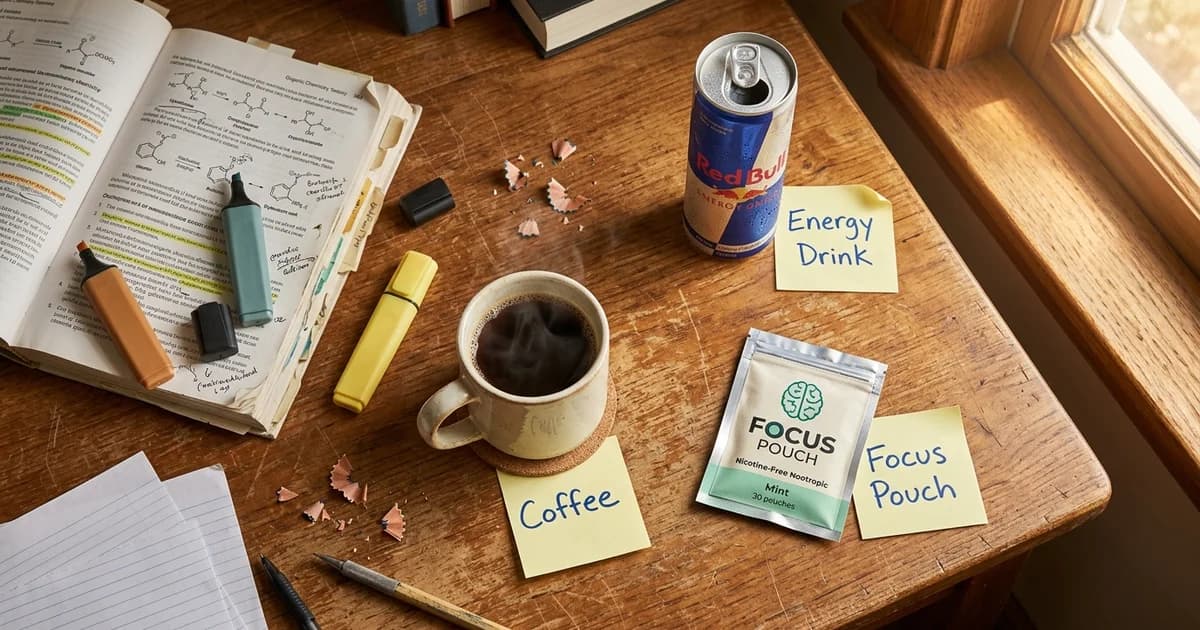
Energy drinks vs coffee vs a focus pouch: which one actually sustains concentration for a full study session? Coffee is cheap and reliable. Energy drinks are fast and convenient. But both formats dump caffeine into your gut, peak in 30 to 60 minutes, and fade within 3 to 4 hours. A sublingual focus pouch like Roon absorbs through the lining of your mouth in 5 to 10 minutes, pairs 80 mg caffeine with 60 mg L-theanine, and holds a 6 to 8 hour focus window with no sugar and no crash. The best study fuel depends on session length, crash tolerance, and budget.
Below is a head-to-head comparison, followed by a deeper breakdown of each format.
How Do Energy Drinks, Coffee, Capsules, and Focus Pouches Compare for Studying?
The short answer: energy drinks win on speed and convenience, coffee wins on price, caffeine capsules win on simplicity, and a focus pouch wins on duration and crash resistance. No single format is best for every situation. Here is how the four stack up on the metrics that matter most during a study session.
| Metric | Energy Drink (16 oz can) | Coffee (12 oz brewed) | Caffeine Capsule (200 mg) | Roon Focus Pouch |
|---|---|---|---|---|
| Caffeine per serving | 160 mg (Monster) | 120–200 mg | 200 mg | 80 mg + 60 mg L-theanine |
| Onset | 15–45 min | 20–40 min | 30–60 min | 5–10 min (sublingual) |
| Focus duration | 2–3 hrs | 3–4 hrs | 3–4 hrs | 6–8 hrs |
| Crash profile | High (sugar + caffeine spike) | Moderate (no sugar, but no L-theanine) | Moderate (pure caffeine, no buffer) | Low (L-theanine + Dynamine + TeaCrine smooth the curve) |
| Sugar per serving | 54 g (Monster Original) | 0 g (black) | 0 g | 0 g |
| Cost per serving | ~$3–4 per can | ~$2–4 café / ~$0.50 home-brewed | ~$0.05–0.10 | $1.00 one-time / $0.61 subscription |
| Best for | A quick 1–2 hr burst when you need energy fast | Steady, budget-friendly sessions under 4 hrs | Cheapest raw caffeine; short tasks | Long sessions (4–8 hrs), exams, no-crash focus |
One honest limitation of the pouch format: 80 mg of caffeine per pouch is roughly half the dose in a large energy drink or strong coffee. If you need a heavy caffeine hit for a very short, intense task, coffee or an energy drink delivers more milligrams per serving. The pouch trades raw stimulant load for duration and smoothness.
What Actually Makes a Good Study Aid?
Good study fuel does three things: it kicks in fast, it lasts through a full session, and it does not drop you off a cliff when it wears off.
Caffeine handles the first part. It is the most studied cognitive stimulant on earth, and at the right dose it sharpens alertness and reaction time. The FDA puts the safe daily ceiling at about 400 mg for most healthy adults, which is roughly two to three 12-ounce cups of brewed coffee.
The problem is everything that gets bundled with caffeine. Sugar is the usual culprit. A 16-ounce can of Monster Original contains 160 mg of caffeine and 54 grams of sugar. When a drink delivers caffeine alongside that much fast sugar, you get a quick lift followed by a blood-sugar dip that feels like exhaustion. That dip tends to land right in the middle of your study block.
Then there is the jitter problem. High-dose caffeine on its own raises anxiety, which is the opposite of what you want when you are trying to hold a complex idea in your head. The fix is not less caffeine. It is pairing caffeine with something that smooths the edges.
Why the Caffeine-Plus-L-Theanine Ratio Matters
This is where most study drinks fall short. L-theanine is an amino acid found naturally in tea leaves, and paired with caffeine it produces calm, directed focus instead of a buzzy rush.
The research here is settled, not speculative. A 2008 study in Nutritional Neuroscience (Owen et al.) found that 50 mg caffeine combined with 100 mg L-theanine improved both speed and accuracy on an attention-switching task and reduced susceptibility to distracting information at 60 and 90 minutes. In practical terms: the pairing helped people focus during exactly the kind of demanding mental work studying requires.
Most energy drinks do not include L-theanine. Coffee does not either. That gap is the reason the category needs rethinking.
Are Energy Drinks Good for Studying?
Energy drinks are the most convenient option and the worst on crash risk. They are built for a quick hit, not a four-hour study marathon. A standard 16-ounce Monster carries 160 mg of caffeine and 54 g of sugar. A regular 8.4-ounce Red Bull has 80 mg of caffeine and 27 grams of sugar. That sugar is the engine behind the mid-session slump.
There is also a ceiling problem. Two large cans push you past the FDA's 400 mg daily caffeine guideline, and during finals week, two cans in a day is nothing. Sugar-free versions cut the calories but not the rollercoaster; the caffeine still arrives all at once through your gut and leaves the same way, with a half-life of about 5 to 6 hours in healthy adults.
If you are searching for the best energy drink for studying, the honest answer is that the format itself works against sustained focus. You are buying speed at the cost of stability.
Is Coffee Better Than Energy Drinks for Studying?
Coffee is usually the better choice. Black coffee delivers 120 to 200 mg of caffeine per 12-ounce cup with zero sugar, so you dodge the blood-sugar crash that sinks energy drinks. A café cup costs around $3.52 at the national median as of mid-2025; home-brewed runs roughly $0.30 to $0.50.
The downside is the lack of anything to balance the caffeine. No L-theanine, no smoothing agent. The higher you push your intake across a long night, the more likely you are to feel anxious and scattered rather than locked in.
Coffee also forces a tradeoff students know well. Drink enough to stay sharp past midnight, and you will not sleep when you finally close the laptop. Caffeine's 5 to 6 hour half-life means a cup at 10 p.m. still has roughly half its caffeine circulating at 3 a.m., which wrecks the sleep your brain needs to consolidate what you studied.
What About Tea and Matcha for Focus?
Green tea and matcha are the only common drinks that naturally pair caffeine with L-theanine. That is why a cup of tea feels like a gentler lift than coffee.
The tradeoff is dose. A cup of green tea delivers only 25 to 50 mg of caffeine, which often is not enough to power a serious study session. You would need 3 to 4 cups, and that means several trips to the bathroom and a sloshing stomach.
Matcha concentrates things a bit more, and it is a reasonable choice for lighter review work. For a high-stakes all-nighter, though, the caffeine ceiling is too low to lean on alone.
When Is a Focus Pouch Better Than a Drink for Studying?
A sublingual focus pouch delivers the caffeine-plus-L-theanine combination without sugar or liquid, which solves the problems all three drink formats share. You tuck it between your lip and gum, the active ingredients absorb through the oral mucosa, and focus arrives in 5 to 10 minutes rather than the 30 to 60 minutes a swallowed drink or capsule takes to peak.
This format exists because the drink delivery system has built-in limits. A pouch carries no sugar, so there is no blood-sugar crash. It carries no liquid, so you are not pacing the library bathroom. And because the dose is fixed per pouch, you know exactly how much caffeine you are taking.
The better pouches also stack ingredients energy drinks skip. Beyond caffeine and L-theanine, Roon includes 25 mg of methylliberine (Dynamine) and 5 mg of theacrine (TeaCrine). A 2022 randomized crossover trial in adult male e-gamers found that a combination of caffeine, theacrine, and methylliberine improved alertness and reaction time without increasing anxiety or headaches, which is the exact performance profile you want for sustained mental work.
That is the case for rethinking what to drink while studying. Sometimes the best tool is not a beverage at all.
How to Choose What to Use While Studying
Match the tool to the task. A 30-minute flashcard review and a six-hour exam cram are not the same problem.
For short bursts (under 2 hours): a single coffee or a small energy drink is fine. The crash will not matter much if you finish before it hits.
For long sessions (3 to 8 hours): prioritize duration and stability over raw kick. You want something that holds a steady line for hours and pairs caffeine with L-theanine so you stay calm instead of frantic. A focus pouch or matcha fits here better than a can of Monster.
For all scenarios: watch your total caffeine across the day. The FDA's 400 mg ceiling applies no matter the format. Stop caffeine intake at least 6 to 8 hours before bed, because sleep is when your brain consolidates what you studied.
The Right Format Depends on the Session, Not the Brand
The best study fuel is not the one with the most caffeine or the flashiest can. It is the one that turns on fast, holds steady through a full session, and lets you off gently instead of dropping you mid-chapter.
Energy drinks win on speed and convenience but lose on sugar and crash risk. Coffee is reliable and cheap but blunt, with no L-theanine to balance the jitters. Tea has the right chemistry but too little caffeine to carry a serious session. Capsules are dirt cheap but slow to absorb and offer no balancing compounds. A focus pouch fills the duration gap but carries less raw caffeine per serving.
Once you judge these options by how long the focus lasts rather than how hard it hits, the format you have always reached for may not be the format that actually serves a long night of studying.
Related from Roon
- Ultra Focus Pouches Review: Concentration and Clarity
- Sublingual Caffeine Absorption: Pharmacokinetics
- Sublingual Absorption: Bypassing First-Pass Metabolism
Frequently Asked Questions
What is the best energy drink for studying?
No single energy drink wins for studying because the format works against long sessions. The caffeine peaks fast and fades in 2 to 3 hours, and many cans pack 27 to 54 grams of sugar that cause a mid-session blood-sugar crash. If you insist on a drink, black coffee or matcha gives you steadier energy. For sessions over 4 hours, a focus pouch that pairs caffeine with L-theanine (like Roon) provides a longer, smoother focus window.
Is coffee or an energy drink better for studying?
Coffee is the better choice for most students. Black coffee delivers 120 to 200 mg of caffeine per cup with zero sugar, so you avoid the crash that sinks many energy drinks. Energy drinks hit harder up front but the combination of high caffeine and sugar tends to produce a sharper slump. For sessions longer than 3 to 4 hours, neither format is ideal; consider something that adds L-theanine to smooth the caffeine curve.
How much caffeine is safe while studying?
The FDA cites about 400 mg of caffeine a day as an amount not generally linked to negative effects for most healthy adults. That equals roughly two to three 12-ounce cups of brewed coffee, or about two and a half 16-ounce cans of Monster. Individual sensitivity varies widely, so track your total intake across all sources and stop caffeine at least 6 hours before you plan to sleep.
Does L-theanine actually help with focus?
Yes, when paired with caffeine. A 2008 study in Nutritional Neuroscience found that 50 mg caffeine plus 100 mg L-theanine improved speed and accuracy on attention-switching tasks and reduced distractibility at 60 and 90 minutes. The combination produces calm, directed focus rather than the jittery buzz caffeine causes on its own. That is why tea, which naturally contains both compounds, feels smoother than coffee.
What can I use to study without crashing?
Skip the sugar and choose something that releases steadily. Black coffee, green tea, and matcha all avoid the sugar spike that sinks most energy drinks. A focus pouch with caffeine and L-theanine also sidesteps the crash since it carries no sugar and the L-theanine smooths the caffeine. The key is pairing your caffeine with a balancing compound, not piling on more milligrams.
Are focus pouches better than energy drinks for studying?
For sessions over 3 hours, generally yes. A sublingual focus pouch absorbs in 5 to 10 minutes, carries no sugar, and avoids the liquid bloat of several cans or cups. The better pouches pair caffeine with L-theanine and add longer-lasting compounds like methylliberine and theacrine. The result is a longer focus window with less crash risk. For quick 1-hour tasks, though, a simple coffee works fine and costs less.
How fast do focus pouches work compared to coffee?
A sublingual pouch absorbs through the oral mucosa and reaches the bloodstream in about 5 to 10 minutes. Swallowed caffeine from coffee or capsules passes through the stomach and intestines, reaching peak blood levels in 30 to 60 minutes. The pouch format does not deliver more caffeine; it delivers it faster, which matters when you need to lock in quickly.
Do focus pouches contain nicotine?
Some oral pouches on the market contain nicotine, but dedicated focus pouches like Roon are zero-nicotine. Roon's active ingredients are caffeine, L-theanine, methylliberine (Dynamine), and theacrine (TeaCrine). Always check the label; if a pouch lists nicotine or tobacco-derived ingredients, it is a nicotine product, not a focus product.
Why One Pouch Outlasts Two Cups of Coffee in a Study Session
The argument in this article comes down to one thing: a study session lives or dies by how the second half feels, not the first fifteen minutes. That is the problem Roon was built around.
Each pouch contains just 80mg of caffeine, roughly a small coffee. What changes the shape of the curve is 25mg of methylliberine (Dynamine). In a human pharmacokinetic study, co-administering methylliberine with caffeine reduced caffeine's oral clearance by more than half and extended its half-life from 7.2 to 15 hours, with no increase in peak concentration. Same peak, longer tail. That is why the felt window stretches to 6 to 8 hours instead of coffee's typical 3 to 4. L-theanine (60mg) smooths the ride. Theacrine (5mg) contributes energy support without building tolerance the way caffeine alone does.
The honest trade-off: a longer half-life means you should not use it late. Stop at least 8 hours before bed. And Roon is not the cheapest option at $1.00 per pouch one-time or $0.61 subscribed. It contains no adaptogens, no mushroom extracts, no nicotine. It is a duration tool. If your problem is fading halfway through a long session, try Roon and judge it by hour four.
Written by Roon Team