Sublingual Caffeine Absorption: Does Mouth Delivery Work Faster?
Roon Team
Does Sublingual Really Work Faster? The Honest Pharmacokinetics of Mouth-Absorbed Caffeine
Most claims about sublingual caffeine absorption are half-true. Marketing pages promise that holding caffeine in your mouth dodges your gut, skips your liver, and hits your brain in minutes. The biology is more interesting than that, and more honest.
Here is the short version. Caffeine taken by mouth is one of the most efficiently absorbed drugs we know of. Whether it arrives through a pouch, a strip, a gum, or a swallowed pill, almost all of it ends up in your blood. What actually changes between formats is timing and smoothness, not the total dose your body sees.
So the right question is not "does sublingual deliver more caffeine?" It's "does it arrive faster, and does that matter?" The data says: sometimes yes, sometimes no, and the difference depends entirely on the format.
Key Takeaways
- Caffeine is nearly 100% bioavailable by any oral route. Sublingual delivery does not give you "more" caffeine, it changes how fast it arrives.
- Buccal and gum formats show genuinely faster absorption through the cheek and gum tissue, reaching the blood sooner than capsules.
- A 2025 oral-spray study found no speed advantage versus a drink, proving format and contact time matter more than the word "sublingual."
- Caffeine's first-pass metabolism is already low, so bypassing the liver is a smaller win than supplement marketing implies.
How Caffeine Normally Gets Into Your Blood
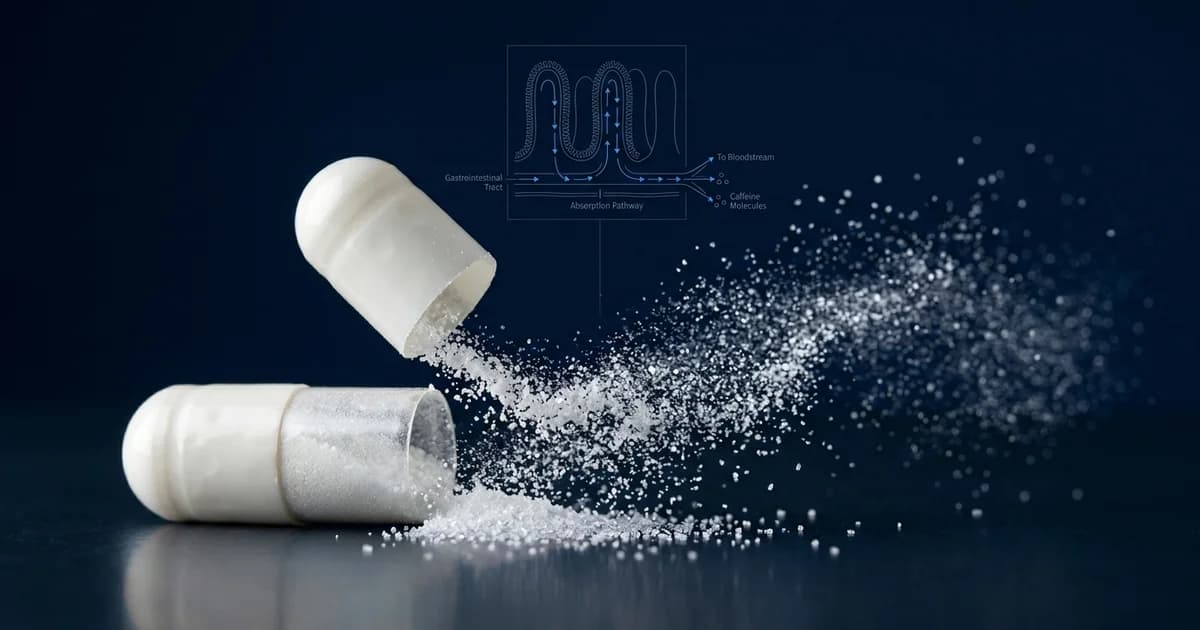
When you swallow caffeine, the absorption story is already very good. Caffeine is rapidly and completely absorbed in humans, with 99 percent absorbed within 45 minutes of ingestion, according to the NCBI's pharmacology reference on caffeine.
Most of that absorption happens in the small intestine, not the stomach. Peak plasma concentrations usually land somewhere between 15 and 120 minutes after you drink coffee, with most people peaking around the 30 to 60 minute mark, per a systematic analysis of caffeine pharmacokinetics in Frontiers in Pharmacology.
That window is the real issue. Swallowed caffeine works, but the onset is slow and variable. A heavy meal, a slow-emptying stomach, or your individual gut can push your peak from 15 minutes out to two hours. That unpredictability is what alternative delivery formats are trying to fix.
What "Sublingual" and "Buccal" Actually Mean
Sublingual means under the tongue. Buccal means against the cheek and gum. Both describe absorption through the lining of your mouth, the oral mucosa, which is thin, well supplied with blood vessels, and capable of moving small molecules straight into circulation.
The theoretical appeal is twofold. Caffeine absorbed through the mouth enters the bloodstream directly instead of waiting for your stomach to empty. And a fraction of it sidesteps the digestive tract entirely.
The catch is contact. Mouth absorption only happens while the caffeine stays in contact with the tissue. A spray you swallow in two seconds behaves very differently from a pouch you hold for twenty minutes. This single variable explains most of the contradictory headlines about sublingual caffeine pharmacokinetics.
The First-Pass Metabolism Question
Here is where the marketing usually overreaches. The "first pass" refers to the liver metabolizing a drug before it reaches the rest of your body, which can lower the effective dose. Bypassing it sounds like a free upgrade.
For most drugs, this matters a lot. For caffeine, it barely registers. Caffeine taken orally is roughly 99% bioavailable, which means the liver removes almost nothing on the first pass. There is not much dose left to "rescue" by going buccal.
So the caffeine first pass metabolism argument is real but small. You are not doubling your caffeine by holding it in your mouth. At best you are shaving off a single-digit percentage of loss. The honest benefit of mouth absorption is speed and consistency, not a bioavailability jackpot.
Does Sublingual Caffeine Work Faster? What the Studies Show
The answer depends on the format, and the evidence splits cleanly in two directions.
The case for faster: gum and oral films
Caffeinated gum is the strongest evidence that mouth absorption speeds things up. A classic study comparing caffeine gum to capsules found the rate of drug absorption was much faster for the gum, with the authors noting this likely reflected absorption through the buccal mucosa.
Newer work agrees. A 2023 paper in Scientific Reports summarized that caffeinated gum absorbs caffeine far faster than capsules, with the membranes of the mouth doing much of the early work while capsules took roughly 45 to 60 minutes to reach high blood concentrations.
Oral films tell a similar story. A 2019 study in Frontiers in Pharmacology testing a micronized caffeine oral delivery film reported rapid absorption into the bloodstream and a measurable, fast onset of activity in the brain.
The case against: the oral spray null result
Then there is the study that keeps everyone honest. A 2025 paper in the European Journal of Applied Physiology tested whether a caffeine mouth spray would raise blood caffeine faster than simply drinking it. It did not. The researchers concluded that sublingual caffeine delivery via oral spray does not accelerate the rise in blood caffeine compared to ingesting a caffeinated beverage.
Why the conflict? Contact time. A spray coats your mouth and gets swallowed almost immediately, so very little caffeine has the chance to cross the mucosa before it heads to your gut. The label said sublingual, but the physics said "swallowed."
That is the lesson buried in the buccal caffeine absorption literature. The word on the package does not determine the result. The format and the dwell time do.
Sublingual vs Swallowed Caffeine Onset: A Side-by-Side
The table below compares common caffeine formats on the factors that actually change the experience. Onset figures are approximate and drawn from the absorption studies cited above.
| Format | Mouth contact time | Typical onset | Bypasses some first pass? | Smoothness of curve |
|---|---|---|---|---|
| Coffee / swallowed pill | None | 30 to 60+ min | No | Variable, depends on stomach |
| Energy drink | Minimal | 30 to 45 min | No | Spiky |
| Caffeine spray | Seconds | No measurable advantage | Negligible | Like swallowing |
| Caffeine gum | 5 to 10 min chewing | Faster than capsules | Partial | Moderate |
| Oral film / strip | 1 to 3 min dissolve | Rapid | Partial | Moderate |
| Roon sublingual pouch | 15 to 20 min held | 5 to 10 min | Partial | Smooth, paired with L-theanine |
The pattern is clear. Formats that keep caffeine in contact with your mouth tissue for several minutes absorb faster. Formats that get swallowed quickly behave like a drink, regardless of the marketing term.
Why Onset Smoothness Matters More Than Raw Speed
Speed is only half the story. A fast caffeine spike is not automatically a good thing. Sharp peaks are what drive jitters and the eventual crash, because what goes up fast tends to come down fast.
This is why the smartest formats pair caffeine with L-theanine, an amino acid from tea that improves attention-switching accuracy and promotes calm alertness without blunting the focus. The combination is one of the most studied pairings in cognitive performance, and we cover the mechanism in depth in our guide to how L-theanine balances caffeine.
A faster onset paired with a smoother curve is the actual goal. Arriving in minutes is useless if you spike, crash, and reach for more an hour later. For more on avoiding that cycle, see our breakdown of why caffeine crashes happen.
Frequently Asked Questions
Does sublingual caffeine give you more caffeine than swallowing it?
No. Caffeine is already about 99% bioavailable when swallowed, so there is very little extra dose to gain by absorbing it through your mouth. The real difference is timing. Mouth absorption can deliver caffeine to your blood faster and more predictably, but it does not raise the total amount your body absorbs from a given dose.
Is sublingual caffeine actually faster than coffee?
It depends on the format. Gums and oral films that stay in contact with your mouth tissue absorb faster than swallowed capsules. A 2025 study found a caffeine spray that gets swallowed quickly offered no speed advantage over a drink. Contact time is the deciding factor, not the label.
Does mouth-absorbed caffeine bypass the liver?
Partly, but it matters less than you'd think. The liver removes almost none of an oral caffeine dose on the first pass, so caffeine first pass metabolism is already minimal. Bypassing it through buccal absorption saves a small single-digit percentage at best. The benefit of mouth absorption is speed and consistency, not a meaningful bioavailability boost.
What is the difference between sublingual and buccal absorption?
Sublingual means under the tongue. Buccal means against the cheek and gums. Both move a drug through the oral mucosa, the thin, blood-rich lining of the mouth, directly into circulation. In practice the terms overlap, and what matters most is how long the caffeine stays in contact with that tissue before being swallowed.
Why did the oral spray study show no benefit?
Contact time. A spray coats the mouth and gets swallowed within seconds, so almost no caffeine crosses the mucosa before it reaches the gut. The result mirrors simply drinking caffeine. It shows that calling a product sublingual means nothing if the format does not keep caffeine in your mouth long enough to absorb.
How long should a sublingual caffeine product stay in your mouth?
Longer is better, within reason. The faster-absorbing formats in the research, gums and films, keep caffeine against the mouth tissue for several minutes. A pouch held for 15 to 20 minutes gives caffeine sustained contact time with the oral mucosa, which is the mechanism behind the faster, smoother onset these formats aim for.
The Honest Bottom Line on Mouth-Absorbed Caffeine
Sublingual caffeine is not a bioavailability cheat code. Your body already absorbs nearly all the caffeine you swallow, and the liver barely touches it on the way through. Anyone selling mouth absorption as a way to get "more" caffeine is selling you biology that doesn't exist.
What mouth absorption can genuinely change is how fast and how smoothly caffeine arrives, and only when the format keeps caffeine in contact with the tissue long enough to matter. Gums and films deliver on that. A quickly swallowed spray does not.
So judge any product by its format and contact time, not by the word "sublingual" on the front. That single distinction separates the formats that work faster from the ones that just sound like they do.
Why Contact Time Is the Whole Point of a Pouch
Everything above lands on one variable: how long caffeine actually sits against your mouth tissue. That is exactly the problem a pouch is built to solve. Roon is a sublingual pouch you hold in your mouth for 15 to 20 minutes, which gives caffeine the sustained contact time that sprays never get and that the faster-absorbing gum and film research points to.
Each pouch delivers a precise 80 mg caffeine, 60 mg L-theanine, 25 mg methylliberine (Dynamine), and 5 mg theacrine (TeaCrine), built for an onset in 5 to 10 minutes and 6 to 8 hours of focus with no jitters, no crash, and no tolerance buildup. The L-theanine is there for the reason this article makes clear: speed only helps if the curve stays smooth.
To be straight about it, a pouch is not a way to absorb "more" caffeine than coffee, because your body already absorbs nearly all of it. It is a way to control when and how cleanly that caffeine arrives. If that trade is what you're after, try Roon and feel the difference contact time makes.
Written by Roon Team