Ultra Focus Pouches Review: The Best Options for Concentration in 2026
Roon Team
Focus Pouches: The Best Options for Concentration in 2026
The best focus pouches in 2026 combine a mild stimulant with one or more nootropic compounds, delivered through the oral mucosa for faster absorption than capsules or drinks. After testing and researching every major brand, the top options are Roon (80 mg caffeine + L-theanine + methylliberine + theacrine, lasting 6 to 8 hours), Ultra Focus (paraxanthine, caffeine-free, 1 to 2 hour window), Nectr Focus (30 mg caffeine + 62.5 mg Cognizin citicoline), Fully Loaded ALPHA (caffeine-free), and Cyclone Pods Focus (50 mg guarana caffeine). The right pick depends on whether you need sustained deep work, a quick midday bump, or a nicotine-free oral ritual. This guide breaks down the best focus pouches available right now, what's actually inside them, and which ones are worth your money.
Key Takeaways
- Focus pouches deliver nootropic ingredients through the mouth's mucous membranes, bypassing the gut for faster absorption.
- The best products combine a mild stimulant (caffeine or paraxanthine) with calming agents like L-theanine to smooth out the energy curve.
- Not all pouches are created equal. Ingredient dosages, duration of effect, and active compounds vary wildly between brands.
- Duration is the biggest differentiator: most pouches last 1 to 2 hours, while multi-alkaloid stacks can extend focus to 6 to 8 hours.
Focus Pouches Comparison Table (2026)
| Brand | Key Stimulant | Nootropic Stack | Caffeine | Est. Duration | Price per Can | Best For |
|---|---|---|---|---|---|---|
| Roon | Caffeine (80 mg) | 60 mg L-theanine, 25 mg methylliberine (Dynamine), 5 mg theacrine (TeaCrine) | 80 mg | 6-8 hours | $9.16-$15.00 (15 pouches) | Sustained deep focus, long work sessions |
| Ultra Focus | Paraxanthine (enfinity, amount not published) | Alpha GPC, L-theanine, Panax Ginseng, B6, B12 | 0 mg | 1-2 hours | ~$16 ($48/3 cans; 15 pouches) | Caffeine-sensitive users, short tasks |
| Nectr Focus+ | Caffeine (50 mg) | 100 mg L-theanine, 85 mg Alpha-GPC, 85 mg L-tyrosine, 30 mcg Huperzine A | 50 mg | ~1-2 hours | ~$9 ($44.99/5-pack; 20 pouches) | Light daily focus support |
| Fully Loaded ALPHA | None | 60 mg Alpha-GPC, 60 mg L-Tyrosine, 20 mg GABA | 0 mg | Varies | ~$5 (15 pouches) | Stress management, long-term cognitive health |
| Cyclone Pods Focus | Guarana caffeine (50 mg) | Five adaptogens (ashwagandha, lion's mane, reishi, cordyceps, bacopa) | 50 mg | Up to 4 hours (brand-stated) | ~$9.99 (20 pouches) | Nicotine-free oral ritual with mild focus |
What Are Focus Pouches, Exactly?
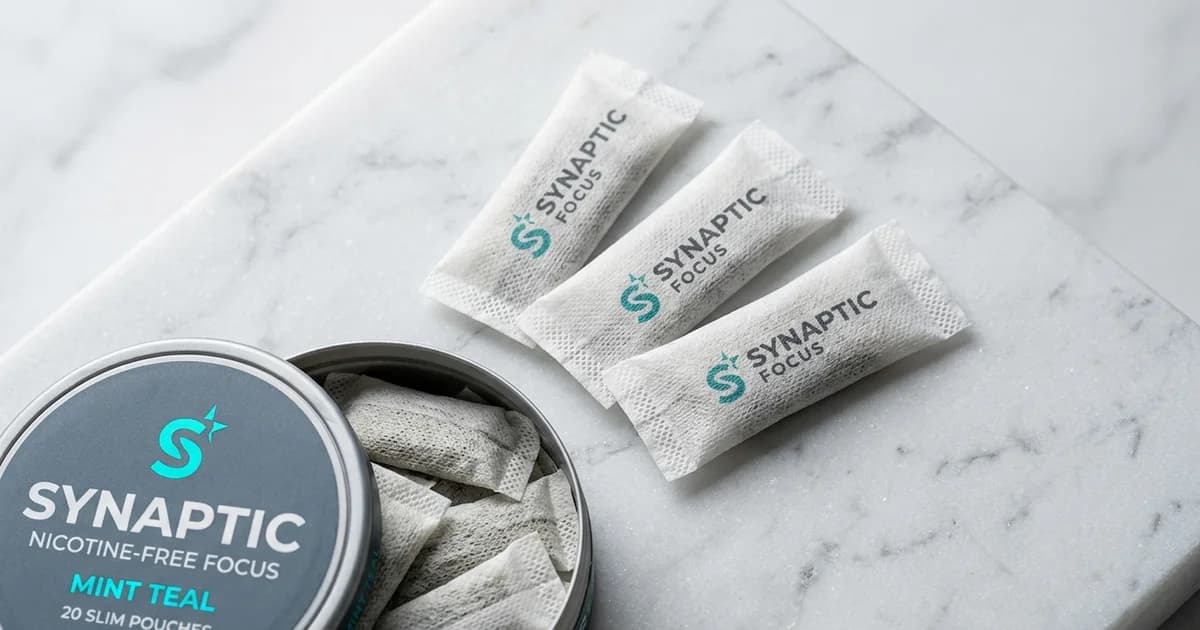
Focus pouches are small, teabag-like packets you tuck between your lip and gum. They contain nootropic compounds, adaptogens, or mild stimulants that absorb through the oral mucosa directly into the bloodstream.
The format borrows from nicotine pouches (like Zyn), but replaces nicotine with cognitive-support ingredients. That distinction matters. Nicotine is a potent stimulant, but it comes with dependence, cardiovascular strain, and a tolerance curve that makes it less effective over time. The tobacco-free pouch market has grown rapidly, and the options range from genuinely useful to glorified breath mints.
Functional pouches aim to give you the ritual and the focus without the addiction. The question is whether the ingredients inside them actually deliver.
Most of this category runs on caffeine, usually paired with L-theanine to take the edge off. We break that format down on its own in our guide to caffeine pouches: dose, onset, and how it compares to coffee.
Ultra Focus Pouches Review: Paraxanthine Over Caffeine
Ultra Pouches are one of the most visible brands in this space. Their formula centers on enfinity paraxanthine, a metabolite of caffeine that your liver naturally produces when you drink coffee. PricePlow reported that Ultra upgraded the dose from 75 mg to 100 mg of enfinity per pouch in January 2026. Ultra itself publishes no milligram amount for any Focus ingredient on takeultra.com, so that number comes from PricePlow's reporting, not from Ultra's label. The named ingredient list also includes L-theanine, Alpha GPC, Panax Ginseng, Vitamin B6, and Vitamin B12.
The formula is caffeine-free, which is a deliberate choice. Paraxanthine delivers stimulation similar to caffeine but with a cleaner cognitive profile, according to research published in the Journal of the International Society of Sports Nutrition. That study found paraxanthine provided greater improvement in cognitive function than caffeine after a 10-km run. Ultra has raised $11 million and sold over a million cans since launching in May 2025.
Where Ultra Falls Short
Two hours is not a long window. If you're trying to get through a four-hour deep work block or a full afternoon of meetings, you'd need to re-dose. Ultra recommends 3 to 4 pouches per day, which means you're cycling through cans faster.
The caffeine-free angle is a genuine plus for people sensitive to caffeine, but it also means the stimulant effect is milder than what some users want. Alpha GPC and Panax Ginseng are solid inclusions, but Ultra publishes no milligram amount for any Focus ingredient on its own site, though it does publish milligram amounts for its Sleep pouch. Questions about Ultra Pouches ingredient transparency and side effects are worth examining closely. Transparency matters when you're putting something in your body multiple times a day.
Other Best Focus Pouches Worth Knowing About
The market has grown fast. Here's how the other major players stack up.
Nectr Nootropic Pouches
Nectr runs multiple product lines. Their original Focus pouches contained 62.5 mg of Cognizin Citicoline and 30 mg caffeine, plus B vitamins, and are being phased out in favor of Focus+. Their newer Focus+ line bumps the stack to 50 mg caffeine, 100 mg L-theanine, 85 mg Alpha-GPC, and 85 mg L-tyrosine, making it one of the more transparent formulas on the market.
Citicoline is a well-studied nootropic that supports acetylcholine production, which plays a direct role in attention and memory. A randomized, placebo-controlled, double-blind crossover study found that 97 mg of L-theanine combined with 40 mg of caffeine improved task switching during demanding cognitive tasks.
Nectr's weakness? The effects are relatively short-lived, similar to Ultra. And Citicoline, while effective, works best with consistent daily use rather than as a one-off focus tool.
Fully Loaded ALPHA Nootropic Pouches
Fully Loaded comes from the tobacco alternative world and has pivoted into functional pouches. Their ALPHA pouch uses 60 mg Alpha-GPC, 60 mg L-Tyrosine, and 20 mg GABA, and it is caffeine-free. ALPHA Fuel is the caffeinated version of the same line, at 50 mg Alpha-GPC, 50 mg L-Tyrosine and 50 mg caffeine. A separate Alpha Mushrooms line adds lion's mane, cordyceps, and chaga.
This is a different approach entirely. Calm-leaning aminos and functional mushrooms work on stress response and long-term cognitive health rather than acute focus. If you're looking for an immediate "locked in" feeling, the caffeine-free ALPHA pouch probably won't deliver that. But for people interested in daily cognitive maintenance and stress management, the formula has merit.
The trade-off: no stimulant means no immediate onset. You're playing a longer game with adaptogens, and the research on buccal absorption of amino acids and mushroom extracts at pouch-level doses is still limited.
Cyclone Pods Focus Pouches
Cyclone Pods comes out of the nicotine-free vape category and sells the oral ritual without nicotine. The brand states plainly that its products are not cessation products and have not been tested as such. Their pouches contain 50 mg of guarana-derived caffeine plus five adaptogens.
The focus benefits here lean heavily on caffeine, similar to what you get from caffeine-based energy pouches like Grinds. There's nothing wrong with that, but compared to the nootropic stacks offered by Ultra, Nectr, or Roon, Cyclone Pods is a simpler product.
The Science Behind the Best Focus Pouch Ingredients
Not every nootropic is equal, and the way ingredients interact matters more than any single compound. Here's what the clinical evidence says about the key ingredients across these focus pouches.
L-Theanine + Caffeine: The Proven Pair
This is the most well-studied nootropic combination in existence. L-theanine, an amino acid found in tea leaves, promotes alpha brain wave activity associated with calm alertness. Paired with caffeine, it smooths out the stimulant's rough edges, reducing jitters and anxiety while preserving the focus boost.
A 2025 study published in the British Journal of Nutrition confirmed that a high-dose L-theanine and caffeine combination improved selective attention in sleep-deprived young adults in a double-blind, placebo-controlled crossover trial. An earlier double-blind study in Nutritional Neuroscience found that just 97 mg of L-theanine with 40 mg of caffeine was enough to improve attention during demanding cognitive tasks. The effect is dose-dependent and consistent across multiple trials.
Theacrine + Methylliberine: The Duration Extenders
Theacrine (sold as TeaCrine) and methylliberine (sold as Dynamine) are purine alkaloids structurally related to caffeine. They act on similar adenosine receptors but with different pharmacokinetic profiles, which is why they extend the duration of focus rather than just amplifying it.
A 2021 randomized crossover study published in Cureus tested caffeine alone versus caffeine combined with theacrine and methylliberine in esports athletes. The combination improved cognitive performance and reaction time without negatively affecting mood.
A separate double-blind, placebo-controlled trial on tactical personnel found that combining caffeine, methylliberine, and theacrine produced similar vigilance benefits to 300 mg of caffeine alone, but with less impact on diastolic blood pressure. In practical terms, you get longer-lasting focus from a lower stimulant load.
The Tolerance Problem: Why Theacrine Matters
Most stimulants lose effectiveness over time. Caffeine is the classic example: regular users need progressively higher doses to feel the same effect. Theacrine appears to sidestep this problem. An 8-week safety study of 60 healthy adults found no evidence of habituation at doses up to 300 mg per day, with baseline values for energy, focus, and concentration remaining stable across the entire study protocol. A 2024 dose-response study in Scientific Reports found no meaningful sleep disruption from theacrine, with some next-morning vigilance benefit at the higher doses tested.
This is the key differentiator any focus pouches comparison should highlight. Most focus pouches rely on a single stimulant (caffeine or paraxanthine) with one or two support ingredients. Stacking caffeine with theacrine and methylliberine extends the duration of cognitive benefits from roughly 1 to 2 hours into the 4 to 8 hour range.
Where to Find Focus Pouches Near Me
If you're searching focus pouches near me, your options depend on where you live. Ultra Pouches are available through their website and Amazon. Nectr sells direct-to-consumer through their site. Fully Loaded has broader retail distribution given their roots in the tobacco alternative space.
Most functional pouch brands are still online-first. Aside from Nectr's Walmart push, the category hasn't hit mainstream retail shelves the way nicotine pouches have. Your best bet for selection and freshness is ordering directly from the brand.
What to Look For in a Focus Pouch
Forget the marketing. Here's what separates a good focus pouch from a bad one:
- Published dosages. If a brand won't tell you exactly how many milligrams of each ingredient are in the pouch, move on. Proprietary blends hide underdosing.
- Ingredient combinations. A single compound rarely outperforms a well-designed stack. Look for formulas with 3 or more compounds that have clinical evidence behind them.
- Duration of effect. A 45-minute focus boost isn't useful for real work. Look for products designed to last through a 4 to 8 hour work session.
- No tolerance buildup. Theacrine has shown no habituation effect over 8 weeks of daily use at doses up to 300 mg/day. That's a meaningful advantage over caffeine alone.
- Zero nicotine. This should be non-negotiable. Nicotine delivers focus, yes, but at the cost of dependence and diminishing returns.
The Bottom Line on Focus Pouches
The focus pouch category has matured past the "glorified breath mint" stage, but most products still cluster around the same short-duration formula: a single stimulant, maybe one nootropic, and a 1 to 2 hour window before you need another. The science is clear that multi-compound stacks outperform single ingredients, that L-theanine improves attention-switching accuracy and calm alertness when paired with caffeine, and that purine alkaloids like theacrine resist the tolerance buildup that undermines caffeine over weeks of daily use. The best focus pouch for you depends on your use case, your caffeine sensitivity, and how long you need to stay locked in.
Related from Roon
- Best Nootropic Pouches 2026: Buyer's Guide
- Ultra Pouches Review (2026): Honest Take
- Ultra Pouches Side Effects: Complete Guide
- Tobacco-Free Pouches: Complete Guide
- Grinds Energy Pouches: Where to Buy
Frequently Asked Questions
What are focus pouches?
Focus pouches are small, tobacco-free, nicotine-free oral pouches that deliver nootropic compounds through the lining of your mouth. You place one between your lip and gum, and the active ingredients absorb through the oral mucosa into your bloodstream. This bypasses digestion, which means faster onset (typically 5 to 15 minutes) compared to capsules or drinks.
Do focus pouches actually work?
Yes, if the ingredients are dosed correctly. The L-theanine and caffeine combination has strong clinical backing across multiple double-blind, placebo-controlled trials. Paraxanthine, citicoline, and theacrine also have published human data supporting cognitive benefits. The key is checking that a brand discloses its dosages rather than hiding behind a proprietary blend.
How long do focus pouches last?
It depends on the formula. Single-stimulant pouches (caffeine or paraxanthine alone) typically last 1 to 2 hours. Multi-alkaloid stacks that include theacrine and methylliberine can extend the focus window to 6 to 8 hours. Adaptogen-based pouches like Fully Loaded Alpha work on a longer timeline and aren't designed for acute, immediate focus.
Are focus pouches safe?
Focus pouches using well-studied ingredients at published doses have a strong safety profile. An 8-week study on theacrine found no adverse effects at up to 300 mg/day in 60 healthy adults. Caffeine at 80 mg per pouch is roughly equivalent to one cup of coffee. As with any supplement, consult a doctor if you have cardiovascular conditions or are pregnant.
What is the difference between focus pouches and nicotine pouches?
Nicotine pouches contain nicotine, a potent stimulant that creates physical dependence and builds tolerance quickly. Focus pouches replace nicotine with nootropic compounds (caffeine, L-theanine, citicoline, theacrine, etc.) that support concentration without the addiction risk. The physical format and oral ritual are similar, which makes focus pouches a popular choice for people quitting nicotine.
Can I use focus pouches every day?
Most focus pouches are designed for daily use. Ingredients like L-theanine, citicoline, and theacrine have been studied in daily protocols without habituation. Caffeine does build tolerance over time, but pairing it with theacrine (which shows no habituation over 8 weeks) helps maintain consistent effects.
How do focus pouches compare to energy drinks?
Focus pouches deliver lower, more precise doses of caffeine (typically 30 to 80 mg vs. 80 to 300 mg in energy drinks) with zero sugar and no liquid volume. They also include nootropic compounds that energy drinks usually skip. The result is cleaner focus with less crash risk. A Nectr analysis estimates pouches cost roughly $0.35 to $0.50 each versus $2.50 to $5.00 per energy drink.
Which focus pouch has the longest-lasting effect?
Roon's 4-ingredient stack (80 mg caffeine, 60 mg L-theanine, 25 mg methylliberine, 5 mg theacrine) is designed for a 6 to 8 hour focus window, the longest claimed duration in this comparison. The theacrine and methylliberine extend caffeine's duration curve without increasing the total stimulant dose.
Do you get a buzz from nootropic pouches?
Not in the amphetamine or nicotine sense. Nootropic pouches like Ultra and Roon run on caffeine or paraxanthine, compounds that block adenosine receptors, the receptors that build the pressure to feel sleepy, rather than flooding the brain with dopamine the way nicotine or stimulant drugs do. The result users report is closer to a steady lift in alertness than a euphoric rush, not a spike. Roon's own customer feedback uses similar language, describing a noticeable but mild lift rather than a jolt. L-theanine, included in most formulas, further smooths that curve so the effect reads as calm focus rather than a jolt of energy. If you want the head-rush a nicotine pouch or an energy drink can produce, a nootropic pouch is a deliberately gentler experience, not a stronger one.
What pouches does Joe Rogan use?
There is no verified reporting confirming which pouch brand, if any, Joe Rogan currently uses. Several retailer and affiliate blogs claim he uses ZYN, Lucy, Athletic Nicotine, or other nicotine brands, but none of the claims we reviewed link to a podcast clip, interview, or other primary source, and we found zero credible mention connecting him to Ultra, Roon, or any nicotine-free nootropic pouch. Mainstream coverage does exist on the broader trend of nicotine pouches among podcasters and commentators, but it does not name Rogan's personal brand of choice. Treat any specific "Rogan uses this pouch" claim you see online as unverified marketing until a primary source surfaces. Neither Ultra nor Roon has an endorsement relationship with Joe Rogan.
Built for the Whole Work Session, Not Just the First Hour
Most of the products in this guide do one or two things well but fall short on duration. Ultra gives you clean stimulation for an hour or two. Nectr offers a gentle daily focus lift. Fully Loaded plays the long game with adaptogens. All solid, depending on what you need.
Roon was built to solve the duration problem. Its pouch delivers 80 mg of caffeine, 60 mg of L-theanine, 25 mg of methylliberine (Dynamine), and 5 mg of theacrine (TeaCrine), roughly the same caffeine as a cup of coffee but with a fundamentally different curve. L-theanine smooths the onset, while theacrine and methylliberine extend it to 6 to 8 hours of sustained focus with no jitters, no crash, and a stack chosen to resist tolerance buildup.
If you've been cycling through pouches, pills, and energy drinks trying to stay sharp past lunch, the ingredient stack in Roon is worth a serious look. It's not a replacement for sleep, exercise, or a well-structured work environment. But based on the clinical evidence behind its four active ingredients, Roon is the only focus pouch on the market built around the caffeine-theacrine-methylliberine combination that the research keeps validating.
Written by Roon Team