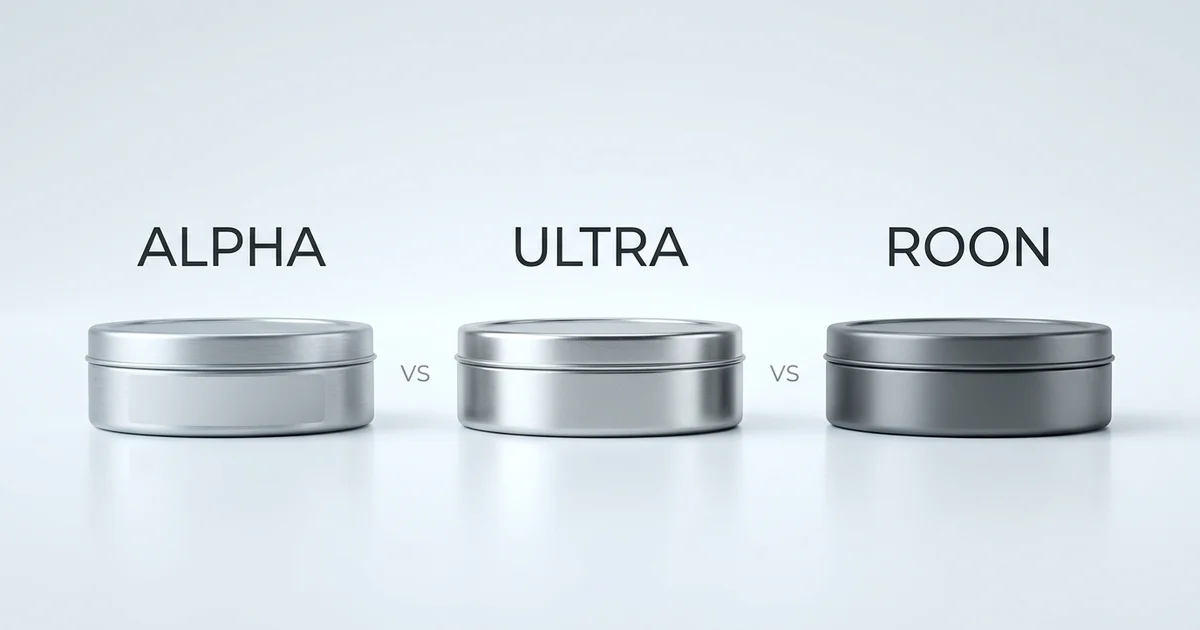
Nectr Pouches vs NZE vs Roon: Price Per Pouch Compared
Nectr Pouches vs NZE vs Roon: Price Per Pouch Compared
Most people shopping for Nectr pouches make the same mistake: they compare the sticker price on the tin instead of the price per pouch and what each pouch actually delivers. A $35 tin with 25 servings can be cheaper per use than a $20 tin with 16. And a pouch with one active ingredient is not the same product as one with four, even if both say "focus" on the label.
So this is a per-pouch breakdown. We pulled the current ingredient panels and pricing for NZE, Nectr, and Roon, then ran the math on what you get for your money.
The goal is simple. Find the best value nicotine-free focus pouch, not the cheapest tin.
Which one should you choose?
Short answer: pick NZE for a low published price per pouch or a caffeine-free pouch, Nectr for the most nootropics per pouch and single cans, and Roon for 80 mg caffeine with L-theanine and a stated 6 to 8 hour window.
Roon makes one of these three products; every NZE and Nectr number on this page comes from the brands' own sites or a named retailer listing, checked Nov 2026. For the two-way version, see Roon vs NZE side by side.
Choose NZE if:
- You want a low, published price per pouch: NZE 5-packs of 15-pouch cans are $34.99, about $0.47 a pouch, or about $0.37 on its $27.99 monthly subscription.
- You want a caffeine-free pouch: NZE Focus has 0 mg caffeine.
- You shop at Costco or on Amazon, where NZE is listed.
Choose Nectr if:
- You want the deepest nootropic panel in one pouch: Focus+ prints 50 mg caffeine, 100 mg L-theanine, 85 mg Alpha GPC, 85 mg L-tyrosine and 30 mcg Huperzine A.
- You want to buy a single can: a Focus+ can is $9.99 on nectr.energy, and Nectr's store locator lists Walmart, Target and Royal Farms.
- You want a lighter caffeine dose with flavor choice: Focus+ comes in 4 flavors and Nectr Energy in 5.
Choose Roon if:
- You want one pouch to cover a 6 to 8 hour work block; Nectr's Focus+ page gives a 1 to 3 hour focus window, and NZE does not publish an effect duration.
- You want 80 mg caffeine with 60 mg L-theanine, plus 25 mg Dynamine and 5 mg TeaCrine, every dose printed on the label.
- You want to set your dose in 80 mg steps: two pouches at once count as two, up to 4 a day at least 2 hours apart.
Where Roon falls short: it costs more per pouch than NZE (from $0.61 against about $0.37). It comes in one flavor, Cool Mint. It contains caffeine, so it is not for anyone avoiding caffeine. You buy it at takeroon.com, with no Amazon listing and no single tin; one-time orders are multi-tin packs, or subscribe. It is sweetened with sucralose.
How we compared: we read each label, product page and price list (checked Nov 2026) and divided pack prices by pouch counts where the brand publishes them. We did not lab-test any of the three products or run any use test of our own.
Key Takeaways
- Nectr runs an energy pouch and a Focus+ pouch. Focus+ carries 50 mg caffeine, 100 mg L-theanine, 85 mg Alpha-GPC, 85 mg L-tyrosine and 30 mcg Huperzine A, about 320 mg of actives in one pouch.
- NZE keeps it minimal, with a 50 mg caffeine energy pouch and a caffeine-free focus pouch using L-theanine, Alpha-GPC, and L-tyrosine.
- Roon stacks four actives in one sublingual pouch: 80 mg caffeine, 60 mg L-theanine, 25 mg Dynamine, and 5 mg TeaCrine.
- Per pouch, value depends on whether you want raw energy, a single nootropic, or a full sustained-focus stack.
How to Judge Value in a Focus Pouch
Value is not the price of the tin. It is what one pouch costs and what that pouch does for your brain over the next several hours.
Three things decide it:
- Active dose. A pouch with 50 mg caffeine and nothing else is an energy product. A pouch with a caffeine and L-theanine pairing is a focus product. The actives, not the flavor, set the price ceiling.
- Onset and duration. Sublingual absorption through the cheek hits faster than swallowing a capsule. A pouch that lasts 6 to 8 hours covers more of a work block than one built for 1 to 3.
- Cost per effective pouch. Divide the tin price by the count, then ask whether that single pouch covers a full work block or just a 90-minute window.
The L-theanine and caffeine pairing is the backbone of most serious focus pouches for a reason. According to research summarized by Ubie, a study in Nutrition Neuroscience found that a 2:1 theanine-to-caffeine ratio raised alpha brain wave activity and improved task performance more than caffeine alone. That combination is what separates calm, clean focus from a jittery buzz.
Nectr Pouches: The Loaded Focus+ Panel
Nectr is the most ingredient-loaded of the mainstream options, and it splits its lineup into energy and focus. The energy pouch is built for a fast, clean caffeine hit. Focus+ keeps the caffeine and stacks the nootropics on top of it. Our review of Nectr Energy, Focus+ and Zero covers the other two labels.
Per the Nectr website, a Focus+ pouch contains 50 mg of caffeine, 100 mg L-theanine, 85 mg Alpha-GPC, 85 mg L-tyrosine, 30 mcg Huperzine A, plus B6 and B12. That is about 320 mg of actives in a single pouch, the deepest panel in this comparison.
Older Nectr blog pages still print a Focus formula of 30 mg caffeine with 62.5 mg of Cognizin Citicoline. The current product pages have replaced it, so use the Focus+ panel above.
On distribution, Nectr's store locator lists Walmart, Target, Royal Farms and independent stores, plus its own site, where a Focus+ can is $9.99 single or $70.99 for a 10-pack ($7.10 a can). Nectr does not publish a pouch count per can, so its price per pouch is not published. The catch: caffeine sits at 50 mg, which is light if you are used to a real coffee dose.
Best for: People who want the deepest nootropic panel in a single pouch at a moderate caffeine dose.
NZE Pouches: The Minimalist, Retail-First Option
NZE wins on simplicity and shelf access, with a short ingredient panel and Costco-level distribution. If you want caffeine and a clean label, NZE keeps the formula short.
The NZE energy pouch delivers 50 mg of caffeine using pharmaceutical-grade caffeine anhydrous, with no artificial sweeteners, relying on stevia and xylitol instead. A competitor review of NZE sums up the positioning bluntly: pick NZE if you shop at Costco and mostly need caffeine.
NZE's Focus variant goes caffeine-free and leans on L-theanine, Alpha-GPC, and L-tyrosine for cognitive support, with five-packs listed around $34.99 on the NZE site. So you choose: stimulation or nootropics, not both in one pouch.
That split is the trade-off. The energy pouch gives you caffeine without the focus actives, and the focus pouch gives you actives without the caffeine that helps drive them.
Best for: Minimalists who buy in bulk at retail and want either plain caffeine or a stimulant-free nootropic, separately.
Roon: The Four-Ingredient Sustained-Focus Stack
Roon is the only pouch of the three that puts a full caffeine, L-theanine, and dual-alkaloid stack into one sublingual pouch. It is built for duration, not just onset.
Each Roon pouch contains 80 mg caffeine, 60 mg L-theanine, 25 mg methylliberine (Dynamine), and 5 mg theacrine (TeaCrine). The caffeine and L-theanine handle clean, alert focus. The two purine alkaloids are what extend it.
Dynamine and TeaCrine are close cousins of caffeine that researchers have studied alongside it. A human pharmacokinetic study on medRxiv examined how methylliberine, caffeine, and theacrine interact in healthy subjects, and theacrine in particular stands out for a useful property.
Most users do not build tolerance to it. Per Holistic Nootropics, research shows no habituation to theacrine even after eight weeks of daily use, the longest period studied. That is the opposite of caffeine, where the dose creeps up over time.
Roon ships as a Cool Mint sublingual pouch, 15 per tin, designed for a 5 to 10 minute onset and 6 to 8 hours of sustained focus with no jitters and no crash.
Best for: People who want one pouch to cover a full work block without redosing or a mid-afternoon dropoff.
NZE vs Nectr vs Roon: The Per-Pouch Comparison
Here is the head-to-head. This is the nze vs nectr question most buyers actually care about, with Roon added so you can see the full stack against the single-active options.
| Feature | Nectr (Focus+) | NZE (Energy / Focus) | Roon |
|---|---|---|---|
| Caffeine | 50 mg | 50 mg / 0 mg | 80 mg |
| L-Theanine | 100 mg | Yes (focus only) | 60 mg |
| Signature actives | Alpha-GPC 85 mg, L-tyrosine 85 mg, Huperzine A 30 mcg | Alpha-GPC, L-tyrosine | Dynamine 25 mg, TeaCrine 5 mg |
| Nicotine | None | None | None |
| Price per pouch (cheapest public offer, Nov 2026) | Not published (no pouch count per can) | About $0.37 (5-pack subscription) | From $0.61 (12-tin subscription) |
| Format | Oral pouch | Oral pouch | Sublingual pouch |
| Stated onset | 10 to 15 min (Nectr) | Rapid absorption | 5 to 10 min |
| Duration focus | 1 to 3 hr (Nectr) | Not published | 6 to 8 hr, no crash |
| Tolerance design | Standard caffeine | Standard caffeine | TeaCrine, low habituation |
| Caffeine + actives in one pouch | Yes (Focus+) | No (split lineup) | Yes |
The pattern is clear once it is on a grid. Nectr loads the most distinct ingredients but keeps caffeine modest. NZE forces a choice between caffeine and nootropics. Roon is the one designed to keep a single pouch working past the standard caffeine window.
The Trade-Offs Across All Three
Every product on this list makes a trade-off. Here is what each one gives up.
The split-lineup problem. NZE makes you pick a lane. Its energy pouch has caffeine but skips the deeper focus actives, and its focus pouch drops caffeine entirely. The L-theanine and caffeine pairing only works when both are present, so a caffeine-free "focus" pouch loses the pairing that the research is built on.
The light-caffeine problem. Nectr's Focus+ pouch runs 50 mg of caffeine. That is well under a cup of coffee and well under Roon's 80 mg. A heavy coffee drinker may want two, which changes the per-pouch math.
The duration problem. Caffeine has a half-life of four to six hours, and as Everyday Dose explains, some people feel a dip as it clears. Nectr's Focus+ page gives a 1 to 3 hour focus window; NZE does not publish an effect duration; Roon states 6 to 8 hours.
The tolerance problem. Daily caffeine builds tolerance in most people. Theacrine does not build tolerance the way caffeine does.
None of these gaps make NZE or Nectr bad products. They make them specialized. The question is whether one pouch can close all four at once.
Where Roon Is the Better Pick
This is the case for Roon, set against the trade-offs above.
Roon puts these pieces in one pouch. The 80 mg caffeine and 60 mg L-theanine keep the proven focus pairing intact, so you are not choosing between stimulation and clarity the way the NZE split forces. The caffeine dose is also full-strength, which addresses the light-caffeine problem without sending you back for a second pouch.
The 25 mg Dynamine and 5 mg TeaCrine target the two hardest gaps. They extend the active window toward 6 to 8 hours to fight the mid-afternoon dropoff, and TeaCrine's low-habituation profile pushes back on the tolerance creep that pure caffeine invites. The sublingual format drives the 5 to 10 minute onset.
To be clear about what this is not: Roon is a dietary supplement, not a replacement for sleep, real food, or a smart caffeine schedule. It will not fix a 4-hour night. It is a focus tool built to fill the specific gaps that single-active and split-lineup pouches leave open.
The Bottom Line on Per-Pouch Value
Value is not the price on the tin. It is whether one pouch carries you through the work you sat down to do.
NZE is the clean, minimalist retail pick if you only need caffeine or only need nootropics and are happy to buy them separately. Nectr is the ingredient-rich choice for people who want the deepest nootropic panel in one pouch. Both are honest products that do one thing well.
The deciding factor is duration and tolerance. Price per pouch is only part of the math; how many pouches a work block takes is the rest. Value comes down to how many of those four jobs (clean energy, calm focus, long duration, low tolerance) one pouch can actually do.
Frequently Asked Questions
Are Nectr pouches nicotine-free?
Yes. Nectr pouches contain zero nicotine and zero tobacco. They are functional caffeine and nootropic pouches built around ingredients like caffeine, L-theanine, Alpha-GPC and L-tyrosine in the Focus+ line. The pouch format is similar to nicotine pouches, but the active ingredients are entirely different and aimed at energy and focus rather than nicotine delivery.
What is the difference between NZE and Nectr?
NZE keeps a short, minimalist ingredient panel and splits its lineup, with a 50 mg caffeine energy pouch and a separate caffeine-free focus pouch using L-theanine, Alpha-GPC, and L-tyrosine. Nectr offers a more loaded panel, putting 50 mg of caffeine and its full nootropic stack into the same Focus+ pouch. NZE leans on retail distribution and simplicity; Nectr leans on ingredient depth.
What are the best caffeine pouches for sustained focus?
For sustained focus, look beyond raw caffeine to the supporting actives. The best caffeine pouches pair caffeine with L-theanine for clean focus, and some formulas add methylliberine and theacrine to extend the window. A pouch that delivers a full caffeine dose plus these supporting compounds tends to outlast a caffeine-only product.
Why does caffeine cause a crash?
Caffeine works by blocking adenosine, the molecule that makes you feel tired. Caffeine has a half-life of roughly four to six hours, and when it clears your system, the adenosine that built up behind it binds all at once. That sudden flood is what the crash feels like. Ingredients that smooth the offset, like L-theanine and theacrine, are used to soften that effect.
Does theacrine build tolerance like caffeine?
Research suggests it does not, at least not the way caffeine does. Studies have shown no measurable habituation to theacrine even after eight weeks of daily use, the longest period studied so far. That is why it appears in focus formulas aimed at people who have grown tolerant to caffeine and want a steadier effect over weeks of use rather than a dose that keeps climbing.
How fast does a sublingual pouch work?
Sublingual and cheek absorption lets active ingredients enter the bloodstream through the tissue in your mouth, which is faster than swallowing a capsule that has to pass through digestion. Pouches built for this route often report onset in the 5 to 10 minute range. The exact timing depends on the formula and how long you keep the pouch in place.
Which pouch is the best value per pouch?
It depends on your goal. If you only need light caffeine or a single nootropic, a minimalist pouch can be the cheapest per use. If you want one pouch to cover a full work block without redosing, a multi-ingredient stack with a longer duration window usually delivers more value per pouch, since you use fewer of them to get the same hours of focus.
One Pouch Built for the Whole Work Block
If the gap analysis above tracked with your experience, the split between energy and focus, the light caffeine, the short caffeine window, the slow tolerance creep, then you already know what a single pouch needs to fix.
That is the problem Roon was built around. One sublingual pouch carries 80 mg caffeine and 60 mg L-theanine for the clean focus pairing, plus 25 mg Dynamine and 5 mg TeaCrine to stretch the active window toward 6 to 8 hours and resist the tolerance buildup that pure caffeine invites. The format is designed for a 5 to 10 minute onset, no jitters, and no crash.
It is not a substitute for sleep or a sane caffeine schedule, and it does not pretend to be. It is a focus tool aimed at the exact trade-offs that single-active and split-lineup pouches leave on the table. If you want one pouch that covers the whole block, try Roon and judge it on the hours, not the tin price.
Written by Roon Team