Caffeine Anhydrous: What "Dried" Caffeine Actually Is
Roon Team
Caffeine Anhydrous: What "Dried" Caffeine Actually Is (and Why It's the Default)
Look at the supplement facts panel on almost any pre-workout, fat burner, or energy capsule. The stimulant listed will say caffeine anhydrous, not just "caffeine." That single word, anhydrous, throws a lot of people off. It sounds like a different, harsher chemical.
It isn't. Caffeine anhydrous is the same molecule that wakes you up in coffee. The only thing that changed is the water.
This piece breaks down what caffeine anhydrous actually is, how it differs from the caffeine in your mug, what a sensible dose looks like, and why nearly every formulator reaches for it by default.
Key Takeaways
- Anhydrous means "without water." Caffeine anhydrous is dehydrated, crystalline caffeine, roughly 99% pure, chemically identical to the caffeine in coffee.
- It is the industry default because it is precise to dose, stable, and easy to put in a capsule or pouch.
- A common per-serving dose runs 100 to 200 mg, and the FDA's safe ceiling for healthy adults is 400 mg per day from all sources.
- Caffeine's half-life averages around 4 to 5 hours, which is why an afternoon dose can still cost you sleep.
- The form matters less than the delivery. How fast and how smoothly caffeine hits depends on how it enters your body.
What Is Caffeine Anhydrous?
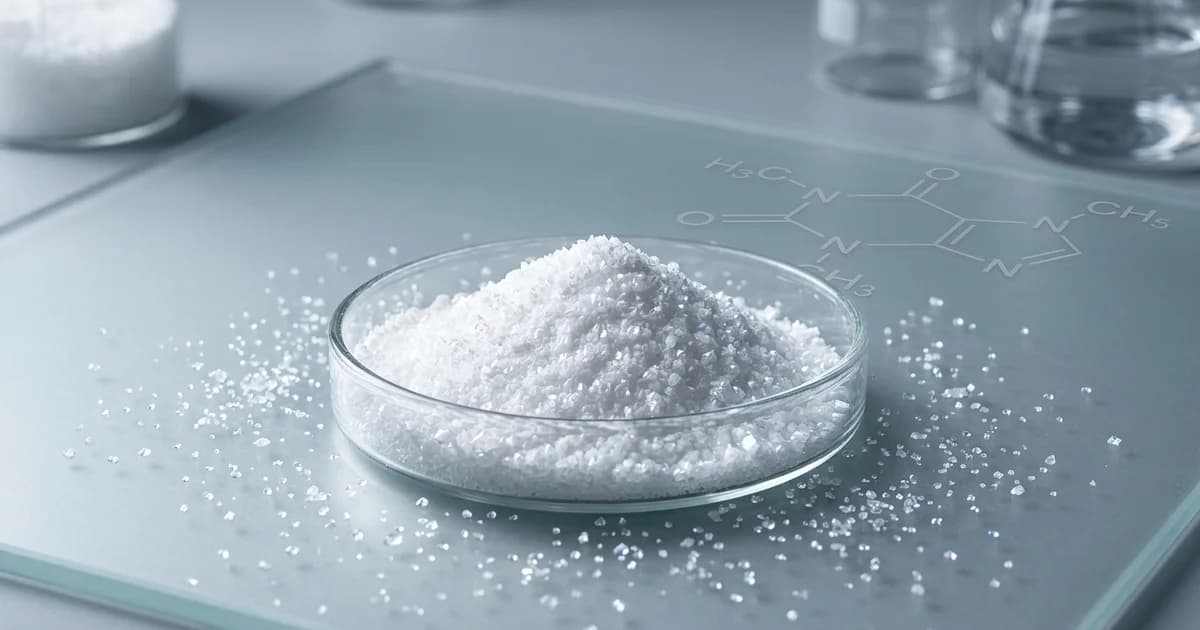
Caffeine anhydrous is dehydrated caffeine, a fine crystalline powder that is close to 100% pure caffeine. The word "anhydrous" comes from Greek and simply means "without water."
Manufacturers extract caffeine from coffee beans or tea leaves, often during decaffeination, then remove the water through drying. What you get is a concentrated white powder. Anhydrous caffeine and regular caffeine are chemically identical molecules; the difference lies in form, concentration, and how the body absorbs them. "Anhydrous" means "without water," referring to a dehydrated, crystalline powder that is nearly 100% pure caffeine.
That purity is the whole point. A formulator who wants exactly 80 mg of caffeine in a product can weigh out 80 mg of powder and trust the number. You cannot do that with brewed coffee, where the caffeine content swings with the bean, the roast, and the grind.
Caffeine Anhydrous vs Caffeine: Same Molecule, Different Package
There is no chemical difference between caffeine anhydrous and the caffeine in coffee. The difference is concentration, consistency, and what comes along for the ride.
Coffee and tea deliver caffeine bound up with water and a long list of plant compounds: chlorogenic acids, polyphenols, and small amounts of other stimulants. Those compounds slow absorption slightly and add their own effects. Anhydrous caffeine strips all of that away and leaves the active molecule.
Because it is dry and concentrated, anhydrous caffeine tends to absorb quickly. Caffeine anhydrous is absorbed faster (peak in 20-30 minutes) and delivers a more intense effect than caffeine consumed through coffee or tea.
Here is the practical contrast.
| Feature | Caffeine Anhydrous | Caffeine in Coffee/Tea |
|---|---|---|
| Chemical identity | Caffeine (1,3,7-trimethylxanthine) | Caffeine (1,3,7-trimethylxanthine) |
| Form | Dry crystalline powder, ~99% pure | Dissolved in water with plant compounds |
| Dose precision | Exact (e.g. 80 mg per serving) | Variable, depends on brew |
| Typical onset | Fast, peak around 20 to 30 min | Slightly slower, blunted by other compounds |
| Other compounds | None | Polyphenols, chlorogenic acids, antioxidants |
| Best for | Supplements, precise dosing | Ritual, flavor, antioxidant intake |
Neither is "better" in a vacuum. If you want antioxidants and a slow morning ritual, brew a pot. If you want a known dose in a small format, anhydrous wins.
Why Anhydrous Is the Default in Supplements
Formulators default to caffeine anhydrous because it offers exact dosing, long shelf stability, and a compact format that fits a capsule, tablet, or pouch.
Think about the alternative. Liquid caffeine takes up volume and can degrade. Coffee extract carries unpredictable amounts of the active compound. Anhydrous powder solves both problems at once. It packs a precise milligram count into a tiny space and stays stable on a shelf for years.
That convenience is also why the global market for it is large. According to Elchemy, the anhydrous caffeine market sat at roughly 2.3 billion USD in 2025.
The same concentration that makes it useful also makes raw powder dangerous to handle at home. The FDA considers bulk powdered and liquid caffeine supplements containing pure or highly concentrated caffeine to be unlawful when sold directly to consumers. Just one teaspoon of pure powdered caffeine can hold about as much caffeine as 28 cups of coffee, well above the lethal threshold. This is the difference between a finished product with a measured dose and a bag of pure powder. The first is routine. The second is a hospital visit waiting to happen.
Caffeine Anhydrous Dosage: How Much Is Reasonable
Most caffeine supplements deliver 100 to 200 mg per serving, and healthy adults can safely consume up to 400 mg of caffeine per day from all sources.
That per-serving range is the industry standard. Most supplements provide between 100 mg and 200 mg of caffeine anhydrous per serving. However, tolerance to caffeine can vary widely depending on body weight, individual sensitivity, and regular caffeine intake.
The 400 mg daily ceiling comes straight from the FDA. According to the FDA, a healthy adult can safely drink 400 mg of caffeine per day, equal to four or five cups of coffee.
A few rules keep you on the right side of that line:
- Count all your sources. Coffee, tea, energy drinks, and a pre-workout all stack on the same daily tally.
- Start low if you are sensitive. Body weight, genetics, and habit all change your response.
- Watch the clock. Caffeine late in the day lingers (more on that below).
- Skip it if you are pregnant, breastfeeding, a teenager, or on medications that interact with stimulants.
That last group should be cautious. Pregnant individuals, breastfeeding women, teenagers, and those on specific medications should avoid caffeine anhydrous due to potential health risks.
Is Caffeine Anhydrous Safe?
In a finished, properly dosed product, caffeine anhydrous is as safe as the caffeine in coffee, because it is the same molecule at the same dose. The risk is not the form. The risk is the amount.
Eighty milligrams of anhydrous caffeine and eighty milligrams from a cup of coffee do the same thing in your body. Problems start when people treat concentrated powder casually and misjudge a dose by a factor of ten. That is exactly why the FDA cracked down on bulk powder sales to consumers.
Common side effects of too much caffeine, from any source, include a racing heart, anxiety, restlessness, and trouble sleeping. The fix is simple: respect the dose and read the label.
Caffeine Anhydrous Half-Life: Why Timing Matters
Caffeine has an average half-life of about 4 to 5 hours, meaning half the dose is still circulating several hours after you take it. Form does not change this. Anhydrous caffeine and coffee caffeine clear at the same rate because your liver handles them identically.
Caffeine has a half-life of approximately four hours, although this timescale may be reduced or extended in certain groups of individuals such as pregnant women, those who smoke and people with impaired liver function. Individual variation is wide. The five-hour half-life is an average, with the actual time for an individual ranging anywhere from 1.5 to 9.5 hours.
What drives that spread is one liver enzyme. Caffeine is primarily metabolised in the liver by cytochrome P450 enzymes, which are responsible for more than 90% of caffeine clearance. The enzyme responsible for metabolism of caffeine is coded for by the gene CYP1A2.
The practical takeaway: a 200 mg dose at 3 p.m. can leave 100 mg in your system at 8 p.m. If your sleep is fragile, that is the culprit. Front-load your caffeine earlier in the day.
The Catch With Capsules: First-Pass Metabolism
Here is the detail most articles skip. When you swallow an anhydrous caffeine capsule, the powder still has to dissolve in your gut, get absorbed through the intestinal wall, and pass through your liver before it reaches your brain. That liver step is called first-pass metabolism, and it shaves off some of the dose and slows the onset.
Caffeine survives this process well, which is part of why it works so reliably. But "well" is not "instant." A swallowed capsule typically takes 30 to 45 minutes to peak.
There is another route. Tissue under the tongue is thin and rich in blood vessels, so compounds placed there can absorb directly into the bloodstream. The sublingual route avoids the "first-pass effect," where drugs are broken down by the stomach and liver before reaching the bloodstream. This allows for greater absorption and is particularly valuable in addiction medicine. The same physiology applies to caffeine: delivered sublingually, it can reach you faster than a swallowed pill.
Conclusion
Caffeine anhydrous is not a stronger or stranger version of caffeine. It is plain caffeine with the water removed, dried into a precise, stable powder that fits neatly into a capsule, tablet, or pouch. That precision is the entire reason it became the industry default.
The molecule is the same everywhere. What actually shapes your experience is the dose, the timing against caffeine's multi-hour half-life, and the route it takes into your body. A swallowed pill detours through your gut and liver. A sublingual format skips that line.
Get those three variables right, and caffeine remains one of the best-studied, most reliable cognitive tools available.
Frequently Asked Questions
What is caffeine anhydrous in simple terms?
It is caffeine with the water removed. Manufacturers extract caffeine from coffee beans or tea leaves, then dry it into a crystalline powder that is roughly 99% pure. It is the same molecule found in your morning coffee, just concentrated and dehydrated so it can be dosed precisely and packed into supplements like capsules, tablets, and pouches.
Is caffeine anhydrous stronger than regular caffeine?
Milligram for milligram, no. Eighty milligrams of caffeine anhydrous and eighty milligrams from coffee have the same effect because they are the same molecule. Anhydrous caffeine can feel stronger because it absorbs slightly faster and is not buffered by the plant compounds in coffee, and because concentrated products can pack a higher dose into one small serving.
What is a safe caffeine anhydrous dosage?
Most supplements use 100 to 200 mg per serving. The FDA considers up to 400 mg of caffeine per day safe for healthy adults, counting every source combined: coffee, tea, energy drinks, and supplements. Your personal tolerance depends on body weight, genetics, and habit, so start lower if you are sensitive or new to it.
Is caffeine anhydrous safe?
In a finished, correctly dosed product, yes. It is identical to coffee caffeine at the same dose. The danger comes from raw, bulk powder, where a tiny measuring error can be life-threatening. That is why the FDA restricts direct-to-consumer sales of pure powdered caffeine. Pregnant or breastfeeding people, teenagers, and those on certain medications should avoid it.
What is the half-life of caffeine anhydrous?
About 4 to 5 hours on average, though it can range from roughly 1.5 to 9.5 hours depending on the person. The form does not change this. Your liver, mainly the CYP1A2 enzyme, processes anhydrous caffeine and coffee caffeine the same way. This is why a late-afternoon dose can still disrupt your sleep that night.
Why do supplements use caffeine anhydrous instead of coffee extract?
Precision and stability. Anhydrous powder lets a formulator put an exact milligram count into each serving, something brewed coffee cannot guarantee. It also stays stable on a shelf for years and takes up almost no space, which makes it ideal for capsules, tablets, and pouches.
Does caffeine anhydrous cause a crash?
Caffeine itself does not guarantee a crash, but a large single dose with nothing to balance it can lead to a sharp drop in alertness as levels fall. Pairing caffeine with L-theanine, an amino acid found in tea, is a common way to smooth the experience and reduce jitters without dulling the focus.
Same Molecule, Better Delivery
If you read this far, you already see the real lesson: caffeine anhydrous is fine, but swallowing it is a compromise. The powder is precise, yet a capsule still routes your dose through your gut and liver first, which slows onset and trims a little off the top.
Roon uses the same caffeine molecule, 80 mg of it, in a sublingual pouch instead of a pill. Held under the lip, it absorbs through the tissue in your mouth, so it can reach you faster than a swallowed capsule and skip first-pass gut metabolism. We pair it with 60 mg L-theanine, 25 mg methylliberine (Dynamine), and 5 mg theacrine (TeaCrine) to smooth the edge and stretch the effect across a 6 to 8 hour window with no jitters and no crash.
Roon is not a replacement for sleep, and it is not a higher dose of caffeine pretending to be magic. It is the same well-studied molecule with a better delivery route and a few partners that round it out. If a swallowed capsule has felt slow or spiky, try Roon and feel the difference the format makes.
Written by Roon Team