MUD WTR vs Magic Mind vs Matcha
Roon Team
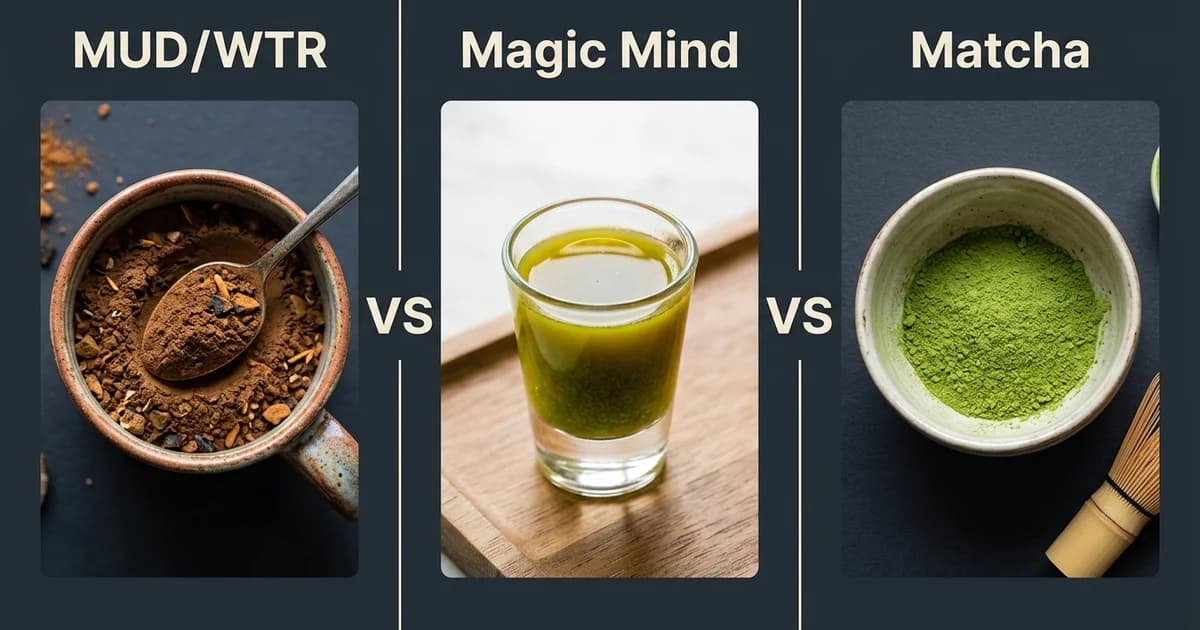
MUD WTR vs Magic Mind vs Matcha: The Best Coffee Alternative for Focus
If you're comparing MUD WTR vs Magic Mind vs matcha, you're probably trying to quit coffee or at least cut back. Either way, you've likely landed on one of these three names. Each promises clean energy without the jitters. Each claims to be the best coffee alternative for focus. And each has a very different approach to getting you there.
But which one actually delivers? And more importantly, which one fits the way you actually work?
This is a head-to-head breakdown of MUD WTR vs Magic Mind vs matcha, covering ingredients, cost, convenience, and real-world performance. No hype. Just what you need to make a decision.
Key Takeaways
- MUD/WTR is a mushroom-based blend with 35mg caffeine from black tea, designed as a ritual replacement for coffee. It requires hot water, stirring, and a frother for best results.
- Magic Mind is a 2oz pre-mixed shot with matcha, adaptogens, and nootropics. It packs more ingredients but costs $2.38 to $5.95 per bottle depending on order size and whether you subscribe.
- Matcha gives you a natural caffeine-plus-L-Theanine combo, but quality varies wildly and preparation takes time.
- All three are liquid-based, require some form of prep or refrigeration, and lack certain extended-release compounds like theacrine and methylliberine. Comparing MUD WTR vs Magic Mind vs matcha reveals shared blind spots worth understanding.
MUD WTR Review: The Mushroom Coffee Alternative
MUD/WTR built its brand on one simple pitch: everything you love about your coffee ritual, minus the caffeine overload. This MUD WTR review starts with the basics. The Original blend contains 35mg of caffeine from organic black tea powder, which is roughly a third of what you'd get from a standard cup of coffee. As a mushroom coffee alternative, it leans heavily on functional fungi rather than stimulants.
What's In It
The formula centers on a four-mushroom blend: Lion's Mane, Chaga, Reishi, and Cordyceps, all cultured on organic oats or sorghum. Alongside the mushrooms, you get organic cacao, turmeric, cinnamon, ginger, cardamom, black pepper, nutmeg, cloves, and Himalayan pink salt. It reads like a spice rack with a neuroscience hobby, according to MUD/WTR's ingredient page.
Lion's Mane is the headliner here for cognitive function. Reishi and Chaga handle immune support and adaptogenic stress response. Cordyceps is included for physical performance and stamina. This mushroom coffee alternative checks a lot of boxes on paper.
How It Works in Practice
You scoop the powder into hot water and stir (or froth, if you want it smooth). Most users add their own creamer or sweetener. The whole process takes 3-5 minutes, which is the point. MUD/WTR markets itself as a morning ritual, not a quick fix.
The focus effects are mild. With only 35mg of caffeine and no concentrated nootropic compounds, any honest MUD WTR review will tell you it's better described as a "coffee replacement" than a "focus enhancer." The mushroom blend may offer long-term adaptogenic benefits with consistent daily use, but you're unlikely to feel a sharp cognitive lift from a single serving. If you're looking for a warm, low-caffeine drink that checks the psychological box of a morning routine, it does that well. If you're looking for the best coffee alternative for focus that noticeably sharpens cognition within 20 minutes, this isn't it.
Pricing
A 30-serving tin runs about $40 on subscription ($1.33/serving). The annual plan drops that to roughly $1.00 per serving. One-time purchases cost more.
Magic Mind Review: The Productivity Shot
Magic Mind takes a different approach entirely. Instead of replacing your coffee ritual, it gives you a 2oz shot packed with 12 active ingredients. This Magic Mind review examines whether the company's claim of 7+ hours of mental clarity and calm energy holds up. In the MUD WTR vs Magic Mind vs matcha comparison, this product sits squarely in the "nootropic stack" category.
What's In It
The formula includes ceremonial-grade matcha (55mg caffeine in the standard version), Lion's Mane, Bacopa Monnieri, Cognizin (citicoline), Ashwagandha, L-Theanine, Rhodiola Rosea, Cordyceps, turmeric, and Vitamins B2, B3, B12, C, and D3. They also offer a caffeine-free version.
On paper, this is the most stacked formula of the three. Bacopa Monnieri has solid research behind it for memory. Cognizin is a branded form of citicoline, which supports acetylcholine production. Rhodiola is a well-studied adaptogen for fatigue resistance.
The catch? According to an Innerbody review, some of these ingredients may be dosed lower than the amounts shown to be effective in clinical studies. That's a common issue with proprietary blends that pack many ingredients into a small serving size, and it's a point any thorough Magic Mind review should raise.
How It Works in Practice
You drink the 2oz shot in the morning, either on its own or alongside your existing coffee. The taste leans minty and fruity with a matcha backbone. Most reviewers report noticeable focus within 30-60 minutes.
A WellnessVerge review noted that sustained energy and increased focus kicked in around the third day of daily use, lasting about 2 hours per session. That's a slower build than you might expect from a product marketed for immediate performance. Magic Mind seems designed to compound over time, with adaptogens like Ashwagandha and Rhodiola building cumulative effects. The first-day experience is unlikely to blow your mind.
The convenience factor is real, though. No mixing. No frother. You crack open a bottle and drink it. In the MUD WTR vs Magic Mind vs matcha lineup, that puts Magic Mind ahead for people who don't want to play barista before their first meeting.
Pricing
Magic Mind runs $4.95 per bottle on a 30-bottle one-time order and $2.48 per bottle on the same order subscribed. Subscription plans bring the cost down, and they periodically run promotions (like a "third month free" on quarterly subscriptions). Even so, daily use is $148.50 a month one-time or $74.25 a month subscribed, which still makes it the most expensive option in this comparison.
Matcha: The OG Clean Caffeine
Matcha doesn't need a marketing team. It's been a staple of Japanese tea culture for centuries, and its cognitive benefits come down to one elegant pairing: caffeine plus L-Theanine. In the MUD WTR vs Magic Mind vs matcha debate, matcha is the simplest option by far.
What's In It
Matcha vs coffee caffeine levels tell an interesting story: a standard serving of ceremonial-grade matcha contains roughly 60-70mg of caffeine alongside a meaningful dose of L-Theanine, the amino acid responsible for that "calm focus" feeling. A study published in PubMed found that 97mg of L-Theanine combined with 40mg of caffeine helped participants focus attention during demanding cognitive tasks.
Matcha also delivers catechins (powerful antioxidants), chlorophyll, and trace vitamins. Research published in PMC has examined matcha's stress-reducing effects, finding that its high theanine content plays a direct role, though caffeine can partially counteract that benefit depending on the ratio.
How It Works in Practice
You whisk matcha powder into hot (not boiling) water, or shake it into a cold drink. The process takes 2-3 minutes if you're doing it properly. Cheap matcha tastes bitter and chalky. Good ceremonial-grade matcha tastes smooth and slightly sweet. The gap between a $15 tin from the grocery store and a $35 tin from a specialty importer is enormous.
The focus effect is real but moderate. In any coffee vs matcha for focus comparison, matcha delivers a clean lift without the spike-and-crash pattern of coffee. Most people describe it as "alert but calm", a contrast at the heart of the matcha vs coffee benefits debate, explained by L-Theanine doing its job. The effect typically lasts 2-3 hours before tapering off gently. For anyone weighing MUD WTR vs Magic Mind vs matcha purely on focus duration, matcha edges ahead slightly.
Matcha's biggest advantage is simplicity. One ingredient. Two active compounds. No proprietary blend, no mystery dosing. You know exactly what you're getting. Its biggest disadvantage is variability. Two different matcha brands can deliver wildly different amounts of L-Theanine and caffeine, a core issue in the matcha vs mushroom coffee debate that makes your Tuesday focus session feel nothing like your Thursday one.
Pricing
Ceremonial-grade matcha ranges from $0.75 to $2.00+ per serving, depending on quality and source. Culinary-grade matcha is cheaper but lower in L-Theanine. You generally get what you pay for.
MUD WTR vs Magic Mind vs Matcha: Side-by-Side Comparison
| Feature | MUD/WTR (Original) | Magic Mind | Matcha (Ceremonial) |
|---|---|---|---|
| Caffeine | 35mg (black tea) | 55mg (matcha) | 60-70mg |
| L-Theanine | Minimal (trace from tea) | Yes (added) | Yes (natural) |
| Mushrooms | Lion's Mane, Chaga, Reishi, Cordyceps | Lion's Mane, Cordyceps | None |
| Adaptogens | Reishi, Turmeric | Ashwagandha, Rhodiola, Turmeric | None |
| Nootropics | None specifically | Bacopa, Cognizin (Citicoline) | None specifically |
| Theacrine | No | No | No |
| Methylliberine | No | No | No |
| Prep Required | Hot water + frother | None (pre-mixed shot) | Hot water + whisk |
| Portable | No (powder + water needed) | Partially (requires refrigeration) | No (powder + water needed) |
| Cost/Serving | ~$1.00-$1.33 | $2.38-$5.95 | ~$0.75-$2.00 |
| Focus Duration | 1-2 hours | ~2 hours (per review data) | 2-3 hours |
What's Missing From MUD WTR vs Magic Mind vs Matcha
Here's where the comparison gets interesting. Each of these products does something well. But looking at MUD WTR vs Magic Mind vs matcha together, they all share the same blind spots.
No Extended-Release Energy Compounds
Caffeine works. Everyone knows that. But caffeine alone has a well-documented tolerance curve. The more you use it, the more you need. None of these three products contain theacrine or methylliberine, two purine alkaloids that work through similar pathways as caffeine but with distinct advantages.
Research published in Scientific Reports found that theacrine improved sustained attention on psychomotor vigilance tasks. A study in PMC noted that theacrine shows "non-habituating effects," meaning your body doesn't build tolerance the way it does with caffeine. And a separate PMC study on methylliberine found it improved mood, energy, and motivation, with a positive impact on sustained energy.
When you combine caffeine with theacrine and methylliberine, you get a longer, smoother energy curve without the diminishing returns. No mushroom coffee alternative in this comparison offers that combination.
The Portability Problem
MUD/WTR requires hot water, a mug, and ideally a frother. Matcha needs hot water and a whisk (or at least a shaker bottle). Magic Mind is the most convenient of the three as a pre-mixed shot, but it still requires refrigeration and you're carrying a glass bottle.
None of them are truly on-demand. If you're in a meeting, on a plane, or just don't have access to a kitchen, you're out of luck. The best coffee alternative for focus should work anywhere, not just in your kitchen.
Dosing Consistency
Matcha's L-Theanine content varies based on grade, origin, and preparation method. MUD/WTR doesn't disclose individual mushroom dosages. Magic Mind packs 12 ingredients into a 2oz shot, which raises questions about whether each ingredient hits its clinically effective dose. When you're relying on a product for daily cognitive performance, inconsistent or sub-clinical dosing is a real problem. Across MUD WTR vs Magic Mind vs matcha, none fully solve this issue.
Duration Gaps
Even the best-case scenario here gives you 2-3 hours of noticeable focus. That's fine for a morning boost. It's not enough for a full workday. The absence of extended-duration compounds like theacrine (which has a longer half-life than caffeine) means these products are front-loaded. You get a lift, then it fades.
The typical response? Take another serving. Which means more caffeine, more cost, and for MUD/WTR and matcha, another trip to the kitchen. That's not a focus system. That's a cycle.
The Tolerance Treadmill
This is the one almost nobody talks about. Caffeine tolerance builds fast. Within a week or two of daily use, the same dose produces a weaker response. Your body adapts. You need more to feel the same thing.
All three products in this MUD WTR vs Magic Mind vs matcha comparison rely on caffeine as their primary stimulant. None of them include compounds specifically chosen to resist tolerance buildup. That means the "clean energy" you felt in week one may feel like nothing by week six, unless you keep increasing your intake or cycling off entirely.
A Different Approach: Why Roon Was Built for the Gaps in MUD WTR vs Magic Mind vs Matcha
Every product above was designed to answer the question: "What do I drink instead of coffee?" Roon was designed to answer a different question: "How do I stay focused for 6-8 hours without planning my day around a beverage?"
Roon's nootropic pouches are zero-nicotine sublingual pouches containing 80mg of caffeine, L-Theanine, theacrine, and methylliberine. That's four compounds working together: caffeine for the initial lift, L-Theanine to smooth out the edges, theacrine for sustained attention without tolerance buildup, and methylliberine for extended energy and mood support.
It's not a drink. There's no mixing, no brewing, no refrigeration. You place the pouch under your lip, and the active ingredients absorb through the sublingual membrane. It fits in your pocket. You can use it in a meeting, on a flight, or at your desk without anyone noticing.
The combination of theacrine and methylliberine is what separates Roon from the three products in this MUD WTR vs Magic Mind vs matcha breakdown. Research supports theacrine's non-habituating properties, which means you don't need to keep increasing your dose to get the same effect. And because sublingual delivery bypasses the digestive system, absorption is faster and more consistent than drinking a powder mixed into water.
Roon isn't trying to replace your morning ritual. If you love making matcha or sipping a mushroom coffee alternative like MUD/WTR, keep doing that. But when you need 6-8 hours of sustained focus and you need it now, without a kitchen, a bottle, or a plan, that's what Roon was built for. For anyone who's compared MUD WTR vs Magic Mind vs matcha and still feels like something's missing, Roon fills the gap.
Focus that fits in your pocket. Try Roon here.