Coffee vs. Matcha: A Head-to-Head Comparison for Focus, Energy, and Health
Roon Team
Coffee vs. Matcha: A Head-to-Head Comparison for Focus, Energy, and Health
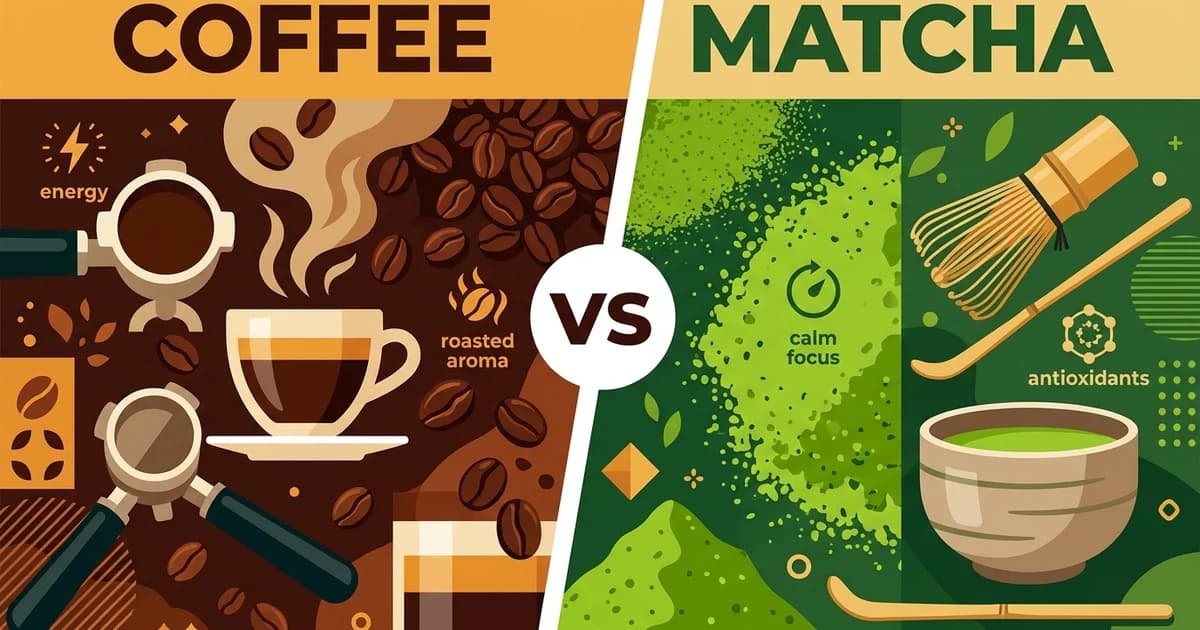
Two-thirds of American adults drink coffee every single day. But a growing number of them are eyeing the bright green cup next door. The coffee vs matcha debate has moved from niche wellness circles to mainstream conversation, and for good reason: the global matcha market is projected to nearly double by 2035, fueled by people who want their caffeine without the jitters.
So in the coffee vs matcha showdown, which one actually performs better for your brain, your body, and your afternoon? Here's what the science says.
Key Takeaways
- Coffee delivers more caffeine per cup (80–200 mg) than matcha (40–80 mg), but more isn't always better.
- Matcha contains L-theanine, an amino acid that promotes calm focus and smooths out caffeine's rough edges.
- Both drinks are loaded with antioxidants, but matcha's EGCG catechins and coffee's chlorogenic acids serve different functions.
- The "best" choice in the coffee vs matcha debate depends on what you're optimizing for: raw alertness, sustained focus, or long-term health markers.
How Much Caffeine Does Matcha Have vs. Coffee?
This is the first question everyone asks about coffee vs matcha, and the answer is straightforward.
A standard 8-ounce cup of brewed coffee contains roughly 95–200 mg of caffeine, depending on the beans and brewing method. A typical cup of matcha, made with 2 grams of powder, lands between 40–80 mg of caffeine. So does matcha have caffeine vs coffee? Absolutely, but at about half the dose, sometimes less.
But caffeine content alone doesn't tell you how a drink feels.
| Factor | Coffee (8 oz) | Matcha (8 oz) |
|---|---|---|
| Caffeine | 95–200 mg | 40–80 mg |
| L-Theanine | Trace amounts | 24–39 mg |
| Peak energy | 30–45 min | 45–60 min |
| Energy duration | 2–3 hours | 4–6 hours |
| Crash likelihood | Moderate to high | Low |
Coffee hits faster and harder. Matcha comes on slower and lasts longer. That difference, central to the coffee vs matcha comparison, comes down to one compound: L-theanine.
Matcha Benefits vs. Coffee: The L-Theanine Factor
The matcha tea vs coffee caffeine question isn't just a numbers game. The real story is how each drink delivers its caffeine to your brain.
Matcha is one of the richest natural sources of L-theanine, an amino acid that increases alpha brain wave activity, the frequency band associated with relaxed alertness. Think of the mental state you hit during a good flow session: focused but not tense. That's alpha-wave territory.
When L-theanine pairs with caffeine, something interesting happens. A study published in Nutritional Neuroscience found that combining 97 mg of L-theanine with 40 mg of caffeine improved cognitive performance and subjective alertness compared to placebo. A separate study from the same journal showed the combination improved both speed and accuracy on attention-switching tasks while reducing susceptibility to distracting information.
Coffee doesn't offer this pairing. You get the caffeine, but without L-theanine's moderating effect, the stimulation tends to be sharper and shorter. That's why a double espresso can leave you wired for 90 minutes and then flat on the couch. This L-theanine advantage is one of the clearest matcha benefits vs coffee.
This matters if your work requires sustained attention, not just a burst of alertness. Writing a brief, debugging code, preparing for a presentation: these tasks take hours, not minutes. In the coffee vs matcha comparison, a caffeine source that keeps you locked in for the full duration beats one that peaks fast and fades.
The Cortisol Problem
There's another wrinkle in the coffee vs matcha discussion. A review presented at the 2025 European Society of Endocrinology congress analyzed 15 studies and found that coffee, with its typical 80–120 mg caffeine per cup, caused the strongest cortisol increase of any caffeinated beverage, up to 50% above baseline. Cortisol is your primary stress hormone. Spiking it repeatedly throughout the day isn't ideal for anyone trying to stay calm and productive.
Matcha still contains caffeine, so it's not cortisol-neutral. But its lower caffeine dose combined with L-theanine's calming properties creates a smoother hormonal response, another key matcha benefit vs coffee.
Does Matcha Have Caffeine vs. Coffee? Yes, and That's the Point
Some people frame this question as though matcha's lower caffeine count is a weakness. It's not. Understanding does matcha have caffeine vs coffee helps explain why less can actually mean more.
For most cognitive tasks, you don't need 200 mg of caffeine. You need the right combination of stimulation and focus. The National Coffee Association's 2025 report shows the average American coffee drinker consumes 3 cups per day. That's roughly 300–600 mg of caffeine, often because the first cup's effects wear off and the crash demands another.
Matcha's gentler caffeine curve means fewer re-doses. One cup in the morning can carry you through to lunch without the 10:30 AM slump that sends most coffee drinkers back to the pot. That's a practical edge in the coffee vs matcha matchup that often gets overlooked.
Caffeine has a half-life of roughly 5 to 6 hours, meaning half of your morning dose is still circulating by early afternoon. With coffee's higher starting dose, that residual caffeine can interfere with sleep architecture later that night, creating a cycle: poor sleep, more coffee, worse sleep. The matcha tea vs coffee caffeine difference matters here, since matcha's lower starting dose leaves less residual stimulation by bedtime.
The Antioxidant Matchup: Coffee vs Matcha
Both drinks are rich in protective compounds, but the types differ.
Matcha is packed with EGCG (epigallocatechin gallate), a catechin that has been studied for its role in neuroprotection and metabolic health. According to Harvard Health, catechins found in green tea help lower blood pressure and LDL cholesterol levels. One comparison from Japan Heartful Store puts matcha's ORAC (antioxidant capacity) value at 1,384 units per gram versus coffee's 200–550 units per gram.
Coffee brings its own arsenal: chlorogenic acids, which have been linked to improved insulin sensitivity and cardiovascular protection. Coffee isn't unhealthy. It's just a different antioxidant profile. The matcha benefits vs coffee in this category come down to density and type.
| Antioxidant Type | Matcha | Coffee |
|---|---|---|
| Primary compounds | EGCG, catechins | Chlorogenic acids |
| ORAC value (per gram) | ~1,384 | 200–550 |
| Key studied benefits | Neuroprotection, LDL reduction | Insulin sensitivity, cardiovascular health |
If you're choosing based purely on antioxidant density, matcha wins by a wide margin. But both drinks contribute meaningfully to your daily polyphenol intake, and most nutritionists would tell you that drinking either one regularly is better than drinking neither.
The practical takeaway: if you already drink coffee and enjoy it, you're still getting solid antioxidant coverage. But if you're looking to maximize protective compounds per serving, matcha delivers more per gram.
Coffee vs Matcha: Who Wins?
There's no universal winner in the coffee vs matcha debate. There's only the right tool for the right situation.
Choose coffee if:
- You need a fast, strong jolt before a workout or early-morning deadline.
- You enjoy the ritual and flavor and can limit yourself to 1–2 cups.
- You metabolize caffeine quickly (a genetic trait tied to the CYP1A2 gene).
Choose matcha if:
- You want sustained focus over 4–6 hours without a crash.
- You're sensitive to caffeine's anxiogenic effects (jitters, racing heart).
- You prefer a lower-dose, L-theanine-buffered caffeine experience.
Choose neither if:
- You want the cognitive benefits of caffeine and L-theanine without brewing anything at all.
- You're tired of timing your caffeine around meetings, commutes, and bathroom breaks.
Beyond the Cup: A Third Option Worth Considering
The coffee vs matcha debate assumes your only delivery method is a hot beverage, but coffee alternative drinks for focus like MUD WTR, Magic Mind, and matcha have expanded those options considerably. But the compounds that make these drinks effective, caffeine and L-theanine, don't require a cup.
Roon is a zero-nicotine sublingual pouch built around the same caffeine + L-theanine pairing that gives matcha its edge, plus two additional compounds: theacrine and methylliberine. A study published in the Journal of the International Society of Sports Nutrition found that this specific combination of caffeine, theacrine, and methylliberine improved cognitive performance and reaction time without increasing anxiety.
Each Roon pouch delivers 80 mg of caffeine (comparable to a cup of coffee), paired with L-theanine for smooth focus and theacrine plus methylliberine for sustained energy without tolerance buildup. No brewing. No crash. No stained teeth.
If you've been bouncing between coffee and matcha trying to find the right balance of energy and calm, see how Roon compares.