Matcha vs. Coffee Benefits: A Head-to-Head Comparison
Matcha vs. Coffee Benefits: A Head-to-Head Comparison
You're standing in line at a café, staring at the menu, and the same question hits you again: matcha or coffee? Both promise energy, both have loyal followings, and the matcha vs coffee benefits debate goes deeper than taste preference, just as the matcha vs mushroom coffee conversation does. It comes down to how each drink actually affects your brain, your body, and the quality of your focus over the next several hours.
This isn't about picking a winner for everyone. It's about picking the right tool for you.
Key Takeaways:
- Coffee delivers more caffeine per cup, but matcha provides a smoother, longer-lasting energy curve.
- Matcha contains L-theanine, an amino acid that promotes calm focus and reduces the jittery side effects of caffeine.
- Coffee raises cortisol levels more than tea, which can amplify stress during demanding workdays.
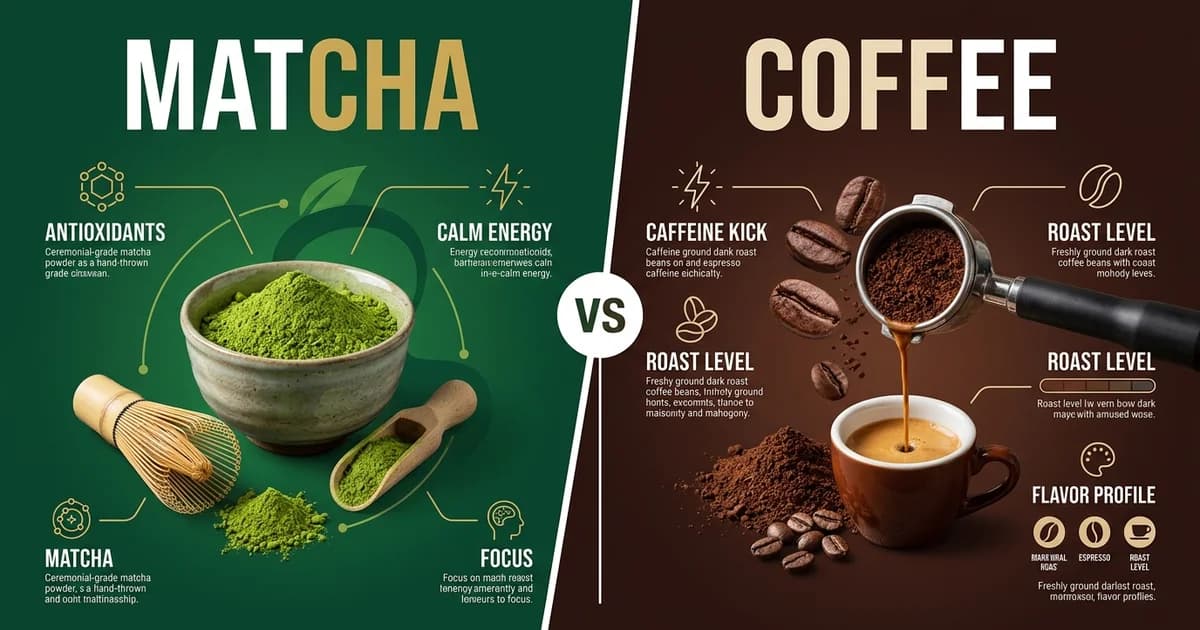
- Comparing matcha vs coffee benefits reveals that both drinks are rich in antioxidants, but they work through different compounds.
- A third option exists: nootropic stacks that combine the best of both worlds without the drawbacks.
Caffeine Content: The Numbers Behind Matcha vs Coffee Benefits
Let's start with what most people care about: the caffeine.
A standard 8-ounce cup of drip coffee contains roughly 95 to 200mg of caffeine, depending on the bean and brew method. A cup of matcha, prepared with about 2 grams of powder, delivers approximately 64mg of caffeine, according to Matcha Direct. That's less than coffee, but not by as much as most people assume.
The real difference in matcha vs coffee benefits isn't the amount. It's the delivery.
Coffee caffeine hits fast. You feel it within 15 to 30 minutes, peaking around the 60-minute mark. That rapid spike is what gives coffee its reputation for quick energy, but it's also what causes the familiar crash 3 to 4 hours later. As Teasenz notes, this quick release often leads to jitters followed by an energy crash.
Matcha works differently. The caffeine in matcha is bound to polyphenols, which slows its absorption into the bloodstream. The result is a gentler rise, a longer plateau, and a softer decline. No spike. No crash. This difference in energy curves is one of the most important matcha vs coffee benefits to understand.
The L-Theanine Advantage: Why Matcha vs Coffee Benefits Favor Calm Focus
Here's where matcha pulls ahead for cognitive performance.
Matcha contains L-theanine, an amino acid found almost exclusively in tea plants. Coffee doesn't have it. And this single compound changes the entire experience of consuming caffeine, making it central to the matcha vs coffee benefits discussion.
L-theanine promotes alpha brain wave activity, the same brain state associated with relaxed focus and creative thinking. A randomized, triple-blind, placebo-controlled study published on PubMed found that a single 200mg dose of L-theanine increased frontal region alpha power compared to placebo. The researchers described these changes as "indicative of relaxation in the brain."
An earlier study, also indexed on PubMed, confirmed that L-theanine produced a greater increase in alpha activity compared to placebo, even during passive tasks.
What does this mean in practice? When you drink matcha, the L-theanine and caffeine work together. The caffeine sharpens your attention. The L-theanine smooths out the rough edges, reducing anxiety and jitteriness. You get alert without getting wired.
Coffee gives you a hammer. Matcha gives you a scalpel.
Cortisol and Stress: Coffee's Hidden Cost
Caffeine doesn't just wake you up. It activates your stress axis. This is one of the less obvious matcha vs coffee benefits that deserves attention.
A study available through PMC, found that caffeine increases cortisol secretion in people at rest and under mental stress. Even daily coffee drinkers don't fully develop tolerance to this effect. The cortisol response is reduced with habitual use, but it's never eliminated.
A comparative review presented at the 2025 ESPE/ESE Joint Congress examined cortisol responses across different caffeinated beverages. Coffee, with its higher caffeine load, produced the largest cortisol spikes. Tea showed a milder cortisol increase of about 20%, with the researchers noting that L-theanine moderated the stress response.
If you're already stressed (and who isn't during a packed workday), adding a cortisol spike on top of that isn't ideal. Matcha's combination of moderate caffeine and L-theanine offers stimulation without pouring fuel on the stress fire. For anyone weighing matcha vs coffee benefits through the lens of stress management, matcha has a clear edge.
Antioxidants: A Different Kind of Matcha vs Coffee Benefit
Both matcha and coffee are loaded with antioxidants, but they deliver different types.
Coffee is rich in chlorogenic acids, a group of polyphenols with anti-inflammatory properties. These compounds have been linked to cardiovascular and metabolic health in large observational studies. Coffee is, for many people, the single largest source of antioxidants in their diet.
Matcha brings a different arsenal. Its primary antioxidant is EGCG (epigallocatechin gallate), the most potent catechin found in green tea. A review published in PMC describes matcha as the best condensed source of EGCG among green teas, with high antioxidant and anti-inflammatory potential. Because you consume the whole leaf when you drink matcha (rather than brewing and discarding it), you get the full spectrum of these compounds.
When evaluating matcha vs coffee benefits on the antioxidant front, neither drink is clearly superior; they simply protect your body through different mechanisms.
| Category | Coffee | Matcha |
|---|---|---|
| Caffeine per cup | 95–200mg | ~64mg |
| Primary antioxidant | Chlorogenic acids | EGCG (catechins) |
| L-theanine | None | Yes (natural) |
| Energy curve | Sharp spike, crash at 3–4 hrs | Gradual rise, sustained 4–6 hrs |
| Cortisol impact | Higher spike | Moderated by L-theanine |
| Preparation | Brewed (filtered) | Whole leaf (whisked powder) |
Where Coffee Still Wins
Let's be fair. Coffee has real advantages, and any honest look at matcha vs coffee benefits has to acknowledge them.
Speed. When you need to go from groggy to functional in 20 minutes, coffee is hard to beat. The rapid caffeine absorption is a feature, not a bug, if you need immediate alertness.
Taste and variety. The world of coffee is vast. Espresso, pour-over, cold brew, French press. Each method produces a different flavor profile and caffeine concentration. Matcha, by comparison, has a narrower range. You either like the earthy, slightly sweet flavor or you don't.
Social infrastructure. Coffee shops are everywhere. Coffee culture is deeply embedded in work life. Ordering a matcha latte is easy enough, but coffee remains the default social lubricant of professional life.
Research depth. Coffee has been studied for decades across massive populations. The evidence linking moderate coffee consumption (3 to 5 cups per day) to lower risks of certain diseases is strong and well-replicated. On the research side of matcha vs coffee benefits, coffee simply has a larger body of evidence.
Where Matcha Wins
Matcha's advantages center on the quality of the energy it provides. These are the matcha vs coffee benefits that matter most for sustained performance.
Sustained focus. The caffeine-plus-L-theanine combination produces a longer, smoother cognitive boost. If your work requires deep concentration over several hours, matcha is the better fit.
Lower anxiety. If you're sensitive to caffeine or prone to anxiety, matcha's L-theanine content acts as a natural buffer. You get the alertness without the racing heart.
Antioxidant density. Gram for gram, matcha delivers more catechins than any other green tea because you're consuming the whole leaf. The PMC review highlights matcha's high concentration of catechins as a key differentiator.
Gentler on the stomach. Coffee's acidity bothers some people, especially on an empty stomach. Matcha is less acidic and generally easier to tolerate.
Beyond the Binary: What If You Want the Best Matcha vs Coffee Benefits Combined?
The matcha vs coffee benefits debate assumes you have to pick one, but coffee alternatives for focus like MUD WTR and Magic Mind show the options extend further. But the real question is: what combination of compounds gives you the best cognitive performance with the fewest side effects?
That's the thinking behind modern nootropic stacks. Instead of relying on a single source of caffeine and hoping for the best, you can use a formula that pairs a controlled dose of caffeine with complementary compounds like L-theanine, theacrine, and methylliberine.
Theacrine is structurally similar to caffeine but doesn't produce the same tolerance buildup. Methylliberine acts faster than caffeine but clears the system quickly, filling the gap before other compounds kick in. Together with L-theanine, these ingredients create a smoother, longer-lasting focus window.
That's exactly what Roon is built around. Roon's zero-nicotine focus pouches are sublingual pouches containing 80mg of caffeine, L-theanine, theacrine, and methylliberine. No brewing. No crash. No jitters. Just 6 to 8 hours of clean, sustained focus.
If you've been weighing matcha vs coffee benefits trying to find the right energy profile, it might be worth looking at the problem differently. See how Roon compares.