Matcha vs. Mushroom Coffee: A Head-to-Head Comparison
Roon Team
Matcha vs. Mushroom Coffee: A Head-to-Head Comparison
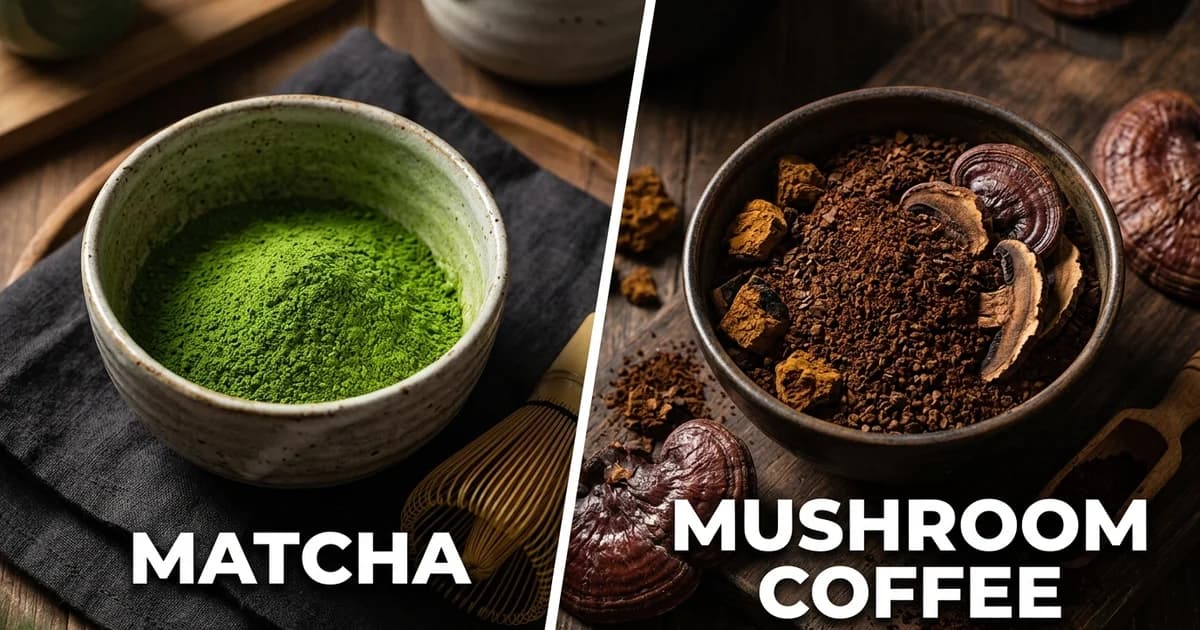
Two drinks dominate the "healthy best coffee alternatives" conversation right now: matcha and mushroom coffee. The matcha vs mushroom coffee debate is one of the most common questions among people looking for cleaner energy, better focus, and fewer side effects than standard drip. But comparing matcha vs mushroom coffee isn't as straightforward as picking the trendier option. They work through completely different mechanisms, contain different active compounds, and suit different people.
Here's what the science actually says about each one, and which might be the better fit for your brain.
Key Takeaways
- Matcha delivers caffeine paired with L-theanine, producing calm, sustained alertness without the typical coffee crash.
- Mushroom coffee combines reduced caffeine with adaptogenic mushroom extracts like lion's mane and chaga.
- In the matcha vs mushroom coffee comparison, matcha has stronger clinical backing for acute cognitive performance. Mushroom coffee's nootropic benefits are promising but less proven in humans.
- Brands like RYZE sell both mushroom coffee and mushroom matcha, blurring the line between the two categories.
- A third option, the nootropic pouch, skips the beverage format entirely.
What's Actually in Each Drink?
Matcha
Matcha is shade-grown green tea ground into a fine powder. You consume the entire leaf, which means you get a concentrated dose of its active compounds: caffeine, L-theanine, and catechins (especially EGCG).
A typical serving contains 38 to 176 mg of caffeine depending on how much powder you use (usually 1 to 4 grams). The L-theanine content is what separates matcha from a shot of espresso. L-theanine is an amino acid that promotes alpha brain wave activity, which is associated with a state of relaxed focus.
A systematic review published in PMC found that the combination of caffeine and L-theanine improved attention and work performance under psychological stress compared to caffeine alone. That's the core appeal of matcha in the matcha vs mushroom coffee discussion, and it mirrors what makes the matcha vs coffee benefits comparison so popular: energy without the edge.
Mushroom Coffee
Mushroom coffee is regular coffee blended with powdered extracts from functional mushrooms. The most common varieties include lion's mane, chaga, reishi, cordyceps, and turkey tail. The coffee base is typically reduced in caffeine (around 48 to 80 mg per serving, roughly half a standard cup).
The star ingredient for cognitive performance is lion's mane. It contains compounds called hericenones and erinacines that promote nerve growth factor (NGF) synthesis in the brain. A 2023 pilot study in PMC examined lion's mane supplementation in young adults and found improvements in cognitive function and stress response. But here's the catch: most lion's mane research uses isolated, high-dose extracts. The amount you get in a scoop of mushroom coffee is usually lower than what's used in clinical trials. This dosing gap matters for anyone weighing mushroom coffee vs matcha for real-world cognitive gains.
Matcha vs Mushroom Coffee: The Full Breakdown
| Category | Matcha | Mushroom Coffee |
|---|---|---|
| Primary stimulant | Caffeine (38–176 mg) | Caffeine (48–80 mg) |
| Key nootropic compound | L-theanine | Lion's mane extract |
| Mechanism | Alpha wave promotion, smooth caffeine release | NGF synthesis, adaptogenic support |
| Onset time | 15–30 minutes | 15–30 minutes |
| Duration | 3–5 hours | 2–4 hours |
| Crash potential | Low (L-theanine buffers caffeine) | Low to moderate |
| Taste | Earthy, vegetal, slightly sweet | Coffee-like, slightly earthy |
| Prep time | 2–3 minutes (whisk or shake) | 1–2 minutes (stir into hot water) |
| Price per serving | $1–3 (ceremonial grade) | $1.50–2.50 (branded blends) |
Cognitive Performance
In the matcha vs mushroom coffee matchup, matcha wins on immediate, measurable focus. The caffeine-plus-L-theanine stack is one of the most studied nootropic combinations in existence. Research from Nature confirms that matcha improved attention under stress better than caffeine alone. You feel it within 20 minutes, and it lasts.
Mushroom coffee's cognitive angle relies heavily on lion's mane. The science is genuinely interesting. A review on Healthline notes that older adults with mild Alzheimer's symptoms showed improved cognitive function after taking lion's mane capsules daily for 49 weeks. But that study used 1,050 mg of lion's mane daily in capsule form. Most mushroom coffee blends don't disclose their exact lion's mane dosage, and it's almost certainly less than clinical trial amounts. This is a key factor in the mushroom coffee vs matcha debate.
Energy Quality
If you're comparing the subjective "feel" of each drink in the matcha vs mushroom coffee equation, matcha tends to deliver smoother energy. The L-theanine takes the sharp edges off caffeine, reducing jitters and the afternoon crash that follows a regular coffee spike. Mushroom coffee achieves something similar by simply using less caffeine and adding adaptogens like reishi that may support stress resilience.
The difference: matcha's calming mechanism is well-documented at the neurochemical level. Mushroom coffee's calming effect is more about caffeine reduction than active modulation. For people who prioritize evidence-backed focus, this distinction tips the matcha vs mushroom coffee scale toward matcha.
Tolerance and Long-Term Use
Both drinks contain caffeine, which means both carry the risk of tolerance buildup over time. Your body adapts to caffeine. After a few weeks of daily use, you need more to get the same effect. Matcha's higher caffeine ceiling makes this more relevant for heavy matcha drinkers.
Mushroom coffee brands often claim their adaptogens help offset tolerance, but there's limited clinical evidence for that specific claim in humans. Tolerance is a factor worth considering no matter where you land on the matcha vs mushroom coffee question.
RYZE Matcha vs RYZE Coffee: Same Brand, Different Drinks
RYZE is one of the few brands selling both a mushroom coffee and a mushroom matcha blend, which makes the ryze matcha vs ryze coffee comparison a natural one. Both products use a similar mushroom blend (lion's mane, chaga, reishi, cordyceps, turkey tail, and king trumpet). The difference is the base: organic coffee in one, organic matcha in the other.
If you're comparing ryze mushroom coffee vs matcha (their matcha product), you're essentially choosing between a coffee-flavored and a matcha-flavored delivery system for the same mushroom stack. The matcha version adds the L-theanine benefit. The coffee version has a more familiar taste for people transitioning off regular coffee.
The ryze matcha vs ryze coffee question comes down to whether you want the L-theanine buffer or the coffee flavor. For pure cognitive performance, the matcha version has a slight edge because of that amino acid pairing. Even within a single brand, the broader matcha vs mushroom coffee tradeoffs still apply.
The Downsides Nobody Talks About
Both options require preparation. You need hot water, a mug, and a few minutes. That's fine at home. It's less convenient at your desk during a meeting, on a commute, or mid-afternoon when you need a second wind.
Both are also drinks, which means variable absorption. How much you ate beforehand, how quickly you drink it, your individual metabolism: all of these affect how fast and how strongly you feel the effects.
And both still rely on caffeine as the primary driver. Whether you choose matcha or mushroom coffee, the mushrooms and the L-theanine are supporting actors. Caffeine is still running the show.
A Third Option Beyond Matcha vs Mushroom Coffee
The matcha vs mushroom coffee debate assumes you have to drink your focus. You don't.
Roon is a sublingual pouch built around a different model entirely. It combines 80 mg of caffeine with L-theanine, theacrine, and methylliberine, four compounds that work together to deliver 6 to 8 hours of sustained focus. No jitters, no crash, no tolerance buildup from the theacrine and methylliberine.
Roon's nootropic pouches are zero-nicotine, require no prep, and absorb through the lining of your mouth, which means faster onset and more consistent delivery than anything you'd sip from a cup.
If you've been going back and forth on the matcha vs mushroom coffee question trying to find the right cognitive edge, it might be worth looking at something that isn't a beverage at all. See how Roon compares.