Caffeine Pills vs Coffee vs Pouches: Speed, Dose and Cost
Roon Team
Caffeine Pills vs Coffee vs Pouches: Speed, Dose and Cost
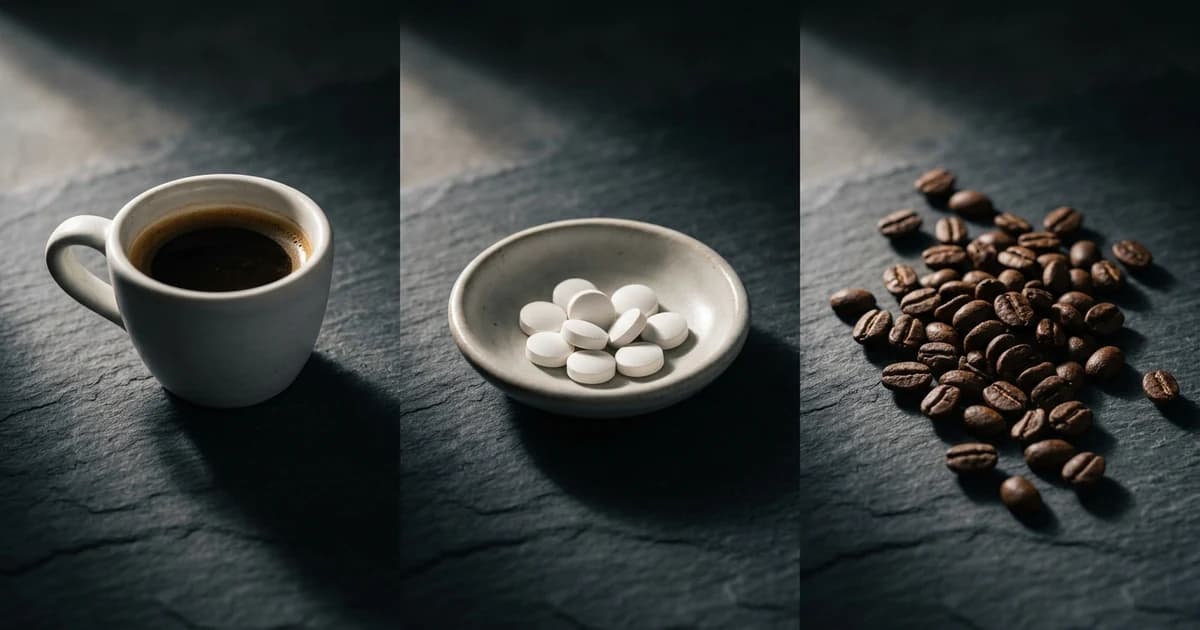
Caffeine pills win on price and precision: a 200 mg tablet costs pennies and doses exactly. Coffee wins on speed in head-to-head studies and brings a ritual most people are unwilling to give up. Pouches skip the drink and the pill, sitting in your lip instead, but cost more per milligram. Same molecule in every case, same daily ceiling: 400 mg for most healthy adults per the FDA. The difference is the delivery.
Key Takeaways
- Cheapest per milligram: Caffeine pills, by a wide margin (about $0.06 to $0.12 per 100 mg for NoDoz).
- Fastest measured onset: Brewed coffee peaked at 42 minutes vs. 67 minutes for capsules in a controlled trial.
- Most portable, no-drink option: Pouches. They cost more per milligram, but there is nothing to brew, swallow, or carry.
- Performance effect: Identical at equal doses. Caffeine from coffee and caffeine from a capsule improved cycling time trial results by the same ~5% in Hodgson et al. 2013.
Caffeine Pills vs Coffee vs Pouches at a Glance
| Caffeine pills | Brewed coffee | Caffeine pouches | |
|---|---|---|---|
| Typical dose | 200 mg per tablet (e.g., NoDoz Maximum Strength) | 113 to 247 mg per 12 oz (FDA range) | 80 to 100 mg per pouch (Roon 80 mg; Berserker 100 mg) |
| Dose precision | Exact, printed on label | Varies by bean, grind, water temp, brew time | Exact per pouch |
| Time to peak (studies) | 67 min (Liguori 1997, n=13); 84 to 120 min (Kamimori 2002, n=84) | 42 min (Liguori 1997) | No published PK study; caffeine gum (nearest buccal comparison) peaked at 44 to 80 min |
| Cost per 100 mg | ~$0.06 to $0.12 | Varies widely; typically among the cheapest | $0.35 to $1.25 depending on brand and plan |
| Comes with | Nothing | Antioxidants, chlorogenic acids, volume, acidity | Flavor, sweetener, often other actives (L-theanine, etc.) |
| Best for | Exact, cheap pre-workout dosing or stacking | Fastest studied onset; daily ritual | Fixed dose, no drink, no pill, discreet use on the go |
Roon's positioning in this table: best for people who want a fixed 80 mg dose without a drink, a pill, sugar, or nicotine, and will pay more per milligram for a four-ingredient stack. For a deeper look at caffeine per cup by brew method, see our breakdown.
Are Caffeine Pills Better Than Coffee?
Same caffeine, different package. Oral caffeine is essentially fully absorbed regardless of format. A 1983 crossover study (n=10) by Blanchard and Sawers measured caffeine's oral bioavailability at 108% compared to intravenous delivery, meaning almost nothing is lost in digestion.
The performance data tell the same story. Hodgson et al. (2013) gave eight trained cyclists 5 mg/kg of caffeine as either anhydrous caffeine or instant coffee one hour before a time trial. Both caffeine arms finished about 5% faster than placebo and decaf. Coffee was 38.27 minutes, caffeine capsule was 38.35 minutes, and both placebo conditions were over 40 minutes. Decaf matched placebo, confirming the performance boost came from the caffeine itself, not from any other coffee compound. (Disclosure: one author was employed by PepsiCo at the time of publication.)
So "better" depends on what you want wrapped around the molecule. If it is price and precision, the pill wins. If it is speed and ritual, coffee wins. If you cannot drink or swallow, a pouch wins. The caffeine does the same work regardless.
How Fast Do Caffeine Pills Work Compared with Coffee?
Coffee gets into your bloodstream faster than a pill. That is not a guess; it is measured.
Liguori et al. (1997) gave 13 regular caffeine users 400 mg via three formats: 12 oz unsweetened coffee, 24 oz sugar-free cola, or two capsules. Saliva caffeine peaked at 42 minutes for coffee, 39 minutes for cola, and 67 minutes for capsules (p = 0.004). Despite the timing difference, subjective effects (alertness, tension, energy) did not differ across formats.
A larger trial from Walter Reed Army Institute of Research (Kamimori et al. 2002, n=84) compared caffeine chewing gum to capsules at 50, 100, and 200 mg. Gum reached peak plasma concentration in 44 to 80 minutes; capsules took 84 to 120 minutes. The researchers attributed the difference to absorption through the buccal mucosa, the lining of the cheek. Total caffeine absorbed was similar at the 100 and 200 mg doses, meaning the same amount got in, just faster via the mouth.
What about pouches? No published pharmacokinetic study of any caffeine pouch was found in PubMed or web search as of October 2026. The gum data suggest that mouth-lining absorption can be faster than swallowing a capsule, so pouches may follow a similar pattern. But brand-stated onset times (including Roon's 5 to 10 minutes) are exactly that: brand statements, not measured plasma data. Treat them accordingly.
Cost per 100 mg of Caffeine: Pills, Coffee, Cans, and Pouches
Price is where formats separate fast. All prices checked October 2026 from retailer listings or brand sites.
| Product | Caffeine per serving | Price per serving | Cost per 100 mg caffeine |
|---|---|---|---|
| NoDoz Maximum Strength (60 ct) | 200 mg per caplet | ~$0.12 to $0.23 | ~$0.06 to $0.12 |
| Home-brewed coffee | ~113 to 247 mg per 12 oz (FDA) | Varies by bean | Among the cheapest, but too variable to print one honest number |
| Berserker pouches (20/can, 100 mg) | 100 mg per pouch | $0.35 to $0.40 | $0.35 to $0.40 |
| Roon (15/tin, 80 mg) | 80 mg per pouch | $0.61 to $1.00 | $0.76 to $1.25 |
| Liquid I.V. Sugar-Free Energy (14 sticks) | ~100 mg per stick | $1.79 | ~$1.79 |
| Liquid Death Sparkling Energy (12-pack) | 100 mg per can | $1.83 | $1.83 |
NoDoz prices are approximate retailer listings (seen at $7.47 to $13.87 for 60 caplets). Roon pricing: from $9.16/tin on a 12-tin subscription ($0.61/pouch) to $15.00/tin one-time ($1.00/pouch). Berserker pricing: $7.00 to $8.00 per can depending on quantity. Liquid I.V. and Liquid Death prices from brand sites as of October 2026; confirm against current listings before purchase.
Takeaway: Pills are the cheapest caffeine you can buy by a wide margin. Roon costs more per milligram than a plain caffeine pouch because it adds L-theanine, methylliberine, and theacrine, which only matters if you value what those compounds do.
What Coffee Gives You That a Pill Does Not (and What It Costs You)
Coffee is not just caffeine in water. It contains chlorogenic acids, diterpenes, and hundreds of other compounds that have been studied for decades. For a longer look at those compounds, see our breakdown of coffee's effects.
But coffee also comes with trade-offs. The acidity bothers some people's stomachs. If that is you, coffee alternatives for acid reflux covers the options. There is also the volume: 12 oz of liquid means bathroom trips on a long drive or during a meeting. And the dose is a moving target. Your morning pour-over and your office drip machine deliver meaningfully different amounts of caffeine with no label to tell you which.
One thing coffee does not give you: extra performance beyond the caffeine. In Hodgson 2013, decaf performed identically to placebo. The ergogenic effect was the caffeine. Full stop.
Are Caffeine Pills Safe?
The molecule is the same, so the safety math is the same: 400 mg per day for most healthy adults, per the FDA. The real risk with pills is how easy they make it to overshoot.
Two 200 mg tablets is 400 mg. That is your entire daily budget in two swallows. Stack those with a cup of coffee and you are past the ceiling. Toxic effects such as seizures can appear with rapid intake of roughly 1,200 mg, according to clinical toxicology literature. The FDA separately warns that pure and highly concentrated caffeine products have caused deaths.
Practical rules:
- Never use pure caffeine powder. The margin of error is too small to measure at home.
- Count every source: pills, coffee, pre-workout, energy drinks, tea. They all add up.
- If you have a heart condition, are pregnant, or are breastfeeding, talk to your clinician before using caffeine in any format.
- For a sense of what a single 200 mg tablet means for your day, see Is 200 mg of caffeine a lot?
Pouches and coffee carry the same caffeine math. The delivery changes. The ceiling does not.
Which Caffeine Format Fits You?
- Exact, cheap dose before training: Caffeine pills. A 200 mg tablet costs 6 to 12 cents, doses precisely, and needs no prep.
- Ritual and fastest measured onset: Coffee. It peaked 25 minutes earlier than a capsule in the Liguori data, and most people already own the equipment.
- No drink, no pill, discreet at a desk or on a drive: A caffeine pouch. Higher cost per milligram, but nothing to brew, carry, or swallow. See our full guide to caffeine pills and supplements for more options.
- Sensitive sleep: Whichever format you pick, timing matters more than format. Drake et al. (2013) found that 400 mg of caffeine taken even six hours before bed reduced total sleep by more than an hour. Pick the format, then pick the cutoff time.
Same Molecule, Different Delivery
Caffeine is caffeine. A pill, a cup, and a pouch all deliver the same compound through slightly different routes, at slightly different speeds, at very different prices. No format is objectively "best." The right one depends on what you need around the molecule: precision, speed, ritual, portability, or cost. Match the format to the situation, stay under 400 mg, and stop early enough to sleep.
Frequently Asked Questions
Is one caffeine pill equal to a cup of coffee?
Close, but not exact. A standard caffeine pill (NoDoz Maximum Strength) contains 200 mg. A 12 oz cup of brewed coffee contains 113 to 247 mg per the FDA, so a pill lands in the upper range of a large cup. An 8 oz cup is typically lower, around 80 to 100 mg. The pill gives you a known number. The cup does not.
Do caffeine pills work faster than coffee?
No. In a controlled trial by Liguori et al. (1997), coffee peaked in saliva at 42 minutes versus 67 minutes for capsules. Coffee's liquid form likely passes through the stomach faster than a solid tablet that needs to dissolve first.
Can I take a caffeine pill on an empty stomach?
Many people do without issues. If it causes stomach discomfort, take it with food or a glass of water. This is not medical advice; if you have a sensitive stomach or a GI condition, talk to your clinician.
Are caffeine pouches faster than pills?
Unknown. No published pharmacokinetic study of any caffeine pouch exists as of October 2026. Caffeine gum, the nearest buccal comparison, peaked faster than capsules in Kamimori et al. (2002), suggesting mouth-lining absorption has an advantage. Brand-stated pouch onset times remain unverified by independent research.
How much caffeine is in a caffeine pouch?
It varies by brand. Roon contains 80 mg per pouch. Berserker contains 100 mg per pouch. Always check the label or product page for the specific brand you are using.
When should I stop caffeine before bed?
Earlier than you think. Drake et al. (2013) showed that 400 mg of caffeine consumed six hours before bed still reduced sleep by over an hour in a 12-person study. A reasonable rule: stop all caffeine at least six to eight hours before you plan to sleep, regardless of format. For a detailed cutoff guide, see the latest time for afternoon caffeine.
What the Extra Cents Per Milligram Buy
The cost table above made Roon look expensive next to a 6-cent pill. That is because it is more expensive per milligram of caffeine, and there is no way to spin that honestly. The question is whether the premium buys something a pill does not.
It buys duration and a different curve. Methylliberine (Dynamine) slows caffeine's clearance: in a randomized, double-blind, crossover PK study (n=12), co-administration of 100 mg methylliberine with 150 mg caffeine cut caffeine's oral clearance from 41.9 to 17.1 L/hr and extended its half-life from 7.2 to 15 hours, with no increase in peak concentration (Mondal et al. 2022). Same peak, longer tail. But that study used about four times Roon's methylliberine (100 mg vs. 25 mg) and nearly twice its caffeine (150 mg vs. 80 mg), so Roon's 6 to 8 hour felt window reflects the same mechanism in direction, not the measured result from that trial. Add 60 mg L-theanine to smooth the response, a no-jitters, no-crash positioning, and a sublingual format that needs no water or swallowing.
The trade-off: a longer caffeine tail means you need to stop earlier. Roon's guidance is at least 8 hours before bed. No published PK study has measured a caffeine pouch's absorption directly, so the onset claim (5 to 10 minutes) is a brand statement.
Pricing: from $9.16 per tin on a 12-tin subscription ($0.61 per pouch), or $15.00 per tin one-time ($1.00 per pouch). If a caffeine pill does the job for you, keep the pill. If you want one dose that lasts the afternoon without re-dosing, try Roon.
Written by Roon Team