Grizzly Pouches vs ZYN: Tobacco-Free? Strengths and Price
Roon Team
ZYN vs Grizzly: Nicotine Pouches vs Smokeless Tobacco, Compared
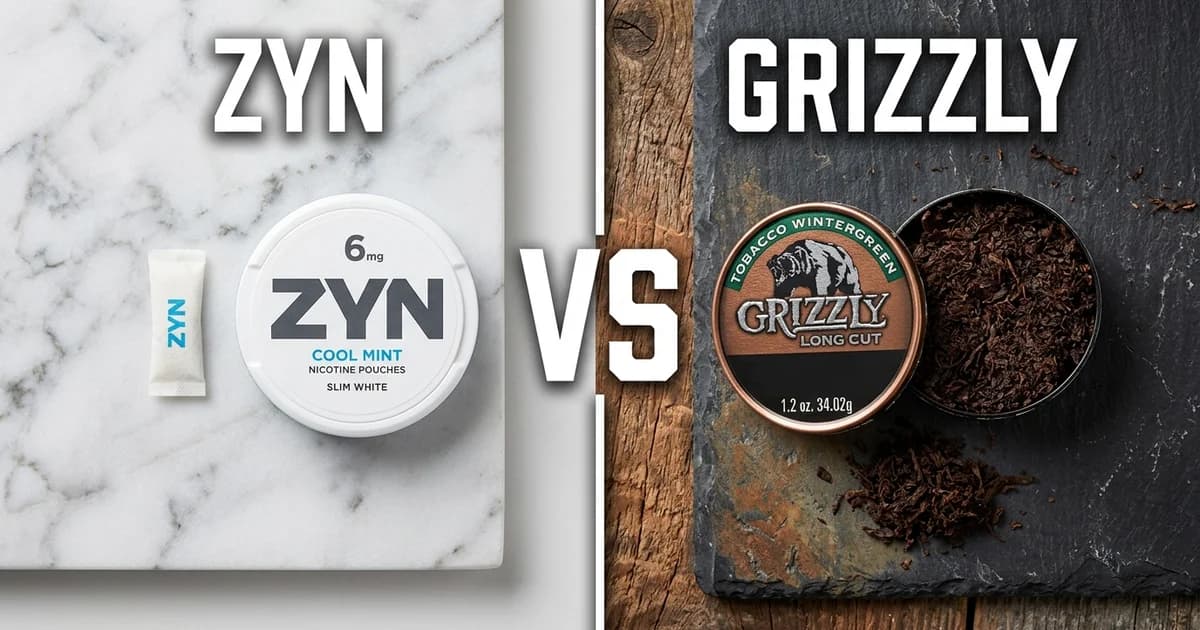
You're standing at a gas station counter staring at two tins. One is ZYN. The other is Grizzly. The zyn vs grizzly debate comes up constantly because both products go in your lip and both deliver nicotine. But the comparison between zyn vs grizzly ends there, because these are fundamentally different products with different ingredients, different health profiles, and different long-term consequences for your body.
This matters more than flavor preference. One category contains tobacco leaf. The other doesn't. That single distinction changes everything about what you're actually putting in your mouth.
Key Takeaways:
- ZYN is a tobacco-leaf-free nicotine pouch; Grizzly's traditional products are moist smokeless tobacco (dip) containing real tobacco leaf.
- Grizzly also makes a newer nicotine pouch line, but it's a separate product from their classic dip.
- Smokeless tobacco contains at least 28 known carcinogens, according to the American Lung Association.
- In January 2025, the FDA authorized certain nicotine pouches as less harmful alternatives to cigarettes and smokeless tobacco for adults already using those products.
ZYN vs Grizzly: What You're Actually Comparing
The grizzly vs zyn search pulls up two very different matchups depending on which Grizzly product you mean.
Grizzly Dip (Traditional Smokeless Tobacco): This is the original product, a moist snuff made from real tobacco leaf. It's been around since 2001 and comes in varieties like Long Cut Wintergreen, Fine Cut Natural, and Snuff. You pack it in your lip, and you spit. It contains tobacco-specific nitrosamines (TSNAs), including the carcinogen N'-nitrosonornicotine (NNN), which has been measured in Grizzly products at levels between 2.64 and 11.1 µg/g.
Grizzly Nicotine Pouches: A newer product line from the same brand. These are tobacco-leaf-free and use either tobacco-derived or synthetic nicotine. Available in flavors like Wintergreen, Peppermint, and Spearmint at 7mg strength, plus an Original flavor in 6mg, 9mg, 12mg, and 15mg options.
ZYN Nicotine Pouches: Made by Swedish Match, ZYN is the dominant player in the nicotine pouch category. The pouches contain pharmaceutical-grade nicotine, microcrystalline cellulose, maltitol, gum arabic, sodium carbonate, and sodium bicarbonate as fillers and pH adjusters. Available in 10 flavors and two strengths: 3mg and 6mg.
The real pouches vs dip comparison is between ZYN (or Grizzly's pouch line) and Grizzly's traditional moist snuff. That's where the zyn vs grizzly differences get serious.
Do Grizzly Nicotine Pouches Have Tobacco in Them?
No. Grizzly nicotine pouches contain no tobacco leaf, and current retailer listings describe the pouch range as using synthetic nicotine rather than nicotine extracted from tobacco plants. Beyond the nicotine, the pouches contain food-grade fillers, flavorings, sweeteners, stabilizers, and pH adjusters. That makes them a fundamentally different product from Grizzly dip, which is real moist tobacco leaf.
The confusion is understandable because both products wear the same bear logo. One wrinkle worth knowing: Grizzly's own FAQ has listed earlier 7mg versions made with tobacco-derived nicotine, so cans from the older production run may describe their nicotine differently. Either way, no Grizzly pouch contains tobacco leaf. Only Grizzly dip and snuff do, and that leaf is where the tobacco-specific carcinogens covered above come from.
The Ingredients: What's in Each Product
Here's a side-by-side breakdown of what you're putting in your body when weighing zyn vs grizzly.
| Feature | ZYN Nicotine Pouches | Grizzly Dip (Moist Snuff) | Grizzly Nicotine Pouches |
|---|---|---|---|
| Contains Tobacco Leaf | No | Yes | No |
| Nicotine Source | Tobacco-derived nicotine salt | Natural (from tobacco leaf) | Tobacco-derived or synthetic nicotine |
| Nicotine Strengths | 3mg, 6mg (Ultra: 9mg, 11mg) | Varies (~8-18mg estimated) | 6mg, 7mg, 9mg, 12mg, 15mg |
| Requires Spitting | No | Yes | No |
| Known Carcinogens (TSNAs) | None detected at meaningful levels | At least 28 cancer-causing chemicals | None detected at meaningful levels |
| Flavors Available | 10 (Mint, Citrus, Coffee, etc.) | ~6 (Wintergreen, Mint, Natural, etc.) | 4 (Wintergreen, Peppermint, Spearmint, Original) |
| Approximate Price/Can | $5-6 | $3-5 (varies by state) | ~$4-5 |
The gap between nicotine pouches vs chew becomes obvious when you look at the carcinogen column. Smokeless tobacco products like Grizzly dip contain TSNAs, polonium-210, and polycyclic aromatic hydrocarbons, all of which are absorbed through the oral mucosa. The NCI confirms these substances have been linked to cancers of the oral cavity, esophagus, and pancreas.
Nicotine pouches don't contain tobacco leaf, which eliminates the primary source of these carcinogens. That's not the same as saying they're "safe." Nicotine itself is highly addictive and harmful to developing brains, per the CDC. But the toxicant exposure profile is a different conversation entirely, and it's the core reason the zyn vs grizzly dip distinction matters so much.
What Strengths Do Grizzly Nicotine Pouches Come In?
Grizzly nicotine pouches come in 6mg, 9mg, 12mg, and 15mg strengths, with 20 pouches per can. Not every flavor gets every strength: Wintergreen and Original run the full 6 to 15mg range, while Mint and Southern (watermelon) come in 9mg and 12mg, and the limited Outdoor Range flavors (Buckshot, Backcountry, Hunter Orange, Copperhead) are 12mg only. That 15mg ceiling is well above ZYN's standard 6mg cap, though ZYN Ultra, launched in June 2026, now reaches 9mg and 11mg.
| Product | Strengths | Pouches per can | Online price per can | Tobacco leaf-free |
|---|---|---|---|---|
| Grizzly pouches | 6, 9, 12, 15mg | 20 | $5.59 | Yes (synthetic nicotine) |
| ZYN | 3, 6mg | 15 | $3.49 to $4.49 | Yes (tobacco-derived nicotine) |
| ZYN Ultra | 9, 11mg | 20 | about $4.45 | Yes (tobacco-derived nicotine) |
| Grizzly dip | Not labeled in mg | n/a (loose tobacco) | Varies by state | No (moist tobacco leaf) |
For heavy dip users moving off tobacco leaf, Grizzly's 12mg and 15mg pouches are among the strongest mainstream options at a gas station counter, which is exactly the transition audience Grizzly built them for. Higher strength also means faster tolerance buildup, so starting at the top of the range locks in a bigger habit, not a bigger edge.
The User Experience: Pouch vs Dip in Practice
Beyond chemistry, the day-to-day experience of using these products is different in ways that matter. Anyone comparing grizzly vs zyn should consider how each product fits into real life.
Discretion. ZYN and Grizzly pouches are spit-free. You pop one under your lip and go about your day. Nobody knows it's there. Grizzly dip requires a spitter or frequent trips to a trash can. In a meeting, on a plane, or at a desk, the pouches vs dip comparison favors pouches by default.
Onset and Duration. How pouch nicotine delivery works is straightforward: the pouch sits under your lip and nicotine absorbs through the gum lining. The onset is relatively fast, usually within a few minutes, and a single pouch lasts 20-40 minutes. Dip tends to release nicotine more gradually over a longer session, but you're also sitting with a wad of tobacco in your mouth for 30-60 minutes. For many users weighing pouches vs dip, the cleaner delivery of a pouch is the deciding factor.
Taste and Variety. ZYN leads here with 10 flavors ranging from Cool Mint and Citrus to Coffee and Cinnamon. Grizzly's pouch line offers just four options. Grizzly dip has around six varieties, but they all carry that unmistakable raw tobacco taste that many newer users find harsh. Flavor selection is a small but real factor in the zyn vs grizzly decision.
Oral Health Impact. Smokeless tobacco is directly linked to gum disease, tooth decay, tooth loss, and leukoplakia (white patches in the mouth that can become cancerous). Nicotine pouches can still cause gum irritation, but they don't carry the same risk profile for oral lesions because there's no tobacco leaf in direct contact with your tissue. This health difference is one of the strongest arguments in the nicotine pouches vs chew conversation.
Nicotine Strength Range. ZYN's standard line caps out at 6mg, and its ZYN Ultra line reaches 9mg and 11mg. Grizzly's pouch line goes up to 15mg. If you're a heavy nicotine user transitioning from dip, ZYN's standard ceiling may feel low. Grizzly's pouch range gives more room for higher-tolerance users to step down gradually, making the grizzly vs zyn choice partly about where you are in your nicotine use.
Are Grizzly Nicotine Pouches Spit Free?
Yes. Grizzly nicotine pouches are spit-free: the pouch sits between your lip and gum, nothing breaks down in your mouth, and you throw the used pouch out when you are done. That is the single biggest practical difference from Grizzly dip, which produces tobacco juice you have to spit. Each can holds 20 white pouches designed to be used without a spitter.
In practice, a pouch typically stays in for 20 to 40 minutes, you can talk and drive with one in place, and there is nothing to dispose of until the pouch itself. That is why the pouch format works in meetings, on flights, and in every other setting where a dip and a spitter never could.
The Market Shift: Why Pouches Are Winning
The numbers tell a clear story. The U.S. nicotine pouch market hit roughly $3.95 billion in 2024 and is projected to grow at a 32.56% compound annual rate through 2033. Meanwhile, traditional chewing tobacco consumption has been declining for years.
This isn't just a trend. It's a structural shift. Consumers are choosing products that deliver nicotine without the baggage of tobacco leaf, spitting, and documented carcinogen exposure. Grizzly clearly sees this too, which is why they launched their own pouch line. Even brands built entirely on dip are pivoting to tobacco-free formats. The zyn vs grizzly question itself reflects this shift: people are actively comparing pouches against dip because they're looking for alternatives.
The demographic is shifting as well. Younger adult consumers who never picked up a tin of dip are entering the nicotine market through pouches, with many first sorting out vaping vs nicotine pouches before ever touching dip. The nicotine pouches vs chew debate barely exists for this group. They've never chewed, and they're not going to start.
A 2024 scoping review published in Cureus found that tobacco-free nicotine pouches likely pose a "much-reduced exposure risk compared with smokeless tobacco products" based on measured toxicant levels. The FDA's January 2025 authorization of certain nicotine pouches reinforced this position, finding them to be a less harmful alternative to cigarettes or smokeless tobacco for adults already using those products.
What Are the Best Alternatives to Grizzly?
The right Grizzly alternative depends on which Grizzly you are leaving. If you use Grizzly dip and want to drop the tobacco leaf but keep nicotine, the closest swaps are Grizzly's own pouches (6 to 15mg, wintergreen-forward flavors), ZYN (3 to 6mg standard, 9 to 11mg in the new ZYN Ultra line), and On! (2 to 8mg, seven flavors with 20 pouches per can). Heavy dip users usually gravitate to the 12mg and 15mg Grizzly pouches or ZYN Ultra, because standard 3 to 6mg pouches can feel weak after years of long-cut tobacco.
If what you actually want to replace is the ritual rather than the nicotine, nicotine-free pouches exist too. Roon is one option in that lane: the same under-the-lip format with zero nicotine and zero tobacco, built around 80mg of caffeine with L-theanine, 15 pouches per tin. It will not satisfy a nicotine craving and it is not a quitting aid, but it covers the hand-to-lip habit for people who have decided nicotine itself is the thing they want out of their day.
What's Missing from Both ZYN and Grizzly
Here's the thing neither product addresses: whether you're looking at zyn vs grizzly pouches or zyn vs grizzly dip, all of these products exist solely to deliver nicotine. That's it. Nicotine is a stimulant, yes, but it's also addictive, builds tolerance quickly, and creates a dependency cycle where you need more of it just to feel baseline normal.
If what you actually want is better focus, sharper thinking, or sustained mental energy, nicotine is a blunt instrument with real costs.
The specific gaps:
- Tolerance and dependency. Nicotine users develop tolerance fast. The 6mg ZYN that used to give you a buzz eventually just prevents withdrawal. You're not gaining performance. You're maintaining a floor.
- No complementary cognitive ingredients. Neither ZYN nor Grizzly contains anything designed to support sustained focus or reduce the jittery edge that stimulants can cause. It's nicotine and filler. That's the whole formula.
- Crash and anxiety. Nicotine's half-life is about two hours. When it wears off, you feel it. The drop in dopamine and norepinephrine can leave you foggy, irritable, or reaching for another pouch just to reset.
- The addiction trade-off. Switching from Grizzly dip to ZYN pouches reduces your carcinogen exposure. That's a real win. But you're still locked into nicotine dependency, which carries its own cardiovascular and neurological costs over time.
If you're using pouches purely to manage a nicotine habit, that's a personal decision. But if you're reaching for a pouch because you want to focus better at work, the zyn vs grizzly debate misses the bigger picture: there are options that deliver cognitive performance without the dependency loop.
A Different Approach to the Pouch Format
Roon uses the same sublingual pouch format, but with a completely different purpose. There's zero nicotine inside. Instead, each pouch contains 80 mg of caffeine, L-Theanine, Theacrine, and Methylliberine, four compounds that work together to support 6-8 hours of sustained focus without the crash or tolerance buildup that comes with nicotine.
L-Theanine sharpens attention-switching accuracy and promotes calm alertness alongside the caffeine. Theacrine and Methylliberine extend the duration and, based on existing research, don't appear to produce the same tolerance pattern that nicotine and even caffeine alone can create.
It's not a nicotine replacement product, and it's not designed for people managing tobacco addiction. It's built for the person who wants what they thought nicotine was giving them (focus, energy, a mental edge) without the dependency that comes with it. Whether you've been weighing zyn vs grizzly or looking beyond nicotine entirely, Roon offers a different path.
If that sounds like a better trade-off, check out Roon here.