Best Caffeine Pills and Supplements 2026, Ranked by Format
Roon Team
Best Caffeine Pills and Supplements 2026, Ranked by Format
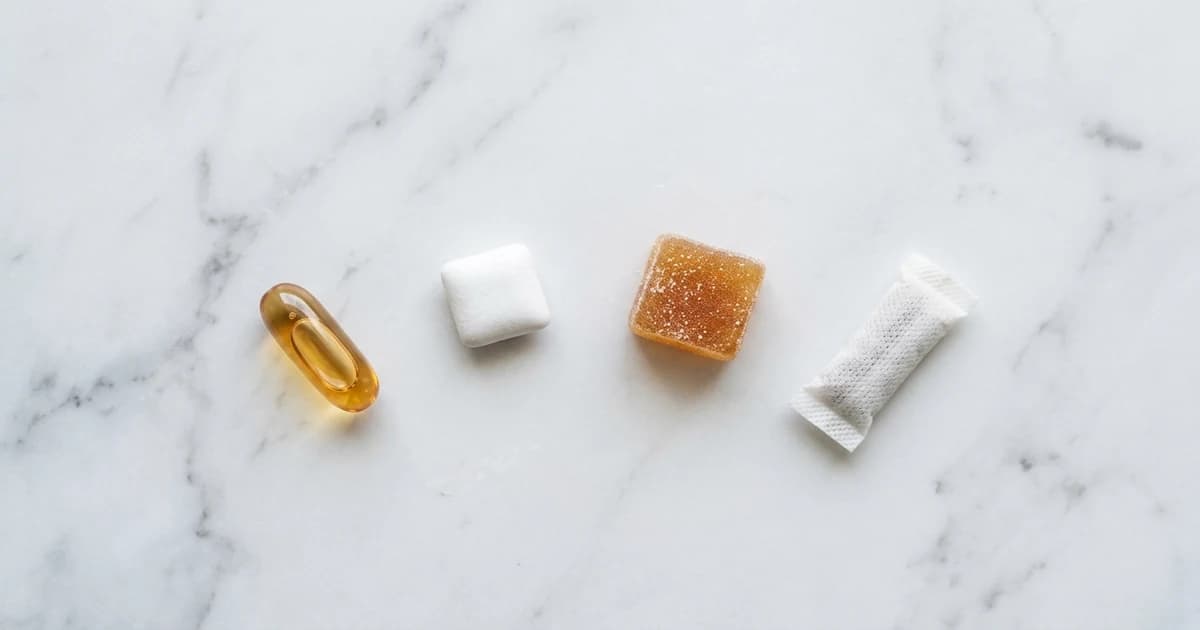
The best caffeine pill for most people in 2026 is still a 200 mg instant-release tablet like Vivarin or NoDoz: cheap, predictable, dosed identically to a strong cup of coffee. But "best" depends on what you need. A plain tablet hits fast and fades fast. An extended-release capsule spreads 100 mg across hours. A caffeine-plus-L-theanine stack smooths the jitter curve. And non-pill formats (gum, sublingual pouches) skip the gut entirely for faster onset. This guide ranks the best caffeine supplements by format first, because format determines onset, duration, and side-effect profile more than brand name does.
Key Takeaways
- Instant-release tablets (Vivarin, NoDoz) are the cheapest caffeine format: ~$0.13 to $0.21 per 200 mg dose.
- Extended-release capsules (Genius Caffeine) delay the spike for steadier energy at 100 mg per cap.
- Caffeine + L-theanine stacks reduce jitters without blunting alertness. Research supports a 2:1 theanine-to-caffeine ratio.
- Non-pill formats (gum, sublingual pouches) absorb partly through the mouth lining, reaching peak plasma caffeine faster than a swallowed capsule.
- The FDA's safety ceiling is 400 mg/day for most healthy adults.
Best Caffeine Pills and Supplements at a Glance
| Product | Format | Caffeine / Dose | Key Add-Ins | Approx. Price / Dose | Best For |
|---|---|---|---|---|---|
| Vivarin | Instant-release tablet | 200 mg | None | ~$0.13 | Cheapest single-ingredient caffeine |
| NoDoz Max Strength | Instant-release caplet | 200 mg | None | ~$0.21 | Drugstore availability |
| Genius Caffeine | Extended-release capsule | 100 mg (VitaShure) | None | ~$0.15 | Slow, steady energy without re-dosing |
| Performance Lab Caffeine 2 | Capsule (stacked) | 50 mg | 100 mg L-theanine, 250 mg L-tyrosine, B-vitamins | ~$1.10–$1.47 | Jitter-free focus, customizable dose |
| Roon | Sublingual pouch | 80 mg | 60 mg L-theanine, 25 mg methylliberine, 5 mg theacrine | From $0.61 | Long-duration (6–8 hr), no swallowing |
| Caffeine gum (various) | Chewing gum | 40–100 mg per piece | Varies | ~$0.50–$1.00 | Fastest onset, portable |
Prices reflect 2026 online retail and subscription offers. They fluctuate by retailer; verify before purchasing.
How We Ranked These
Format came first, price per dose second, ingredient transparency third. We excluded proprietary blends that hide caffeine behind a "matrix" total, and anything positioned as a pre-workout. Price per dose uses the lowest widely available retail or subscription price, not MSRP. Where a product adds companion ingredients, we note the tradeoff: you pay more per milligram of caffeine, but you get a different effect curve.
Instant-Release Caffeine Tablets: Vivarin and NoDoz
Both Vivarin and NoDoz deliver 200 mg of caffeine per dose, roughly equivalent to a strong 12 oz cup of brewed coffee. Pharmacokinetics are identical: swallow, dissolve, absorb through the small intestine, peak plasma in about 45 to 60 minutes. Vivarin's label inactive ingredients include dicalcium phosphate dihydrate as a filler.
Vivarin runs about $0.13 to $0.16 per tablet (60-count box, $8 to $10). NoDoz costs around $0.21 per caplet ($12.64 for 60). Either way, these are the cheapest per-dose caffeine supplements on the market.
Pros: Dirt cheap. Exact dose every time. No sugar, no calories. Widely available at drugstores.
Cons: No jitter buffering. The full spike-and-fade curve means a crash at 3 to 4 hours. See caffeine pills vs coffee for a deeper comparison.
Best for: People who tolerate coffee fine and just want the caffeine without the liquid or ritual.
Extended-Release Caffeine: Genius Caffeine
Genius Caffeine uses VitaShure, a microencapsulated caffeine technology that coats particles so they dissolve gradually. Each capsule contains 100 mg of caffeine, half a Vivarin tablet, released over several hours for a flatter energy curve.
The label directs up to 3 capsules per day, not within 8 hours of bedtime. At 100 capsules per bottle, the cost works out to roughly $0.15 per capsule.
Pros: Gentler onset. Half the per-dose caffeine means less risk of overshooting. Good entry point for caffeine-sensitive users.
Cons: 100 mg is modest. Doubling up defeats some of the extended-release benefit. No companion ingredients to smooth the response.
Best for: People who find 200 mg pills too aggressive, or who want background alertness without a pronounced peak.
Caffeine Plus L-Theanine Stacks
L-theanine is the amino acid behind the "alert calm" tea drinkers describe. A 2008 study by Owen et al. found the caffeine-theanine combination improved performance on cognitive tasks. Research supports a ratio around 2:1 theanine-to-caffeine. For a full breakdown, see why the theanine ratio matters.
Performance Lab Caffeine 2 is the best-known capsule here. Each capsule packs 50 mg natural caffeine, 100 mg L-theanine, 250 mg L-tyrosine, and B-vitamins (B2, B6, B9, B12). The theanine-to-caffeine ratio is exactly 2:1. At 30 capsules per bottle and a price around $33 to $44 depending on subscription, you pay roughly $1.10 to $1.47 per capsule. Expensive for 50 mg of caffeine, but you are paying for the stack, not the stimulant alone.
Pros: Transparent ingredient profile. Customizable dosing (1 to 5 capsules per day).
Cons: Premium price. Multiple capsules for a coffee-equivalent dose multiplies cost fast.
Best for: Caffeine-sensitive users who want focus without jitters.
Caffeine Gum, Gummies, and Strips
These formats exist because the mouth absorbs caffeine faster than the stomach. A 2002 study by Kamimori et al. found caffeine gum reached peak plasma concentration in 44 to 80 minutes versus 84 to 120 minutes for an equivalent capsule dose. A 2018 review in Sports Medicine confirmed that buccal delivery gets caffeine into the bloodstream faster, though total absorption over time is comparable between formats.
Most caffeine gums deliver 40 to 100 mg per piece. Gummies sit in a similar range. For a full side-by-side of every delivery method, see caffeine formats compared.
Pros: Fastest onset of any caffeine format. No water needed. Portable.
Cons: Dose per piece is lower than a pill. Flavor fades. Gummies may contain added sugar.
Best for: Pre-competition, long drives, early-morning shifts where you need alertness in minutes, not an hour.
Sublingual Pouches: The Newest Non-Pill Caffeine Format
Buccal pouches sit between your lip and gum, delivering caffeine through the oral mucosa. Same principle as caffeine gum (bypassing first-pass gut metabolism), but with a fixed dose that does not depend on chewing rate. See buccal vs digestive absorption explained and sublingual caffeine pharmacokinetics.
Roon is the primary sublingual caffeine pouch on the market. Each pouch contains 80 mg caffeine, 60 mg L-theanine, 25 mg methylliberine (Dynamine), and 5 mg theacrine (TeaCrine). The methylliberine and theacrine add something pills do not: duration extension.
Onset is 5 to 10 minutes. The felt window is 6 to 8 hours. A tin holds 15 pouches and starts at $9.16 per tin ($0.61 per pouch) on a 12-tin subscription, or $15.00 per tin ($1.00 per pouch) for a one-time 4-tin purchase.
Pros: Fast onset. 6 to 8 hour duration from 80 mg. Zero sugar, zero calories. No water needed.
Cons: One flavor (Cool Mint). Higher per-dose cost than plain tablets. Contains sucralose and natural-and-artificial flavor. Online only.
Best for: Long-duration focus from a low caffeine dose, without timing a second pill.
How Much Caffeine Is Too Much?
The FDA states that 400 mg per day is not generally associated with negative effects for most healthy adults. Roughly 1,200 mg in a single dose can produce toxic effects.
The practical problem is stacking. Two cups of coffee plus one 200 mg pill puts you at 400 mg before lunch.
| Daily Caffeine Source | Approx. Caffeine | Running Total |
|---|---|---|
| Morning coffee (12 oz brewed) | ~95–200 mg | 95–200 mg |
| Midday caffeine pill (Vivarin) | 200 mg | 295–400 mg |
| Afternoon energy drink (16 oz) | ~150 mg | 445–550 mg |
If you use caffeine pills, track your total from all sources, not just the pill.
Picking the Right Caffeine Format
There is no single best caffeine supplement. There is the best format for what you need right now.
If price per milligram is all that matters, buy Vivarin. If you want a smoother curve, look at extended-release or theanine-stacked options. If speed of onset is the priority, gum or sublingual pouches beat any swallowed pill. And if you want duration from a single low dose, the combination of caffeine with methylliberine in a buccal pouch is the newest approach with real pharmacokinetic rationale behind it.
Whatever you choose, track your total against 400 mg/day.
Frequently Asked Questions
Do caffeine pills work as well as coffee?
Yes. A 200 mg pill delivers the same molecule as a cup of coffee brewed to that strength. Coffee includes chlorogenic acids that may affect absorption timing slightly, but the active ingredient is identical.
How long do caffeine pills take to kick in?
Instant-release tablets peak in about 45 to 60 minutes. Extended-release capsules take longer by design. Buccal formats (gum, sublingual pouches) are faster: as few as 44 minutes for gum versus 84+ minutes for capsules.
Are caffeine pills bad for you?
Not at recommended doses. The FDA considers up to 400 mg/day safe for most healthy adults. Risks come from exceeding that or stacking multiple caffeine sources. Talk to your clinician if you have heart conditions, anxiety disorders, or are pregnant.
What is the difference between caffeine pills and caffeine and L-theanine pills?
Plain caffeine pills contain only caffeine plus inactive fillers. Caffeine and L-theanine pills add theanine, an amino acid from tea, which modulates jittery side effects while preserving alertness. Research supports a 2:1 theanine-to-caffeine ratio for this effect.
Can I take caffeine pills every day?
Most healthy adults can use caffeine daily within the 400 mg/day limit. Tolerance builds with regular use. Cycling off periodically (a few days to a week) can help reset sensitivity, though this varies by individual.
Are caffeine pills cheaper than coffee?
Almost always. A Vivarin tablet costs roughly $0.13 for 200 mg of caffeine. A medium coffee from a chain costs $2 to $5 for a similar dose. Even premium stacked supplements like Performance Lab Caffeine 2 ($1.10 to $1.47 per capsule) are cheaper than a latte.
What is the best caffeine pill for studying?
For sustained study sessions, an extended-release capsule or caffeine-plus-theanine stack avoids the sharp crash that interrupts long work blocks. A sublingual pouch with theanine and methylliberine (like Roon) offers a 6 to 8 hour window from a single dose. Plain 200 mg tablets work but tend to fade after 3 to 4 hours.
Why 80 mg Lasts Longer Than You'd Expect
Most caffeine pills compete on dose: 200 mg, 300 mg, more. Roon takes the opposite approach. Each pouch delivers 80 mg caffeine, 60 mg L-theanine, 25 mg methylliberine (Dynamine), and 5 mg theacrine (TeaCrine) through a sublingual pouch.
The duration claim rests on methylliberine's effect on caffeine clearance. A randomized, double-blind, crossover PK study (n=12) found co-administering methylliberine with caffeine cut oral clearance from 41.9 to 17.1 L/hr and extended half-life from 7.2 to 15 hours, with no increase in peak concentration (study). That study used 100 mg methylliberine + 150 mg caffeine, roughly 4x the methylliberine and 1.9x the caffeine in a Roon pouch. The mechanism is directionally the same at lower doses, but the magnitude at 25 mg + 80 mg has not been measured. Roon's felt window is 6 to 8 hours, not 15. Stop at least 8 hours before bed.
Roon is not a pill, not a pre-workout, and not a nicotine replacement. It is a caffeine supplement in pouch form, from $0.61 per pouch on a 12-tin subscription. If pills have always felt like too much or too little, try Roon.
Related from Roon
- Caffeine and L-Theanine Pills: Why the Ratio Matters
- Caffeine Without the Cup: Coffee-Level Energy When You Can't Drink Coffee
- Caffeine Forms Compared
- How Fast Do Caffeine Pouches Work?
Written by Roon Team