Focus Pouch vs Caffeine Gum vs Energy Mint
Focus Pouch vs Caffeine Gum vs Energy Mint: Which Oral Format Hits Fastest?
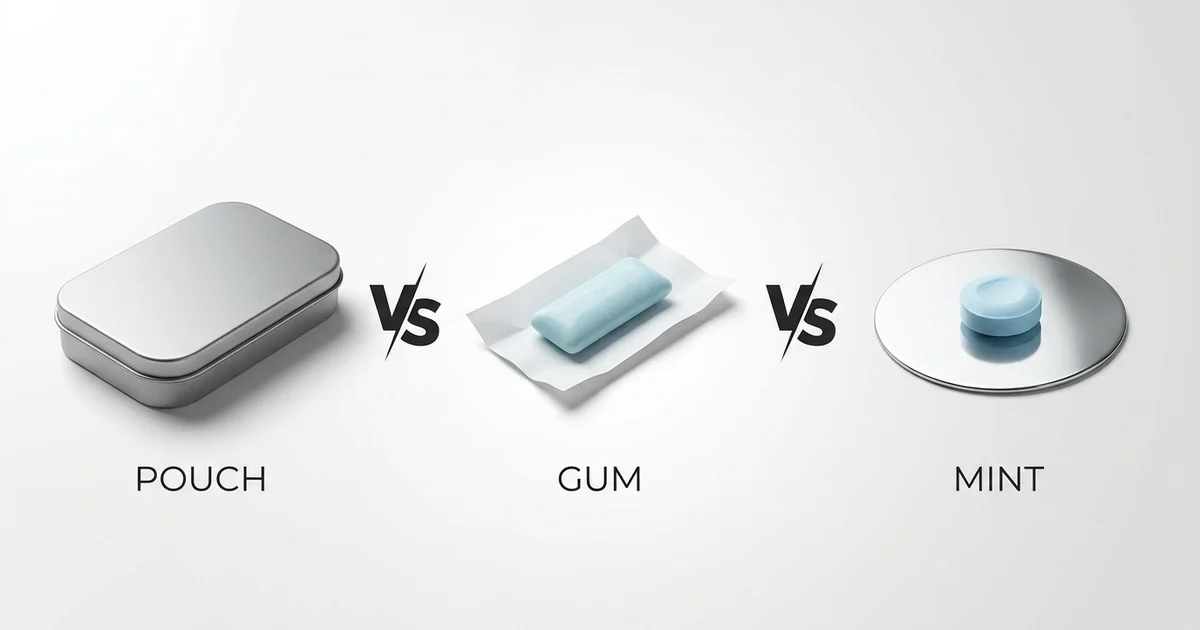
If you want caffeine in your bloodstream fast, the delivery route matters more than the milligram count. A focus pouch and caffeine gum both use the tissue inside your mouth to move caffeine straight into circulation, which is faster than swallowing a pill and waiting on your gut. In a head-to-head focus pouch vs caffeine gum comparison, both can register effects in roughly 5 to 15 minutes, while energy mints behave less predictably depending on whether you suck or swallow them. The real separator is dose precision and whether you want anything beyond raw stimulation.
This article is for informational purposes only and is not medical advice. If you have health concerns, are pregnant or breastfeeding, or are trying to cut down on caffeine or quit nicotine, talk to a healthcare provider.
Key Takeaways
- Onset is similar for pouches and gum (about 5 to 15 minutes) because both rely on absorption through the lining of the mouth, bypassing the slower digestive route.
- Caffeine gum is hard to dose accurately because how long and how hard you chew changes how much caffeine actually crosses into your bloodstream.
- A focus pouch delivers a fixed milligram dose with no chewing required, which makes it the most repeatable option.
- Energy mints are the least predictable because absorption splits between the mouth and the gut depending on how you use them.
- Roon is a zero-nicotine focus pouch with a fixed 80 mg caffeine plus 60 mg L-theanine, positioned for people who want consistent dosing over guesswork.
How Oral Caffeine Formats Actually Work
The tissue inside your mouth absorbs caffeine faster than your stomach does. This is the entire reason buccal and sublingual products exist. When caffeine sits against the inner cheek or under the tongue, a portion crosses the thin, blood-rich membrane directly into circulation, skipping the trip through the stomach, intestine, and first-pass metabolism in the liver. According to a primer on sublingual absorption, this route can move a compound into the bloodstream more quickly than swallowing because it avoids the digestive delay.
Swallowed caffeine, by contrast, still works, just slower. A pill or a swallowed mint has to dissolve, empty from the stomach, and absorb through the intestinal wall before peaking.
That timing gap is why format is a real decision and not a marketing detail. The fastest oral formats are the ones that keep caffeine in contact with the mouth long enough to absorb there.
Focus Pouch vs Caffeine Gum: The Onset and Dose Comparison
Caffeine gum and a focus pouch hit at similar speeds, but the pouch wins on dose control. The U.S. Military studied caffeinated gum specifically because soldiers needed alertness on demand. Research on caffeinated gum pharmacokinetics has found that caffeine delivered through the gum route enters the bloodstream faster than the same dose taken as a capsule, a finding established by Kamimori et al. (2002) in a randomized study comparing gum to capsules across multiple dose levels. That is the case for gum. It is also the case for a pouch, because both formats use the same mouth-tissue pathway.
Here is the practical breakdown across the three formats.
| Format | Onset | Duration | Dose precision | Discreetness | Typical caffeine mg | Best scenario |
|---|---|---|---|---|---|---|
| Focus pouch | 5 to 15 min | 1 to 3 hr active release, sustained tail | High (fixed mg per pouch, no chewing) | High (sits discreetly, no chewing motion) | 50 to 100 mg | You want a repeatable, exact dose and a steady ramp |
| Caffeine gum | 5 to 10 min | Shorter, tapers as you stop chewing | Low (chew time and intensity change actual dose) | Medium (visible chewing) | 50 to 100 mg | You want the fastest possible hit and don't mind chewing |
| Energy mint | Variable | Variable | Low to medium (depends on suck vs swallow) | High | 40 to 80 mg | You want flavor plus a light, casual lift |
The gap that matters: gum is fast but imprecise. The same piece can deliver different amounts of caffeine to two people, or to the same person on two days, because absorption depends on how vigorously and how long you chew. A pouch removes that variable. You place it, the dose is set, and you do nothing else.
Why Dose Precision Beats Raw Speed
A dose you can repeat is worth more than a dose that is slightly faster but unpredictable. Speed only helps if you know how much you actually absorbed. With gum, the active variable is your jaw. Chew hard and you release and absorb caffeine quickly; chew lazily or stop early and you leave a chunk of the dose unabsorbed in the gum base.
A focus pouch sidesteps this. The milligram count printed on the tin is the milligram count you get, because there is no mechanical step you can do wrong. You are not metering the dose with your chewing.
This is why the focus pouch vs caffeine gum decision usually comes down to your goal. For a one-time emergency jolt, gum's speed is fine. For a daily tool where you want the same response every morning, a fixed-dose pouch is the more controlled choice.
Where the Energy Mint Fits
An energy mint is the most casual format and the least predictable. The problem is behavioral: some of the caffeine absorbs through the mouth while the mint dissolves, but the rest gets swallowed with saliva and absorbs through the gut on the slower timeline. The split changes every time depending on whether you let it dissolve or crunch and swallow it.
That makes mints pleasant but vague. You get flavor and a modest lift, but you cannot reliably predict onset or peak.
If your priority is taste and a light pick-me-up, a mint is reasonable. If your priority is knowing exactly when and how much caffeine arrives, it is the weakest of the three.
A Decision Guide by Scenario
Match the format to the moment, not to the marketing.
- You need to be sharp in 10 minutes for something high-stakes: Gum or a pouch. Both use mouth-tissue absorption, so both are fast. Choose gum if you genuinely want the fastest possible spike and don't mind the imprecision.
- You want the same controlled dose every day: A focus pouch. Fixed milligrams, no chewing variable, no guessing.
- You're in a meeting, a library, or anywhere chewing looks off: A pouch. It sits discreetly and requires no visible motion.
- You want flavor and a light lift with no concern for exact timing: An energy mint.
- You want caffeine plus something to smooth the edge: A pouch that pairs caffeine with L-theanine, which lets you keep the alertness without leaning entirely on a high stimulant load.
Conclusion: Route Decides Speed, Precision Decides Trust
All three oral formats beat a swallowed pill on onset because they put caffeine against the tissue in your mouth, the fastest practical route short of an injection. Between them, gum and pouches land in the same 5 to 15 minute window, while mints stay variable. The deciding factor is not which one is two minutes faster. It is which one gives you a dose you can repeat. Gum trades precision for speed. Mints trade everything for flavor. A fixed-dose pouch keeps the speed of mouth-tissue absorption while removing the guesswork, which is why it tends to win for anyone who wants the same result twice.
Frequently Asked Questions
Is a focus pouch faster than caffeine gum?
They are roughly comparable. Both a focus pouch and caffeine gum use absorption through the tissue inside your mouth, which moves caffeine into your bloodstream faster than swallowing a pill. Onset for both typically lands in the 5 to 15 minute range. Gum can feel slightly quicker if you chew aggressively, but that same chewing variability makes the actual absorbed dose harder to predict than a pouch.
Why is caffeine gum hard to dose accurately?
Because your jaw controls the dose. How long and how hard you chew determines how much caffeine releases from the gum base and absorbs through your mouth. Chew briefly and you leave caffeine unabsorbed. Chew vigorously and you release more. Two people using the same piece of gum can absorb different amounts, which makes repeatable dosing difficult compared with a fixed-milligram pouch.
Do energy mints work as well as pouches or gum?
Energy mints provide caffeine, but with less predictable timing. Some of the caffeine absorbs through your mouth while the mint dissolves, and the rest gets swallowed and absorbs slowly through your gut. That split changes based on whether you let it dissolve or chew and swallow it. Mints are good for flavor and a light lift, but weaker if you want precise onset and dose.
Why do mouth-absorbed formats beat caffeine pills on speed?
A swallowed pill has to dissolve, leave the stomach, and absorb through the intestine before peaking, which takes longer. Formats that hold caffeine against the lining of your mouth let a portion cross directly into your bloodstream, skipping the digestive delay. This is the same principle behind sublingual products and the reason gum and pouches register effects in minutes rather than tens of minutes.
How much caffeine is in a typical focus pouch?
It varies by brand, generally from about 50 mg to 100 mg per pouch. Roon, for example, contains a fixed 80 mg of caffeine per pouch, roughly comparable to a strong cup of coffee. The advantage of a pouch over gum is that this number is exact. You absorb the dose on the tin without a chewing step that changes the result.
Can you add L-theanine to a caffeine routine?
Yes. L-theanine is an amino acid found in tea and is often paired with caffeine. Some pouches, including Roon, combine 80 mg caffeine with 60 mg L-theanine in a single fixed dose. Pairing the two is a common approach for people who want the alertness of caffeine while supporting a smoother feel. Gum and mints rarely include it.
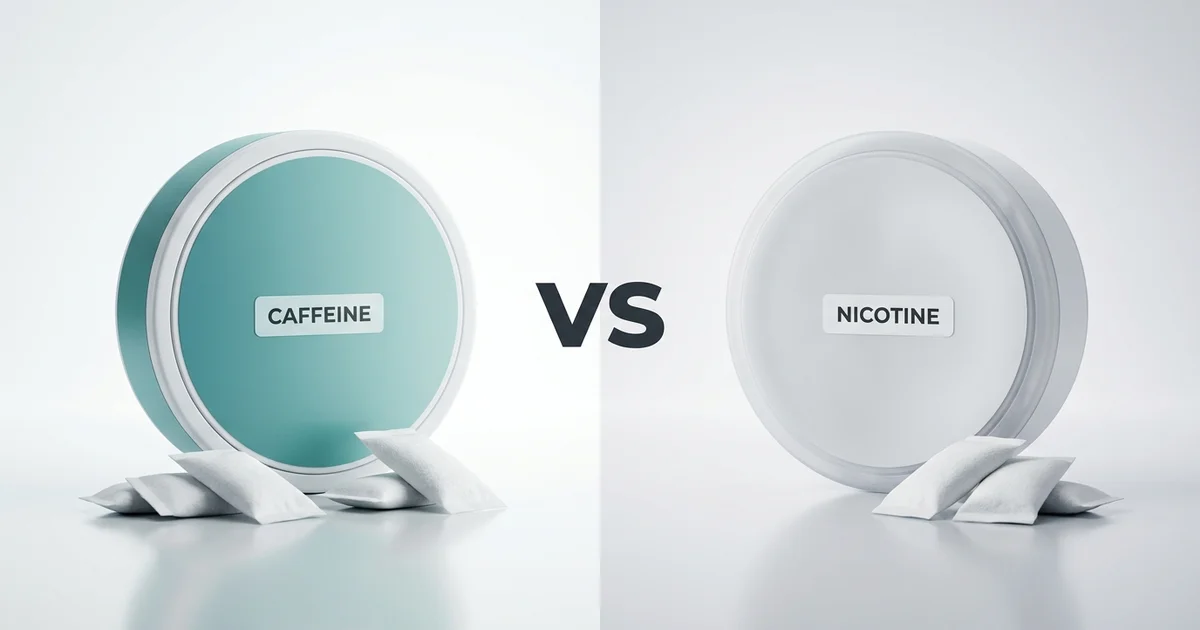
Is a focus pouch the same as a nicotine pouch?
No. They share a format, a small pouch you place in your mouth, but the contents differ entirely. A nicotine pouch delivers nicotine. A zero-nicotine focus pouch like Roon delivers caffeine and supporting ingredients with no nicotine at all. If you specifically want to avoid nicotine, check the label, because the pouch shape alone tells you nothing about what is inside.
If You Want the Speed of Gum Without the Guesswork
This article's argument comes down to one tradeoff: gum is fast but imprecise, mints are pleasant but vague, and a fixed-dose pouch keeps the fast mouth-tissue absorption while removing the chewing variable. That is exactly the gap Roon, a fixed-dose focus pouch, is built to fill.
Each Roon pouch delivers a set 80 mg caffeine, 60 mg L-theanine, 25 mg methylliberine (Dynamine), and 5 mg theacrine (TeaCrine). No chewing, no metering the dose with your jaw, and the same milligrams every time. It is designed for a steady, sustained focus window without the jitters or crash of a stimulant spike you can't control.
To be clear about what Roon is not: it contains zero nicotine, and it is not a replacement for sleep, food, or a sensible daily caffeine ceiling. If your problem with gum was never the speed but the inconsistency, a Roon pouch is worth trying as the more repeatable option.
By Roon Team