Why Do Baseball Players Eat Sunflower Seeds?
Roon Team
Why Do Baseball Players Eat Sunflower Seeds?
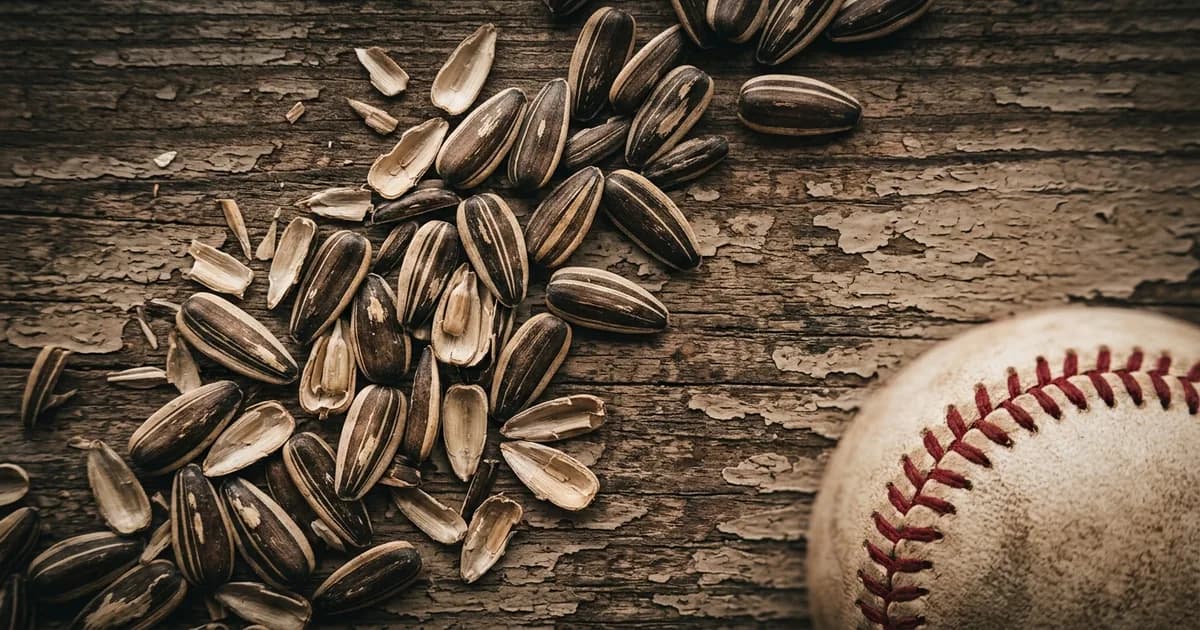
Baseball players eat sunflower seeds because a regulation game is mostly waiting, and seeds give your mouth and hands something to do while you sit. The habit took hold in the 1950s as a tobacco substitute, Reggie Jackson turned it into a cultural fixture in the 1970s, and by now it is as much a part of the dugout as pine tar and batting gloves. The crack-and-spit rhythm fills dead time. That is the whole answer. The longer answer involves nutrition, league rules, a pandemic ban, and a few alternatives worth comparing.
Key Takeaways
- Sunflower seeds entered MLB dugouts in the 1950s as players looked for a substitute for chewing tobacco, which was later banned for new major leaguers under the December 2016 CBA.
- The real function is sensory: cracking shells is a repetitive fine-motor task that fills the long gaps between at-bats.
- A one-ounce serving of in-shell sunflower seeds is roughly 82 calories and 3 g of protein, with sodium varying widely by brand.
- Seeds were banned from MLB dugouts during the 2020 COVID season; gum was allowed.
Dugout Options at a Glance: Seeds vs. Gum vs. Caffeine Pouch
| Sunflower Seeds | Bubble Gum | Caffeine Pouch | |
|---|---|---|---|
| Lasts | 1 to 3 hours (one bag) | 15 to 20 minutes per piece | 30 to 60+ minutes per pouch |
| Spitting required | Yes (shells) | No | No |
| Sodium per serving | ~129 mg (salted, 1 oz in-shell) | 0 mg | 0 mg |
| Sugar per serving | 0 g (unsalted) | 2 to 6 g per piece | 0 g |
| Alertness effect | None demonstrated | Small, short-lived, and only during long monotonous tasks; no benefit in rested subjects on short tasks | Yes (caffeine-dependent) |
| Mess | Shells everywhere | Wrapper | None |
| 2020 COVID rule | Banned | Allowed | N/A (not common in dugouts then) |
Where the Sunflower Seed Habit Came From
Before seeds, there was tobacco. From baseball's earliest decades through the mid-twentieth century, chewing tobacco was standard equipment. Players chewed it, spit it, and rubbed it into their gloves. The shift started in the 1950s with a pair of St. Louis Cardinals Hall of Famers. Stan Musial and Enos Slaughter were known to throw sunflower seeds into their mouths between pitches while patrolling the outfield, looking for something to replace the tobacco habit.
Seeds stayed a niche preference until the late 1960s, when Reggie Jackson adopted them publicly. As quoted in a Chinook Seedery retrospective, Jackson gave reporters a nutrient-by-nutrient case: "Sunflower seeds have protein, thiamine, niacin, iron, magnesium, phosphorus." Kids wanted to be like Reggie, and seed sales followed.
Meanwhile, the anti-tobacco side gained teeth. Smokeless tobacco was banned in the minor leagues in 1993. The December 2016 CBA extended the ban to new major league players, grandfathering existing players but closing the door for anyone who came up after that season. Seeds and gum filled the gap. For a full rundown of what baseball players actually chew now, the inventory has grown well beyond a bag of David's.
The Real Function: Filling Dead Time
A regulation nine-inning game averages around three hours. A position player might get four at-bats totaling eight to twelve minutes of action. A relief pitcher who enters in the seventh inning has spent over two hours sitting in the bullpen. That is a lot of nothing.
Cracking sunflower seeds is a low-stakes motor loop: tongue a seed from your cheek, crack it between your molars, separate shell from kernel, spit the shell. Repeat. It keeps the jaw working and the hands busy without requiring any attention. That is the appeal. No study has shown that eating seeds improves reaction time or decision-making, and you should be skeptical of anyone who claims otherwise. The benefit is sensory occupation, not cognitive enhancement.
This is also why the shell-spitting ritual became its own thing. Spitting is half the point. It marks time.
What Is Actually in a Bag of Seeds
Here is what the USDA reports for dried sunflower seed kernels (FDC 170562), per one ounce (28 g) of shelled kernels:
| Nutrient | Per 1 oz kernels (28 g) | Per 1 oz in-shell (~14 g kernels) |
|---|---|---|
| Calories | 164 kcal | ~82 kcal |
| Protein | 5.9 g | ~3.0 g |
| Fat | 14.3 g | ~7.2 g |
| Sodium (salted) | ~129 mg | Varies by brand |
In-shell seeds are roughly half shell by weight, so a one-ounce handful of the seeds you actually crack at the ballpark delivers about half the kernel nutrition of a one-ounce serving of shelled kernels. The sodium swings wildly depending on the brand and flavor. Ranch, BBQ, and dill pickle varieties can push well past 200 mg per ounce.
The 2020 Season: No Seeds Allowed
When MLB released its COVID-19 health protocols for the 2020 restart, the league banned spitting of any kind, "including but not limited to saliva, sunflower seeds or peanut shells, or tobacco." Chewing gum was still allowed because it does not produce a spray of expelled shells.
The ban was a revealing experiment. Players adapted, mostly to gum and candy, but the cultural loss was visible. Without shells littering the dugout floor, something felt off. The protocols quietly reinforced that seeds are not really about nutrition. They are about ritual.
Seeds in the Minors and the Brand Pipeline
The seed-to-dugout pipeline is an actual industry. David Seeds reportedly provides three cases, 432 packages, to each minor league team every season as part of an anti-tobacco initiative, a practice that has reportedly continued since 1993. David has been the official seed of Little League since 2009.
On the national team side, Chinook Seedery was named the official sunflower seed supplier of USA Baseball, cementing seeds as institutional equipment, not just a snack someone picked up at a gas station.
Seeds vs. Gum vs. Pouch for the Adult Rec-League Player
If you play in an adult league, you already know the drill: somebody brings a bag of seeds, somebody else has gum, and someone is pulling out a tin of something. Here is how the three actually compare across what matters during a game.
Duration. Seeds last as long as the bag does, usually one to three hours of steady cracking. A piece of gum loses its flavor in fifteen to twenty minutes, and you either replace it or chew rubber. A caffeine pouch sits between your lip and gum for thirty to sixty minutes, no replacement needed, and the caffeine itself stays active for hours. One pouch before first pitch can cover the full game and then some at a felt window of six to eight hours.
Alertness. Seeds do nothing measurable for focus. Gum's record is mixed: a 2014 study found chewing gum helped sustain alertness during a monotonous vigilance task, but a 2025 Washington State University study published in Acta Psychologica found no improvement in rested participants on short tasks. Caffeine is caffeine: it works, reliably, across decades of research. Paired with L-theanine, a 2025 systematic review in Nutrition Reviews (50 RCTs) found the combination improved attention-switching accuracy and digit vigilance. That is a real effect, not a folk claim.
Mess and manners. Seeds leave a carpet of shells. Some leagues and indoor facilities ban them outright. Gum is clean but generates wrappers. A pouch leaves nothing behind. For anyone weighing their alternatives to chewing gum, the pouch format has a practical edge here.
The Ritual Outlasts the Reason
Sunflower seeds stuck in baseball because the game's structure demands something to fill the wait, and cracking shells is satisfying in a way that science does not need to explain. The tobacco replacement origin is real, the nutrition is modest, and the ritual is self-reinforcing: you see other players doing it, so you do it too. Whether that is enough depends on what you want from the dugout. If it is just something to chew, seeds still work. If you want the chewing and the alertness, other options have caught up.
Frequently Asked Questions
Why do baseball players eat sunflower seeds instead of chewing tobacco?
Seeds became popular in the 1950s as a tobacco alternative, and the transition accelerated after smokeless tobacco was banned in the minor leagues in 1993 and for new major leaguers in December 2016. Seeds give the same mouth-and-hands occupation without the health risks of tobacco. Big League Chew launched in 1980 as another tobacco-mimicking alternative, this time as shredded bubble gum in a pouch.
When did baseball players start eating sunflower seeds?
The earliest well-known examples are Stan Musial and Enos Slaughter in the 1950s, both Cardinals outfielders who cracked seeds between pitches. Reggie Jackson popularized the habit widely in the late 1960s and 1970s by promoting seeds' nutritional value to reporters.
Are sunflower seeds good for baseball players?
They are a decent source of protein (~5.9 g per ounce of kernels), healthy fats, and minerals like magnesium and phosphorus. They are not a performance enhancer. No evidence supports the idea that eating seeds improves reaction time, focus, or decision speed. Their primary function in the dugout is keeping your mouth busy, not fueling performance.
Why do baseball players spit out the shells?
Because you eat the kernel, not the shell. The shell is the casing you crack with your teeth to get to the edible seed inside. Spitting it is practical, and over time it became part of the broader spitting culture in baseball, alongside tobacco spit and plain saliva.
What sunflower seeds do MLB players eat?
David Seeds is the most visible brand in professional baseball, with reported sponsorship ties to minor league teams since 1993 and official Little League status. Chinook Seedery is the official sunflower seed supplier of USA Baseball. BIGS is another common brand in clubhouses. Individual players have their own preferences, but no single brand has a confirmed exclusive MLB-wide deal.
Were sunflower seeds ever banned in baseball?
Yes. During the 2020 COVID-shortened season, MLB banned spitting of sunflower seeds, peanut shells, and tobacco from the dugout as part of health protocols. Chewing gum was allowed. The ban was temporary and applied only to that season.
One Pouch Before First Pitch Instead of a Bag of Seeds
The comparison table above makes the case plainly: seeds are a ritual, not a tool. They fill time, they leave a mess, and they do nothing for alertness. If you are playing adult rec-league ball and want something that fills the wait and keeps you sharp through nine innings, the math favors a different format.
Roon is a zero-nicotine, zero-sugar caffeine pouch. One pouch delivers 80 mg caffeine (about the size of a small coffee) with 60 mg L-theanine, 25 mg methylliberine (Dynamine), and 5 mg theacrine (TeaCrine). The methylliberine is why it lasts: in a randomized, double-blind crossover PK study (n=12), co-administration of methylliberine with caffeine cut caffeine's oral clearance from 41.9 to 17.1 L/hr and extended its half-life from 7.2 to 15 hours, with no increase in peak concentration. That study used 100 mg methylliberine and 150 mg caffeine, roughly 4x and 1.9x Roon's doses respectively, so the magnitude will differ, but the mechanism is directionally the same. The felt window is 6 to 8 hours: one pouch before first pitch, and you are covered through the final out. The tradeoff is real too. A longer caffeine half-life means you should not use it within 8 hours of bedtime.
Roon is not a snack, not a tobacco product, and not a replacement for the sensory ritual of cracking shells. It is a caffeine pouch. From $9.16 per tin on a 12-tin subscription, or $15.00 per tin on a one-time 4-tin order ($60.00 total). If you want focus for the game without the pile of shells, try Roon.
Related from Roon
- What Do Baseball Players Chew Now?
- Why Do Baseball Players Spit?
- Energy Gum vs. Pouches for Focus
- Caffeine + L-Theanine for Athletes: The Calm Focus Stack
Written by Roon Team