Alternatives to Chewing Gum: The Complete Guide
Roon Team
Alternatives to Chewing Gum: The Complete Guide
Most people don't think twice about reaching for a stick of gum. Pop one in, chew mindlessly, spit it out. But if you're reading this, you've already started questioning the habit. Maybe your jaw aches after a long day. Maybe the artificial sweeteners are wrecking your stomach. Maybe you just want alternatives to chewing gum that actually do something useful for your brain and body.
You're not alone. Close to 160 million Americans chew gum regularly. And a growing number of them are looking for alternatives to chewing gum that deliver real benefits.
This guide breaks down the best alternatives to chewing gum across every category: oral fixation, fresh breath, focus, and stress relief. No filler. Just options that work.
Key Takeaways
- Chewing gum can cause jaw pain, headaches, and digestive issues from artificial sweeteners like sorbitol.
- Natural chewing alternatives (mastic gum, licorice root, fennel seeds) satisfy the oral fixation without the downsides.
- For fresh breath, sugar-free mints, parsley, and oil pulling are effective alternatives to chewing gum.
- For focus and energy, functional oral pouches with ingredients like caffeine and L-theanine outperform gum entirely.
Why People Seek Alternatives to Chewing Gum
Gum seems harmless. It freshens breath, keeps your mouth busy, and some research even links it to short-term improvements in alertness. So why quit?
Three reasons keep coming up.
Jaw Pain and TMJ Problems
Your temporomandibular joint (TMJ) is the hinge connecting your jawbone to your skull. Repetitive chewing puts constant stress on it. A study published in PubMed found that the incidence of clicking and pain was statistically higher in habitual gum chewers compared to non-chewers. The Cleveland Clinic is blunt about it: if you have jaw problems, you shouldn't chew gum.
TMJ disorders affect millions of Americans, and according to the National Institute of Dental and Craniofacial Research, they are at least twice as prevalent in women as men. If you already have jaw tension, daily gum chewing is adding fuel to the fire.
Headaches
Here's one most people miss. Research from Tel Aviv University studied 30 adolescents with chronic headaches who chewed gum for at least an hour daily. After they stopped chewing gum, 26 out of 30 reported major improvement, and 19 had complete headache resolution. When 20 of those patients went back to gum, every single one relapsed within days.
The mechanism likely involves TMJ strain radiating into the temples and skull. If you get frequent tension headaches, your gum habit deserves a hard look, and alternatives to chewing gum deserve serious consideration.
Digestive Issues from Artificial Sweeteners
Most sugar-free gums rely on sugar alcohols like sorbitol and mannitol. These are technically safe, but your gut doesn't always agree. Researchers at UC Davis found that sorbitol can cause bloating, cramps, and diarrhea, especially in people with altered gut microbiomes.
One case report published in PMC documented severe weight loss in a patient whose chronic diarrhea was traced entirely to excessive sorbitol intake from chewing gum. The problem resolved completely when gum was removed from the diet.
If you chew multiple pieces per day, you're consuming more sorbitol than you think.
The Best Alternatives to Chewing Gum (By Category)
Not every gum alternative serves the same purpose. Some people chew for the oral fixation. Others chew for fresh breath. Others chew because they think it helps them focus. Here's what actually works for each goal.
For the Oral Fixation: Things to Chew
If you're exploring oral fixation alternatives for adults, these alternatives to chewing gum are your best options.
| Alternative | Texture | Benefits | Watch Out For |
|---|---|---|---|
| Mastic gum | Firm, resinous | Jaw exercise, antimicrobial properties | Expensive, strong taste |
| Licorice root sticks | Woody, fibrous | Natural breath freshening, no sugar | Avoid if you have high blood pressure |
| Beef or turkey jerky | Tough, chewy | Protein-rich, satisfying | Check sodium and sugar content |
| Fennel or anise seeds | Crunchy, aromatic | Aid digestion, freshen breath | Mild licorice flavor not for everyone |
| Sunflower seeds | Crunchy shell | Keeps hands and mouth busy | Shells create mess |
Mastic gum has gained traction on social media as a jawline exercise tool, but its real value is simpler: it's a natural tree resin that gives you something firm to chew without synthetic additives. According to Medical News Today, mastic gum has gone viral as a way to exercise the jaw muscles, though the evidence for dramatic jawline changes is limited.
Licorice root is an old-school option. The Children's Dental Health Project (CDHP) notes that the fibrous dried root of the licorice plant works well as one of many alternatives to chewing gum and has a natural breath-freshening effect. Just stick to the actual root, not the candy.
For Fresh Breath: Gum-Free Alternatives to Chewing Gum
Gum's most common selling point is fresh breath. But gum doesn't actually fix bad breath. It masks it temporarily with mint flavoring while stimulating saliva. These alternatives to chewing gum do the same thing, or better.
Sugar-free mints. The simplest swap. Look for xylitol-sweetened varieties, which research has shown can help stimulate saliva flow and neutralize acidity in the mouth. They dissolve in minutes, so there's no repetitive jaw stress.
Fresh parsley or mint leaves. Sounds old-fashioned. Works anyway. Livestrong reports that chewing fresh parsley can neutralize garlic and onion breath naturally. Keep a sprig on your plate after a heavy meal.
Oil pulling. Swishing coconut or sesame oil in your mouth for 10 to 15 minutes pulls bacteria from your gums and teeth. It won't replace brushing, but it's a solid morning routine addition for people who want cleaner breath without chewing anything. Do it first thing in the morning before eating or drinking. Spit the oil into the trash (not the sink), then brush normally.
Tongue scraping. Most bad breath originates on the back of the tongue, where bacteria build up in a thin film. A simple stainless steel tongue scraper, used once each morning, removes that layer more effectively than any amount of gum chewing.
Water. Seriously. Dry mouth is one of the biggest causes of bad breath. Staying hydrated throughout the day does more for your breath than any stick of gum. If plain water bores you, add a few fresh mint leaves to your bottle.
For Stress Relief: Alternatives to Chewing Gum That Calm Without Chewing
Some people chew gum to manage anxiety or nervous energy. The repetitive motion is soothing. But there are better alternatives to chewing gum that provide the same effect without straining your jaw.
Breathing exercises. Box breathing (four seconds in, four seconds hold, four seconds out, four seconds hold) activates your parasympathetic nervous system. It takes 60 seconds and works better than chewing through a pack of Trident.
Fidget tools. A stress ball, a smooth stone in your pocket, or a simple pen to click. These redirect the same restless energy without involving your jaw at all.
Cold water. Splashing cold water on your face or holding an ice cube triggers the dive reflex, which slows your heart rate almost instantly. It's the fastest non-pharmaceutical way to calm your nervous system.
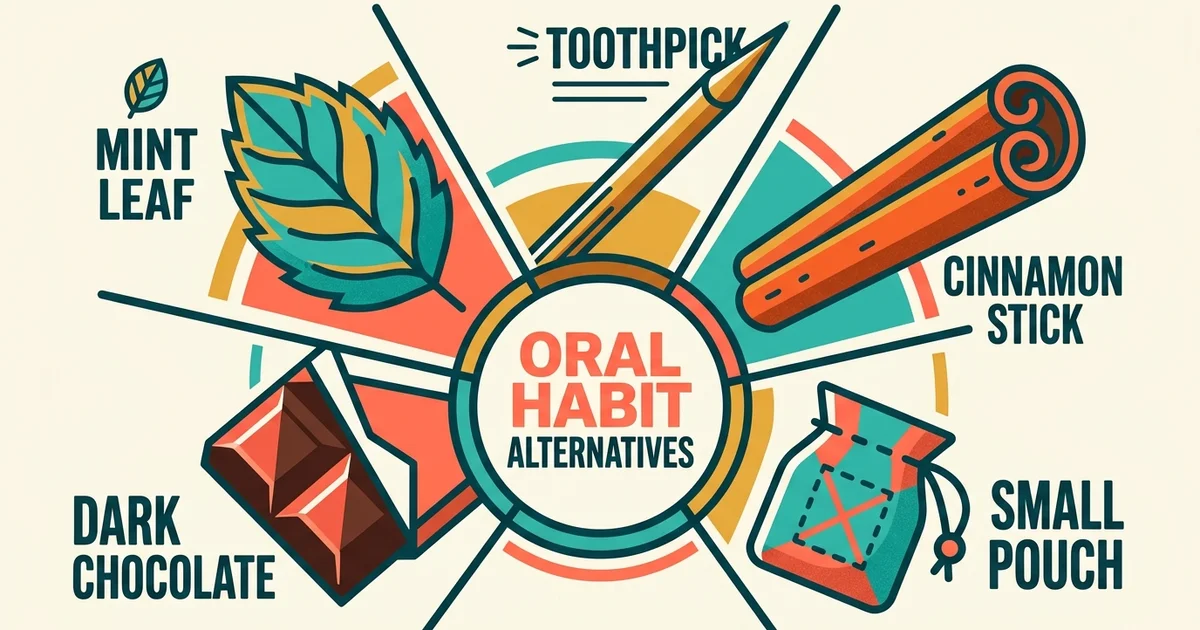
Chewing on a cinnamon stick. If you need something in your mouth specifically, a cinnamon stick or a purpose-built oral fixation device gives you an outlet without the repetitive jaw motion of gum. It lasts longer than you'd expect and has mild antimicrobial properties.
For Focus and Energy: Where Alternatives to Chewing Gum Win
This is where the gap between gum and its replacements gets wide.
People often chew gum during work or study sessions because the act of chewing provides a mild boost in alertness. And there is some evidence for this. But the effect is small, temporary, and entirely mechanical. Gum contains no active compounds that support sustained cognitive performance.
Compare that to what we now know about specific nootropic combinations. A study published on PubMed found that 97mg of L-theanine combined with 40mg of caffeine helped participants focus attention during demanding cognitive tasks. A more recent double-blind, placebo-controlled study confirmed that the L-theanine and caffeine combination enhances attentional focus by suppressing mind wandering and deviation of attention to distracters.
A systematic review published in PMC concluded that the caffeine and L-theanine combination has shown improvement in short-term sustained attention and overall cognition.
Gum can't do any of that. It just gives your jaw something to do.
What to Look for Among Alternatives to Chewing Gum
Before you commit to any replacement, ask yourself what you actually want from it:
- Oral fixation? Go with mastic gum, jerky, or seeds.
- Fresh breath? Xylitol mints or fresh herbs.
- Stress relief? Breathing techniques and fidget tools.
- Focus and sustained energy? A functional product with active nootropic ingredients.
The best alternatives to chewing gum depend entirely on your reason for chewing in the first place. Most people chew for a mix of these reasons, which means the ideal replacement might be a combination of approaches.
For example: xylitol mints in your desk drawer for breath, a bag of fennel seeds in the kitchen for after meals, and a functional pouch for the afternoon focus window. Layer your solutions instead of looking for a single one-to-one swap.
A Smarter Option for Focus
If your gum habit was really about staying sharp during long work sessions, a stick of Doublemint was never going to cut it.
That's the thinking behind Roon, a zero-nicotine sublingual pouch built specifically for cognitive performance. It combines 80mg of caffeine with L-theanine, theacrine, and methylliberine, a stack designed to deliver 6 to 8 hours of clean, sustained focus without jitters or a crash.
You place it under your lip. The active ingredients absorb through the oral mucosa, bypassing the digestive system entirely. No chewing. No jaw strain. No sugar alcohols wreaking havoc on your gut.
Roon isn't one of those alternatives to chewing gum for everyone. But if the reason you reached for gum was to stay locked in during a long afternoon, it's worth a look at takeroon.com.