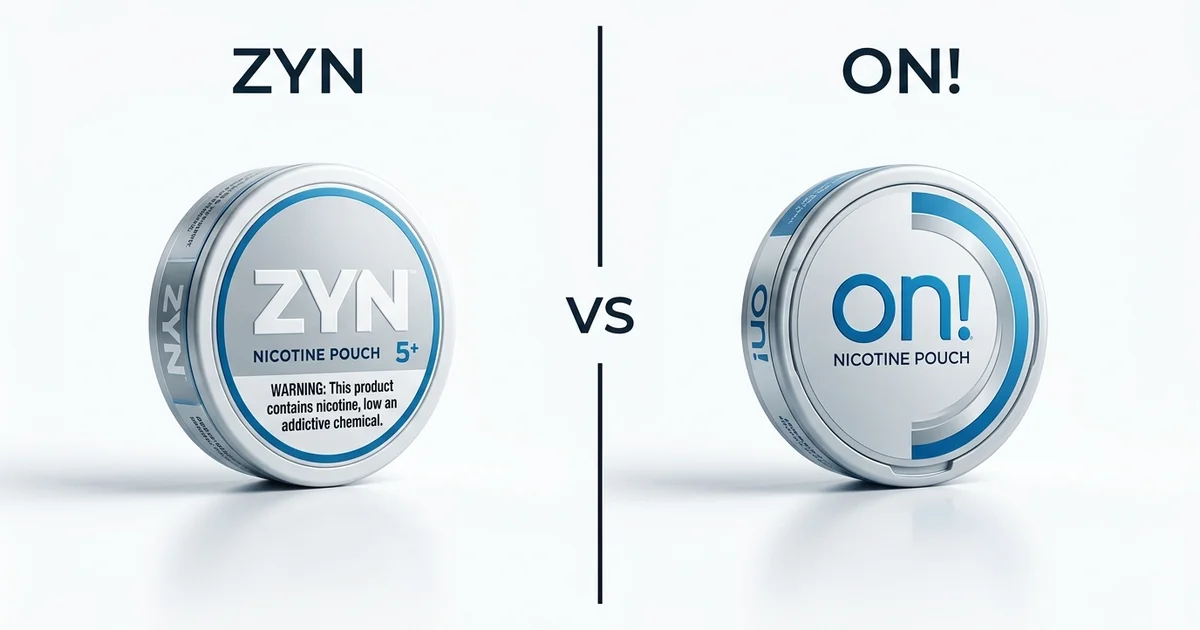
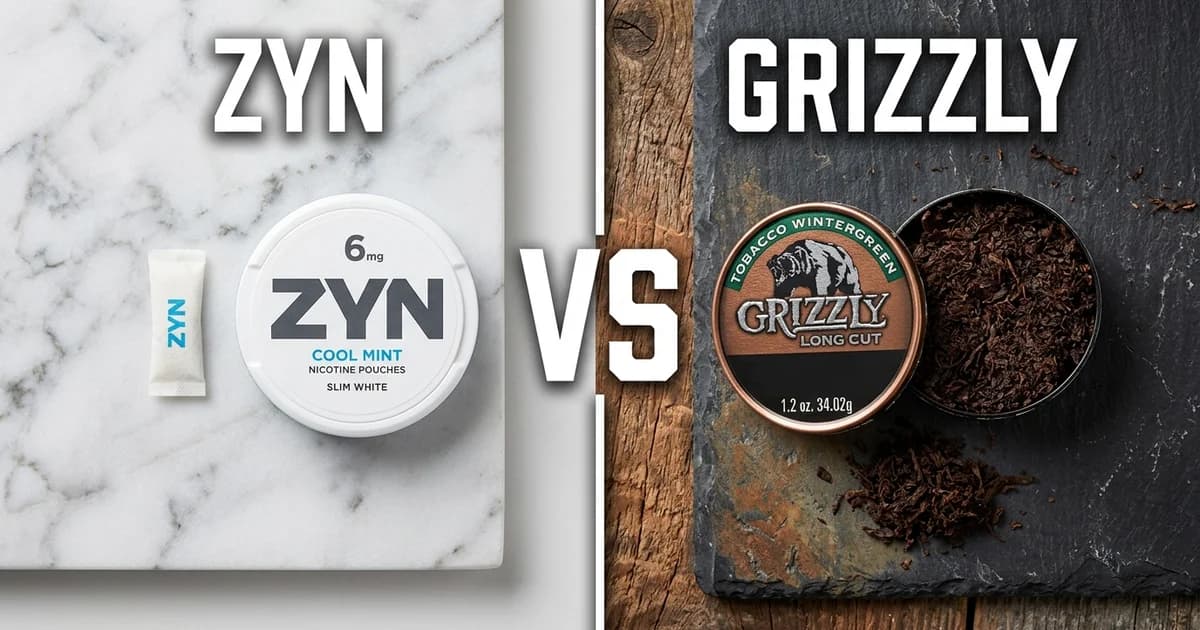
On! vs. Zyn: A Head-to-Head Comparison
On! vs. Zyn: A Head-to-Head Comparison for 2025
Two brands own the nicotine pouch market right now. If you've been weighing on! vs zyn, you're not alone. These two products sit at the top of nearly every retailer's bestseller list, and the gap between them is smaller than most people think.
But the details matter. Pouch size, nicotine source, flavor range, strength options, and price per can all differ in the on! vs zyn matchup. This guide breaks down every meaningful difference so you can figure out which one actually fits your preferences, or whether you should be looking at a different category entirely.
Key Takeaways:
- Both Zyn and On! use tobacco-derived nicotine.
- Both brands now span a wide strength range: On! runs 2mg to 8mg plus 6, 9 and 12mg in On! PLUS; Zyn runs 1.5mg to 8mg plus 9mg and 11mg in ZYN Ultra.
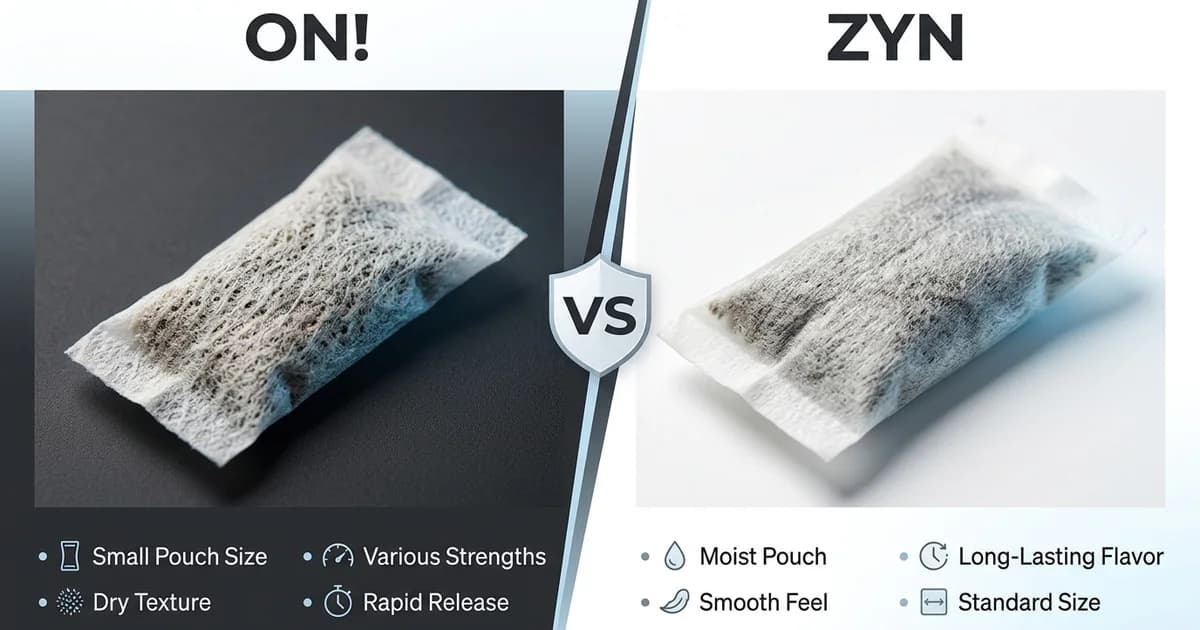
- Zyn pouches are the larger slim format; On! pouches are mini and dry.
- Zyn received FDA marketing authorization for 20 products in January 2025. On! has not received the same authorization.
- Both products carry nicotine addiction risks and potential oral health side effects.
- Roon is a zero-nicotine alternative in the same pouch format, built on caffeine, L-theanine, and two additional nootropics.
The Brands Behind On! vs. Zyn
Zyn is made by Swedish Match, now a subsidiary of Philip Morris International. It launched in the U.S. in 2014 and has dominated the category ever since. According to Global Market Insights, Zyn maintains the leading market position in the U.S. nicotine pouch space.
On! is made by Altria, the tobacco giant behind Marlboro. On! entered the market as a competitor with a different approach: smaller, drier pouches and more strength options. Altria also launched On! PLUS, a newer line with larger pouches and higher strengths.
Both brands are tobacco leaf-free, neither contains spit, and both are designed to sit under your upper lip, though comparisons like Velo pouches vs Zyn show how much varies across the wider category.
Nicotine Source: Both On! and Zyn Are Tobacco-Derived
This is a detail that gets reported wrong constantly, including by retailers. Both Zyn and On! use tobacco-derived nicotine, extracted from the tobacco plant. Altria describes on! PLUS in its own launch materials as "a spit-free, oral tobacco-derived nicotine pouch." What does that actually mean for you?
Tobacco-derived nicotine is extracted directly from the tobacco plant, which is what both of these brands use. Synthetic nicotine, manufactured in a lab without tobacco input, does exist in this category (Lucy is one example), but neither Zyn nor On! uses it. Either way the molecule delivered to your body is the same and the pharmacological effect is identical.
The practical difference is regulatory. Zyn's tobacco-derived nicotine placed it squarely under FDA tobacco authority, and in January 2025, the FDA authorized 20 ZYN products covering 10 flavor profiles in 3mg and 6mg strengths. On! has not received equivalent authorization for its products as of mid-2025.
For the end user comparing on! vs zyn, the nicotine hit feels comparable at similar milligram levels. The source doesn't change the experience in your mouth.
Strength Options
This is where the on! vs zyn comparison tilts in On!'s favor on paper.
| Feature | Zyn | On! | On! PLUS |
|---|---|---|---|
| Strengths Available | 3mg, 6mg | 2mg, 4mg, 8mg | 6mg, 9mg |
| Lowest Option | 3mg | 2mg | 6mg |
| Highest Option | 6mg | 8mg | 9mg |
Zyn keeps it simple with two strengths. On! gives you five options across its standard and PLUS lines. If you want something lighter than 3mg, On!'s 2mg is your only option between these two brands. If you want something stronger than 6mg, On!'s 8mg and On! PLUS 9mg are the clear picks.
On! may be the better brand if you're an experienced user seeking intensity and a strong kick, since it goes higher in mg per pouch than Zyn.
Pouch Size and Feel
Pouch format is another area where on! vs zyn differences are immediately noticeable. Zyn pouches are what the industry calls "slim" format. They're soft, dry to semi-dry, and sit comfortably under the lip. Each can contains 15 all-white nicotine pouches.
On! pouches are "mini dry" format. They're noticeably smaller than Zyn, which makes them more discreet but also means they take a bit longer to activate. Each can of standard On! contains 20 mini pouches, while On! PLUS cans hold 14 larger pouches.
The size difference is real. If you want something barely noticeable in your lip, On! wins. If you prefer a fuller, more traditional pouch feel with faster flavor release, Zyn has the edge.
Flavors: On! vs. Zyn Variety
Both brands offer a solid range, but the profiles differ.
Zyn's 10 flavors (all FDA-authorized): Cool Mint, Spearmint, Peppermint, Menthol, Wintergreen, Citrus, Coffee, Cinnamon, Chill, and Smooth.
On!'s 7 standard flavors: Wintergreen, Mint, Coffee, Cinnamon, Citrus, Berry, and Original. On! PLUS adds Mint, Wintergreen, and Tobacco Flavor in its larger format.
Zyn leans heavily into the mint/menthol category with four separate cool options. On! skips menthol entirely. On!'s Wintergreen pouches deliver a classic chewing-gum taste without added cooling effects, which some users prefer and others find too mild.
If you want variety within the mint family, Zyn has more options. If you want a non-menthol wintergreen or a berry flavor, On! is your pick. Flavor preference alone can settle the on! vs zyn decision for many users, and Velo vs Zyn Reddit threads show the same pattern plays out across brands.
Price
Price is another factor that separates on! vs zyn. Nicotine pouches aren't expensive, but the cost difference between brands adds up over time.
Zyn typically costs between $5 and $6 per can at most retailers. With 15 pouches per can, that works out to roughly $0.33 to $0.40 per pouch.
On! is generally cheaper. You can find cans for as little as $3.49 online, and with 20 pouches per can, the per-pouch cost drops to around $0.17 to $0.25.
| Zyn | On! | |
|---|---|---|
| Price per Can | $5.00–$6.00 | $3.49–$4.99 |
| Pouches per Can | 15 | 20 |
| Cost per Pouch | ~$0.33–$0.40 | ~$0.17–$0.25 |
On! is the clear budget winner. If you go through a can a day, the savings are meaningful over a month.
Health Considerations
No matter where you land on on! vs zyn, neither product is "safe." Both deliver nicotine, which is addictive. Period.
A 2002 review published in Nicotine & Tobacco Research (PMID: 12521400) found that chronic tolerance to nicotine develops across a range of mood effects, and that dependent and non-dependent users both show tolerance over time. This matters when you're choosing a pouch brand: the strength you start at today may not be the strength that works in six months.
Nicotine can cause heart, lung, stomach, and fertility problems, raise blood pressure, and weaken the immune system. These risks apply to both Zyn and On! equally.
On the oral health side, continuous exposure to nicotine and other ingredients can lead to inflammation, redness, ulcers, and swelling, and over time, this can contribute to gum recession. This is true regardless of which brand you choose.
The honest answer: if you don't currently use nicotine, neither of these products is for you. If you do, pouches are widely considered less harmful than combustible cigarettes, but "less harmful" is not the same as "harmless."
The On! vs. Zyn Verdict: Which One Wins?
There's no universal answer to the on! vs zyn question. It depends on what you prioritize.
Choose Zyn if you want: FDA-authorized products, a larger and more comfortable pouch, strong mint/menthol variety, and you're fine with 3mg or 6mg.
Choose On! if you want: More strength options (especially below 3mg or above 6mg), a smaller and more discreet pouch, lower per-can pricing, and a non-menthol wintergreen.
Both are solid products from major tobacco companies. Both will deliver nicotine reliably. And both come with the same fundamental tradeoff: you're feeding an addiction. That's the bottom line in any on! vs zyn comparison.
On! vs. Zyn vs. Roon: A Third Option Without Nicotine
If your comparison includes the pouch format but not necessarily nicotine, Roon belongs in the table. It sits in a different product category, zero nicotine, but uses the same delivery mechanism for a different purpose: cognitive performance.
| Brand | Active Compounds + Exact Mg | Nicotine-Free | Duration | Price/Pouch | Ingredient Transparency |
|---|---|---|---|---|---|
| Zyn | Nicotine 3mg or 6mg (tobacco-derived) | No | ~45–60 min | ~$0.33–$0.40 | Partial |
| On! | Nicotine 2mg, 4mg, or 8mg (tobacco-derived) | No | ~30–45 min | ~$0.17–$0.25 | Partial |
| Roon | Caffeine 80mg, L-Theanine 60mg, Methylliberine (Dynamine) 25mg, Theacrine (TeaCrine) 5mg | Yes | 6–8 hr | ~$2.00 | Full (label + website) |
Roon's per-pouch cost is higher, but the duration is substantially longer and the ingredient stack is fully disclosed. A 2008 study in Nutritional Neuroscience (PMID: 18681988) found that combining caffeine with L-theanine improved attention-switching and reduced distractibility compared to caffeine alone, which is the core rationale behind Roon's 80mg/60mg ratio.
The categories serve different needs. Zyn and On! deliver nicotine. Roon delivers a nootropic stack. If the reason you're reaching for a pouch is focus rather than nicotine, they're not interchangeable, but they are worth comparing on the same page.
Frequently Asked Questions
Does On! or Zyn have more nicotine strength options?
Both brands now cover a wide range. Standard On! comes in 2mg, 4mg, and 8mg. On! PLUS adds 6mg, 9mg and 12mg (the 12mg is not FDA-authorized). Zyn's standard line now offers 1.5mg, 3mg, 6mg, and 8mg, and ZYN Ultra adds 9mg and 11mg, so both brands now cover very low and high doses.
Which is cheaper per pouch, On! or Zyn?
On! costs roughly $0.17 to $0.25 per pouch, compared to $0.33 to $0.40 for Zyn. On! cans also contain 20 pouches versus Zyn's 15, so the per-use savings compound quickly. For daily users, On! is meaningfully cheaper at most price points.
Is On! safer than Zyn?
No. Both use tobacco-derived nicotine and the chemical delivered to your body is identical. Neither is "safer" in terms of addiction potential or health effects.
Why does Zyn have FDA authorization but On! does not?
Both brands sit under FDA tobacco product authority, which requires a premarket tobacco application (PMTA). Zyn completed that process and received authorization for 20 products in January 2025. On! PLUS followed in December 2025 with six authorized products. Authorization is a legal market-status decision; the FDA is explicit that it "does not mean these tobacco products are safe, nor are they 'FDA approved.'"
Do nicotine pouch users build tolerance over time?
Yes. A 2002 review in Nicotine & Tobacco Research found that chronic tolerance to nicotine's mood effects develops in both dependent and non-dependent users. In practical terms, the strength level that satisfies you today may feel weaker after months of regular use, which is one reason the full strength range of On! tends to matter more over time than it does on day one.
What is a nicotine-free alternative to On! and Zyn in the same pouch format?
Roon is a sublingual pouch with zero nicotine. It uses 80mg caffeine, 60mg L-theanine, 25mg methylliberine (Dynamine), and 5mg theacrine (TeaCrine) to support sustained focus for 6 to 8 hours. It sits in a completely different product category from nicotine pouches, but shares the same format and discretion. See Roon for details.
What If You Want the Focus Without the Nicotine?
Here's the thing most people won't say out loud: a lot of nicotine pouch users aren't chasing a nicotine buzz. They want the focus. The alertness. The feeling of being locked in during a long work session or a tough workout.
If that sounds familiar, there's a different category worth knowing about. Roon is a sublingual pouch built specifically for cognitive performance, with zero nicotine. It uses a stack of Caffeine (80mg), L-Theanine, Theacrine, and Methylliberine to deliver 6 to 8 hours of sustained focus without jitters, crashes, or tolerance buildup.
No nicotine. No tobacco. Just clean, sustained mental clarity in the same convenient pouch format.
If you've been researching on! vs zyn for the focus benefits and wondering whether you actually need the nicotine, see how Roon compares.
The Case for a Tolerance-Free Stack
A lot of nicotine pouch users aren't chasing a nicotine buzz. They want the focus, and the research on nicotine tolerance suggests that the more you use, the harder it gets to get that feeling back.
Roon is built around a different premise. No nicotine, no tolerance buildup. Its 4-ingredient stack, 80mg caffeine, 60mg L-theanine, 25mg Dynamine, and 5mg TeaCrine, is designed to deliver 6 to 8 hours of sustained mental clarity in the same discreet pouch format you're already used to. The caffeine-theanine ratio specifically targets the jitter problem: L-theanine smooths the edges of caffeine's stimulation without blunting the focus.
Roon is not a nicotine replacement product. If you're using Zyn or On! for nicotine itself, Roon does not substitute for that. But if you're using it for the cognitive edge, it's worth knowing a zero-nicotine option with fully disclosed ingredients exists in the same format. Try Roon if the focus is the point.
By Roon Team