How to Stop Doomscrolling: What Actually Works
Roon Team
How to Stop Doomscrolling: What Actually Works
To stop doomscrolling, stop relying on willpower and make the feed harder to reach. In experiments, a short forced delay before an app opens cut app opens by 57% over six weeks. Grayscale mode cut screen time immediately. A 30-minute daily cap on social apps lowered loneliness and depression scores in three weeks. The common thread across every trial that worked: change the phone, not the promise you make to yourself.
Key Takeaways
- Friction beats intention. Every tested intervention changes the phone itself, not your motivation.
- Three fixes have published trial data: a delay-and-dismiss app, grayscale mode, and a daily time cap.
- Expect to get your time and attention back first. One trial found less screen time but no immediate change in well-being.
- The hardest version (blocking all mobile internet) produced the broadest improvements, but only 25.5% of participants managed to comply.
What Has Actually Been Tested
| Fix | What the study did | Result | Study |
|---|---|---|---|
| Delay + dismiss button (one sec app) | Pop-up with a short wait and option to close before the app opens; 280 users, 6 weeks | App opens fell 57%; 36% of attempts ended with the user closing the app | Grüning et al., PNAS 2023 |
| Grayscale mode | Phones set to grayscale vs. self-monitoring; N=112, several weeks | Immediate, significant screen time reduction; self-set time limits worked more slowly | Zimmermann & Sobolev, Cyberpsychology Behav. Soc. Netw. 2023 |
| 10 min per platform per day (~30 min total) | Facebook, Instagram, Snapchat capped at 10 min each; 143 undergrads, 3 weeks | Significant reductions in loneliness and depression vs. control | Hunt et al., J. Soc. Clin. Psychol. 2018 |
| Block all mobile internet for 2 weeks | Freedom app blocked mobile internet; calls, texts, desktop stayed; n=467, 1 month | Improved mental health, well-being, and sustained attention; 91% improved on at least one measure | Castelo et al., PNAS Nexus 2025 |
One caveat on the last row: only 25.5% of participants who committed to the two-week block met the preregistered compliance threshold. Blocking mobile internet works. Sticking to it is another problem.
What Is Doomscrolling?
Merriam-Webster defines doomscrolling as spending excessive time scrolling through online content, especially news, that makes you feel sad, anxious, or angry. First known use: 2020. A 30-day daily-diary study during COVID-19 found social media exposure was associated with increased depression and PTSD symptoms, more strongly in people with more severe childhood maltreatment histories. Traditional media sources did not show the same pattern. The feed, not the news, is the delivery mechanism.
Why You Can't Just Stop
Infinite feeds have no natural stopping cue. A book has a chapter end. A newspaper has a back page. An Instagram or TikTok feed regenerates the moment you reach the bottom. Your thumb literally never hits a wall.
Negative content holds attention longer than positive content. That is not a character flaw. Threats get priority processing across attention research, and the feed's ranking algorithms learn what holds you. Upsetting content holds you. So the feed serves more of it.
The phone is always within reach. Yale New Haven Health's Dr. Berlin puts it plainly: this is not an issue of willpower, because you will engage with the phone unknowingly. Stimulus control, putting barriers between you and the thing that is hard to disengage from, works better than resolve.
That trio (no stopping cue, negativity bias in the algorithm, zero physical distance) is why "just put the phone down" fails. The fixes that work change one or more of those three variables. For more on how feeds erode sustained attention, see brain rot and shrinking attention.
How to Stop Doomscrolling: 7 Fixes, Ranked by Evidence
1. Put a delay in front of the app (tested)
Install a friction app that forces a short pause before your target apps open. The one sec trial (280 participants, 6 weeks, PNAS) found that a pop-up combining a brief wait with an option to dismiss reduced actual app opens by 57%. A preregistered experiment (N=500) within the same paper found the dismiss button carried the most weight; the deliberation message alone was not effective. Disclosure: one of the study's authors created one sec. The data is peer-reviewed, but you should know that.
2. Turn the screen gray (tested)
Switch your phone to grayscale mode. In a preregistered field experiment (N=112, several weeks), grayscale led to an immediate, significant reduction in objectively measured screen time compared with a control group doing self-monitoring. Self-commitment to time limits produced a smaller and more gradual drop. On iPhone, go to Settings > Accessibility > Display & Text Size > Color Filters > Grayscale. On Android, the path varies by manufacturer, but search "grayscale" in Settings.
3. Cap social apps at about 30 minutes a day (tested)
The "No More FOMO" trial (143 University of Pennsylvania undergrads, 3 weeks) limited Facebook, Instagram, and Snapchat to 10 minutes per platform per day. The limited group showed significant reductions in loneliness and depression versus control. Both groups showed reduced anxiety and fear of missing out, which the authors attribute to self-monitoring alone. One practical add not from the study: have someone else set your Screen Time or Digital Wellbeing passcode so you cannot tap "ignore limit."
4. Cut mobile data to the feed apps (tested, with a caveat)
The most aggressive tested version: Castelo et al. (PNAS Nexus 2025) used the Freedom app to block all mobile internet on participants' phones for two weeks. Calls, texts, and desktop internet stayed available. The result: improved mental health, subjective well-being, and objectively measured sustained attention. People spent more time socializing in person, exercising, and in nature.
The honest caveat: of 467 who committed, only 266 set up the app, and 119 (25.5%) met the preregistered compliance definition. A lighter version, blocking data only for specific social apps while keeping them on a laptop, is an extrapolation, not what the study tested. But it follows the same logic: make the feed reachable only from a device that requires more effort.
5. Charge the phone outside the bedroom (clinical advice, not trial-tested here)
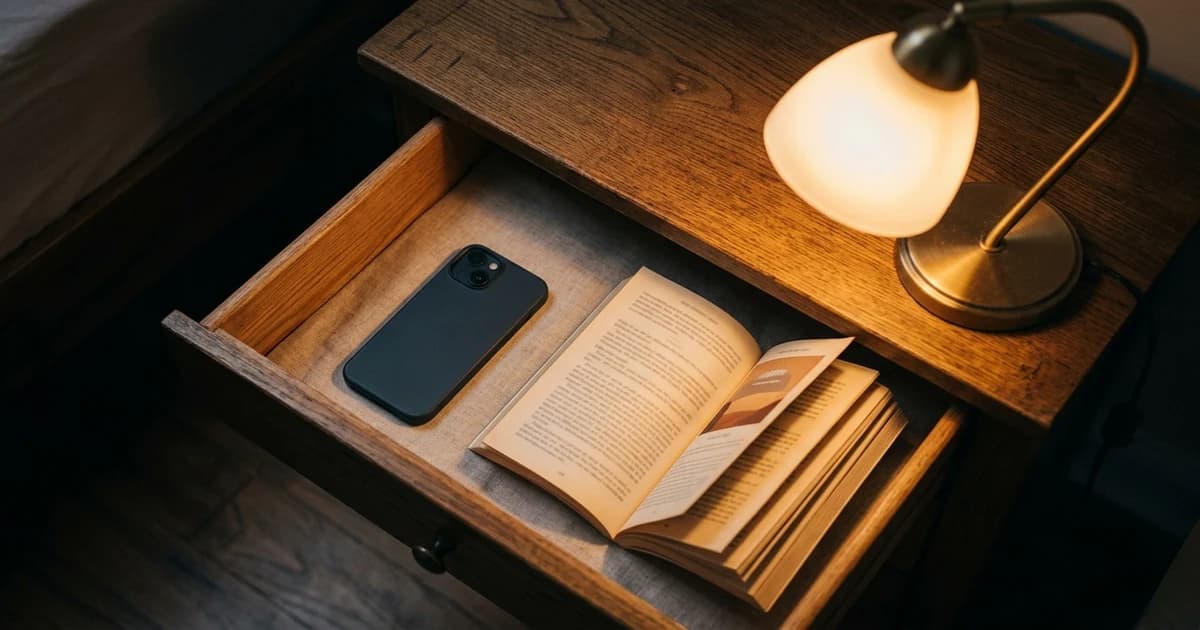
Yale New Haven Health and Cleveland Clinic both recommend putting the phone away before bed. Buy a cheap alarm clock. The phone goes in a drawer in another room at least 30 to 60 minutes before lights out. This is standard clinical guidance, not something measured in the randomized trials above, but it directly eliminates the physical proximity problem.
6. Replace the feed with a finite source (untested, logical)
Subscribe to one newsletter, one podcast, or a print magazine. A finite source has a built-in stopping cue: it ends. This has not been measured in a randomized trial, but it directly addresses the "no stopping cue" mechanism. The goal is not less information. It is information that comes in a container with a bottom.
7. Give the pickup a replacement action (untested, habit substitution)
When you catch yourself reaching for the phone, do something specific for 60 seconds: stand up, fill a glass of water, do ten pushups, open a physical book. The pickup is automatic, so willpower to not do it fails. A competing physical action has a better chance of interrupting the loop. This is habit-substitution logic, widely used in behavioral therapy, but not tested specifically for doomscrolling in the trials here.
How to Stop Doomscrolling at Work
The pickup at work does not happen randomly. It clusters at task boundaries and at the moment a task gets difficult. Your brain looks for an exit, and the phone is the nearest one.
Two structural changes help. First, put the phone in a bag or another room during focus blocks. If you need brown noise for focus blocks, play it from a laptop or a speaker. Second, schedule one deliberate news check per day, 10 minutes, at a set time. The check is not the enemy. The unplanned, repetitive scroll between tasks is. For a full walkthrough, see focusing at home when everything is a distraction.
How to Stop Doomscrolling Before Bed
Night is the highest-risk window. The brain is depleted, resistance is low, and the bed is where the phone lives if you charge it on the nightstand. Cleveland Clinic notes that doomscrolling can disrupt sleep. Yale New Haven Health recommends putting the phone away 30 to 60 minutes before bed. The minimum viable version: buy an alarm clock, charge the phone in another room, pick up a book or a podcast with a sleep timer. That is fix 5 and fix 6 combined.
What Stopping Will and Won't Do
Be honest about what the evidence shows. The Castelo et al. trial (blocking mobile internet) found improvements across attention, mental health, and well-being. But the Zimmermann & Sobolev trial (grayscale and time limits) found reduced screen time with no immediate causal effect on subjective well-being or academic performance.
So expect to get your time and attention back first. How you feel may take longer to shift, or it may depend on what you do with the recovered hours. A 14-day attention rehab protocol with a baseline and retest gives you a structured way to track improvement, and how attention is measured explains the tests behind it. For the difference between passive stimulation and active recovery, see what a "dopamine detox" can and cannot do.
Pick Two Fixes Tonight
Friction beats intention. That is the single line running through every trial in the table above. The interventions that worked changed the phone, not the person's resolve.
You do not need all seven. Pick two: one from the tested rows (delay app, grayscale, or the 30-minute cap) and one structural change (phone out of the bedroom, a finite news source, a replacement action). Try them for three weeks, the shortest trial duration that showed measurable results.
Frequently Asked Questions
Why do I doomscroll even when it makes me feel worse?
Your brain prioritizes threats, and negative content holds your gaze longer. The algorithm learns this and serves more of it. The phone is always within reach, the feed never ends, and that combination overrides your conscious intention to stop. It is not a willpower failure. It is a design mismatch between how your attention works and how the feed is built.
Is doomscrolling bad for your mental health?
Association studies say yes. A 30-day daily-diary study found social media exposure was associated with increased depression and PTSD symptoms. A cross-sectional study found doomscrolling was associated with psychological distress, which mediated its relationship with lower life satisfaction and mental well-being. These are associations, not proof of causation. If mood or anxiety symptoms persist after reducing your screen time, talk to a clinician.
Do screen time limits work?
They work, but not as well as friction. In the Zimmermann & Sobolev trial, self-set time limits produced a smaller and more gradual reduction in screen time than grayscale mode. The bigger problem is the "ignore limit" button. Built-in screen time limits on iOS and Android let you dismiss the warning in one tap. Having someone else hold the passcode removes that escape hatch.
What is the best app to stop doomscrolling?
The only app with a published, peer-reviewed trial is one sec (PNAS 2023, 280 users, 6 weeks, 57% reduction in app opens). Disclosure: one of the study's authors created the app. Other blocker and friction apps exist, but none have published comparable experimental data, so this article does not rank them.
How long does it take to break a doomscrolling habit?
The trials here ran two to six weeks. The 30-minute cap study measured results at three weeks; the one sec study tracked users for six. No study gives a specific day count for "habit broken," and anyone who quotes one is guessing. Three weeks is a reasonable minimum to expect measurable changes in screen time.
Does grayscale mode really help?
Yes, with a caveat. The Zimmermann & Sobolev field experiment (N=112) found grayscale led to an immediate, significant reduction in screen time. But the same study found no immediate causal effect of reduced screen time on subjective well-being or academic performance. Grayscale gets you off the phone. Whether that alone makes you feel better is a separate question, and the evidence so far says not right away.
Friction for the Phone, a Longer Runway for the Work
Every fix in this article targets the phone. None of them address the other half of the problem: the energy dip that triggers the pickup in the first place. You reach for the feed when focus fades, usually mid-afternoon, usually when a task gets hard.
A Roon pouch does nothing about a feed. It cannot fix your notification settings or move your phone to another room. What it can do is address the afternoon sag behind the pickup. One pouch delivers 80 mg caffeine, 60 mg L-theanine, 25 mg methylliberine (Dynamine), and 5 mg theacrine (TeaCrine) in a zero-nicotine, zero-sugar sublingual format. A 2025 meta-analysis (PMID 40314930) found the caffeine-plus-L-theanine combination improved attention-switching accuracy and alertness. Methylliberine slows caffeine's clearance: in a randomized, double-blind crossover study (n=12), co-administration of 100 mg methylliberine with 150 mg caffeine cut caffeine's oral clearance from 41.9 to 17.1 L/hr and extended its half-life from 7.2 to 15 hours, with no higher peak. Roon uses 25 mg methylliberine with 80 mg caffeine (roughly a quarter of the study's methylliberine and half the caffeine), so the magnitude will differ, but the mechanism is directionally the same: same peak, longer tail, for a felt window of 6 to 8 hours.
The trade-off: a longer half-life means stopping at least 8 hours before bed. Late caffeine and a late feed wreck the same night. From $9.16 per tin on the 12-tin subscription ($0.61 per pouch) or $15.00 per tin one-time for 4 tins. First-order 30-day money-back guarantee. Try Roon for the longer runway.
Related from Roon
- Brain Rot and Shrinking Attention
- A 14-Day Attention Rehab Protocol
- Cheap Dopamine vs. Real Dopamine
- How to Actually Focus Working from Home
Written by Roon Team