How to Rebuild Attention Span: A 14-Day Rehab Protocol With a Baseline and a Retest
How to Rebuild Attention Span: A 14-Day Rehab Protocol With a Baseline and a Retest
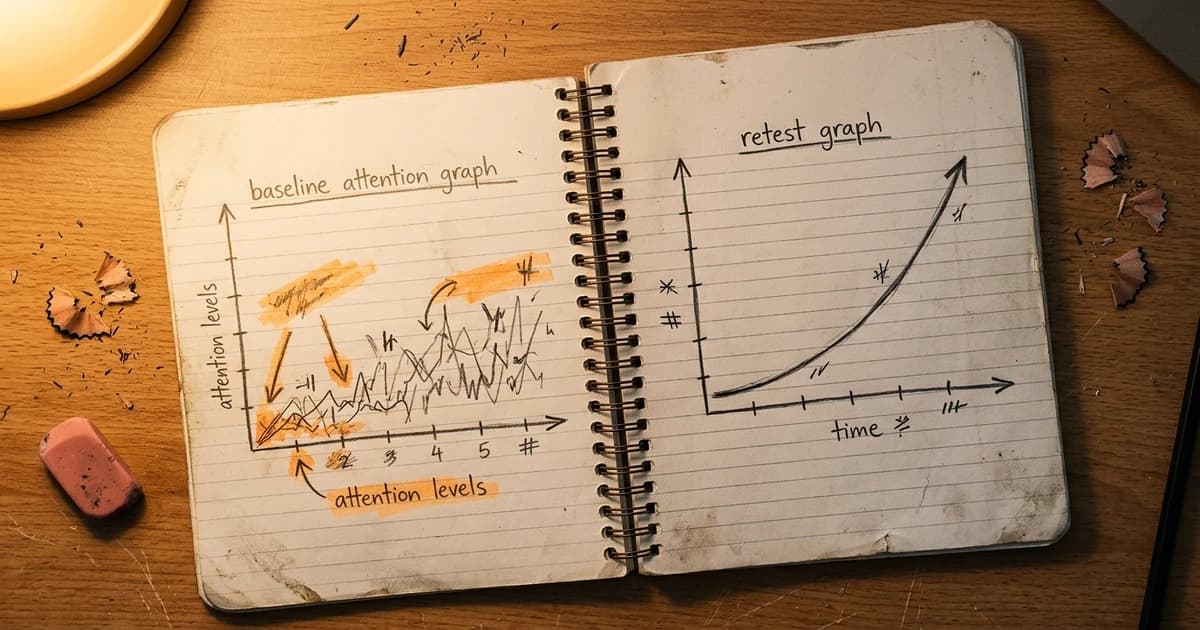
If you want to know how to rebuild attention span, start by measuring what you actually do, whether with a stopwatch or a timed attention span test. Time how long you stay on one task before you pull yourself away. Write that number down. Then run one growing single-task block per day for two weeks, starting at 12 minutes and ending at 40, with a phone rule, a 40-second green break, a one-minute boredom rep, and a short focus practice on four days per week. On day 14, measure again. That is the entire protocol, and the rest of this page is the schedule, the evidence behind each element, and an honest account of what two weeks can and cannot do.
Key Takeaways
- Day 0 and day 14 are measurement days. You time your first self-initiated switch away from a single task, and count total switches in 25 minutes. Two data points beat zero.
- The daily work is one single-task block, starting at 12 minutes and climbing to 40 by the end. The ladder is an editorial design, not a tested protocol.
- Five elements, graded honestly. The green micro-break and the focus practice have direct trial support. The phone rule has a mixed record. The block ladder and the boredom rep are reasonable design choices without their own randomized evidence.
- Two weeks is half of what the research tested. The shortest mindfulness-based attention training program with randomized support ran four weeks. This protocol borrows from it and says so.
What "Attention Span" Means in This Protocol
It is a behavior: how long you stay on one thing before you switch yourself away. Not a trait, not a diagnosis, not a score.
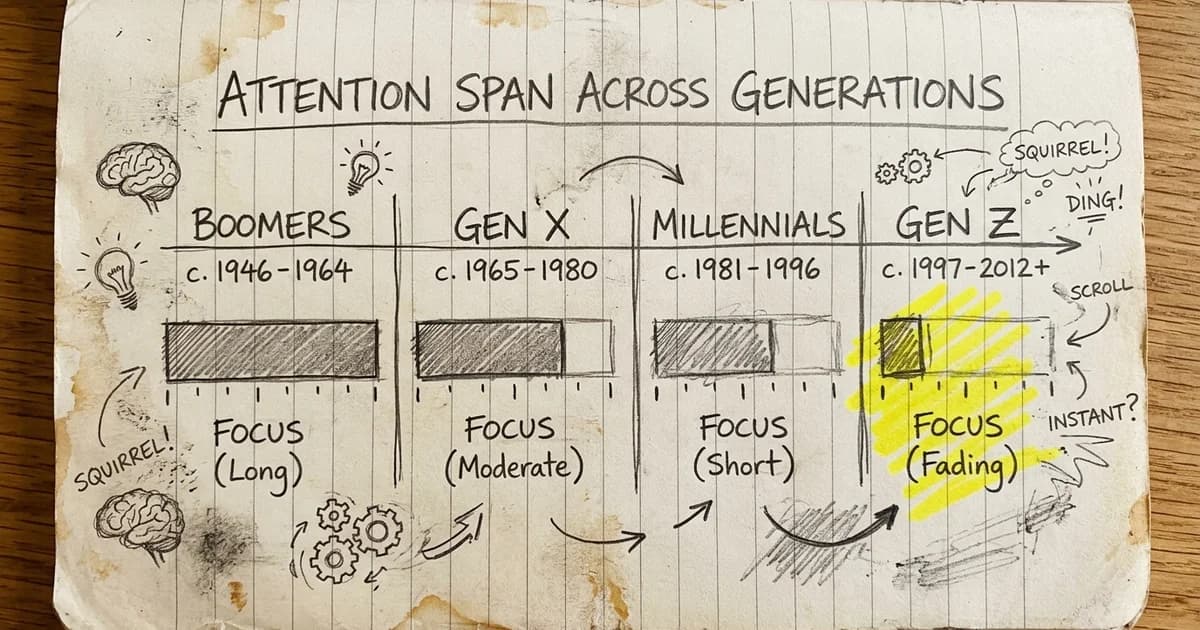
Gloria Mark, a professor of informatics at UC Irvine, has been measuring how long knowledge workers stay on a single screen before switching. The average dropped from about 150 seconds in 2004 to 75 seconds in 2012, and to 47 seconds by 2024. That 47-second number measures switching behavior on screens. It is not a biological limit on how long you can pay attention.
The goldfish comparison is wrong too. The "8-second attention span, shorter than a goldfish" figure came from a 2015 Microsoft Canada infographic that sourced it to a site called Statistic Brain, which had no underlying source. The BBC investigated it in 2017 and found no evidence for the goldfish's supposed 9-second span either.
A 2026 update worth flagging: several "attention span statistics 2026" pages now cite a "7.2 second" figure from a "Global Attention Metrics report, Microsoft Research, March 15, 2026." No such report exists. It is the same fabricated statistic with a new date, laundered through stat-aggregator sites. If you see it, ignore it.
Where "Attention Span Rehab" Came From
The phrase lives on TikTok. Los Angeles artist Lizi Phoenix (@liziphoenix) makes long, slow watercolor and Zentangle videos, sometimes over eight minutes, and asks viewers to follow along. Child psychiatrist Yann Poncin of the Yale School of Medicine said the videos work by offering a break from short-burst content and by countering algorithmic novelty-seeking.
Watching a calm video for eight minutes is a pleasant experience. It is not a training program. You do not get stronger by watching someone else lift. The "attention span rehab" format is a starting point, not a protocol, which is why this page exists. For more on what short-form video does to attention in research, that is a separate and more complicated question.
Day 0: The Baseline
Pick one task with no audio and no second screen. Reading a chapter of a book, writing longhand, or working through a single document all qualify. Set a stopwatch. Start.
Stop the clock the moment you switch away on your own. That means the moment you reach for your phone, open a new tab, or stand up to do something else because you felt like it. An interruption from another person, a fire alarm, or a notification you did not choose does not count. Restart the clock if that happens.
Write down two numbers:
- Minutes to your first self-initiated switch.
- Number of self-initiated switches in 25 minutes (restart the task each time and keep the stopwatch running).
This is a stopwatch reading, not a screening instrument or a clinical assessment. It tells you what you did on one day, not what is wrong with you. If you want context on what an attention span test actually measures and how most of them are self-report quizzes, that page covers it.
The Five Daily Elements (and What the Evidence Supports)
1. The Single-Task Block
One block per day. No second screen, no background audio, no phone in the room. The block starts at 12 minutes on day 1 and climbs to 40 by day 14.
The ladder is an editorial design for this article. No trial has tested it. The logic behind it: Mark's research found that recovering from an interruption takes roughly 25 minutes, so a block shorter than about 25 minutes spends most of its length in recovery. Psychologist David Meyer's estimate is that switching between tasks can cost up to 40% of productive time. The block ladder exists to build you past the 25-minute mark gradually.
2. The 40-Second Green Break
After each block, look at something green and alive for 40 seconds. A window with trees, a plant on your desk, or a photo of a green landscape on your phone (then put the phone back).
This one has a trial behind it. Lee et al. (2015) tested 150 university students on a sustained-attention task. A 40-second view of a flowering green roof, compared with a bare concrete roof, improved performance on the task afterward. Berman, Jonides, and Kaplan (2008) found that nature walks improved directed-attention performance. A 40-second look at greenery is the smallest break with a controlled trial behind it. Do not extrapolate to "nature heals attention." The effect was modest and task-specific. More on the mechanism in this breakdown of attention restoration theory.
3. Phone in Another Room
During the block, your phone is not on your desk. It is in another room, or at minimum in a bag you cannot see.
Ward et al. (2017) tested roughly 800 participants and found that a phone on the desk, even face down, reduced available working-memory capacity compared with a phone in another room. But a 2022 replication did not reproduce the effect, and a 2023 meta-analysis found the effect small and inconsistent. The evidence is mixed. The cost of trying is zero.
4. The Unfilled Minute
Once a day, sit and do nothing for 60 seconds. No phone, no music, no fidgeting with purpose. Just one minute.
This is a boredom rep, not meditation. Wilson et al. (2014) ran a series of studies and found that 67% of men and 25% of women chose to give themselves an electric shock rather than sit with their own thoughts for 6 to 15 minutes. The claim here is only that tolerating an unfilled minute is a behavior you can practice. No trial in this brief tested whether boredom tolerance improves attention span.
5. Fifteen Minutes of Focused-Attention Practice
On four days per week, sit quietly and hold your attention on one thing (your breath, a sound, a candle) for 15 minutes. When your attention wanders, bring it back. That is the entire instruction.
This element has the strongest research behind it. The Mindfulness-Based Attention Training (MBAT) program from Amishi Jha's lab at the University of Miami is an 8-hour, 4-week course with 15 minutes of practice 3 to 4 days per week. In high-demand cohorts including military service members, the 4-week group showed improved sustained attention and working memory compared with no training and compared with a shorter 2-week course. A 2024 randomized trial found that four weeks of meditation improved sustained attention in older adults.
The honesty this article turns on: the shortest program with randomized support is four weeks. This protocol runs two. It borrows the dose (15 minutes, four days a week) and cuts the duration in half. Two weeks is long enough to practice the behavior. It has not been shown, at that length, to change measured attention in a trial. For the full picture on what mindfulness does to attention in controlled studies, that page goes deeper.
The 14-Day Schedule
This ladder is an editorial design. It has not been tested as a unit. Each element draws on the research cited above, but the progression and the combination are this article's structure, not a clinically validated program.
| Day | Block Length | Focus Practice (15 min) | Boredom Rep (1 min) | Notes |
|---|---|---|---|---|
| 0 | Baseline test | No | Yes | Measure: minutes to first switch, switches in 25 min |
| 1 | 12 min | Yes | Yes | |
| 2 | 12 min | No | Yes | |
| 3 | 15 min | Yes | Yes | |
| 4 | 15 min | No | Yes | |
| 5 | 20 min | Yes | Yes | |
| 6 | 20 min | No | Yes | |
| 7 | 20 min | Yes | Yes | Checkpoint: review your log |
| 8 | 25 min | No | Yes | |
| 9 | 25 min | Yes | Yes | |
| 10 | 30 min | No | Yes | |
| 11 | 30 min | Yes | Yes | |
| 12 | 35 min | No | Yes | |
| 13 | 35 min | Yes | Yes | |
| 14 | 40 min + retest | Yes | Yes | Measure again: same task, same time of day |
Focus practice lands on days 1, 3, 5, 7, 9, 11, 13, and 14: eight sessions across two weeks. The research dose that showed results was 3 to 4 sessions per week over four weeks.
The Tracking Card
Copy this table or print it. The first two rows are filled in as examples.
| Day | Block (min) | Focus Practice? | Boredom Rep? | Switches Logged |
|---|---|---|---|---|
| 0 | Baseline | -- | ✓ | 5 in 25 min, first at 4:30 |
| 1 | 12 | ✓ | ✓ | 2 in block |
| 2-14 | (fill in) |
Day 7 Checkpoint: What to Do if It Is Going Badly
Three failure modes and what to do about each:
The block is too long. You cannot finish a 20-minute block without switching multiple times. Drop back two rungs (to 12 or 15 minutes) and stay there for two more days before climbing again. The schedule is a suggestion, not a test you can fail.
You keep getting interrupted by other people. That is not the thing being measured. Restart the clock. The measurement tracks self-initiated switches, so a coworker asking a question does not count. If your environment makes uninterrupted blocks impossible, try early morning or move rooms.
You did nothing for three days. Resume at the last rung you completed. Do not restart from day 1. A study of 96 volunteers (Lally et al., 2010) found the median time to form a habit was 66 days, with a range of 18 to 254 days. Missing a few days does not erase progress. Fourteen days is a trial run, not a finished habit.
Day 14: The Retest, and How to Read It
Repeat day 0 exactly. Same type of task, same time of day if possible. Time your first self-initiated switch. Count switches in 25 minutes. Compare.
What a useful result looks like: More minutes before the first switch, fewer switches in 25 minutes.
What it does not prove: Nothing about your brain, your memory, or your intelligence. Regression to the mean and practice effects both exist. You might score better on the retest just because you have done the test before. A single retest is a personal log entry, not evidence.
The supportable claim: you changed what you did each day for two weeks, and you have two measurements to compare. That is more than most people who search "how to rebuild attention span" will walk away with.
What the Evidence Does Not Support
Brain-training apps and neurofeedback. A 2024 meta-analysis (Kimura et al.) pooled 15 randomized controlled trials with 569 participants. The overall effect of neurofeedback on attentional performance in healthy adults was a standardized mean difference of 0.27, and when only sham-controlled trials were analyzed (eight RCTs), the effect was not significant. Brain-training apps and neurofeedback have not been shown to grow attention span.
The claim that two weeks of anything changes measured cognition. The best evidence for attention training comes from four-week programs, not two-week ones. This protocol runs two weeks because it is a starting point, not because two weeks is proven to be enough.
Dopamine resets. Abstaining from screens has not been shown to change dopamine receptors. The useful part of "dopamine detox" programs is stimulus control, which is what the phone rule in this protocol is. The mechanism language is not supported.
When This Page Is Not the Right Page
If difficulty concentrating has been there for years, or is affecting work, school, or relationships in a way that a 14-day protocol is not going to address, that is worth raising with a doctor. This page covers attention span exercises for adults who want to change a daily habit. It does not cover anything clinical.
Two Weeks Buys You a Measurement, Not a New Brain
The protocol on this page is not complicated. One block a day, one boredom rep, a phone in another room, a green break, and a focus practice four days a week. The honest version of how to rebuild attention span starts with measuring what you actually do, changing one behavior at a time, and measuring again. It does not promise that two weeks is enough, because the shortest trial-tested programs ran four. What it gives you is a schedule, two data points, and a clear view of what changed and what did not. If you want the wider set of habits that support longer attention, the full guide to increasing attention span covers more ground.
Frequently Asked Questions
How long does it take to rebuild your attention span?
There is no single answer. The shortest mindfulness-based attention training program with randomized trial support ran four weeks with 15 minutes of practice 3 to 4 days per week (Jha Lab, University of Miami). Habit formation research (Lally et al., 2010) found a median of 66 days to reach maximum automaticity, with a range of 18 to 254 days. Two weeks is a trial run, not a finish line.
Do attention span exercises actually work?
Some do, with caveats. Focused-attention meditation practiced for 15 minutes, 3 to 4 times per week over four weeks improved sustained attention and working memory in randomized trials. A 40-second nature break improved performance on a sustained-attention task in one controlled study. Brain-training apps and neurofeedback have not shown significant effects versus sham in pooled analyses. The exercise matters more than the label.
What is "attention span rehab" on TikTok?
It is a format popularized by Los Angeles artist Lizi Phoenix: long, slow watercolor and Zentangle painting videos, sometimes over eight minutes, that ask viewers to follow along. Psychiatrist Yann Poncin of the Yale School of Medicine described them as offering a break from short-burst content. They are calming to watch but are not a structured training program.
Is 14 days enough?
Enough to change what you do each day and produce a second measurement. Not enough to have been shown, in a randomized trial, to change measured attention. The research-backed programs ran four weeks minimum. This protocol is honest about that gap.
People search "how to fix attention span." What is the honest answer?
The honest answer is that attention span is a behavior, not a broken part. You can change the behavior by practicing longer single-task sessions, reducing self-initiated switching, and building tolerance for low-stimulus moments. You cannot "fix" it the way you fix a flat tire. For the longer version, this page addresses the "fix" framing directly.
Does reading rebuild attention span?
Reading a book (not a feed) is a single-task activity that demands sustained attention, which makes it a good candidate for the daily block in this protocol. One personal account from a reader who retrained with books described it as the most effective change they made. But no randomized trial has isolated book reading as an attention span intervention. It works as practice. Whether it works as training is unproven.
Can I do the protocol with a different starting length?
Yes. If 12 minutes is too easy, start at 20. If 12 minutes is too hard, start at 5. The ladder is an editorial design, not a fixed dose. The principle is the same: one block, no switching, gradual increase. Adjust the rungs to where you actually are.
Should I change my caffeine intake during the protocol?
The protocol does not ask you to change your caffeine intake either way. Caffeine is not one of the five elements, and controlling for it across two weeks would add a variable that makes the retest harder to read.
The Protocol Trains the Behavior. Roon Supports the Session.
This 14-day protocol asks you to sit with one task for progressively longer blocks without switching. That is a behavioral demand, not a chemical one. But if your caffeine wears off at minute 30 of a 45-minute block, the protocol gets harder for the wrong reason.
Roon is a sublingual caffeine pouch carrying 80 mg caffeine, 60 mg L-theanine, 25 mg methylliberine (Dynamine), and 5 mg theacrine (TeaCrine). The design prioritizes duration: Dynamine slows caffeine's clearance. A randomized double-blind crossover PK study (n=12) with 150 mg caffeine cut oral clearance from 41.9 to 17.1 L/hr and extended half-life from 7.2 to 15 hours with no increase in peak. That study used roughly 4x the methylliberine and 1.9x the caffeine Roon carries, so the mechanism is directionally the same but the study did not measure Roon. The practical window is 6 to 8 hours, which covers your daily block and the work that follows it. Stop at least 8 hours before bed, because sleep is what consolidates the attention gains you are building.
Roon is not a substitute for doing the actual sessions, and it will not rebuild your attention span on its own. Zero sugar, from $9.16 per tin. Try Roon on Day 1 and see if the block feels easier to finish.
Written by Roon Team