67 Brain Rot: What a Meaningless Meme Reveals About Your Shrinking Attention Span
Roon Team
67 Brain Rot: What a Meaningless Meme Reveals About Your Shrinking Attention Span
You've heard someone say "six seven" in the last 48 hours. Maybe a coworker muttered it. Maybe your kid screamed it at dinner. Maybe you caught yourself humming a melody you can't place, built around two numbers that mean absolutely nothing. That's 67 brain rot in action, and the fact that it lives rent-free in your head is the whole point.
The phrase "brain rot" earned Oxford's Word of the Year in 2024. Twelve months later, the 67 brain rot meme became its perfect mascot. Together, they tell a story about brain rot and shrinking attention, and what constant, low-value digital content is doing to human cognition. This isn't a moral panic. It's neuroscience.
Key Takeaways:
- The 67 brain rot meme has no fixed meaning, which is exactly why it spreads so effectively through your brain's reward circuits.
- "Brain rot" describes the measurable cognitive effects of excessive low-quality screen time, not just a feeling.
- Short-form video platforms are designed to exploit dopamine pathways, reducing your ability to sustain attention over time.
- Reclaiming focus requires targeting the same neurochemical systems these platforms hijack, the same systems that make 67 brain rot so sticky.
Where 67 Brain Rot Came From
The 6-7 meme exploded on TikTok and Instagram Reels in 2025. According to its Wikipedia entry, it originated from the song "Doot Doot (6 7)" by Skrilla, and it has no fixed meaning. That's not a bug. It's the feature.
The 67 brain rot phenomenon spread so far that U.S. lawmakers started referencing it on the floor. Connecticut Representative Bill Buckbee, who represents the 67th District, jokingly used the phrase during a special legislative session. Utah Representative Blake Moore did the same. When elected officials are parroting brain rot language and viral vocabulary during government proceedings, you're looking at a cultural contagion event.
The term "brain rot" gets attached to 67 because the meme is the purest distillation of what brain rot actually looks like: content with zero informational value that nonetheless colonizes your working memory. You didn't choose to remember "six seven." Your brain's pattern-recognition systems grabbed it anyway, because the short, rhythmic, repetitive structure is precisely what dopamine-driven reward circuits respond to. That's 67 brain rot in its simplest form.
What "Brain Rot" Actually Means (It's Not Just an Insult)
People throw around "brain rot" casually, but the term has a real definition now. Oxford University Press named it the 2024 Word of the Year after more than 37,000 public votes. They define it as "the supposed deterioration of a person's mental or intellectual state, especially viewed as the result of overconsumption of material considered to be trivial or unchallenging."
The key word in that definition is "deterioration." This isn't about feeling dumb after a TikTok binge. It's about measurable changes in how your brain processes information after sustained exposure to low-effort digital content, the exact kind of content that fuels 67 brain rot.
Oxford Languages President Casper Grathwohl noted that the term "speaks to one of the perceived dangers of virtual life, and how we are using our free time," as reported by PBS News. The word gained new prominence in 2024 because people started recognizing the pattern in their own lives: the inability to read a full article, the compulsive urge to check a phone during a conversation, the sense that sustained focus has become physically uncomfortable. The 67 brain rot trend only accelerated that recognition.
The Neuroscience Behind the Buzzword
Brain rot isn't a clinical diagnosis. But the cognitive effects it describes, the same effects that make 67 brain rot more than just a joke, map onto well-documented neurological processes.
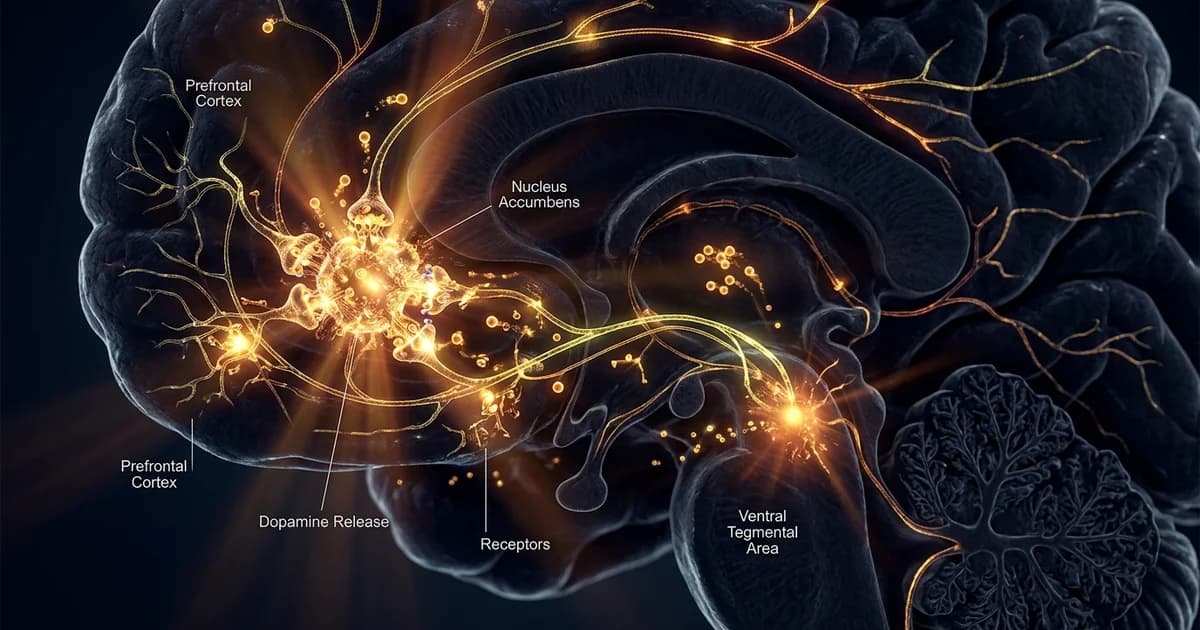
Your brain runs on a system of neurotransmitters that regulate attention, motivation, and reward. The three most relevant to this conversation are:
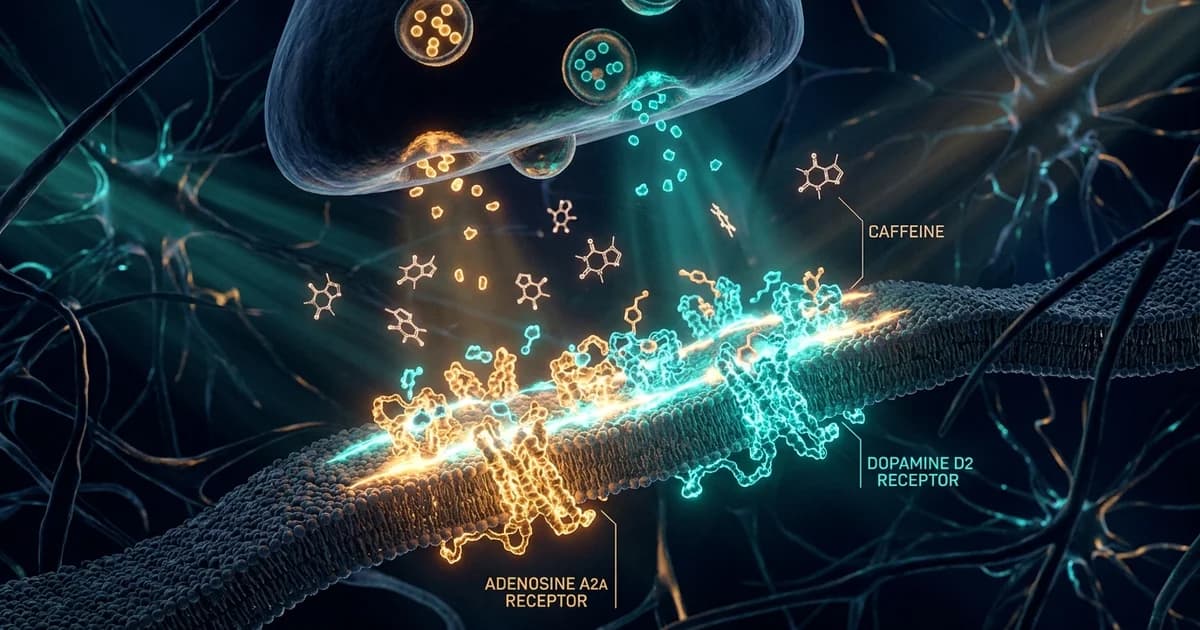
- Dopamine: The "wanting" chemical. It doesn't create pleasure. It creates the anticipation of pleasure, which drives you to seek the next stimulus.
- Adenosine: A fatigue signal. It builds up during waking hours and makes you feel mentally tired. Caffeine works by blocking adenosine receptors.
- GABA: The brain's primary inhibitory neurotransmitter. It calms neural activity. When GABA signaling is disrupted, you get anxiety, restlessness, and an inability to filter out distractions.
Short-form video platforms manipulate all three systems simultaneously. Each swipe delivers a micro-dose of dopamine. The rapid-fire novelty suppresses adenosine-driven fatigue signals (which is why you can scroll for two hours but can't read for twenty minutes). And the constant stimulation overwhelms GABA's ability to quiet irrelevant neural noise, leaving you in a state of low-grade cognitive chaos. This is the neurochemical engine behind 67 brain rot.
A research paper published in PubMed on digital dementia found that chronic sensory stimulation via excessive screen exposure affects brain development and increases the risk of cognitive, emotional, and behavioral disorders. The researchers noted effects similar to those seen in adults with symptoms of mild cognitive impairment, including impaired concentration and difficulty acquiring recent memories.
Why 67 Is the Perfect Brain Rot Case Study
Most memes carry at least some meaning. A joke. A cultural reference. A political statement. Unlike AI-generated brain rot creatures, the 67 brain rot meme carries none of that. It's two numbers and a beat. That's it.
This is what makes 67 brain rot such an effective illustration of how cognitive degradation works at the neurological level. Your brain didn't store "six seven" because it was useful or meaningful. It stored it because the pattern was:
- Short (two syllables, instant processing)
- Repetitive (the song loops, the meme repeats across videos)
- Novel enough to trigger dopamine (the first time you heard it, your brain flagged it as new information)
- Socially reinforced (everyone around you is also saying it, activating mirror neuron networks)
This is the same mechanism that makes advertising jingles stick. But advertising jingles at least serve a commercial purpose. The 67 brain rot meme serves no purpose at all, which means the cognitive real estate it occupies is pure waste. Your working memory has limited capacity. Every "six seven" loop running in the background is bandwidth that isn't available for actual thinking.
The Attention Tax You Don't Notice
A scoping review published in PMC examined the impact of screen time on cognitive function and found consistent associations between excessive passive screen use and reduced cognitive performance. The effects weren't limited to children. Adults showed measurable declines in attention, processing speed, and executive function. The 67 brain rot phenomenon is a visible symptom of these invisible declines.
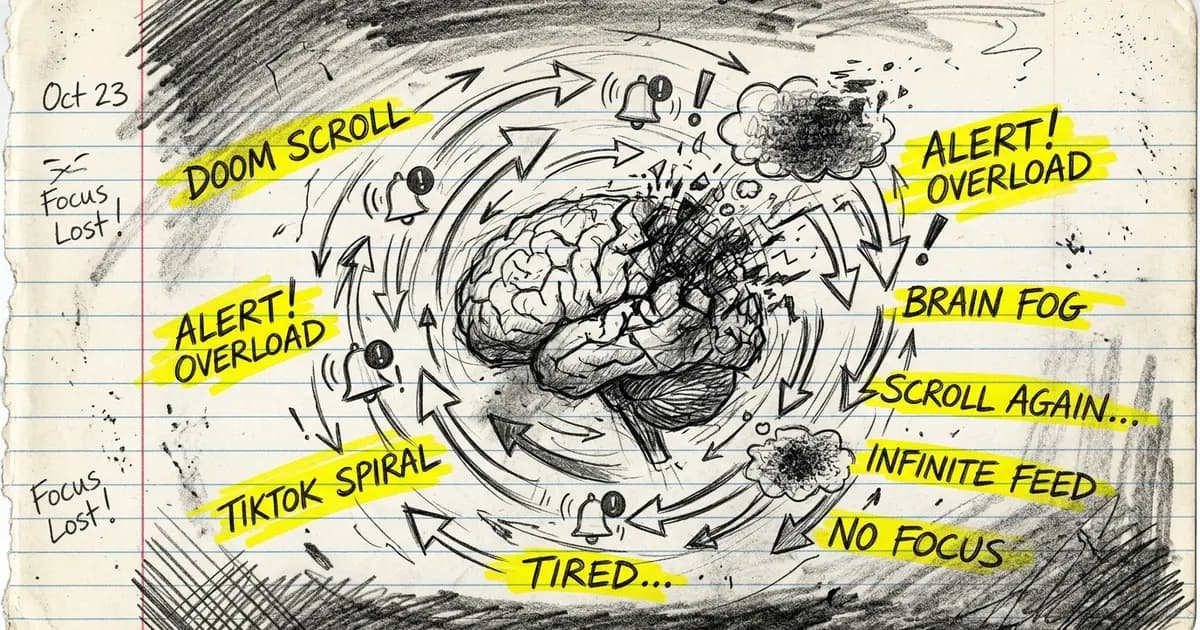
Here's what that looks like in practice. You sit down to write an email. Three sentences in, your hand reaches for your phone. You don't have a notification. You don't need to check anything. But your brain has been trained to expect a dopamine hit every 15 to 30 seconds, and the email isn't delivering one. So it sends you a craving signal disguised as boredom.
That's not laziness. That's a retrained reward circuit, the same one that makes 67 brain rot content so compulsively consumable.
Psychology Today reports that screen time for American adults has increased by over 60%, and emerging research from MIT suggests that even using AI tools for tasks like essay writing creates what researchers call "cognitive debt," a deficit in the brain's ability to perform those tasks independently.
The 67 Brain Rot Spectrum: From Harmless to Harmful
Not all low-value content consumption is equal. There's a spectrum, and understanding where you fall on it matters.
| Level | Behavior | Cognitive Impact |
|---|---|---|
| Mild | Occasional meme browsing, 15-20 min/day | Minimal. Your brain recovers quickly. |
| Moderate | 1-2 hours of short-form video daily | Noticeable reduction in sustained attention. Reading feels harder. |
| Severe | 3+ hours daily, first thing in the morning and last thing at night | Measurable changes in working memory, impulse control, and ability to delay gratification. |
| Chronic | Constant background scrolling throughout the day | Resembles symptoms of mild cognitive impairment: brain fog, poor recall, difficulty concentrating on single tasks. |
The 67 brain rot meme itself is harmless. Knowing what "six seven" means (or doesn't mean) won't damage your prefrontal cortex. But the delivery mechanism matters. If you encountered 67 once in a conversation, your brain would process it and move on. If you encountered it across 200 TikTok videos in a single session, each one triggering a small dopamine response, you've just completed a training session that teaches your brain to prefer fragmented, meaningless stimulation over sustained, meaningful engagement. That's when 67 brain rot stops being a meme and starts being a real cognitive problem.
How to Reverse 67 Brain Rot (What the Science Says)
The good news: your brain is plastic. The same neuroplasticity that allowed short-form content to reshape your attention circuits can work in reverse. But reversing 67 brain rot requires deliberate effort and, in some cases, targeted neurochemical support.
1. Enforce a Stimulus Diet
The concept is simple. Reduce the volume of low-quality inputs. In practice, this means:
- No phone for the first 60 minutes after waking. Morning cortisol and adenosine levels set the tone for your entire day. Flooding your brain with dopamine hits before you've fully woken up creates a deficit you'll chase for hours.
- Set a hard cap on short-form video consumption. Thirty minutes is a reasonable ceiling.
- Replace passive scrolling with active consumption. Reading, listening to long-form podcasts, or watching content that requires sustained attention all rebuild the neural pathways that 67 brain rot degrades.
2. Protect Your Dopamine Baseline
Your dopamine system operates on contrast. The more intense the stimulus, the deeper the subsequent dip. This is why a two-hour TikTok session leaves you feeling flat and unmotivated afterward: your baseline dopamine has dropped below normal, and everything else feels boring by comparison. That post-scroll emptiness is the hangover of 67 brain rot.
Protecting your baseline means reducing peak dopamine spikes from artificial sources. It also means supporting the neurochemical systems that regulate dopamine release and reuptake. Exercise is the single most effective tool here. A 30-minute session of moderate-intensity cardio raises baseline dopamine levels for several hours without the crash that follows digital stimulation.
3. Support Adenosine and GABA Regulation
Adenosine and GABA don't get the same press as dopamine, but they're equally important for sustained cognitive performance and for counteracting the effects of 67 brain rot.
Adenosine regulation is about sleep quality and strategic caffeine use. Caffeine blocks adenosine receptors, which is why it makes you feel alert. But too much caffeine, or caffeine consumed too late in the day, disrupts the natural adenosine clearance that happens during sleep. The result is a cycle of artificial alertness followed by deeper fatigue.
GABA support comes from compounds that promote calm, focused attention without sedation. L-Theanine, an amino acid found naturally in tea, increases GABA activity in the brain. Research has consistently shown that L-Theanine combined with caffeine produces a state of alert relaxation: improved focus and reaction time without the jitteriness or anxiety that caffeine alone can cause.
4. Train Sustained Attention Like a Muscle
Your ability to focus for extended periods is a skill, not a trait. It atrophies with disuse and strengthens with practice. If 67 brain rot has shortened your attention span, this is how you rebuild it.
Start small. Set a timer for 15 minutes and work on a single task without switching. No phone, no tabs, no music with lyrics. When the timer goes off, take a two-minute break, then do another 15-minute block. Over the course of two to three weeks, extend the blocks to 25, then 45, then 60 minutes.
This isn't productivity advice. It's cognitive rehabilitation. You're literally rebuilding the prefrontal circuits that sustained attention depends on.
The Bigger Picture: Why 67 Brain Rot Matters Beyond Memes
The 67 meme will fade. Another meaningless sound will replace it within weeks. That's the nature of internet culture. But the underlying pattern behind 67 brain rot won't change unless the way you interact with digital content changes.
Every generation has had its version of brain rot, from surreal memes that hijack attention to television and video games. Television was going to rot your brain in the 1960s. Video games were going to rot your brain in the 1990s. The difference now is speed and volume. A television show delivered one narrative arc over 30 minutes. TikTok delivers hundreds of unrelated stimuli in the same window. The sheer density of context-switching is what makes modern brain rot, including the 67 brain rot variety, qualitatively different from its predecessors.
The 67 brain rot meme is a symptom. The disease is a digital environment engineered to capture and hold attention at the expense of cognitive depth. Recognizing that is the first step. Doing something about it is the second.
Cut Through the 67 Brain Rot Fog
If you've read this far (genuinely, the whole way, without checking your phone), you've already demonstrated that your sustained attention circuits aren't completely offline. That's a good sign.
But if the fog is real for you, if deep focus feels like it requires more effort than it used to, the neurochemistry behind that experience is well understood. Adenosine buildup makes you feel mentally heavy. Disrupted GABA signaling makes it hard to filter noise. And a dopamine system trained on rapid-fire stimulation, the kind that makes 67 brain rot so contagious, makes everything that requires patience feel unrewarding.
Roon was built around this exact problem. Its sublingual pouch delivers 80 mg of caffeine, L-theanine, methylliberine, and theacrine directly into your system, targeting the adenosine, GABA, and dopamine pathways that 67 brain rot disrupts. No nicotine. No jitters. No crash. Just 6 to 8 hours of clean, sustained focus.
Your brain adapted to the scroll. It can adapt back. Give it the right inputs.