How to Actually Lock In and Focus for Hours (The Great Lock-In Guide)
You sit down to work, open the document, and forty seconds later you're checking your phone. That's not a willpower failure. That's the modern baseline.
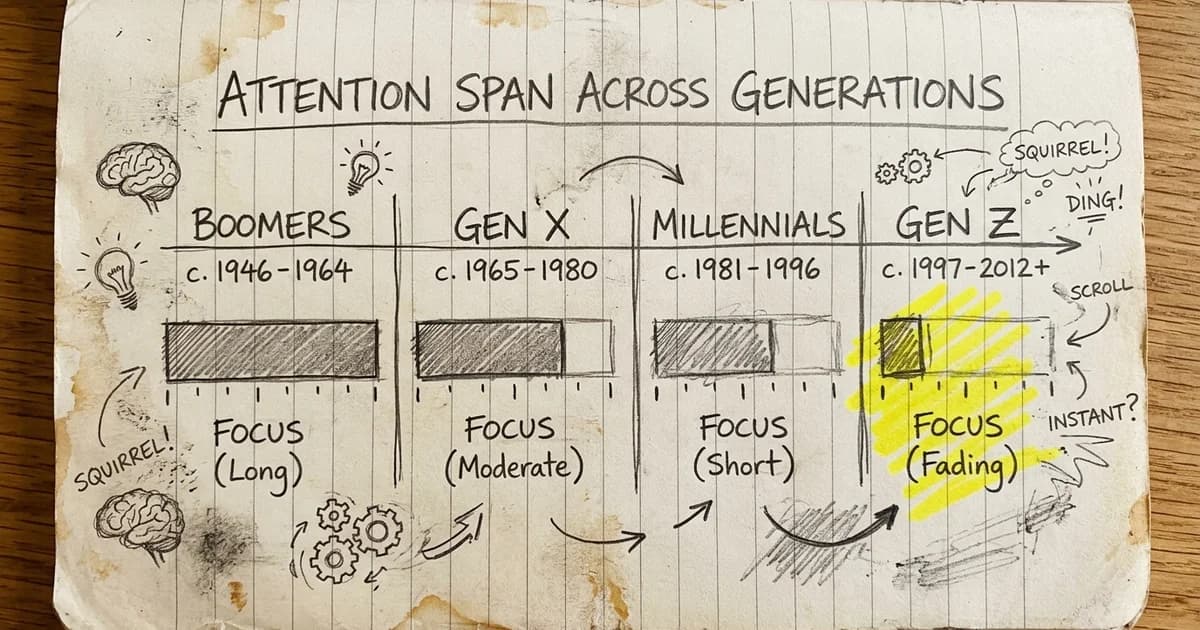
If you want to know how to lock in, the first thing to accept is that your brain is fighting an environment built to fragment it. Researcher Gloria Mark spent two decades measuring how long people actually stay on one screen before switching. After 20 years, people average just 47 seconds on any screen, and this was measured across various workplaces, college students, and replicated by others. When her research first started in 2004, the average was about 150 seconds, or roughly two and a half minutes.
So locking in is not about trying harder. It's about removing friction, then giving your attention something steady to run on.
Key Takeaways
- "Lock in mode" is a state, not a mood. You engineer it with environment, timing, and inputs, not motivation.
- Context switching is the real tax. Every interruption costs you minutes of rebuilding, so the goal is fewer switches, not faster ones.
- Your chemistry matters. Caffeine alone spikes and crashes; pairing it with L-theanine smooths the focus without the jitter.
- Sustained focus beats intense focus. The win is holding attention for hours, not white-knuckling for ten minutes.
What "Lock In Mode" Actually Means
Locking in means holding sustained, single-task attention long enough that the work starts moving on its own. You stop fighting the task and start flowing through it.
This is different from "being busy." Busy is answering Slack and refreshing email, feeling productive while producing nothing. Locking in is one task, one window of time, zero negotiation with yourself about whether to start.
The neuroscience term closest to this is sustained attention: the ability to keep cognitive resources pointed at one thing over time. It's a finite resource, and the way you spend the first 20 minutes determines whether the next two hours hold.
If you came for the slang, see lock in meaning; for the 2026 trend dates, see the great lock in 2026.
Why You Can't Focus (It's Not Your Fault)
The single biggest threat to focus is task switching. Every time you jump from your work to a notification and back, your brain fighting task switching pays a reload cost.
That cost is bigger than most people think. Research summarized by Able describes how switching between tasks degrades performance and slows you down, because your brain has to drop one context and load another. Do this 50 times a day and you've spent your best cognitive hours just rebooting.
The second threat is your body's energy curve. Most people run on coffee, which gives a sharp rise and an equally sharp fall. By 2 PM you're not lazy, you're crashing.
The third is sleep. No focus protocol survives a 5-hour night. Lock-in technique sits on top of recovery, it does not replace it.
How to Lock In: The Step-by-Step Protocol
Here's how to lock in and focus for hours, in the order that actually works.
1. Define one target, not a to-do list
Pick the single task that matters most and write it in one sentence. "Draft section 2 of the report" beats "work on report." A vague target invites switching, because your brain keeps asking what to do next.
2. Kill the inputs before you start
Phone in another room. Notifications off. Tabs closed except the one you need. You are not strong enough to ignore a buzzing phone, and neither am I. The trick is to make distraction physically inconvenient.
3. Use a timed block
Set a 50 to 90 minute block and commit to it. The Pomodoro method (25 minutes on, 5 off) works for shallow tasks, but deep work usually needs longer runways. Pick the length that matches the work and protect it like a meeting.
4. Lower the activation energy
Open the file and write one bad sentence. Solve one easy sub-problem. Starting is the hardest part, so make the first action almost embarrassingly small. Momentum does the rest.
5. Manage your energy curve
This is where most people lose the afternoon. If your fuel spikes and crashes, your focus will too. Steady chemistry produces steady attention, which brings us to the science of what you actually put in your body.
How Do You Lock In at Work When You Can't Control Your Environment?
You cannot remove the interruptions at work, so the goal shifts from preventing them to making the recovery cheap. The research on this is blunt: in a study of 24 information workers observed across more than 700 hours, Mark, Gonzalez and Harris found that when people resumed an interrupted task on the same day, it took an average of 25 minutes and 26 seconds. The number everyone quotes online is "23 minutes and 15 seconds," and it does not appear in the paper. The real figure is worse, and it comes with a detail that matters more than the average.
That detail is the spread. The standard deviation on that 25 minutes was 54 minutes and 48 seconds, more than double the mean. Recovery time is not a reliable 25-minute tax you can plan around. It is mostly fast with a long, ugly tail, and the tail is what eats an afternoon. The same study found that 57.1% of work segments were interrupted, and that people passed through an average of 2.26 other working spheres before returning to what they had been doing.
So the practical moves at work are the ones that shorten the tail rather than the ones that pretend you can eliminate interruptions.
Leave yourself a re-entry note. Before you get up, before the meeting, before you answer the thing, write one line about what you were about to do next. Not what you finished. What was next. The reload cost is mostly the cost of rebuilding context, and a sentence you wrote 30 seconds ago rebuilds it faster than your memory will.
Finish under mild time pressure rather than drifting off a task. This is the counterintuitive one. Sophie Leroy's attention residue research found that finishing a task is not by itself enough to let you transition cleanly. Her experiments found that time pressure while completing the prior task is what enabled people to disengage from it and perform well on the next one. Trailing off a task leaves it running in the background. Closing it against a deadline does not.
Pre-commit the block, in writing, with a trigger. The meta-analysis on if-then planning, Gollwitzer and Sheeran (2006), pooled 94 independent tests and found a medium-to-large effect on goal attainment (d = 0.65). The mechanism is that specifying the cue removes the moment of deliberation where you would otherwise negotiate with yourself. "When I get back from standup, I open the deck and write slide 4" beats "I'll work on the deck this afternoon."
Batch the interruptible work into one ugly window. Slack, email and the small asks are not going away. Giving them a scheduled home is what stops them from being distributed across every block you were trying to protect.
How to Lock In for Studying (and Other Long Sessions)
If you want to know how to lock in for studying specifically, the rules tighten. Studying punishes shallow attention because retention depends on depth of processing, not time logged. Studying is one specific case; the general version of staying locked in across a full workday is what we cover in our guide to getting more focused and productive without burning out.
Studying with active recall in focused blocks, not passive rereading, is where retention actually builds. Quiz yourself, close the book, and try to reconstruct the idea. This feels harder, which is exactly why it works.
Space your sessions across days instead of cramming. And match your hardest material to your sharpest hours, usually mid-morning or early evening, when your alertness is naturally higher.
Which Lock-In Methods Actually Have Research Behind Them?
Some of them, and several of the most popular ones have less than you would guess. The two things with the strongest evidence are if-then planning and protecting your sleep. The Pomodoro technique's specific 25-minute interval has no peer-reviewed validation at all, and the "90-minute ultradian work block" that circulates constantly is a sleep-science idea that was never established for waking cognitive performance.
| Method | What the evidence actually says | Grade |
|---|---|---|
| If-then plans ("when X, I do Y") | Meta-analysis of 94 independent tests found d = 0.65 on goal attainment. Gollwitzer and Sheeran 2006 | Well supported |
| Protecting sleep | 6 hours or less nightly for 14 days produced deficits equal to up to 2 nights of total sleep deprivation. Van Dongen 2003 | Well supported |
| Single-tasking over switching | Switch costs are real and additive with rule complexity. Rubinstein, Meyer and Evans 2001 | Well supported |
| Closing a task before moving on | Attention residue impairs the next task; time pressure on the prior one helps you disengage. Leroy 2009 | Supported |
| Brief goal reactivation during long tasks | Briefly switching to a secondary task prevented the vigilance decrement. Ariga and Lleras 2011 | Supported, but widely misread |
| Phone in another room | Real effect on working memory, but tiny, and a pre-registered replication failed. Ward 2017, Ruiz Pardo and Minda 2022 | Contested |
| Pomodoro's specific 25/5 interval | No peer-reviewed study tests 25/5 or compares it against other intervals. | Not established |
| 90-minute blocks from "ultradian rhythms" | The basic rest-activity cycle is established for sleep architecture. Its extension to waking cognitive performance is a popular leap, not a finding. | Not established |
A few of these deserve more than a table row, because the popular version has drifted a long way from the paper.
The phone-in-another-room study is not settled. Ward and colleagues (2017) is the famous "Brain Drain" paper, and it did find that having your phone on the desk reduced available working memory versus leaving it in another room. Two things almost never get reported. The effect sizes were tiny, on the order of 1 to 3% of variance. And the study found no effect at all on sustained attention: a phone on the desk did not measurably change Go/No-Go performance. Then in 2022 a pre-registered direct replication found no difference between phone locations. Putting your phone in another room is still a reasonable thing to do, because it removes the option to pick it up. Just do not claim science proved your phone is draining your brain.
The "take a break" study argues the opposite of what it gets cited for. Ariga and Lleras (2011) is universally cited as proof that breaks recharge depleted attention. The paper explicitly rejects the depletion model. Their manipulation was not a rest break, it was briefly switching to a secondary memory task while continuing the main one, and their proposed mechanism is goal habituation: the vigilance goal fades from active maintenance, and briefly reactivating it prevents the decline. Their own words are that the results "present a direct challenge to the pervasive view that vigilance decrements are due to a depletion of attentional resources." The practical translation is not "go rest." It is "briefly re-touch the goal," which is closer to restating what you are doing than to scrolling for five minutes.
Pomodoro is a useful ritual with no validated interval. There is real research comparing systematic breaks against self-regulated breaks, including work by Biwer and colleagues (2023) with 87 university students, and more recent studies in 2025 and 2026 comparing Pomodoro against self-regulated and flowtime approaches. What none of it does is establish that 25 minutes on and 5 off is optimal, or better than 40/10, or better than 90/15. The 25 minutes came from Francesco Cirillo's kitchen timer. Use it if the structure helps you start, which is a genuine benefit. Do not believe the number is tuned to your neurology.
The Chemistry of Locking In: Caffeine, L-Theanine, and Beyond
The cleanest focus comes from steady stimulation without the spike and crash. Caffeine alone is a blunt instrument. Pair it with the right compounds and you get sustained attention instead of a jittery peak.
Caffeine blocks adenosine, the molecule that makes you feel tired. It works, but on its own it can bring anxiety, jitter, and a hard drop once it clears.
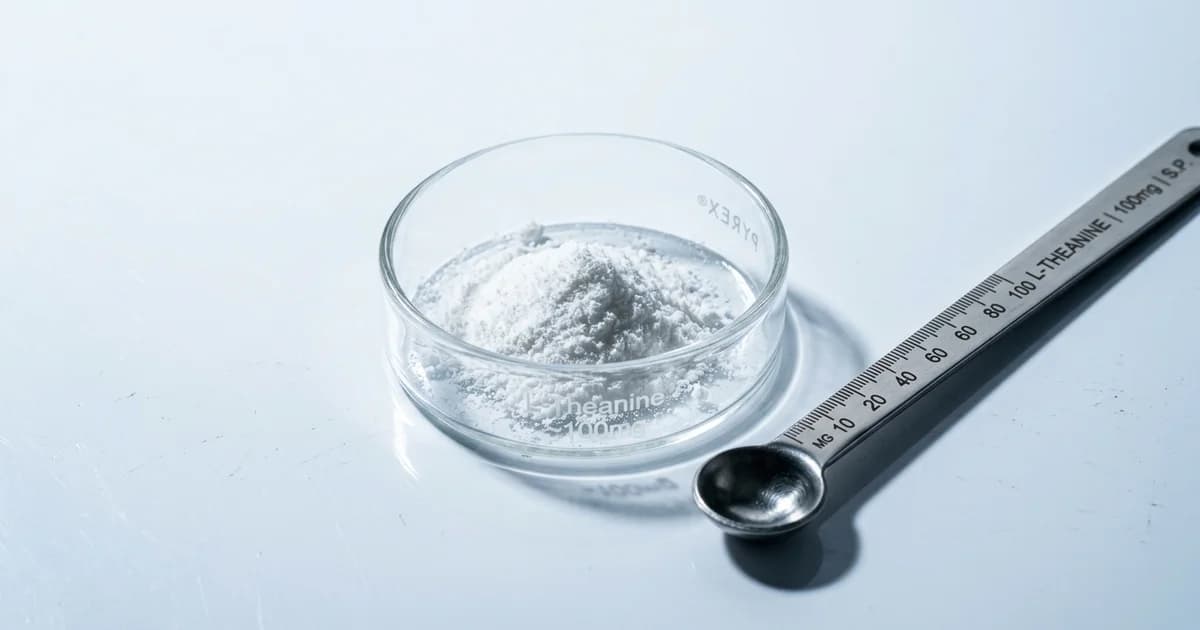
L-theanine is the fix. It's an amino acid found in tea that smooths caffeine's rough edges. In a double-blind crossover trial on 37 adults kept awake overnight (Nawarathna et al., British Journal of Nutrition 2025; reported by PsyPost), 200 mg L-theanine plus 160 mg caffeine improved both accuracy and reaction time, with participants responding about 40 milliseconds faster on average compared to placebo. A separate trial summarized by the Alzheimer's Drug Discovery Foundation found that while caffeine increased blood pressure and alertness, theanine attenuated the rise in blood pressure without affecting caffeine's positive effects on alertness.
Two newer compounds extend the window. Methylliberine (Dynamine) and theacrine (TeaCrine) are chemical cousins of caffeine. According to ingredient maker Compound Solutions, Dynamine's onset is faster than caffeine while TeaCrine's is slower, so the combination of all three may lead to a faster-acting onset coupled with a longer-lasting experience without the crash.
There's also the jitter question. A preprint on bioRxiv notes that caffeine and theacrine together have been shown to lower jitteriness compared to caffeine alone, while the two compounds together did not elevate blood pressure or heart rate.
How focus inputs compare
| Input | Onset | Duration | Crash risk | Jitter |
|---|---|---|---|---|
| Coffee (black) | 30 to 45 min | 3 to 4 hrs | High | Moderate to high |
| Energy drink | 15 to 30 min | 2 to 4 hrs | High (sugar + caffeine) | High |
| Caffeine + L-theanine | 30 to 45 min | 4 to 5 hrs | Low | Low |
| 4-ingredient sublingual pouch (caffeine, L-theanine, Dynamine, TeaCrine) | 5 to 10 min | 6 to 8 hrs | Low | Low |
| L-theanine alone | 30 to 40 min | 2 to 3 hrs | None | None (no stimulation) |
The point of the table is simple. The more you smooth the curve, the longer you stay locked in.
How Do You Stay Locked In Once You've Started?
Getting in and staying in are different problems. Starting is a friction problem, and you solve it by shrinking the first action. Staying in is a maintenance problem, and the research points at something more specific than willpower: your attention to a task degrades over time on its own, and the fix is periodically reactivating the goal rather than gritting your teeth harder.
The effect is called the vigilance decrement, and it is one of the more robust findings in attention research. Performance on a sustained task declines with time on task, reliably, in people who are trying hard. Langner and Eickhoff's meta-analytic review frames it as a basic limit: our ability to stay focused on a task is limited, and performance decrements appear with increasing time on task.
What changes the picture is Ariga and Lleras (2011), covered above. When their participants briefly recalled a set of digits at intervals during a long vigilance task, the decline was averted. When they only recalled the digits at the end, performance fell steeply. The mechanism they propose is that the goal itself habituates, and a brief reactivation resets it.
That gives three practical moves for the middle of a block, which is where most lock-in attempts actually die.
Restate the target out loud or in writing, roughly every 20 to 30 minutes. Not a break. A five-second re-touch of what you are doing and why this specific chunk matters. This is the closest practical analogue to what the study manipulated.
Work on one artifact, not one topic. "Work on the report" habituates fast because it never resolves. "Finish the second paragraph of the methods section" gives the goal something to close against, which is also what Leroy's time-pressure finding rewards.
Treat the crash as information, not failure. If focus falls off a cliff at the same time every day, that is worth diagnosing rather than overriding. The post-lunch dip is a real, documented phenomenon: Monk (2005) found it occurs even when the person has not eaten lunch and does not know the time of day, which implicates circadian biology rather than digestion alone. A high-carbohydrate meal makes it worse.
And the unglamorous one that outranks every technique here. Van Dongen and colleagues (2003) restricted 48 healthy adults to 4, 6 or 8 hours in bed for 14 consecutive nights. Restriction to 6 hours or less produced cognitive deficits equivalent to up to two nights of total sleep deprivation, and lapses in alertness rose near-linearly with accumulated wakefulness. The finding that should end most focus arguments is the last one: sleepiness ratings suggested participants were largely unaware of how impaired they had become. You cannot feel this deficit accruing. No lock-in protocol survives it, and no amount of caffeine reveals it to you.
Frequently Asked Questions
How long can you realistically stay locked in?
Most people sustain genuine deep focus for 60 to 90 minutes before quality drops, then need a short break. Across a day, you can chain a few of these blocks, but expect three to four hours of true deep work to be a strong day. Anything beyond that usually trades depth for the illusion of effort. Protect your sharpest blocks for your hardest task.
What's the fastest way to get into lock in mode?
Remove your phone, write your single target in one sentence, and start with the smallest possible action. The barrier is almost always starting, not continuing. Pair that with a timed block of 50 to 90 minutes so your brain knows exactly how long it has to run. Steady energy helps, which is why people stack caffeine with L-theanine rather than relying on coffee alone.
Does caffeine actually help you focus or just feel awake?
Both, but the quality depends on dose and pairing. Caffeine genuinely sharpens alertness by blocking adenosine, but alone it can tip into anxiety and jitter that work against deep focus. Paired with L-theanine, the alertness stays while the rough edges fade. That combination is why tea often produces calmer focus than coffee at the same caffeine level.
How do I lock in for studying without burning out?
Use focused blocks with active recall instead of passive rereading, space sessions across multiple days, and match hard material to your sharpest hours. Take real breaks between blocks, away from a screen. Cramming feels productive but produces weak retention. Consistent, shorter sessions beat one marathon every time, and they protect your sleep, which is the foundation everything else sits on.
Why do I crash in the afternoon?
The afternoon dip is partly your natural circadian rhythm and partly your morning caffeine clearing out at the same time your post-lunch energy drops. The fix is steadier fuel and protected recovery, not more coffee at 3 PM. A slower, longer-lasting energy curve avoids the spike that guarantees the fall. Hydration, light, and a short walk also help reset attention.
Is sustained focus better than intense focus?
For most knowledge work and studying, yes. Intense focus that lasts ten minutes produces little. Sustained attention held across a 60 to 90 minute block is where real output happens. The goal of any focus protocol is to extend the window you can hold, not to spike harder for a moment. Steady inputs and a clean environment both serve that aim.
Sustained Attention Is Engineered, Not Summoned
Locking in is not a personality trait you either have or lack, but the result of a deliberate environment and habit system. It's the result of a few decisions: one clear target, a protected block of time, an environment stripped of inputs, and an energy curve that holds instead of crashing.
Get those right and focus stops feeling like a fight. The work starts pulling you forward instead of the other way around. Willpower was never the variable. Friction was.
The On-Demand Layer for Your Focus Blocks
Everything above is the system. The environment, the single target, the protected block. Roon is the chemistry layer that sits on top of it.
Roon's nootropic pouches are a zero-nicotine sublingual pouch built for exactly the energy-curve problem this guide keeps returning to. Each pouch carries 80 mg caffeine, 60 mg L-theanine, 25 mg methylliberine (Dynamine), and 5 mg theacrine (TeaCrine). The sublingual format means a 5 to 10 minute onset, and the four-ingredient stack is designed for 6 to 8 hours of steady focus with no jitters, no crash, and no tolerance buildup.
To be clear about what it is not: Roon will not fix a 5-hour night, and it won't build your focus system for you. It supports focus, it doesn't manufacture it. Put the protocol in place first, then try Roon for the blocks where you need the curve to hold. Roon is for adults 18+.
Related from Roon
- Winter Arc 2026: Rules, Start Date, and Daily Template
- 75 Hard vs Winter Arc vs the Great Lock In: Which Fits You
- Pomodoro Technique for Studying: Where the Caffeine Goes
- Writing Sprints: How to Run a 25-Minute Sprint That Works
Written by Roon Team
What Does "Locking In for 30 Days" Actually Involve?
The 30-day lock-in is an internet format, not a research protocol, and no study has tested it. What it usually means in practice is a self-imposed month of narrowed focus: one goal, a stripped-back routine, most discretionary distractions cut. There is nothing wrong with that, and parts of it map onto findings that do hold up. But the framing carries a predictable failure mode worth naming before you start one.
The failure mode is that 30-day challenges are usually built out of restrictions, and restrictions are the weakest form of the thing that actually works. The evidence favours specifying what you will do and when, rather than listing what you will avoid. Gollwitzer and Sheeran's meta-analysis of 94 tests found a medium-to-large effect (d = 0.65) for if-then plans, and the mechanism is that naming the cue automates initiation so you stop deliberating. "No phone for 30 days" gives your brain nothing to do at the trigger point. "When I sit down at 9, I open the file and write for 25 minutes" does.
Three things are worth building into a 30-day run if you are going to do one.
Fix the sleep floor first, and treat it as non-negotiable. This is the single highest-leverage variable and the one most 30-day challenges sacrifice in week one to buy more working hours. The Van Dongen data is unambiguous that 6 hours or less compounds across two weeks into a deficit equivalent to a couple of nights of no sleep at all, and that you will not perceive it happening. A 30-day sprint run on 5 hours a night is 30 days of measurably degraded work that feels fine from the inside.
Pick one goal with a closable daily unit. Not "get fit" or "learn Spanish." Something that finishes each day. The attention research keeps pointing the same direction: unclosed tasks leave residue, and goals that never resolve habituate. A daily unit that closes gives you both a clean stop and a visible streak.
Expect week two to be the hard one, and plan the recovery rather than the intensity. Motivation is high in week one and the novelty carries you. The useful design question is not how hard you can go, it is what the minimum viable version of the day looks like when you are tired, travelling or sick. A 30-day streak survives on its floor, not its ceiling.
One honest caveat on the whole format. There is no evidence that 30 days is a meaningful number, any more than 21 days is. It is a convenient unit of a month. The value of a 30-day lock-in is that a fixed end date makes a temporary sacrifice tolerable, which is a real psychological benefit and a perfectly good reason to use it. It is just not a neurological threshold, and nothing switches over on day 31.