Average Attention Span by Generation
Average Attention Span by Generation: What the Data Actually Says
No study measures attention span by generation; the "8 seconds" figure traces to a 2015 Microsoft Canada marketing report, not a lab test. What research does measure is time on one screen before switching, which fell from about 2.5 minutes in 2004 to 47 seconds, for everyone, not just Gen Z.
You've probably seen the claim: humans now have a shorter attention span than a goldfish. Eight seconds for you, nine for the fish. It's been repeated by TIME, the Guardian, USA Today, and thousands of marketing blogs. There's just one problem. The data behind that stat is, to put it plainly, made up.
The real picture is more interesting, more nuanced, and honestly more alarming than any goldfish comparison. Here's what the research actually shows about the average attention span by generation, why the numbers are shifting, and what's driving the decline.
Key Takeaways:
- The famous "8-second attention span" stat has no peer-reviewed research behind it
- On-screen attention has dropped from 2.5 minutes to 47 seconds over two decades
- Average attention span by generation figures are unsourced; on-screen attention fell for everyone, shaped by media environments, not raw cognitive ability
- Younger generations aren't less capable of focus; they're more selective about what earns it
Where the "8-Second Attention Span" Myth Came From
In 2015, a Microsoft Canada consumer insights team published a report claiming the average human attention span had fallen to eight seconds, down from twelve in 2000. The report also compared this unfavorably to the nine-second attention span of a goldfish.
The stat went viral. But as Dr. Maria Panagiotidi detailed in her breakdown of the claim, the data in the Microsoft report was traced back to a source called "Statistic Brain," and the numbers were entirely fabricated. The goldfish comparison was adapted from an old folk myth about goldfish memory, not from any controlled experiment.
According to the Speakwise blog's review of the literature, there is no peer-reviewed research supporting an 8-second human attention span, and no scientific evidence that goldfish have a 9-second attention span either. Anyone citing these figures as proof of generational decline is working from bad data.
So if the goldfish number is junk science, what does the real data say about the average attention span by generation?
The Real Data: Average Attention Span by Generation
The most credible longitudinal research on attention spans comes from Dr. Gloria Mark, Chancellor's Professor of Informatics at the University of California, Irvine. She's been tracking how long people stay focused on a single screen since 2004.
Her findings show a clear, measurable decline. In 2004, the average time spent on a single screen before switching was about 2.5 minutes. By 2012, that dropped to 75 seconds. In recent years, it has settled at roughly 47 seconds.
That's not eight seconds. But a drop from 150 seconds to 47 seconds over two decades is still a serious shift, and it sets the stage for reading the generational numbers in context. Measure your own: the five-minute attention span test times seconds on task, the same thing the research counts.
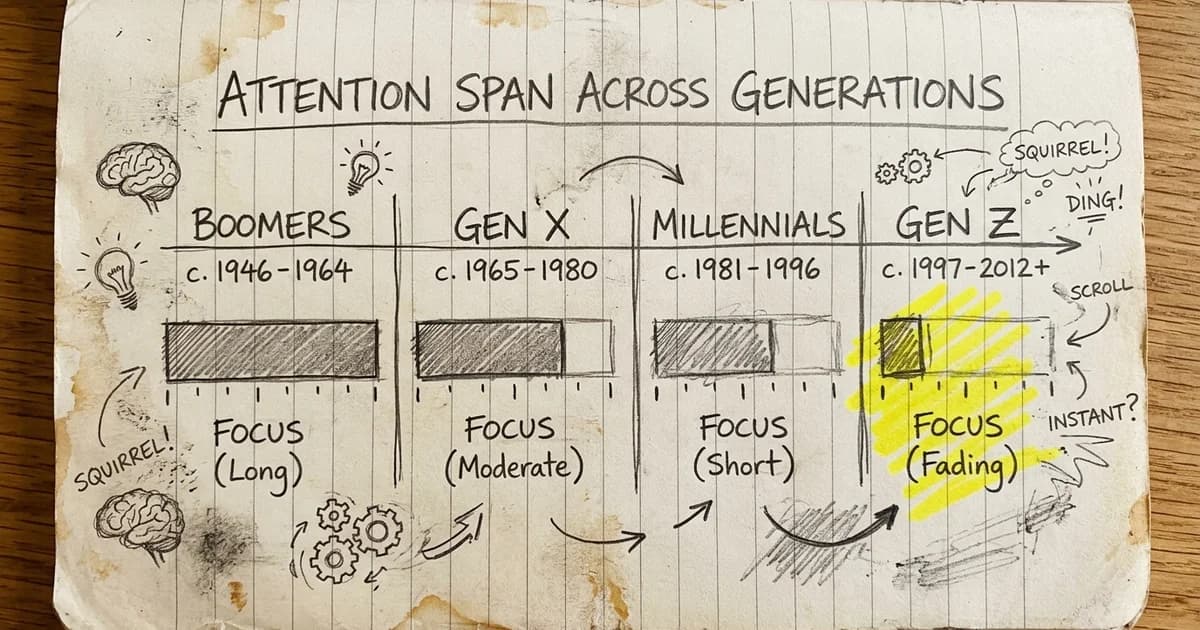
No peer-reviewed study breaks this down by generation. The figures that circulate come from marketing compilations like the one below, which reuse the same unsourced numbers debunked above (Gen Z's "8 seconds" is the Microsoft figure), so read the table as folklore, not data. According to compiled statistics from Amra and Elma, the generational breakdown looks roughly like this:
| Generation | Birth Years | Estimated Avg. Attention Span | Key Media Environment |
|---|---|---|---|
| Silent Generation | 1928–1945 | ~25 seconds | Radio, print newspapers |
| Baby Boomers | 1946–1964 | ~20 seconds | Television, long-form media |
| Gen X | 1965–1980 | ~15 seconds | Cable TV, early internet |
| Millennials | 1981–1996 | ~12 seconds | Social media, smartphones |
| Gen Z | 1997–2012 | ~8 seconds | Short-form video, infinite scroll |
A few caveats here. Where these figures mean anything, they describe on-screen sustained attention in digital contexts, not the total capacity for focus. A Gen Z college student can absolutely concentrate on a two-hour exam. The question is how quickly they disengage from a piece of digital content that doesn't immediately earn their interest.
Why the Decline Is Real (But Not What You Think)
The drop in on-screen attention isn't evidence that younger brains are broken. It's evidence that digital environments have trained all of us, but especially younger generations, to filter faster. The generational story is about adaptation, not deficiency.
A 2022 McKinsey report made this point directly: Gen Z does love short-form content, and they spend more than six hours a day watching it, but the idea that they can only pay attention for eight seconds is a myth. They're selective, not incapable.
This tracks with advertising research too. A study covered by WARC found that Gen Z actually had higher recall of ad content than Millennials or Gen X, particularly for skippable video ads under two seconds. Gen Z's recall rate was 55%, compared to 46% for Millennials and just 26% for Gen X and Boomers.
Think about what that means. The generation with the "worst" attention ranking is actually the best at extracting information from brief content. Their brains aren't slower. They're running a different filtering algorithm.
What's Actually Driving the Generational Attention Gap
Three forces explain most of the differences people read into average attention span by generation charts.
1. Notification Density
A 2024 survey by Reviews.org found that Americans now check their phones an average of 205 times per day, a 42% increase from the previous year. That's roughly once every five minutes during waking hours.
But the generational split is telling. According to PhoneArena's analysis of the same data, Millennials actually lead in the number of daily phone pickups, averaging 324 times per day, and are the fastest to check notifications. Gen Z spends more total time on their phones but checks less compulsively. These habits shape how each generation's attention gets split.
Every notification is a micro-interruption. And Dr. Mark's research at UCI found that it can take up to 25 minutes to fully return your attention to a task after a single interruption. Multiply that by 200+ daily phone checks, and the math on lost focus is staggering.
2. Content Format Training
Each generation's attention was shaped by the dominant media of their formative years, a pattern that becomes most visible when looking at the generation born inside the smartphone era. Boomers grew up with 30-minute network TV shows and full newspaper articles. Gen X got cable and channel surfing. Millennials got Facebook feeds and YouTube. Gen Z got TikTok, Instagram Reels, and content designed to hook you in under three seconds.
Your brain adapts to the input it receives most frequently. If you spend years consuming content in 15-to-60-second clips, your neural reward circuits calibrate to that rhythm. Long-form content starts to feel like friction, not because you can't process it, but because your dopamine system has been tuned to expect faster payoffs. This is the single biggest factor in the generational gap.
3. Cognitive Load and Information Volume
The sheer volume of information competing for your attention today dwarfs what any previous generation faced. Speakwise's analysis of workplace data found that 59% of employees report being unable to focus for even 30 minutes without getting sidetracked by a digital distraction. Among managers, the rate is even higher.
This isn't a generational character flaw. It's an environmental response. Your brain has a limited budget for sustained attention, and modern digital environments drain that budget faster than anything humans have previously encountered. That reality is baked into every generational estimate.
The Neuroscience Behind the Fog
When your attention fragments this frequently, the effects go beyond just "getting distracted." Chronic task-switching elevates cortisol, the stress hormone that impairs working memory. It disrupts adenosine regulation, the system your brain uses to signal when it's time to rest versus when it's time to lock in. And it blunts dopamine sensitivity, meaning you need stronger and stronger stimuli to feel engaged.
This is the neurochemical recipe for brain fog: the persistent sense that you can't quite think clearly, can't hold a thought, can't get into a flow state even when the task in front of you matters.
The relationship between attention span and brain fog affects every generation, but the younger you are, the more accumulated exposure you've had to the digital environments that accelerate it. The generational data reflects this cumulative exposure.
What Actually Helps (According to the Research)
The good news: attention is trainable. The brain's attentional circuits are plastic, meaning they respond to consistent input. Whatever your generation, you can improve.
A few evidence-based strategies:
- Time-blocked deep work: Even 25-minute focused sessions (the Pomodoro method) can rebuild your tolerance for sustained attention over weeks.
- Notification batching: Turning off non-essential notifications and checking messages at set intervals reduces the interruption-recovery cycle that fragments focus.
- Targeted neurochemical support: The combination of L-Theanine and caffeine has solid clinical backing. A study published on PubMed found that 97mg of L-Theanine combined with 40mg of caffeine helped participants focus attention during demanding cognitive tasks. A more recent double-blind, placebo-controlled trial confirmed that the L-Theanine and caffeine combination improved selective attention and target-distractor discriminability, even in sleep-deprived subjects.
The key is addressing the right neurochemical pathways. Adenosine buildup makes you feel mentally sluggish. Disrupted GABA signaling keeps your brain from settling into focus. Blunted dopamine response makes everything feel equally uninteresting. An effective approach targets all three. For the focus side, see best caffeine pouches for focus and deep work.
Cut Through the Fog
The average attention span by generation data tells us something real: the environments we live in are making sustained focus harder for everyone. But the data also tells us that the problem isn't your brain. It's the mismatch between what your neurochemistry needs and what your digital environment provides.
Roon was built around this exact problem. Roon's zero-nicotine focus pouches deliver a precise stack of Caffeine (80mg), L-Theanine, Theacrine, and Methylliberine, four compounds that target the adenosine, GABA, and dopamine pathways behind brain fog. No nicotine. No jitters. No crash. Just 6 to 8 hours of clean, sustained focus.
Your generation doesn't determine your ability to concentrate. Your neurochemistry does. And that, you can actually do something about, regardless of where the average attention span by generation numbers place you.