Energy Drink vs Coffee: Caffeine, Additives, Crash, Cost, and Which Is Better for Focus
Energy Drink vs Coffee: Caffeine, Additives, Crash, Cost, and Which Is Better for Focus
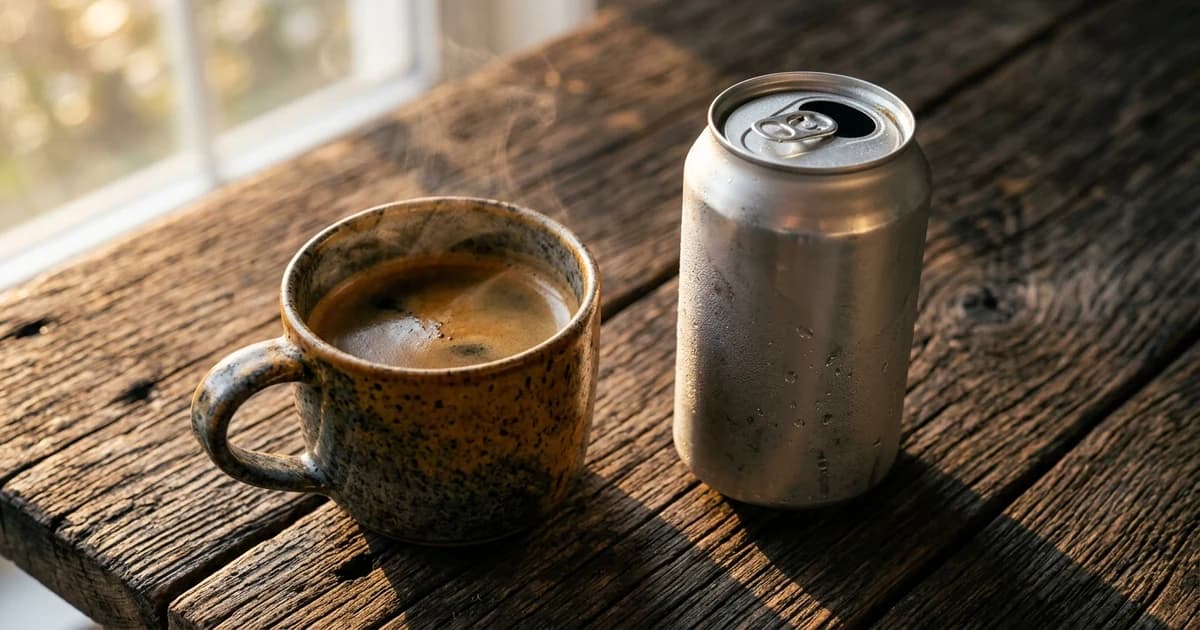
Short answer: For focus, black coffee usually wins: about 95 mg of caffeine per 8 oz, no sugar, a dose you can adjust, and roughly $0.20 to $0.50 a cup brewed at home. An energy drink gives a fixed 160 to 200 mg dose, often with added sugar (Monster Original has 54 g), and costs several times more.
The energy drink vs coffee debate comes down to dose control, additives, and what happens after the caffeine wears off. Coffee gives you dose control and zero additives beyond what the bean provides. An energy drink gives you a fixed caffeine hit, a longer ingredient list, and measurable cardiovascular differences that caffeine alone does not explain. Neither is categorically better. The answer depends on dose, timing, and what else is in the can.
Key Takeaways
- Coffee wins on dose control. An 8 oz cup runs about 95 mg of caffeine, and you can pour half a cup or two depending on the day. A can is a fixed number you cannot adjust.
- Energy drinks carry ingredients beyond caffeine with real physiological effects. A 2017 randomized crossover trial found that a caffeine-matched energy drink produced QTc prolongation and blood pressure elevation that plain caffeine did not.
- Sugar is the biggest variable. A single Monster Original delivers 54 g of sugar, past the AHA's 36 g daily limit for men and 25 g for women.
- Home-brewed coffee is far cheaper. Roughly $0.20 to $0.50 per cup versus an estimated $2.00 to $4.00 per can at retail.
Coffee vs Energy Drinks: Side-by-Side Comparison
| Criterion | Brewed Coffee (8 oz) | Monster Original (16 oz) | Celsius Original (12 oz) |
|---|---|---|---|
| Caffeine | ~95 mg (varies 70-200 mg) | 160 mg | 200 mg |
| Sugar | 0 g (black) | 54 g | 0 g |
| Calories | ~2 (black) | ~210 | ~10 |
| Other stimulants | None | Taurine, guarana, ginseng | Guarana, green tea extract, ginger |
| Sweetener | None (black) | Sugar, glucose | Sucralose |
| Dose adjustable? | Yes | No (fixed can) | No (fixed can) |
| Cost per serving | ~$0.20-0.50 home / $3-6 cafe | ~$2.00-3.00 | Set by the retailer; no published price |
| Onset | 15-45 min | 15-45 min | 15-45 min |
Sources: USDA FoodData Central, Monster Energy, Celsius. Prices are retail estimates.
How this comparison was put together
Caffeine for coffee comes from USDA FoodData Central; Monster and Celsius figures come from the brands' own pages. Prices are retail estimates, labeled as such, because Monster and Celsius do not sell direct at a published price. We did not lab-test or use any competitor product. Roon makes a competing product, the caffeine pouch covered at the end of this page.
Caffeine Dose: Coffee's Range vs an Energy Drink's Fixed Number
A standard 8 oz cup of brewed coffee contains roughly 95 mg of caffeine, but the real range is 70 to 200 mg depending on bean, roast, grind, and brew method (for the full breakdown, see coffee's real caffeine range by brew method). That variability is a feature. You can drink half a cup on a light day or two cups when the deadline is real.
Energy drinks remove that flexibility. A 16 oz Monster delivers exactly 160 mg. A 12 oz Celsius packs 200 mg. You cannot halve a sealed can and save the rest.
The FDA considers up to 400 mg/day not generally associated with dangerous effects in healthy adults. That is roughly four cups of coffee or two cans of Celsius. The math tightens fast with energy drinks because each serving is a larger fixed dose.
What Else Is in the Can That Isn't in Your Mug
Black coffee is a straightforward delivery vehicle: caffeine, chlorogenic acids, and volatile compounds that mostly affect taste. No added sugar. No taurine. No B-vitamin megadoses.
A standard energy drink adds layers. Monster Original's label includes taurine, guarana (another caffeine source), panax ginseng, L-carnitine, and glucuronolactone, plus 54 g of sugar and artificial colors. Celsius skips the sugar but adds guarana, green tea extract (EGCG), and ginger root, sweetened with sucralose.
Are those extra ingredients inert bystanders or active players? The next section covers the one study that tried to isolate that question.
The Study That Separates Caffeine From "Something Else"
Fletcher et al. (2017), published in the Journal of the American Heart Association, ran an 18-person randomized, double-blind, crossover trial. Each participant drank either 32 oz of a commercial energy drink containing 320 mg of caffeine, or a caffeine-only control matched to the same 320 mg, separated by a 6-day washout. Same caffeine. Different everything else.
The energy drink group showed statistically significant QTc prolongation at 2 hours and higher peripheral systolic blood pressure persisting at 6 hours, compared to the caffeine-only group. A later study by Shah et al. (2019), also published in JAHA, tested two different commercial energy drinks against a caffeine-free placebo in 34 healthy adults and found an average maximal QTc increase of 18 to 20 ms persisting up to 4 hours, reinforcing Fletcher's earlier finding that non-caffeine ingredients drive measurable cardiovascular effects.
This does not mean one can will harm you. It means that when people ask "are energy drinks worse than coffee," the answer is not just about caffeine quantity. Non-caffeine ingredients have measurable cardiovascular effects in controlled conditions, and the specific compounds responsible remain under investigation.
The Crash Comparison
Both coffee and energy drinks produce an adenosine rebound. Caffeine blocks adenosine receptors; when it clears (mean half-life ~5 hours, ranging 1.5 to 9.5 hours), that pent-up adenosine hits. That is the caffeine crash, and it happens regardless of source.
A sugared energy drink adds a second crash on top. Fifty-four grams of sugar spikes blood glucose, triggers an insulin response, and can drop glucose below baseline within 60 to 90 minutes. You get the glucose crash first, then the caffeine crash later. Two dips instead of one. (For more, see why energy drinks make you crash and why energy drinks can make you tired.)
Black coffee sidesteps the sugar problem entirely. Zero-sugar energy drinks also dodge it, but still carry the additive profile discussed above.
Energy Drink vs Coffee Cost
Home-brewed drip coffee is one of the cheapest caffeine sources available. A pound of mid-range beans ($10 to $15) makes 40 to 50 cups, landing around $0.20 to $0.50 per cup. A cafe latte runs $3 to $6, but that is a convenience premium.
Energy drinks are pricier. A single 16 oz Monster retails for roughly $2.00 to $3.00. Celsius does not sell direct and publishes no price, so its shelf price is whatever the retailer sets. Bulk buying helps, but per-milligram of caffeine, home-brewed coffee still wins by a wide margin.
Monster vs Coffee: Caffeine per Ounce and per Dollar
Ounce for ounce, Monster and brewed coffee are close: Monster Original has 10 mg of caffeine per ounce (160 mg in 16 oz), brewed coffee about 12 mg (95 mg in 8 oz). Monster wins on total dose per serving only because the can is twice the size. Per dollar, coffee wins easily.
| Option | Caffeine per serving | Price per serving (estimate) | Price per 100 mg caffeine |
|---|---|---|---|
| Brewed coffee, home (8 oz) | ~95 mg | $0.20-0.50 | $0.21-0.53 |
| Monster Original (16 oz) | 160 mg | $2.00-3.00 | $1.25-1.88 |
| Roon pouch | 80 mg | from $0.61 (12-tin subscription) | $0.76 |
Price per 100 mg = price per serving / caffeine mg x 100. Source: USDA FoodData Central, Monster's product page and Roon's product page; coffee and Monster prices are the retail estimates above, checked Oct 2026.
Why Roon uses 80 mg. On price per 100 mg, brewed coffee wins and Monster's 160 mg looks like more for the money. Roon instead holds the dose near a small coffee, adds 60 mg L-theanine for calm focus, and adds 25 mg methylliberine (Dynamine), which slowed caffeine clearance in a small PK study run at about 4x Roon's methylliberine and 1.9x its caffeine (details at the end of this page). Similar lift, longer tail, felt for 6 to 8 hours. If one pouch is not enough, double up (160 mg) or take a second later, within 4 pouches and 400 mg of caffeine a day from all sources.
Which Is Better for Focus: Energy Drink or Coffee?
Neither format wins by default. Focus depends on the dose, the timing, and your personal caffeine metabolism.
Coffee's advantage is granularity. You can brew weaker or stronger, drink half a cup, or space out sips over an hour. Energy drinks lock you into a single dose. If 200 mg is too much for your afternoon session, you cannot take 120 mg from a Celsius can.
The additive profile in energy drinks does not clearly help focus. Taurine, guarana, and B-vitamin megadoses have not shown consistent cognitive benefits in well-controlled human trials beyond what the caffeine itself provides. If you want the three-way version of this comparison for studying specifically, see energy drinks vs coffee vs a focus pouch.
The Real Variable Is What You Consume Daily
The energy drink vs coffee debate often misses the point. The format matters less than the dose, the sugar, the additives, and the crash profile. A person drinking 400 mg of black coffee is not inherently healthier than someone having a single 80 mg zero-sugar energy drink. Context and quantity decide the outcome, not the container.
Control what you can: total daily caffeine (the FDA's 400 mg ceiling is a reasonable guardrail), added sugar (zero is ideal), and timing relative to sleep.
Frequently Asked Questions
Is caffeine in coffee the same as caffeine in energy drinks?
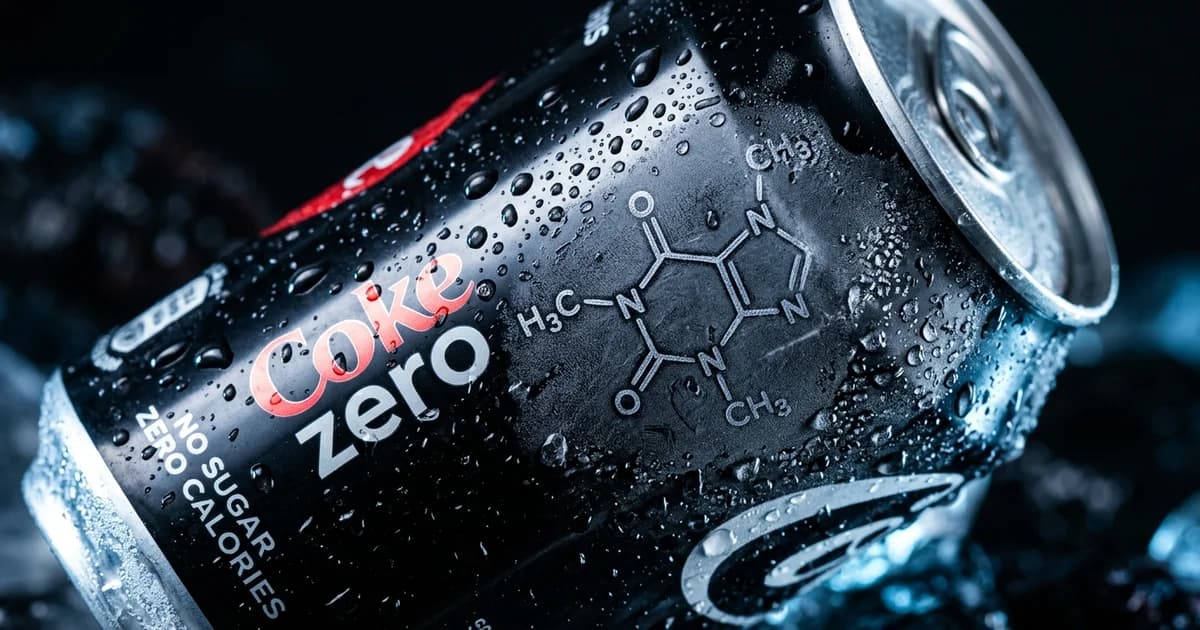
Yes. Caffeine is 1,3,7-trimethylxanthine regardless of source. The molecule is identical whether it comes from a coffee bean or synthetic production. The difference is what else comes with it: coffee delivers caffeine alongside chlorogenic acids, while energy drinks add taurine, guarana, B-vitamins, and sweeteners. Absorption speed and half-life are essentially the same for oral caffeine in any liquid form.
How much caffeine is in coffee vs Monster?
An 8 oz cup of brewed coffee contains about 95 mg. A 16 oz Monster Original contains 160 mg. Cup for cup (8 oz to 8 oz), they are comparable, but Monster cans are 16 oz, so you get a larger total dose per sitting.
Do energy drinks crash harder than coffee?
Sugared energy drinks can produce a two-phase crash: a glucose dip from the sugar spike (within 60 to 90 minutes) followed by the standard adenosine rebound as caffeine clears. Black coffee only produces the adenosine rebound. Zero-sugar energy drinks eliminate the glucose component but still carry additive-related effects that black coffee does not.
Are energy drinks more expensive than coffee?
For daily use, significantly. Home-brewed coffee costs roughly $0.20 to $0.50 per cup. A single energy drink runs an estimated $2.00 to $4.00 at retail. Over a month, that is roughly $6 to $15 for coffee vs $60 to $120 for energy drinks.
Can I drink energy drinks every day?
The FDA's guidance is that up to 400 mg of caffeine per day is not generally associated with negative effects in healthy adults. One moderate energy drink fits within that limit. The concern is the non-caffeine ingredients: the Fletcher et al. study showed cardiovascular effects from the full formula that caffeine alone did not produce, and long-term daily exposure to those ingredients has not been well-studied.
Is black coffee the healthiest caffeine source?
For most people, it is among the simplest and best-studied. Black coffee has two calories, zero sugar, zero additives, and decades of epidemiological data supporting moderate consumption (for more, see is coffee good for you). Its main limitation is that the felt effect wears off in 3 to 4 hours for most people, and re-dosing late in the day disrupts sleep.
A Third Option: Caffeine Without the Can or the Crash
This article frames the question as coffee vs energy drink, but the frustration most people describe is the same from both: the crash, the inability to fine-tune the dose, or the sugar load.
Roon is a zero-nicotine oral pouch with 80 mg caffeine, 60 mg L-theanine, 25 mg methylliberine (Dynamine), and 5 mg theacrine (TeaCrine). Zero sugar, zero calories, no taurine, no guarana, no B-vitamin megadoses. It does contain sucralose.
The 80 mg caffeine is a small-coffee dose, but the felt window stretches to 6 to 8 hours because methylliberine slows caffeine clearance. A randomized, double-blind, crossover PK study (n=12) found that co-administration of methylliberine with caffeine reduced caffeine's oral clearance from 41.9 to 17.1 L/hr and extended its half-life from 7.2 to 15 hours, with no increase in peak concentration (study). That study used 100 mg methylliberine + 150 mg caffeine, roughly 4x the methylliberine and 1.9x the caffeine in a Roon pouch, so the exact magnitude differs at Roon's dose. The mechanism is directionally the same: same peak, longer tail. That also means you should stop at least 8 hours before bed.
Roon is not a clinical improvement over coffee or energy drinks. No Fletcher-style cardiovascular trial has been run on it. What it offers is a dose-controlled, additive-minimal format with a longer duration per serving, starting from $9.16 per tin (as little as $0.61 per pouch) on the 12-tin subscription. If neither the mug nor the can is solving the problem, try Roon.
Related from Roon
- The Best Study Drink Isn't a Drink: Energy Drinks vs Coffee vs a Focus Pouch
- How Much Caffeine in a Cup of Coffee
- Why Energy Drinks Make You Crash
- Healthiest Energy Drinks Ranked
Written by Roon Team