Why Caffeine's Half-Life Varies 5-Fold: Genes, Smoking
Roon Team
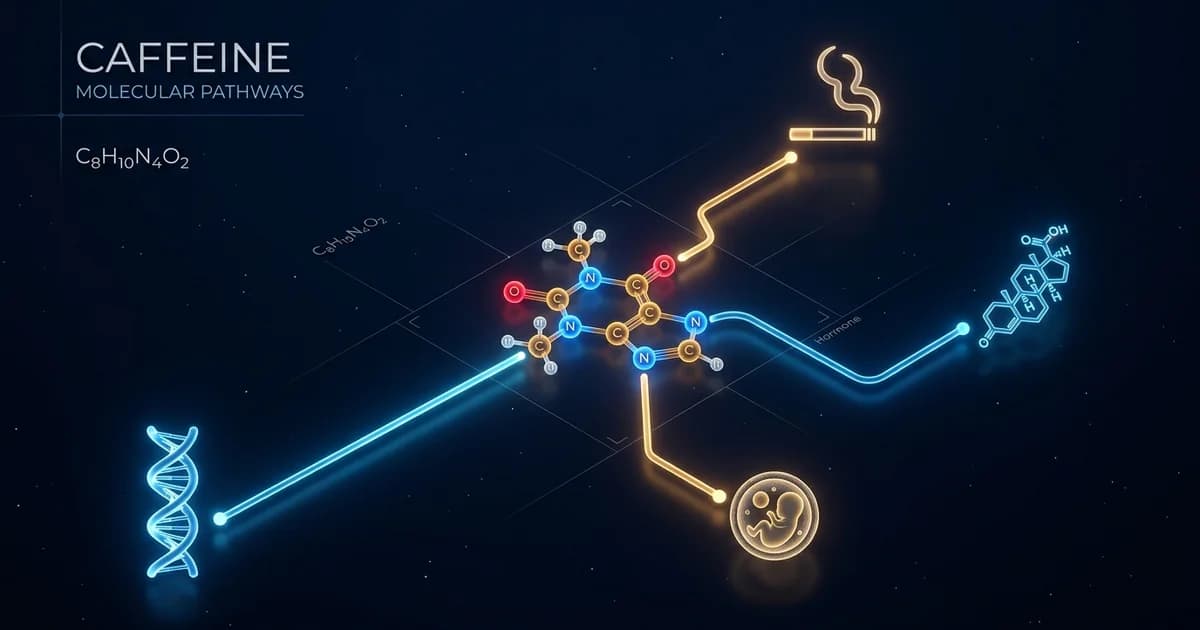
Why Caffeine's Half-Life Varies 5-Fold: Genes, Smoking, the Pill, and Pregnancy
Two people drink the same 200 mg coffee at 3 p.m. One falls asleep fine at 10. The other stares at the ceiling until 2 a.m., wired and confused.
Same dose, same drink, wildly different outcomes. The reason sits in a single number: the caffeine half life, the time your body takes to clear half of what you consumed. For the average healthy adult that number is around 5 hours, but the real range runs from roughly 2 hours to over 18. That is a five-fold spread, and most of it is invisible to you.
Genes set your baseline. Then smoking, hormonal birth control, and pregnancy push it around in ways that change how long your afternoon coffee actually lingers.
Key Takeaways
- Caffeine's half-life averages about 5 hours, but ranges from roughly 2 to 18 hours across people and life stages.
- A single liver enzyme, CYP1A2, does most of the work, and your genes set how fast it runs.
- Smoking roughly doubles how fast you clear caffeine; quitting reverses this.
- Oral contraceptives and pregnancy slow clearance dramatically, with late pregnancy stretching the half-life to 15 hours or more.
- The practical takeaway is timing, not just dose.
What "Caffeine Half-Life" Actually Means
Half-life is the time it takes to eliminate half of the caffeine in your bloodstream. It is the cleanest way to answer the real question people have, which is how long does caffeine last in your system.
Say you drink a coffee with 200 mg of caffeine at 9 a.m. and your half-life is the typical 5 hours. By 2 p.m., five hours later, you still have about 100 mg active in your system.
By 7 p.m. you are at 50 mg. By midnight, around 25 mg. Caffeine does not leave in one clean exit. It tapers, and the slower your clearance, the longer that tail drags into your night.
This matters because a half-life of 2 hours versus 10 hours describes two completely different relationships with the same cup. Same milligrams, opposite consequences for sleep.
CYP1A2: The Liver Enzyme Behind Your Caffeine Metabolism
Your liver does almost all the work, and one enzyme dominates. The gene CYP1A2 controls caffeine metabolism more than any other single factor, and a common variant determines whether you process coffee quickly or slowly.
The key variant has a name: rs762551, also called CYP1A2*1F. Depending on which version you inherited, your enzyme runs at full speed or half capacity.
The difference is not subtle. In fast metabolizers this enzyme runs at full speed and caffeine's half-life is roughly 2 to 4 hours, while in slow metabolizers it runs at half capacity and caffeine lingers for 6 to 8 hours or longer.
So before you account for anything else, genetics alone can roughly double your half-life. Fast metabolizers tend to handle a late espresso without much trouble. Slow metabolizers often discover, the hard way, that "just one afternoon coffee" was the culprit behind three weeks of bad sleep.
This is also why blanket caffeine advice fails. Your friend's 4 p.m. cold brew habit says almost nothing about whether yours will wreck your rest.
What Affects Caffeine Clearance Beyond Genes
Genes set the baseline. Three big modifiers then move it, sometimes by a lot. If you want to understand what affects caffeine clearance in practice, these are the heavy hitters.
Smoking Speeds It Up
Cigarette smoke is one of the strongest accelerators of caffeine clearance. The polycyclic aromatic hydrocarbons in smoke ramp up CYP1A2 activity, so caffeine gets broken down faster.
The effect is large. Pharmacology reviews report that smoking stimulates caffeine clearance and almost doubles the rate of caffeine metabolism through enzyme induction.
This creates a hidden trap for anyone quitting. Smokers often require more caffeine to achieve the same stimulating effects as non-smokers due to quicker clearance from the body. When you stop smoking, that boosted clearance fades over a week or two, your old coffee habit suddenly hits twice as hard, and the jitters and insomnia that follow can feel like withdrawal from quitting itself. Often it is just caffeine you no longer clear as fast.
Hormonal Birth Control Slows It Down
Estrogen does the opposite of smoking. The synthetic estrogen in many oral contraceptives suppresses CYP1A2, so caffeine hangs around longer.
A classic pharmacokinetic study measured it directly. Subjects on oral contraceptives had a prolonged elimination half-life of caffeine, with a mean of 7.88 hours versus 5.37 hours in controls.
Some women see an even larger shift. Studies show the half-life of caffeine can double in women on hormonal birth control, sometimes increasing from the typical 5 to 7 hours to over 10 hours, so even a modest afternoon caffeine dose may disrupt sleep.
If you started the pill and your usual coffee schedule suddenly felt like too much, this is likely why. The dose did not change. Your clearance did.
Pregnancy Slows It Dramatically
Pregnancy produces the most extreme slowdown of all, and it builds across trimesters. Rising progesterone and estrogen suppress the same liver enzyme, and clearance falls off steeply by the end.
The numbers are striking. Reviews of caffeine metabolism during pregnancy report that the liver enzyme responsible for breaking down caffeine slows steadily, extending its half-life from roughly 5 hours to 10 to 18 hours by the third trimester.
At the top of that range, caffeine's half-life can reach roughly 18 hours by the third trimester, which means the fetus is exposed to caffeine for far longer.
For caffeine half life pregnancy specifically, the practical effect is that a single morning coffee can stay active well into the night. That is part of why guidance during pregnancy leans toward lower daily limits and earlier cutoffs. Always follow your own clinician's advice here.
How the Four Big Factors Stack Up
Here is the full range side by side, drawn from the sources above. Note how the same person can sit at very different points depending on circumstance.
| Factor | Typical caffeine half-life | Direction |
|---|---|---|
| Fast metabolizer (CYP1A2) | ~2 to 4 hours | Faster clearance |
| Average healthy adult | ~5 hours | Baseline |
| Slow metabolizer (CYP1A2) | ~6 to 8 hours | Slower clearance |
| Regular smoker | Roughly half the usual time | Much faster |
| On estrogen-containing birth control | ~8 to 10+ hours | Slower |
| Third trimester of pregnancy | ~10 to 18 hours | Much slower |
The takeaway is not that one number is "right." It is that your number is personal and it moves. Smoking and quitting, starting or stopping the pill, and pregnancy can each reset where you sit on this scale.
Why This Changes How You Should Time Caffeine
The lesson hiding in all this is that timing usually matters more than total dose. If your half-life is 8 hours, a noon coffee still has a quarter of its caffeine active at 4 a.m.
So the practical move is to work backward from bedtime, not forward from when you feel tired. A slow metabolizer who wants clean sleep often needs a caffeine cutoff closer to early afternoon, while a fast metabolizer has more room.
If you are curious about your own profile, you can learn a lot without a genetic test. Notice how late you can drink coffee before your sleep suffers. That lived pattern is your half-life talking. For the bigger picture on dosing and tolerance, our guide on how long caffeine really stays in your system covers the timing math in more depth.
Conclusion
Caffeine is not one experience shared evenly across people. It is a molecule filtered through your genes, your hormones, your habits, and your stage of life, and the result is a half-life that can vary five-fold from one person to the next.
CYP1A2 sets your baseline speed. Smoking pushes it faster. Birth control and pregnancy slow it down, sometimes by a wide margin. Once you know roughly where you sit, the right caffeine strategy stops being about willpower and starts being about timing. The same cup that ruins one person's sleep is harmless for another, and now you know why.
Frequently Asked Questions
How long does caffeine stay in your system?
For most healthy adults, caffeine has a half-life of about 5 hours, so half remains after 5 hours and a quarter after 10. Full clearance typically takes 10 to 12 hours. Your personal timeline depends on genetics, smoking, hormonal birth control, and pregnancy, any of which can shift the half-life from as little as 2 hours to well over 15.
What is a fast versus slow caffeine metabolizer?
It comes down to your CYP1A2 gene, specifically the rs762551 variant. Fast metabolizers break caffeine down in roughly 2 to 4 hours and often tolerate late-day coffee. Slow metabolizers take 6 to 8 hours or more, so the same afternoon cup can disrupt sleep and feel more intense. Your everyday response to coffee is a decent clue to which group you fall into.
Does smoking really affect caffeine?
Yes, and the effect is large. Compounds in cigarette smoke induce the CYP1A2 enzyme and nearly double the rate of caffeine metabolism. This is why many smokers drink more coffee for the same effect. The trap comes when quitting, because clearance slows back down within a week or two and your usual caffeine intake can suddenly feel like too much.
Why does caffeine hit harder on birth control?
Estrogen-containing oral contraceptives suppress the liver enzyme that clears caffeine. In classic studies the half-life rose from about 5.4 hours to nearly 8 hours, and some women see it double to over 10 hours. The dose of coffee has not changed, but it now lingers longer, so an afternoon cup is more likely to interfere with sleep.
How much does pregnancy change caffeine clearance?
A lot, and it increases as pregnancy progresses. Rising progesterone and estrogen slow the relevant liver enzyme, and by the third trimester caffeine's half-life can stretch from about 5 hours to anywhere from 10 to 18 hours. A single morning coffee can stay active deep into the night. Follow your clinician's specific guidance on limits during pregnancy.
Can I do anything to clear caffeine faster?
Not quickly, no. There is no reliable shortcut to speed up caffeine clearance once it is in your system, since your liver enzyme activity sets the pace. The effective lever is timing your last dose earlier in the day based on your own sensitivity, rather than trying to flush it out afterward with water, food, or exercise.
The Timing Problem a Sublingual Pouch Solves
If your half-life runs long, your real struggle is not feeling caffeine. It is feeling it for too long. Slow metabolizers, people on the pill, and anyone navigating a hormone shift all share the same issue: the dose that helps at 2 p.m. is still working against them at midnight.
This is the gap Roon was built to address. Each sublingual pouch delivers 80 mg caffeine, 60 mg L-theanine, 25 mg methylliberine (Dynamine), and 5 mg theacrine (TeaCrine), absorbed in about 5 to 10 minutes so you feel the onset fast and stay focused for 6 to 8 hours without the jitters or the crash. The smaller, controlled caffeine dose gives you more room to manage your cutoff than a 200 mg coffee does.
To be clear, Roon does not change your genetics or override pregnancy clearance, and it is not a substitute for medical advice on caffeine during pregnancy. It is a cleaner way to decouple "feeling it now" from "still wired at bedtime." If slow clearance has been quietly wrecking your sleep, try Roon as a more predictable way to time your focus.
Written by Roon Team