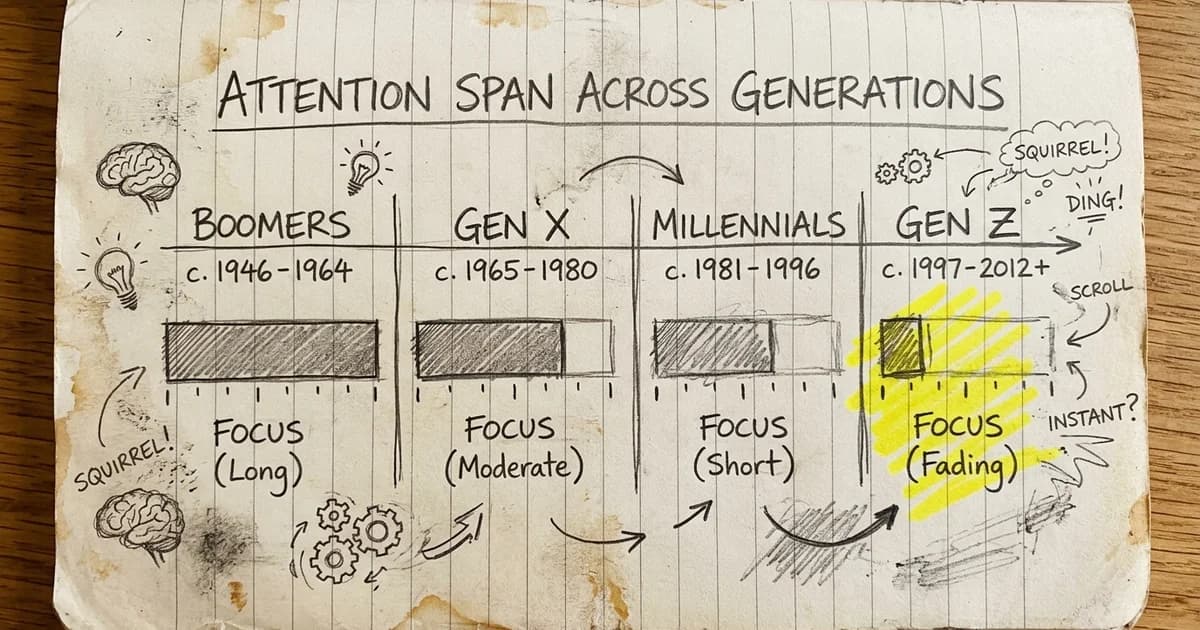
Interest-Based Nervous System: What ADHD Science Says
Interest-Based Nervous System: What ADHD Science Says
The "interest-based nervous system" is a description of ADHD motivation coined by psychiatrist William Dodson. The idea: attention turns on for interest, challenge, novelty, or urgency, not for importance alone. It is a clinical model, not a diagnosis, and no published study tests it by name. But several measured findings in neuroscience and behavioral economics point in the same direction.
Key Takeaways
- The interest-based nervous system is a clinician's framework, not a peer-reviewed construct or a DSM-5-TR diagnosis.
- PET and fMRI studies show lower dopamine-receptor markers and reduced reward-pathway activation in adults with ADHD, consistent with the model's claim that "importance" alone is not enough.
- Delay discounting is the best-supported piece of the puzzle, with meta-analytic effect sizes holding across age groups.
- The model helps replace "lazy" with something more specific, but it can become an excuse to abandon every boring task.
What Is the Interest-Based Nervous System?
The term comes from psychiatrist William Dodson's writing in ADDitude, where he describes the ADHD nervous system as "interest-based, rather than importance- or priority-based." Engagement is created by "interest, competition, novelty, or urgency created by a do-or-die deadline." He presents this as clinical observation and cites no studies.
ADHD coaches later compressed the idea into acronyms: ICNU (Interest, Challenge, Novelty, Urgency) and PINCH (Passion/Play, Interest, Novelty, Competition/Challenge, Hurry). INCUP is another community variant with no clear origin. None cite a controlled experiment. The model is descriptive. The question is whether the research literature, under different names, measures the same things Dodson noticed.
Interest-Based vs. Importance-Based: The Comparison
| Driver | What it looks like at work | Closest research construct | Evidence strength |
|---|---|---|---|
| Interest | The topic you research for 4 hours without standing up | Reduced reward-pathway dopamine markers, lower trait motivation (Volkow 2009, 2011) | Moderate, correlational |
| Novelty | New app, new system, new hobby cycle | Ventral-striatal hyporesponsiveness to reward anticipation (Plichta & Scheres 2014) | Moderate, mixed |
| Challenge / competition | A rival, a puzzle, a bet | Reinforcement intensity effects (Luman 2005) | Modest, mostly children |
| Urgency | The deadline-night sprint | Delay aversion (Sonuga-Barke 2003), steeper delay discounting (Jackson & MacKillop 2016) | Good meta-analytic support |
| Importance alone | The expense report that sat there for three weeks | The gap the model describes | Descriptive only |
The evidence ranges from solid to thin, and none of it was designed to test the interest-based model directly.
Is the Interest-Based Nervous System Real? What the Evidence Says
A PubMed title/abstract search for "interest based nervous system" AND ADHD returned zero results. The term is not in the DSM-5-TR. So what IS measured?
Dopamine markers in the reward pathway. Volkow and colleagues used PET imaging in a 2009 JAMA study (53 unmedicated adults with ADHD vs. 44 controls) and found lower dopamine transporter and D2/D3 receptor availability in reward-pathway regions, including the nucleus accumbens and midbrain. A 2011 follow-up in Molecular Psychiatry (45 ADHD vs. 41 controls) found lower trait "Achievement" motivation scores in the ADHD group, correlated with dopamine receptor markers in the accumbens and midbrain, in the ADHD group only.
These are group averages and correlations, not causal chains. But they show the reward pathway operates differently in ADHD, in the direction Dodson's model predicts.
Ventral-striatal response to anticipated rewards. Plichta and Scheres (2014) ran an fMRI meta-analysis and found a medium effect (Cohen's d = 0.48 to 0.58) for lower ventral-striatal activation in ADHD participants anticipating rewards. The authors flagged that included studies were too few for a definitive conclusion, but the direction is consistent.
Why Urgency Works When Importance Does Not
This is where the data is strongest. Sonuga-Barke's 2003 dual-pathway model proposed two partially independent routes in ADHD: executive dysfunction and delay aversion, a motivational style defined by attempts to escape or avoid delay. The looming deadline does not fix executive function. It removes the delay.
Jackson and MacKillop (2016) supported this with a delay-discounting meta-analysis: 21 investigations, 25 comparisons, N = 3,913, d = 0.43. The effect held across adults and children, real or hypothetical rewards. Luman, Oosterlaan, and Sergeant (2005) reviewed 22 studies (1,181 children) and found reinforcement improved performance somewhat more in ADHD, with high-intensity reinforcement particularly effective. Nearly all participants were children.
That tracks with the procrastination-deadline cycle and with time blindness research: far-off deadlines do not register the same way.
Where the Model Helps, and Where It Misleads
It helps by replacing "lazy" with something specific. The model gives you a design brief: make the task novel, timed, social, or competitive, and you raise the odds of engaging.
It misleads in a few ways. It implies people without ADHD are purely importance-driven. They are not. Everyone is more motivated by interest than by obligation; the difference in ADHD is one of degree, not of kind. It can also become permission to only pursue interesting work.
The model overlaps with Dinah Murray's monotropism, a separate interest-based account of autism. The constructs come from different clinical traditions. Conflating them muddies both.
And hyperfocus, the "good side" of interest-based attention, is poorly defined. Hupfeld and colleagues (2019) found higher ADHD symptoms linked to more hyperfocus in samples of 251 and 372 adults, but a 2021 review by Ashinoff and Abu-Akel concluded there is no consensus definition. The phenomenon is real; the science is early.
The interest-based model is not a self-diagnosis tool. If the description fits, talk to a clinician.
How to Work with an Interest-Based Nervous System
Each strategy borrows one of the drivers the model describes.
- Borrow urgency. Short timers, sprints, artificial near-deadlines. A 15-minute countdown applies the logic of the delay-discounting research.
- Add novelty. Change location, change the order of steps, use a new tool. Novelty resets attention briefly, and briefly is enough.
- Add people. Body doubling, co-working sessions, accountability partners. Another person changes the reward structure.
- Add challenge. Beat your previous time, keep a points tally. Weakest evidence base (mostly children), but zero cost to try.
- Shrink the task. A 10-minute first step beats a 3-hour block. Starting is the bottleneck.
There is structured evidence for skills-based approaches too. Solanto and colleagues (2010) randomized 88 adults with ADHD to 12 weeks of meta-cognitive therapy (time management, organization, planning) versus supportive therapy. The skills group had better inattention outcomes (response OR 5.41, 95% CI 1.77 to 16.55).
If you suspect ADHD, talk to a clinician about an evaluation.
A Useful Story, Not a Diagnosis
The interest-based nervous system is a clinician's metaphor that lines up with measured findings on dopamine receptors, reward anticipation, and delay discounting. No study has tested the model itself, but the patterns it names are real. Use it as a design brief for your day: borrow urgency, add novelty, recruit people, build in challenge. Do not confuse a useful description with a formal diagnosis.
Frequently Asked Questions
Who coined the interest-based nervous system?
Psychiatrist William Dodson introduced the term in his clinical writing, most prominently in an ADDitude article describing ADHD motivation as driven by interest, competition, novelty, and urgency rather than importance. He presents it as clinical experience and cites no studies.
Is the interest-based nervous system scientifically proven?
No study uses the term. It does not appear in peer-reviewed literature or the DSM-5-TR. However, measured findings on dopamine-receptor markers, ventral-striatal activation, and delay discounting align with the model's predictions. The evidence supports the direction, not the specific framework.
What is an importance-based nervous system?
In Dodson's framing, the importance-based nervous system describes how most people prioritize: by perceived importance, deadlines, and consequences. He contrasts it with the ADHD nervous system, which responds primarily to interest and urgency. The term is shorthand for a contrast, not a researched category.
What does INCUP or PINCH stand for?
PINCH stands for Passion/Play, Interest, Novelty, Competition (or Cooperation/Challenge), and Hurry, popularized by the Neurodivergent Insights community as a more memorable replacement for the earlier ICNU acronym (Interest, Challenge, Novelty, Urgency). INCUP is another community variant with no verified original author.
Is the interest-based nervous system only in ADHD?
No. Everyone is more motivated by interest than by obligation. The difference in ADHD is one of degree: lower dopamine-receptor availability in reward regions, stronger delay aversion, and a more pronounced preference for immediate rewards. The model describes a tendency amplified in ADHD, not exclusive to it.
How do you motivate an interest-based nervous system?
Borrow the drivers: a short timer for urgency, a new environment for novelty, a co-working partner for accountability, a challenge for competition. Structured skills training has randomized trial support in adults. For persistent difficulty with motivation, talk to a clinician about ADHD evaluation or medication.
Borrowing a Cue for the Tasks That Only Matter
The hardest part of an interest-based day is the part that only matters: the form, the inbox, the errand. You need a start cue and a short delay between action and payoff. Some people use a timer or a co-working session. Roon is a physical ritual: a zero-nicotine pouch you place before a timed block on something boring.
A 2025 systematic review in Nutrition Reviews found, in a subgroup of six trials in healthy adults, that caffeine plus L-theanine improved attention-switching accuracy versus placebo (SMD 0.33, 95% CI 0.13 to 0.54), with uncertainty the authors flagged. None of those adults had ADHD.
Roon is not a treatment for ADHD; if you take stimulant medication, talk to your prescriber before adding caffeine. It does not create interest or fix dopamine pathways. Each pouch has 80 mg caffeine, 60 mg L-theanine, 25 mg methylliberine (Dynamine), and 5 mg theacrine (TeaCrine). In a randomized crossover study (n=12), 100 mg methylliberine with 150 mg caffeine extended caffeine's half-life from 7.2 to 15 hours with no higher peak. That is 4x Roon's methylliberine and about 1.9x its caffeine, so the direction applies, not the exact numbers; Roon is designed for 6 to 8 hours of sustained alertness. Stop at least 8 hours before bed. Tins start at $9.16 on the 12-tin subscription. For the evidence, see what the caffeine trials in ADHD actually found.
Related from Roon
- ADHD Procrastination and Deadline Pressure
- ADHD Time Blindness: Why Far-Off Deadlines Don't Register
- Body Doubling for ADHD
- How Dopamine Drives Motivation
Written by Roon Team