What Is Suntheanine? The Patented L-Theanine on Your Supplement Label
What Is Suntheanine? The Patented L-Theanine on Your Supplement Label
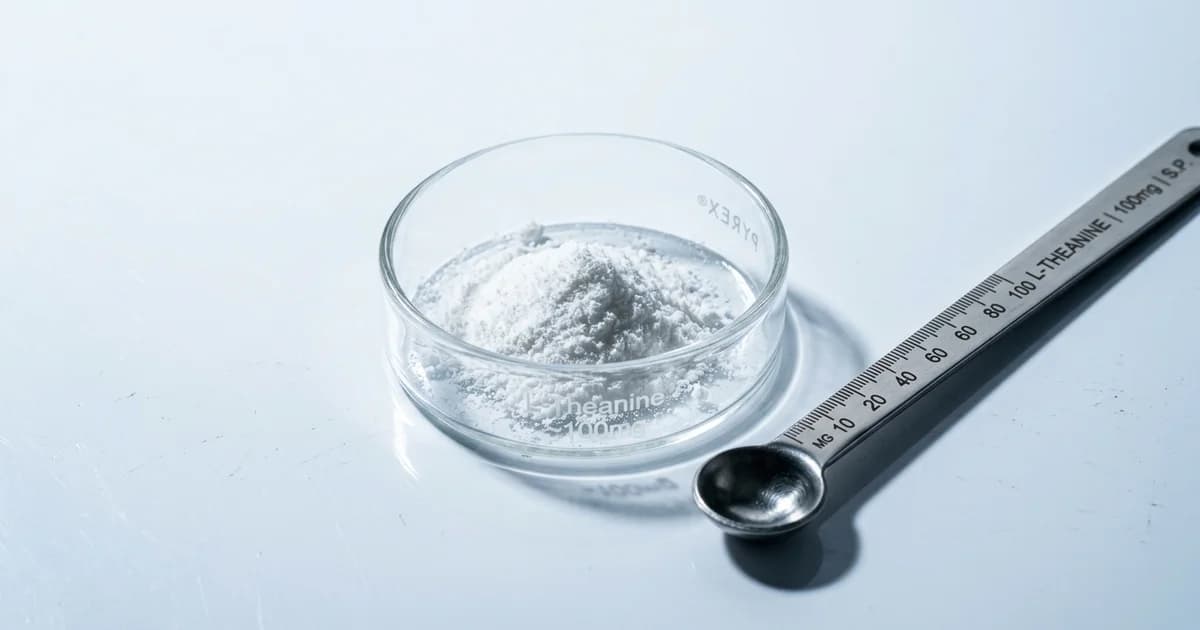
You flip over a supplement bottle and the label says "Suntheanine" instead of plain L-theanine. Suntheanine is Taiyo International's trademarked, enzymatically produced L-theanine, manufactured to be isomerically pure: only the L-isomer, none of its mirror-image D-form. It holds FDA GRAS status (GRN 000209), and it shows up in everything from sleep capsules to energy pouches.
Whether that trademark signals something useful, or is just a licensing fee baked into your price, depends on what you care about: purity, study provenance, or both.
Key Takeaways
- Suntheanine is not a different molecule from L-theanine. It is a branded version made by a specific enzymatic process that produces only the L-isomer.
- The FDA issued a letter of no questions on Taiyo's L-theanine GRAS notice (filed 2006, response issued 2007) for food use up to 250 mg per serving.
- Some generic "L-theanine" supplements are actually racemic mixtures containing both D- and L-theanine, which are absorbed and cleared differently in animal models.
- EFSA reviewed L-theanine health claims in 2011 and declined to authorize any of them, citing insufficient evidence, though small human trials published since then have shown promising (if modest) results.
How Suntheanine Is Made: Enzymatic Synthesis vs. the Alternatives
Three routes exist for producing supplemental L-theanine.
| Method | How It Works | Isomeric Purity | Typical Cost |
|---|---|---|---|
| Enzymatic synthesis (Suntheanine) | Bacterial glutaminase catalyzes a reaction between glutamine and ethylamine, replicating the pathway tea plants use | Pure L-isomer | Higher |
| Chemical synthesis | Standard organic chemistry; produces a racemic D,L-theanine mixture unless an extra chiral separation step is added | Mixed (racemic) unless purified | Lower |
| Green tea extraction | Theanine is isolated from brewed or powdered tea leaves | Naturally L-isomer, but yields are tiny and variable | Highest |
Taiyo's enzymatic method uses a patented process that mirrors what happens inside Camellia sinensis. The enzyme forces the reaction to produce only the L-enantiomer. Chemical synthesis, the cheapest route, produces equal parts D- and L-theanine unless the manufacturer invests in chiral purification afterward. Tea extraction yields a pure L-form but is expensive and low-volume, which is why almost no supplement-grade theanine comes from actual tea leaves.
Is Suntheanine "Natural"?
This is where label language gets slippery. Suntheanine holds Non-GMO Project Verification, and Taiyo describes the process as mimicking the natural biosynthetic pathway. Both things are true. But the starting materials are industrially produced amino acids and the reaction happens in a bioreactor, not in a tea field.
The FDA's GRAS review (GRN 000209) evaluated safety and intended use, not whether the ingredient qualifies as "natural" by any legal definition. Non-GMO Project Verification confirms the input organisms are not genetically modified; it says nothing about source or extraction method. So if your definition of "natural" requires plant extraction, Suntheanine does not meet it. If your definition is "produced by an enzyme rather than a chemical reagent," it does.
The honest label read: enzymatically manufactured, isomerically pure, non-GMO inputs, not tea-extracted.
Suntheanine vs. Generic L-Theanine: What the Purity Data Shows
The practical difference comes down to enantiomeric purity. D-theanine and L-theanine are not interchangeable in the body. A 2005 study in Chirality (Desai, Gill, Hsu, Armstrong) found that in rats, oral absorption of D-theanine was far lower than L-theanine, and the two enantiomers competed for renal reabsorption. L-theanine was preferentially reabsorbed and metabolized by the kidney, while D-theanine was preferentially excreted. This is animal data, not human, but it establishes that the two forms behave differently at a basic pharmacokinetic level.
In the same study, the researchers evaluated several commercial "L-theanine" products using chiral HPLC with mass spectrometry. Most contained significant amounts of D-theanine. One caveat: the lead author (Armstrong) has co-authored work with Taiyo-affiliated researchers, and the analytical method development traces partly to Taiyo-supported research. The finding is consistent with what you would expect from chemical synthesis without chiral purification, but it is not fully independent of the brand it favors.
If a label says "L-theanine" with no further identification, you cannot tell whether it is enzymatically produced, chemically synthesized, or a racemic mixture relabeled as the L-form.
What the Human Studies Actually Show
Several small trials have used the Suntheanine brand specifically. Others used unspecified L-theanine that may or may not have been Suntheanine. The table below separates the two.
| Study | n | Dose | Key Finding | Suntheanine Named? | Funding/Supply |
|---|---|---|---|---|---|
| Kimura et al. 2007, Biol Psychol | 12 | 200 mg single dose | Blunted heart-rate and salivary IgA responses to acute mental stress; reduced subjective stress vs. placebo | Not confirmed in abstract | Not confirmed |
| Nobre, Rao, Owen 2008, Asia Pac J Clin Nutr | Small | 50 mg single dose | Increased alpha-band EEG activity within 40 minutes | Nobre affiliated with Unilever; Rao affiliation unclear | Not confirmed |
| Hidese et al. 2019, Nutrients | 30 | 200 mg/day, 4 weeks | Reduced depression and trait-anxiety scores; improved PSQI sleep subscales; improved verbal fluency in lower-baseline subgroup | Yes, explicitly | Taiyo-supported |
The pattern matters. The best-designed trial that explicitly names Suntheanine (Hidese 2019) was supported by Taiyo. That does not make the data wrong, but the evidence base for the branded ingredient is not independent of the company selling it. The broader L-theanine literature (covered in our post on what L-theanine actually does) includes more and larger trials, but many do not specify the brand or manufacturing method.
The European Food Safety Authority reviewed L-theanine health claims in 2011 and did not authorize any of them, covering cognitive function, stress relief, sleep, and menstrual discomfort. EFSA's bar for authorization is high, and the post-2011 literature (including Hidese 2019) was not part of that review. Still, no regulatory body in the US or EU has formally approved L-theanine health claims.
Suntheanine Dosage: What the Trials Used
Clinical trials have used doses ranging from 50 mg to 400 mg per day, with 200 mg being the most common single or daily dose. For context, a typical cup of brewed green tea contains roughly 20 to 60 mg of L-theanine, which means you would need somewhere between 3 and 10 cups to reach a 200 mg study dose. That is why supplemental forms exist.
The FDA's GRAS notice covers food use up to 250 mg per serving. This is a safety ceiling for food-product formulation, not a recommended supplement dose, but it gives a reference point. For a deeper look at dose timing and stacking, see our L-theanine dosage guide.
Who Should Use Caution
L-theanine can have a mild blood-pressure-lowering effect. WebMD notes that it may interact with sedatives (benzodiazepines like diazepam, sleep aids like zolpidem), stimulants, and blood-pressure medications. If you take any of those, talk to your prescriber before adding L-theanine or Suntheanine.
There is not enough safety data on L-theanine use during pregnancy or breastfeeding. Multiple clinical references recommend avoiding it in both cases until more data exists. The same applies to children: some trials have been conducted in pediatric populations, but the evidence base is too thin to draw general recommendations.
How to Read the Label
If a supplement contains Suntheanine, the label will typically show the Suntheanine logo or the registered trademark symbol next to the ingredient name. The trademark guarantees enzymatic production and enantiomeric purity through Taiyo's supply chain. It does not guarantee that the finished product is better formulated, better dosed, or more effective than a competing product using a different high-purity L-theanine source.
Generic L-theanine can also be pure L-isomer if the manufacturer uses enzymatic production or chiral purification after chemical synthesis. The trademark is a shortcut for verifying purity, not the only path to it.
The Trademark vs. the Molecule
Suntheanine is a quality-control story, not a different-ingredient story. It tells you the L-theanine in your supplement was made by Taiyo's enzymatic process and should be free of D-theanine contamination. That is a real manufacturing distinction backed by GRAS review and consistent (if not fully independent) analytical data. It is not a guarantee of clinical superiority, and the human trials conducted on the branded ingredient are small and mostly manufacturer-funded. The molecule itself, L-theanine, is the same regardless of who made it or how.
If enantiomeric purity matters to you and you do not want to research the manufacturer behind a generic label, the Suntheanine trademark is a reasonable heuristic. If you trust the supplier or can verify purity through third-party testing, generic L-theanine at the right dose does the same job.
Frequently Asked Questions
Is Suntheanine different from L-theanine?
No. Suntheanine is L-theanine. The difference is manufacturing origin: Suntheanine is produced by Taiyo International using a patented enzymatic process that guarantees the product is purely the L-isomer. Some generic L-theanine products are also pure, but others may contain D-theanine from chemical synthesis. The molecule itself is identical.
Is Suntheanine natural?
It depends on your definition. Suntheanine is made enzymatically, replicating the biological pathway found in tea plants, and uses non-GMO inputs. But it is not extracted from tea. It is produced in a bioreactor from precursor amino acids. The FDA GRAS review and Non-GMO Project Verification do not certify it as "natural."
What is a good Suntheanine dosage?
Most clinical trials use 200 mg per day, either as a single dose or split. The FDA's GRAS notice for food use covers up to 250 mg per serving. Doses in published research range from 50 mg to 400 mg. Healthy adults in published trials typically started at 100 to 200 mg per day. For more detail, read our L-theanine dosage guide.
Who should not take Suntheanine?
Anyone on blood-pressure medications, sedatives, or sleep aids should consult their prescriber first. There is insufficient safety data for use during pregnancy or breastfeeding. If you are taking stimulant medications, the interaction profile is also worth discussing with a clinician.
Does Suntheanine help with anxiety?
Small trials suggest L-theanine (including the Suntheanine brand) can modestly reduce self-reported anxiety during acute stress. Hidese et al. (2019) found reduced trait-anxiety scores over four weeks at 200 mg/day. But EFSA reviewed L-theanine stress claims in 2011 and did not authorize them, and the positive trials are small and often manufacturer-funded. Promising, not proven.
Why do some supplements say Suntheanine on the label?
The manufacturer (supplement brand) licenses the Suntheanine trademark from Taiyo International. Using the name signals that the L-theanine in the product comes from Taiyo's supply chain and was produced by their enzymatic process. It is a sourcing and purity claim, not a potency claim.
How long does L-theanine take to work?
EEG studies show increased alpha-wave activity within 30 to 40 minutes of a single dose. For more on timing and duration, see how long L-theanine lasts.
Can you take Suntheanine with caffeine?
Yes, and most research on the L-theanine plus caffeine combination shows they work well together: caffeine provides alertness while L-theanine smooths the jittery edge. For the science behind this pairing, read why caffeine pairs with L-theanine.
One Ingredient, Verified Purity, Inside a Wider Stack
L-theanine is one of the four active ingredients in Roon, a zero-nicotine oral pouch that pairs it with caffeine, methylliberine (Dynamine), and theacrine (TeaCrine). The L-theanine in Roon is there for the same reason it appears in clinical trials: to take the sharp edges off stimulant-driven focus without blunting the alertness itself.
Roon is not a theanine supplement. It is a caffeine-delivery format where L-theanine plays a supporting role alongside caffeine and two other active ingredients. If you want pure L-theanine at study-level doses, a standalone supplement (Suntheanine-branded or otherwise) is the right call. If you want L-theanine doing what it does best, smoothing a caffeine response inside a timed-release stack, Roon is built for that. For a full ranking of standalone options, check out our list of best L-theanine brands ranked.
Related from Roon
Written by Roon Team