Suntheanine vs L-Theanine: Is the Trademark Worth Paying For?
Suntheanine vs L-Theanine: Is the Trademark Worth Paying For?
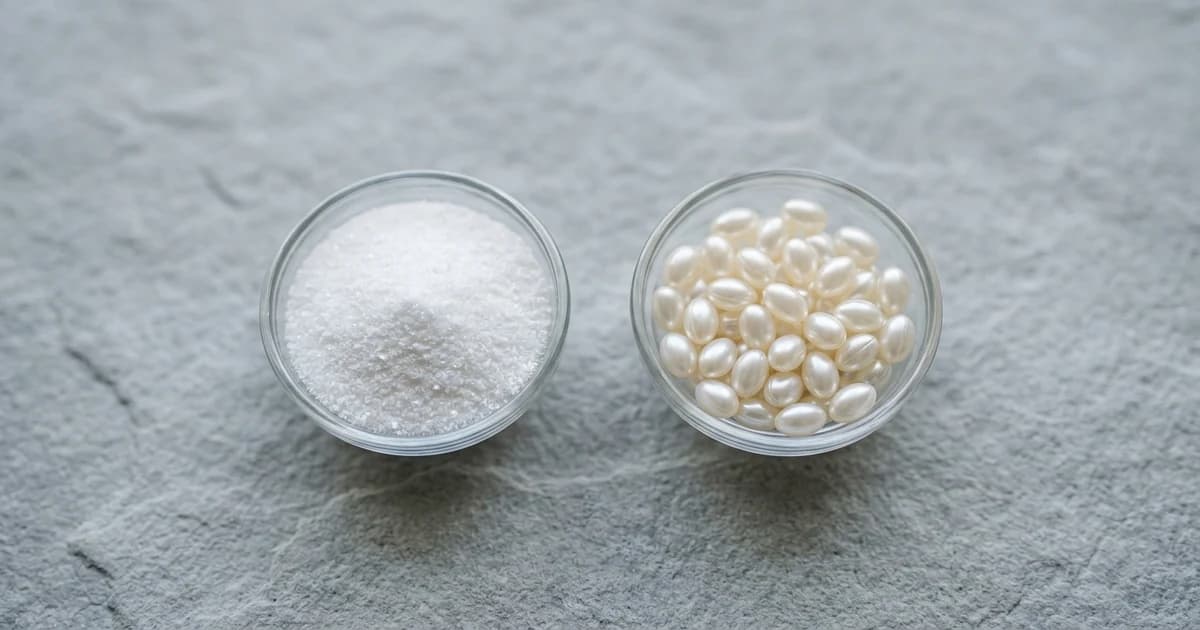
Suntheanine and generic L-theanine are the same molecule: L-glutamic acid gamma-monoethylamide. The difference is manufacturing. Suntheanine is produced by Taiyo International through a patented enzymatic process verified to yield isomerically pure L-theanine. Generic L-theanine can come from chemical synthesis or tea-leaf extraction, with no universal purity standard. Most human clinical evidence used Suntheanine specifically, because for years it was the only supply with confirmed enantiomeric identity.
"Branded" does not automatically mean "better for you." It means better documented. Whether that documentation is worth an extra $0.05 to $0.14 per dose depends on how you use L-theanine and how much batch consistency matters to your stack.
Key Takeaways
- Same active molecule, different quality control. Suntheanine guarantees pure L-isomer theanine via enzymatic synthesis. Generic products vary by manufacturer and method.
- The clinical literature skews toward Suntheanine because it was the first supplier with verified isomeric purity, not because generics were tested and failed.
- Price gap is real but narrow. Suntheanine-labeled capsules run roughly $0.19 per 200 mg dose; unbranded generics start around $0.05 to $0.12.
- A third option exists. AlphaWave (Ethical Naturals) is a competing branded L-theanine standardized to 98% L-theanine with its own GRAS affirmation.
Side-by-Side: Suntheanine vs Generic L-Theanine
| Criterion | Suntheanine (Taiyo) | Generic L-Theanine | AlphaWave (Ethical Naturals) |
|---|---|---|---|
| Manufacturing method | Patented enzymatic synthesis | Chemical synthesis or tea-leaf extraction (varies) | Botanical extraction, standardized |
| Isomeric purity | ~100% L-isomer (verified) | Unverified; racemic D/L mixture possible with chemical synthesis | 98% L-theanine (per supplier spec) |
| FDA GRAS status | Yes, GRN 000209 (2007) | Depends on manufacturer | GRAS affirmed (per Ethical Naturals) |
| Named in human RCTs | Yes, multiple (Hidese 2019, others) | Rarely specified by brand | Two clinical trials claimed by supplier |
| Typical dose in studies | 200 mg/day | 200 mg/day | 200 mg/day |
| Cost per 200 mg dose | ~$0.19 (Sports Research, 150 ct at Costco) | ~$0.05 to $0.12 (BulkSupplements, Nutricost) | Varies by finished product |
| Availability | Wide; sold by Sports Research, Thorne, NOW, Jarrow | Very wide; bulk and capsule formats | Narrower retail distribution |
Prices checked from bulksupplements.com, nutricost.com, and Costco/Sports Research at the time of writing. Retail prices fluctuate.
How Each Form Is Made
Suntheanine uses a patented enzymatic process that mimics the biosynthetic pathway in tea plants. The enzyme is stereospecific: it produces only the L-enantiomer. Taiyo holds U.S. and international patents on this method, and the product earned FDA GRAS status (GRN 000209) in 2007 for up to 250 mg per serving.
Generic L-theanine comes from two routes. Chemical synthesis is cheap but produces a racemic L/D mixture unless a chiral separation step is added. Tea-leaf extraction yields the correct L-isomer naturally, but at lower volume and more variability, since theanine is only about 1 to 2% of dried tea-leaf weight. Neither route is inherently bad. The risk with generics is the absence of a verified purity spec for the finished lot.
What "Isomerically Pure" Actually Means
Theanine has two mirror-image forms: L-theanine and D-theanine. Your body handles them differently. A 2005 study by Desai et al. in Chirality showed that in rats, L-theanine is reabsorbed and metabolized through renal pathways, while D-theanine is preferentially excreted. This is animal pharmacokinetic data, not a human efficacy trial, but it establishes that the two enantiomers are not interchangeable in the body.
A label claiming "99% pure L-theanine" may mean 99% total theanine by weight, without specifying the L-to-D ratio. A product could be 99% theanine and still contain a meaningful fraction of the D-isomer if it was synthesized racemically.
One frequently cited claim, that 5 of 6 commercial L-theanine products tested contained measurable D-theanine, originates from a 2007 trade publication authored by Taiyo's own researchers, not from independent peer review. It may be accurate, but the conflict of interest means you should weigh it accordingly.
Suntheanine vs AlphaWave and Other Branded Forms
Suntheanine is not the only branded L-theanine. AlphaWave, supplied by Ethical Naturals, is standardized to 98% L-theanine, holds its own GRAS affirmation, and claims two clinical trials. Its retail distribution is narrower, so you will see it on fewer labels.
AlphaWave on a label signals the same thing Suntheanine does: a branded, purity-verified supply chain. The choice between them comes down to which finished product you prefer, not a pharmacological difference at the same dose.
What the Studies Show, by Brand
Most controlled human trials on L-theanine used Suntheanine by default, because it was the only form with confirmed isomeric identity. This does not prove generics are inferior. It means generics were never separately tested at the same rigor.
| Study | Form Used | Dose | n | Key Finding |
|---|---|---|---|---|
| Hidese et al. 2019, Nutrients | Suntheanine (named) | 200 mg/day, 4 weeks | 30 | Reduced trait-anxiety and depression scores; improved sleep-quality subscales vs placebo |
| Kimura et al. 2007, Biol Psychol | L-theanine (brand unspecified) | 200 mg single dose | 12 | Reduced heart-rate and salivary immunoglobulin-A stress responses during acute stress task |
| Nobre et al. 2008, Asia Pac J Clin Nutr (conference abstract) | L-theanine (Suntheanine likely, Taiyo-supplied) | 50 mg single dose | ~35 (per abstract) | Increased alpha-wave activity on EEG within 45 min of ingestion |
Suntheanine shows up by name in the best-controlled trials. Studies that say "L-theanine" without naming a supplier leave brand ambiguous. For a deeper look at what the studies actually show, the evidence base is strong at 200 mg regardless of brand.
Price Per Dose: Real Numbers
The cost gap exists but is not dramatic in absolute dollars.
| Product | Form | Branded? | Count | Price | Cost per 200 mg |
|---|---|---|---|---|---|
| BulkSupplements L-Theanine | Capsule, 200 mg | No | 365 | $18.97 | ~$0.05 |
| Nutricost L-Theanine | Capsule, 200 mg | No | 120 | $13.97 | ~$0.12 |
| Sports Research Suntheanine (Costco) | Softgel, 200 mg | Suntheanine | 150 | $28.99 | ~$0.19 |
At one dose per day, the annual difference between the cheapest generic (BulkSupplements at ~$0.05) and the Suntheanine product (Sports Research at ~$0.19) is roughly $51. That is not nothing, but it is not the 3x markup some forum posts claim, either.
If you stack L-theanine with caffeine daily, price per dose compounds over a year. For guidance on how much L-theanine to take and how long the effect lasts, those numbers help you decide whether you are buying 365 doses or 180.
Who Should Care About the Difference (and Who Shouldn't)
Pay for Suntheanine (or AlphaWave) if:
- You stack L-theanine with caffeine daily and need consistent batch-to-batch effect. Consistency matters more when the ratio of L-theanine to caffeine drives the experience.
- You want a verified purity paper trail without having to chase COAs yourself.
- The $51/year premium is trivial next to your coffee spend.
Generic is fine if:
- Your manufacturer publishes a Certificate of Analysis (COA) with chiral purity data.
- You use L-theanine occasionally, not daily.
- Budget is the priority and you accept more variability between lots.
For a ranked comparison of specific products, see our L-theanine brands ranked and reviewed.
The Verdict on Branded vs Generic Theanine
Suntheanine's value is documentation, not a different molecule. You are paying for a verified enzymatic process, confirmed L-isomer purity, FDA GRAS status tied to that specific ingredient, and the fact that most human trials happened to use it. A well-manufactured generic at 200 mg will not feel different. You just have less paper proving what is in the capsule.
If the supplement industry had universal chiral-purity testing, the brand premium would be harder to justify. It does not, so the premium buys a shortcut past uncertainty. Whether $0.07 to $0.14 per dose is worth that shortcut is a personal call, not a pharmacological one.
Frequently Asked Questions
Is Suntheanine better than regular L-theanine?
Suntheanine is not a different compound. It is a purity-verified form of L-theanine made by enzymatic synthesis, guaranteeing near-100% L-isomer content with FDA GRAS backing. If a generic has equivalent chiral purity, the effect at the same dose should be the same. You are paying for documentation, not a different molecule.
What is the difference between Suntheanine and AlphaWave?
Both are branded, purity-verified L-theanine with GRAS status. Suntheanine (Taiyo) uses enzymatic synthesis and appears in more published trials. AlphaWave (Ethical Naturals) is standardized to 98% L-theanine and claims two clinical trials. For most users, the practical difference is minimal.
Does generic L-theanine contain D-theanine?
It can. Chemical synthesis produces a racemic L/D mixture unless a chiral separation step is added. Tea-leaf extraction naturally yields L-theanine. A 2005 study showed the two enantiomers are handled differently in rat metabolism. Not all generics disclose their L-to-D ratio.
How much L-theanine is in green tea compared to supplements?
A cup of brewed green tea contains roughly 5 to 60 mg of L-theanine depending on variety and brew time. Clinical studies use 200 mg per dose. You would need 3 to 4 cups of high-quality green tea to approach one supplemental dose.
Is Suntheanine safe?
Suntheanine received FDA GRAS status (GRN 000209) in 2007 for use up to 250 mg per serving. Adverse events at typical doses (100 to 400 mg) are rare in published trials. If you take blood-pressure medications, sedatives, or are pregnant or breastfeeding, talk to your clinician before supplementing with any form of L-theanine.
What dose of Suntheanine do studies use?
Most human trials use 200 mg per day as a single dose. The Hidese et al. 2019 trial used 200 mg/day for four weeks. Some EEG studies have used doses as low as 50 mg.
Can I tell if my L-theanine supplement uses Suntheanine?
Yes. Products containing Suntheanine display the trademark on the label and product page. If the label says only "L-theanine" without a branded ingredient callout, it is generic. Check the supplement facts panel or the manufacturer's COA if purity matters to you.
Why Stack Design Matters More Than Any Single Ingredient
The Suntheanine vs generic debate matters most when L-theanine is part of a daily stack, where consistency in one ingredient affects the whole experience. L-theanine's primary role in a stack is smoothing the stimulant curve: reducing jitter, softening the tail-end of caffeine without blunting the focus.
Roon uses L-theanine alongside caffeine, methylliberine (Dynamine), and theacrine (TeaCrine) in a sublingual pouch designed for a 6 to 8 hour felt window with no crash. The L-theanine serves the role the clinical literature describes: modulating the stimulant response so energy stays steady. Roon is not a standalone L-theanine supplement for relaxation or sleep. It is built for sustained focus, and the L-theanine keeps the ride smooth. If that fits, try Roon starting from $0.61 per pouch.
For a full explainer on the ingredient, the sibling article covers Suntheanine's mechanism and history in more detail.
Related from Roon
- L-theanine brands ranked and reviewed
- What the studies actually show
- How much L-theanine to take
- L-theanine paired with caffeine
Written by Roon Team