How Long Does Caffeine Last? Onset, Peak and Wear-Off

How Long Does Caffeine Last? Onset, Peak and Wear-Off
Caffeine is absorbed within about an hour, and healthy adults clear half of it in roughly 3 to 7 hours (Temple et al., 2017). That means a 100 mg coffee still leaves about 44 mg in the blood six hours later at a mid-range 5-hour half-life. Most people notice the lift for a few hours, but the sleep effect runs longer: one study found that 400 mg taken 6 hours before bed still disrupted sleep.
The table below shows what three common doses leave behind, hour by hour, across the adult half-life range.
How Much Caffeine Is Left, Hour by Hour
| Dose | Half-life | 2 h | 4 h | 6 h | 8 h | 10 h | 12 h |
|---|---|---|---|---|---|---|---|
| 80 mg | 3 h (fast) | 50 mg | 32 mg | 20 mg | 13 mg | 8 mg | 5 mg |
| 80 mg | 5 h (mid-range) | 61 mg | 46 mg | 35 mg | 26 mg | 20 mg | 15 mg |
| 80 mg | 7 h (slow) | 66 mg | 54 mg | 44 mg | 36 mg | 30 mg | 24 mg |
| 100 mg | 3 h | 63 mg | 40 mg | 25 mg | 16 mg | 10 mg | 6 mg |
| 100 mg | 5 h | 76 mg | 57 mg | 44 mg | 33 mg | 25 mg | 19 mg |
| 100 mg | 7 h | 82 mg | 67 mg | 55 mg | 45 mg | 37 mg | 30 mg |
| 200 mg | 3 h | 126 mg | 79 mg | 50 mg | 31 mg | 20 mg | 12 mg |
| 200 mg | 5 h | 152 mg | 115 mg | 87 mg | 66 mg | 50 mg | 38 mg |
| 200 mg | 7 h | 164 mg | 135 mg | 110 mg | 91 mg | 74 mg | 61 mg |
Source: simple first-order decay after absorption, using the 3 to 7 hour adult half-life range (Temple et al., 2017). Real curves vary by person; the model ignores the absorption hour.
To run your own numbers, try the caffeine calculator or the caffeine half-life calculator.
Does "Feeling It" Match What Is in Your Blood?
Feeling caffeine and having caffeine in your blood are two different clocks. Absorption is fast: caffeine clears the small intestine in under an hour, saliva concentrations peak at about 45 minutes (Temple et al., 2017), and serum levels from a swallowed capsule peak between 84 and 120 minutes (Kamimori et al., 2002). After the peak, blood levels taper along the exponential curve in the table above.
No study cited on this page measures "felt duration" as a clean number. That is why the table gives blood-level math and the sleep section gives bedtime cutoffs: those are the clocks researchers actually track. For more on what the blood curve means for your body, see how long caffeine stays in your system.
When Does Caffeine Kick In and Peak?
Caffeine from a swallowed capsule reaches peak blood concentration (Tmax) in about 84 to 120 minutes. A caffeinated gum hits faster, with Tmax between 44 and 80 minutes, likely because some caffeine absorbs through the cheek lining (buccal mucosa) before reaching the gut (Kamimori et al., 2002). That gum result suggests caffeine held in the mouth may act sooner than a swallowed dose, though Kamimori did not test pouches.
How Long Does 80 mg, 100 mg or 200 mg of Caffeine Last?
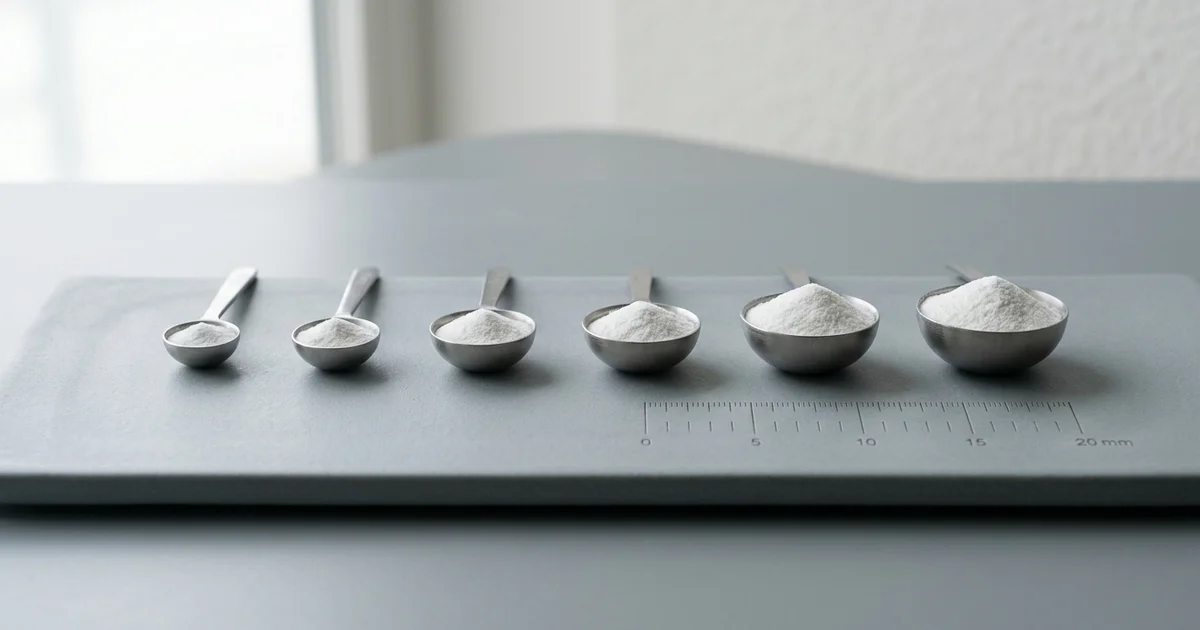
The table above tells the full story, but three rows are worth pulling out. At a mid-range 5-hour half-life:
- 80 mg (a small coffee or one caffeine pouch): 46 mg at 4 hours, 26 mg at 8 hours, 15 mg at 12 hours.
- 100 mg (about one cup of coffee): 57 mg at 4 hours, 33 mg at 8 hours, 19 mg at 12 hours.
- 200 mg (a large coffee or a pre-workout): 115 mg at 4 hours, 66 mg at 8 hours, 38 mg at 12 hours.
Doubling the dose does not double the felt window. It doubles the residual at bedtime. A 200 mg dose at noon still leaves 38 mg circulating at midnight (at a 5-hour half-life). For context on the dose itself, see whether 200 mg is a lot.
Why Does Caffeine Last Longer for Some People?
Roughly 95% of ingested caffeine is metabolized by a single liver enzyme, CYP1A2, and the gene that codes for it varies widely between people (Nehlig, 2018). That variation is a big part of why the adult half-life range is 3 to 7 hours instead of a single number.
Beyond genetics, several factors shift the clock:
- Oral contraceptives tend to double caffeine's half-life (Temple et al., 2017).
- Pregnancy adds an average of 8.3 hours to the half-life, and in some cases up to 16 hours longer than usual (Temple et al., 2017).
- Smoking doubles the rate of caffeine clearance, making it wear off faster (Temple et al., 2017).
- Heavy alcohol intake increases the half-life and slows clearance (Temple et al., 2017).
- Liver disease can extend the half-life substantially (Temple et al., 2017).
For a deeper look at each factor, see why caffeine's half-life varies.
How Long Does Caffeine Keep You Awake?
Longer than most people plan for. Two studies frame the sleep side clearly:
Drake et al. (2013) gave 12 participants 400 mg of caffeine at 0, 3, or 6 hours before their usual bedtime. All three timing conditions disrupted sleep compared with placebo. The authors concluded that people should refrain from substantial caffeine use for a minimum of 6 hours before bed.
Gardiner et al. (2023) pooled 24 studies in a meta-analysis and found caffeine reduced total sleep time by 45 minutes, increased sleep-onset latency by 9 minutes, added 12 minutes of wake after sleep onset, and cut deep sleep by 11.4 minutes. Their dose-specific cutoffs: a 107 mg coffee should be consumed at least 8.8 hours before bed, and a 217.5 mg pre-workout at least 13.2 hours.
If you go to bed at 10:30 p.m. and drink a standard coffee, the Gardiner cutoff is 8.8 hours (8 hours 48 minutes): 10:30 p.m. minus 8 h 48 min puts your last coffee before about 1:42 p.m.
Who Should Be More Careful with Caffeine Timing?
Some groups face a longer or more sensitive caffeine clock and should talk to a clinician before relying on general guidelines:
- Pregnant or trying to conceive. Caffeine's half-life can extend dramatically during pregnancy (Temple et al., 2017). The FDA advises talking to a health care provider about caffeine intake during pregnancy or breastfeeding.
- People on oral contraceptives. The half-life roughly doubles, so a dose taken at noon is still half-present at bedtime.
- Liver disease or heavy alcohol intake. Slower clearance means higher and longer exposure.
- Anxiety or sleep disorders. Even moderate doses can amplify symptoms.
- Heart rhythm problems. Ask your clinician how much caffeine, and how late in the day, is right for you.
- Anyone taking medications that interact with caffeine. Ask your pharmacist, since many medications change how fast caffeine is cleared (Nehlig, 2018).
- Under 18. The numbers on this page are adult figures. Newborns clear caffeine far more slowly (half-lives of 65 to 130 hours, per Temple et al., 2017), so ask a pediatrician about caffeine for children and teens.
For most healthy adults, the FDA has cited 400 mg per day as an amount not generally associated with negative effects. For where that line comes from, see how much caffeine is too much.
Related from Roon
- Caffeine Half-Life Calculator
- How Long Does Caffeine Stay in Your System?
- How Long Do Energy Drinks Last?
- Caffeine Crash: Symptoms and Timeline
Frequently Asked Questions
Does caffeine last longer if you drink it on an empty stomach?
The sources on this page do not show food changing how long caffeine lasts. Caffeine is absorbed rapidly and completely in the small intestine in under an hour (Temple et al., 2017), and how long it lingers after that depends on your half-life, which is set by liver clearance rather than by what is in your stomach.
How long does a caffeine pouch last?
No brand publishes pouch-specific half-life data, because the half-life is a property of caffeine metabolism, not the delivery method. What does differ is onset: buccal absorption (through the cheek) can shorten Tmax compared with swallowed caffeine (Kamimori et al., 2002). For pouch-specific timing, see how long a caffeine pouch takes to kick in and how long it lasts.
Does caffeine last longer when you are pregnant?
Yes, and by a large margin. Caffeine's half-life during pregnancy averages 8.3 hours longer than usual and can extend up to 16 hours beyond normal (Temple et al., 2017). If your pre-pregnancy half-life was 5 hours, the average increase would put it at about 13 hours. Talk to your provider about caffeine limits during pregnancy and breastfeeding.
Can you flush caffeine out faster with water or exercise?
No reliable evidence shows that water, exercise, or any supplement speeds liver clearance of caffeine in the moment. Your liver clears it at its own pace.
A Longer Window at a Coffee-Sized Dose
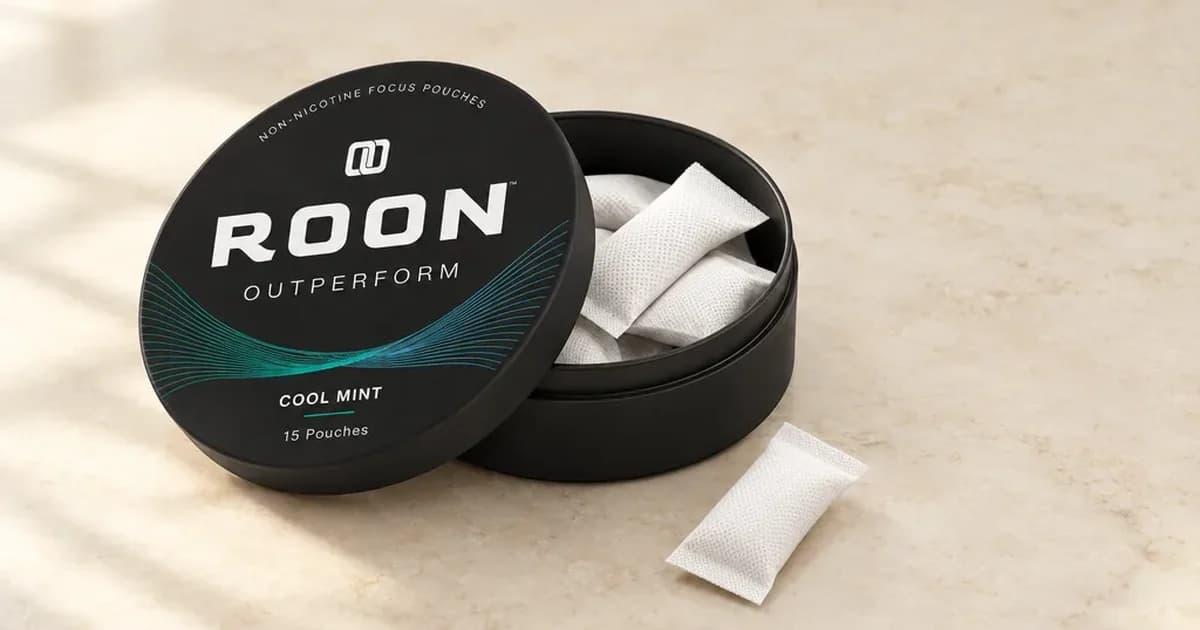
The table on this page shows a pattern: a bigger dose mainly buys a bigger bedtime residual, not a proportionally longer useful window. Roon is a zero-nicotine caffeine pouch that keeps the dose at small-coffee size. Each pouch pairs 80 mg caffeine with 60 mg L-theanine, 25 mg methylliberine (Dynamine), and 5 mg theacrine (TeaCrine).
For background on the pharmacokinetics of these ingredients together: a randomized, double-blind crossover PK study (n=12) found that co-administering methylliberine with caffeine cut oral clearance from 41.9 to 17.1 L/hr and shifted half-life from 7.2 to 15 hours, with no higher peak (Mondal et al., 2022). That study used 100 mg methylliberine and 150 mg caffeine, about 4x and 1.9x what a Roon pouch contains, so the direction applies but the exact numbers do not. A 15-hour half-life also does not mean 15 hours of felt focus: people typically feel a Roon pouch for 6 to 8 hours, which is a felt window, not a half-life (more on methylliberine).
Want more punch? Taking two at once (160 mg) is fine; do what feels right. Cap your day at four pouches and 400 mg total caffeine from all sources, and leave at least 8 hours before bed. From $9.16 per tin on subscription (as little as $0.61 per pouch), Roon is a portable way to get caffeine without a cup.
Sources
- Temple JL et al., "The Safety of Ingested Caffeine: A Comprehensive Review," Front Psychiatry, 2017. PMC5445139
- Nehlig A, "Interindividual Differences in Caffeine Metabolism and Factors Driving Caffeine Consumption," Pharmacol Rev, 2018. PubMed 29514871
- Kamimori GH et al., "The rate of absorption and relative bioavailability of caffeine administered in chewing gum versus capsules," Int J Pharm, 2002. PubMed 11839447
- Drake C et al., "Caffeine Effects on Sleep Taken 0, 3, or 6 Hours before Going to Bed," J Clin Sleep Med, 2013. PMC3805807
- Gardiner C et al., "The effect of caffeine on subsequent sleep: A systematic review and meta-analysis," Sleep Med Rev, 2023. PubMed 36870101
- FDA, "Spilling the Beans: How Much Caffeine Is Too Much?" fda.gov
- Mondal G et al., "Pharmacokinetics of Methylliberine Alone and in Combination with Caffeine," J Exerc Nutr, 2022. Study
Written by Roon Team