How Long Does It Take a Caffeine Pouch to Kick In?
Roon Team
How Long Does It Take a Caffeine Pouch to Kick In? (And How Long It Lasts)
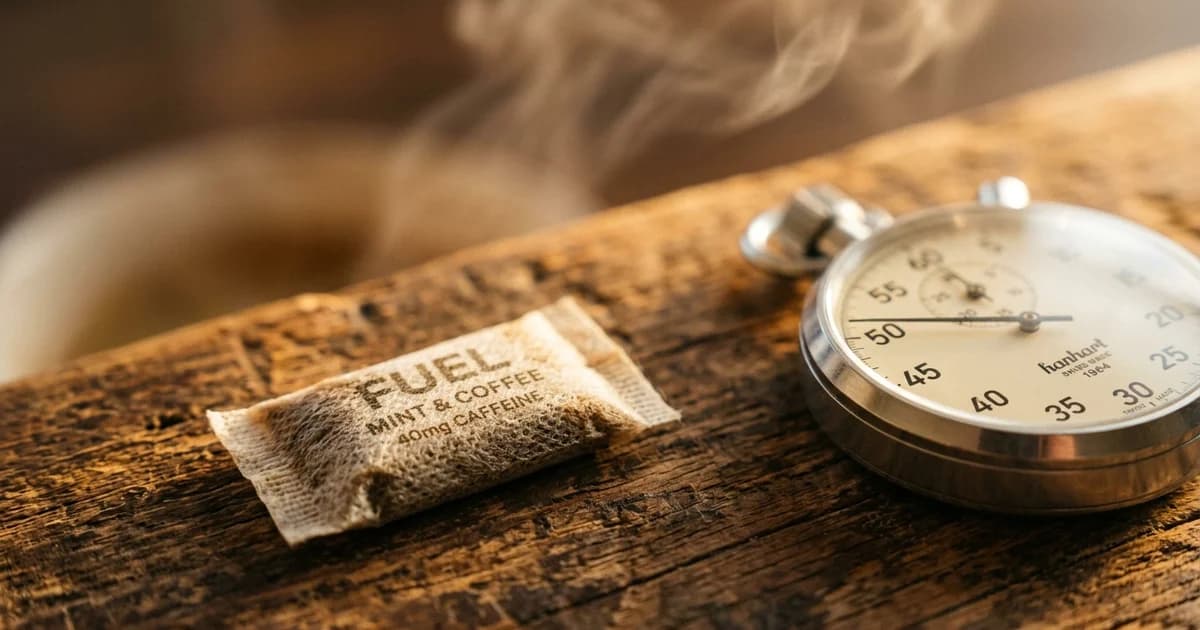
Caffeine pouches typically kick in within 5 to 10 minutes and last 3 to 6 hours depending on the formula. Roon's four-ingredient sublingual pouch hits in 5 to 10 minutes and is designed for a 6 to 8 hour focus window. By comparison, coffee takes 30 to 60 minutes to reach peak blood levels, and capsules can take 60 to 120 minutes. The speed difference comes down to one thing: where the caffeine enters your bloodstream.
This guide covers the real timing data, the science behind buccal absorption, how every major caffeine format compares, and the gap most pouches still ignore.
Key Takeaways
- Onset: Caffeine pouches start working in 5 to 10 minutes via buccal absorption through the oral mucosa, faster than coffee (30 to 60 min) or capsules (60 to 120 min).
- Duration: Caffeine's half-life averages about 5 hours, so the felt effect from a single dose typically fades after 3 to 5 hours. Multi-compound formulas extend the window.
- The trade-off: Most caffeine pouches deliver speed but include nothing to smooth the comedown, so you get jitters going up and a slump coming down.
- Do caffeine pouches work? Yes, for speed and convenience. The better question is what else is in the pouch.
How Long Do Caffeine Pouches Last Compared to Coffee, Gum, and Capsules?
A caffeine pouch delivers noticeable effects for 3 to 6 hours, with the exact duration depending on your metabolism, the dose, and the supporting ingredients in the formula. Plain caffeine-only pouches tend to fade faster because there's nothing extending the tail end. Multi-compound pouches like Roon, which pairs caffeine with L-theanine, methylliberine, and theacrine, are designed to sustain focus for 6 to 8 hours.
Here's how each caffeine format stacks up on speed and staying power:
| Format | Typical Onset | Time to Peak Blood Levels | Felt Duration | Absorption Route |
|---|---|---|---|---|
| Caffeine pouch (sublingual) | 5 to 10 min | ~30 min | 3 to 6 hr (formula-dependent) | Buccal mucosa + some GI |
| Coffee | 15 to 30 min | 45 to 60 min | 3 to 5 hr | Gastrointestinal |
| Energy drink | 10 to 20 min | 30 to 60 min | 3 to 5 hr | Gastrointestinal |
| Caffeine capsule/pill | 30 to 45 min | 60 to 120 min | 4 to 6 hr | Gastrointestinal |
| Caffeine gum | 5 to 10 min | 44 to 80 min | 3 to 5 hr | Buccal mucosa + GI |
| Roon pouch | 5 to 10 min | ~30 min | 6 to 8 hr | Buccal mucosa |
Sources: Onset and peak data drawn from NCBI Pharmacology of Caffeine, Kamimori et al., International Journal of Pharmaceutics, and European Journal of Applied Physiology (2025). Roon duration reflects its designed multi-compound formula; individual results vary.
The pattern is obvious. Buccal formats (pouches and gum) get caffeine into your blood faster because they skip the digestive tract. But onset is only one variable. Duration depends on what else is in the formula, which is where most single-ingredient products fall short.
How Does Caffeine Absorption Work Through a Pouch?
Caffeine pouches use buccal absorption, a delivery route where the drug passes directly through the thin tissue lining your mouth and into the capillary-rich blood supply underneath. This skips the stomach, the intestinal wall, and first-pass liver metabolism, which is the sequence that slows down coffee and capsules.
Here's the mechanism in practical terms. You tuck the pouch between your lip and gum. Caffeine dissolves into your saliva and diffuses across the oral mucosa at the contact point. The tissue there is thin, non-keratinized in many areas, and supplied with dense capillary networks. Caffeine is a small, lipophilic molecule (molecular weight 194 g/mol), which means it crosses mucosal membranes efficiently.
A 2025 paper in the European Journal of Applied Physiology confirmed that buccal caffeine absorption bypasses digestion and can produce peak serum caffeine concentration within approximately 30 minutes of administration. The study noted this route elicits cognitive benefits faster than swallowed caffeine.
The classic comparison comes from Kamimori et al., who tested caffeine gum against capsules at matched doses. The rate of absorption from the gum was faster, and the authors attributed this to absorption through the buccal mucosa. Time to peak plasma concentration was 44 to 80 minutes for gum versus 84 to 120 minutes for capsules. Bioavailability at the same dose was comparable between routes. You don't absorb more caffeine through your mouth. You absorb it sooner.
A pouch held for 15 to 20 minutes gives caffeine sustained contact time with the oral mucosa, which is what drives the speed advantage over swallowed formats. The longer the contact, the more caffeine enters the bloodstream before any swallowed portion hits the GI tract.
Why Coffee and Capsules Are Slower
Swallowed caffeine has to pass through the stomach, survive gastric emptying (which food and fiber slow down), then absorb through the intestinal wall and pass through the liver before reaching systemic circulation. According to the NCBI Pharmacology of Caffeine review, peak plasma concentrations from oral ingestion occur between 15 and 120 minutes, with the wide range driven by gastric emptying variability. A coffee on an empty stomach hits sooner than one chased by a big breakfast. A capsule with a gel coating adds another delay.
How Long Does Caffeine Stay in Your System?
Caffeine's elimination half-life averages about 5 hours in healthy adults, with a range of 1.5 to 9.5 hours depending on genetics, body composition, medications, and smoking status. This means half the caffeine from your morning pouch is still circulating 5 hours later.
The StatPearls reference on caffeine puts the mean half-life at approximately 5 hours and notes the range extends from 1.5 to 9.5 hours depending on factors like pregnancy, obesity, oral contraceptive use, smoking, and altitude. Smokers metabolize caffeine roughly twice as fast as non-smokers. Women on oral contraceptives can see their half-life nearly double.
For practical planning: if you take an 80 mg caffeine pouch at 8 AM, you'll still have about 40 mg active at 1 PM and roughly 20 mg at 6 PM. That's enough to interfere with sleep if you're sensitive. A good cutoff is 6 to 8 hours before your target bedtime.
Tolerance is the other variable. The same StatPearls source notes that tolerance to caffeine's stimulant effects develops with repeated use. Your third week on the same dose will not feel like your first. This is a core reason some formulas add longer-acting methylxanthine relatives (theacrine, methylliberine) to maintain perceived effect without simply escalating the caffeine dose.
Do Caffeine Pouches Work? The Honest Answer
Yes, caffeine pouches work for fast, discreet, smoke-free energy. They deliver caffeine through the oral mucosa, kick in faster than coffee, and require no cup, no water, and no nicotine in the zero-nicotine versions. The real question is what happens after the first 30 minutes.
Caffeine on its own is a blunt tool. It blocks adenosine receptors, which suppresses the "I'm tired" signal, and it can leave you wired, anxious, or crashing once it clears. That's the experience most single-ingredient pouches deliver: a fast spike, then a fade.
The most studied fix is pairing caffeine with L-theanine, an amino acid found in tea. A 2025 study in the Journal of the International Society of Sports Nutrition treated caffeine plus L-theanine as a dual-action strategy, with L-theanine's calming effects working alongside caffeine's stimulatory benefits to improve cognitive performance in elite athletes. Earlier work summarized by Nutrition Reviews found that the caffeine-L-theanine combination produced improvements in attention switching, alertness, and reduced susceptibility to distraction compared to caffeine alone.
So pouches work. The better ones engineer the full curve, not just the first hit.
How the Popular Caffeine Pouches Compare
Most caffeine pouches fall into a few categories: coffee-based dip alternatives, vitamin-loaded energy pouches, and dedicated focus pouches. Here's an honest breakdown. Specs reflect each brand's general positioning; always check the current label before buying.
| Product | Caffeine per Pouch | Other Active Ingredients | Built For | Crash Control |
|---|---|---|---|---|
| Grinds | ~25 mg | B vitamins in some lines | Coffee/dip replacement, oral habit | None added |
| FRE | ~20 mg | Vitamins, taurine in some lines | Casual energy, flavor | None added |
| Sneak / energy-style pouches | ~50 to 100 mg | Vitamins, sometimes taurine | Gaming, quick energy | None added |
| Generic "energy" pouches | Varies widely | Often just caffeine + flavor | Cheap stimulation | None added |
| Roon | 80 mg | L-theanine 60 mg, methylliberine (Dynamine) 25 mg, theacrine (TeaCrine) 5 mg | Sustained cognitive focus | Designed in |
The pattern repeats. Coffee-style pouches deliver a low caffeine dose and lean on the oral habit. Energy pouches push more caffeine and pad the label with B vitamins. None of them add ingredients that meaningfully shape how the caffeine feels at hour three or hour four.
If you want a deeper look at the format itself, our breakdown of how caffeine pouches work and whether they're worth it covers the mechanics.
What's Missing From Most Caffeine Pouches?
After comparing the category, three gaps show up in almost every product.
Gap 1: No jitter control. Most pouches are caffeine and flavor. Without L-theanine or a similar partner, a fast 50 to 100 mg caffeine hit can feel like anxiety rather than focus, especially if you're sensitive or fasted.
Gap 2: No crash management. Caffeine alone spikes and fades. When it clears (around the 3 to 5 hour mark), you feel the drop. Standard pouches include nothing to extend the smooth portion of the curve, so you're back to baseline, or below it, within a few hours.
Gap 3: Vitamin padding instead of functional ingredients. B vitamins and taurine look good on a label, but they don't change how locked-in you feel during a work session. The active focus story in most pouches starts and ends with caffeine.
Put simply, most pouches solved speed and convenience, then stopped. The ride quality was never the design priority. For a deeper look at the comedown problem, see our guide on how to avoid a caffeine crash.
Speed Is Only Half the Equation
A caffeine pouch kicks in fast, often in 5 to 10 minutes, because caffeine absorbs through the oral mucosa instead of waiting on the stomach. That speed advantage over coffee and capsules is real and well-documented.
But onset is only half of the question. With caffeine's roughly 5-hour half-life and no supporting ingredients, a plain pouch gives you a sharp rise and an uncontrolled fall. The product that performs best isn't the one with the most caffeine or the most vitamins on the label. It's the one engineered for the whole curve: fast up, steady through, gentle down.
Judge a pouch by how it feels at hour four, not just minute four.
Frequently Asked Questions
How fast does a caffeine pouch kick in compared to coffee?
A caffeine pouch starts working in 5 to 10 minutes because caffeine absorbs directly through the lining of your mouth, bypassing digestion. Coffee typically takes 30 to 60 minutes to reach peak blood levels since it passes through the stomach and intestinal wall first. The pouch wins on speed. The total amount of caffeine your body absorbs is comparable between the two routes, according to Kamimori et al.
How long do caffeine pouches last?
The felt effect from a caffeine-only pouch typically lasts 3 to 5 hours. Caffeine's half-life averages about 5 hours, meaning half the dose is still circulating at that point. Your personal timing depends on genetics, medications, and metabolism. Multi-ingredient pouches with supporting compounds like L-theanine, methylliberine, and theacrine can extend perceived focus to 6 to 8 hours.
Do caffeine pouches actually work?
Yes. Caffeine pouches deliver caffeine through the oral mucosa and kick in faster than coffee. Zero-nicotine versions contain no tobacco or nicotine. The real difference between products is what else is in the pouch, since caffeine alone can cause jitters and a crash without supporting ingredients like L-theanine to smooth the ride.
Why do some caffeine pouches give me jitters?
Jitters come from a fast, large caffeine dose with nothing to balance it. Caffeine blocks adenosine and ramps up sympathetic nervous system activity, which on its own can feel like anxiety or a racing heart. Pairing caffeine with L-theanine is the most studied way to take the edge off. That's why caffeine-only pouches tend to feel rougher than formulas that include a calming counterweight.
How many caffeine pouches can I use in a day?
The FDA considers up to 400 mg of caffeine per day generally safe for healthy adults. How many pouches that equals depends on the caffeine per pouch, which ranges from about 20 mg to 100 mg across brands. At 80 mg per pouch (Roon's dose), that's a maximum of 5 pouches, but count your full daily intake from coffee and tea. Stop early enough that the 5-hour half-life doesn't wreck your sleep.
Will a caffeine pouch keep me awake at night?
It can. With a half-life near 5 hours, a 3 PM pouch with 80 mg still leaves about 40 mg active at 8 PM. That's enough to delay sleep onset in sensitive individuals. A practical rule: take your last pouch at least 6 to 8 hours before you want to sleep, then adjust based on how quickly you metabolize caffeine.
Are caffeine pouches safer than energy drinks?
Caffeine pouches and energy drinks both deliver caffeine, so the safety profile depends primarily on dose and what else is in the product. A pouch with 80 mg caffeine delivers less than a typical 16 oz energy drink (150 to 300 mg). Pouches skip the sugar and carbonation. The format is not inherently safer or more dangerous; total daily caffeine intake is what matters.
Does tolerance build up with caffeine pouches?
Yes. Tolerance to caffeine's stimulant effects develops with regular use regardless of the delivery format, which is why your usual dose feels weaker over time. Cycling intake or taking periodic breaks (2 to 3 days off) helps reset sensitivity. Some formulas add longer-acting methylxanthines like theacrine to maintain perceived effect without escalating the caffeine dose.
Why Roon's Felt Window Is 6 to 8 Hours, Not Coffee's 3 to 4
The difference is one ingredient: methylliberine (Dynamine). In a human pharmacokinetic study, co-administering methylliberine with 150mg caffeine cut caffeine's oral clearance by more than half and extended its half-life from 7.2 to 15 hours, with no increase in peak concentration. Same peak, longer tail. That is the mechanism behind Roon's 6 to 8 hour felt window: 80mg caffeine (a small-coffee dose), 25mg Dynamine to reshape the clearance curve, 60mg L-theanine to smooth the ride, and 5mg theacrine (TeaCrine) which does not build tolerance the way caffeine alone does.
A longer half-life is not free. It means you should stop at least 8 hours before bed, or you will pay for it with sleep. And Roon is not the cheapest pouch on the shelf. It contains no adaptogens, no mushroom extracts, no paraxanthine. What you are paying for is duration per pouch: $0.61 subscribed ($9.16/tin) or $1.00 one-time ($15.00/tin of 15). If you have been cycling through pouches that fade by hour two, try Roon and judge it at hour five.
Written by Roon Team