How Long Does Caffeine Stay in Your System? Half-Life Math for Sleep
Roon Team
How Late Is Too Late for Caffeine? The Half-Life Math That Protects Your Sleep
That 3 p.m. coffee feels harmless. You drink it, you finish your work, you fall asleep that night without much trouble. So no harm done, right?
Not quite. The question of how long does caffeine stay in your system has a precise answer, and it explains why your sleep can be worse on coffee days even when you swear you fell asleep fine. The molecule is still circulating long after the alertness fades.
Here is the math that decides your personal cutoff time, backed by what the sleep labs actually measured.
Key Takeaways
- Caffeine has an average half-life of about 5 hours, but it ranges from roughly 1.5 to 9.5 hours depending on your genetics, age, and liver function.
- A 2023 meta-analysis found that a standard cup of coffee should be consumed at least 8.8 hours before bed to avoid cutting your total sleep time.
- A controlled study showed that 400 mg of caffeine taken even 6 hours before bed still measurably disrupted sleep.
- Falling asleep is not the same as sleeping well. Caffeine quietly trims deep sleep even when you do not feel wired.
How Long Does Caffeine Stay in Your System?
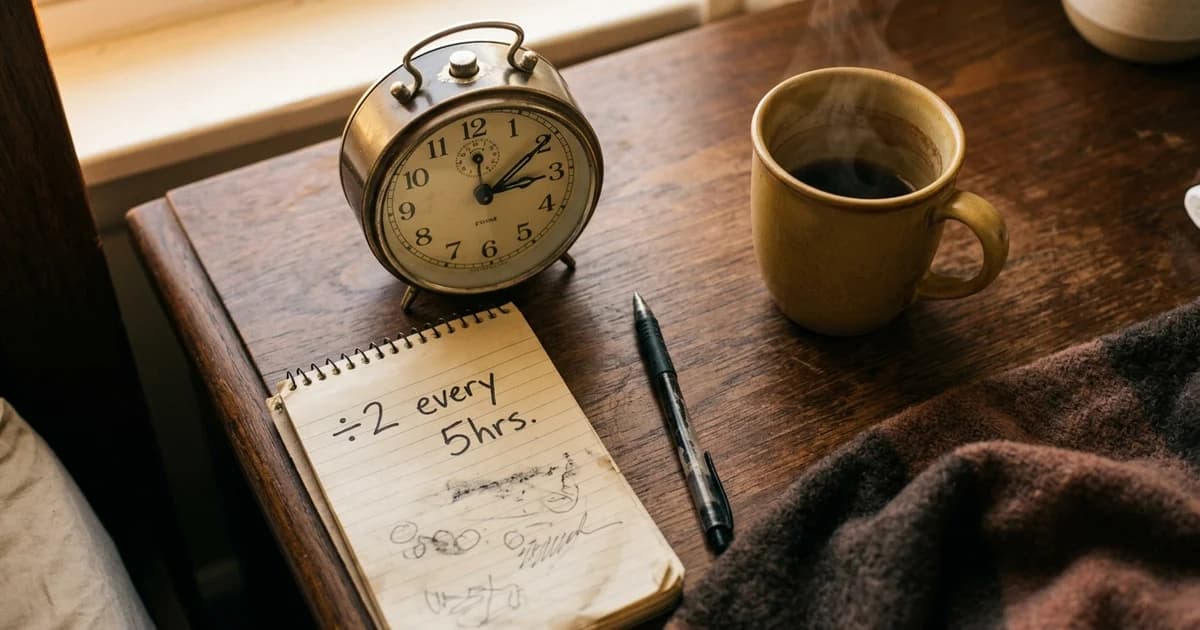
Caffeine has an average half-life of about 5 hours, meaning half the dose is still in your bloodstream five hours after you drink it. According to the American Academy of Sleep Medicine via Healthline, caffeine's half-life is up to 5 hours, and half-life is the amount of time it takes for a quantity of a substance to be reduced to half the original amount.
Run the numbers on a 200 mg afternoon coffee. After 5 hours you still have 100 mg active. After 10 hours, 50 mg. That residual 50 mg is roughly a half-cup of coffee sitting in your blood at midnight.
The half-life is not fixed for everyone, which is the part most people miss. The Sleep Foundation notes that the average caffeine half-life is about 5 hours, but it ranges from 1.5 to 9.5 hours depending on genetics, age, medications, and liver health. If you sit at the slow end, your evening is built on a much higher caffeine floor than your fast-metabolizing friend.
Why the same coffee hits two people differently
Most of caffeine's breakdown happens in the liver through an enzyme called CYP1A2. Some people carry a gene variant that makes that enzyme sluggish. Same cup, very different clearance.
Age matters too. Caffeine half-life generally increases with age as liver enzyme activity decreases, with young adults typically clearing it in 3 to 5 hours. Pregnancy, oral contraceptives, and certain medications can stretch it further.
Caffeine Before Bed: What the Sleep Studies Actually Found
The most useful number for a caffeine cutoff time comes from a 2023 systematic review and meta-analysis published in Sleep Medicine Reviews. The researchers pooled 24 studies to find the point after which caffeine measurably harms sleep.
Their headline finding is specific. The model identified a cut-off time of 8.8 hours prior to bedtime for a cup of coffee, 13.2 hours for a standard pre-workout supplement, and no cut-off time for a cup of black tea.
So if you go to bed at 11 p.m., your last coffee should land around 2 p.m. That afternoon cup at 3 or 4 is already inside the danger window for many people.
The same review quantified the damage. Caffeine consumption diminished total sleep time by 45 minutes and sleep efficiency by 7%, with sleep onset latency rising by 9 minutes and wake after sleep onset increasing by 12 minutes. You can read the full meta-analysis on ScienceDirect.
Does afternoon coffee affect sleep even when you fall asleep fine?
Yes, and this is the trap. The classic test on this came from Christopher Drake and colleagues in the Journal of Clinical Sleep Medicine in 2013.
They gave participants 400 mg of caffeine at three different times before bed. The study found that 400 mg of caffeine taken at bedtime, three hours before, and even six hours before bedtime each disrupted sleep relative to placebo.
The authors did not mince words about the everyday version of this. Lead author Christopher Drake noted that drinking a big cup of coffee on the way home from work can hurt sleep just as if someone consumed caffeine closer to bedtime. Their conclusion was that caffeine taken 6 hours before bedtime has important disruptive effects on sleep, supporting recommendations to avoid substantial caffeine use for a minimum of 6 hours before bed.
The Adenosine Problem: Why "Tired but Wired" Happens
Caffeine works by blocking adenosine, the molecule that builds up across your waking day and creates sleep pressure. Block it and you feel alert. The catch is that adenosine keeps accumulating while it is blocked.
When the caffeine clears, that backlog floods in. That is the crash. And if any caffeine is still active at bedtime, it keeps muting the sleep signal your brain is sending.
This is why caffeine and sleep quality stay linked even on nights you fall asleep on schedule. The bigger losses show up in deep, slow-wave sleep, the stage that does most of the physical recovery. You sleep, but you do not restore.
Your Personal Cutoff Time: A Simple Table
Your cutoff depends on dose and bedtime. Here is a practical guide based on the roughly 8 to 9 hour window the research supports for a standard coffee, scaled by dose.
| Caffeine dose | Rough source | Suggested last intake before an 11 p.m. bedtime |
|---|---|---|
| 40 mg | Half a cup of coffee, one tea | By ~6 p.m. |
| 80 mg | One espresso, one focus pouch | By ~3 p.m. |
| 100-110 mg | One standard cup of coffee | By ~2 p.m. |
| 200 mg | Large coffee, two cups | By ~12 p.m. |
| 300-400 mg | Pre-workout, energy drink | By ~10 a.m. |
These are starting points, not laws. A slow metabolizer should push every row earlier. If you sleep poorly after a 2 p.m. coffee, you have your answer regardless of what the table says.
How to Find Your Own Number
You do not need a genetic test. You need about two weeks of paying attention.
- Pick a baseline cutoff. Start at 8 hours before bed and hold it for a week.
- Track sleep, not just bedtime. Note how rested you feel, not only whether you fell asleep.
- Adjust by an hour. If mornings feel flat, move your cutoff earlier the next week.
- Watch your total daily dose. Timing matters, but a 400 mg afternoon hit is hard to outrun no matter when you take it.
The goal is a steady, lower daily intake with a clean evening, not a single massive dose you are still metabolizing at 1 a.m.
The Bottom Line on Timing and Sleep
Caffeine is a tool with a long tail. The average 5-hour half-life means a normal afternoon coffee can leave a meaningful dose in your blood at bedtime, and the controlled research is consistent: even 6 hours of lead time is not always enough to protect total sleep time and sleep efficiency.
The fix is not abstinence. It is a cutoff time and a sensible dose. Smaller, earlier, and consistent beats large, late, and occasional every single time. Protect the sleep, and you protect the next day's focus that depends on it.
Frequently Asked Questions
How long does it take for caffeine to fully leave your body?
With a half-life around 5 hours, caffeine clears slower than most people assume. Full elimination takes roughly 5 to 6 half-lives, or 25 to 30 hours, though the active, sleep-disrupting amount drops off sooner. The real concern is the dose still circulating at bedtime, usually 8 to 10 hours after intake.
Is a 5-hour half-life the same for everyone?
No. Five hours is an average. Genetics, mainly your CYP1A2 enzyme activity, can move your half-life anywhere from about 1.5 to 9.5 hours. Age, pregnancy, liver health, and medications such as oral contraceptives all shift it. If you are sensitive to evening caffeine, you likely sit toward the slower end and need an earlier cutoff.
Does afternoon coffee affect sleep if I fall asleep easily?
Yes. Falling asleep quickly does not mean you slept well. Controlled research shows caffeine taken six hours before bed still reduces total sleep time and trims deep, restorative sleep, even in people who report no trouble nodding off. The damage lives in sleep quality, not always in how fast you drift off.
What is the best caffeine cutoff time?
For a standard coffee, the 2023 meta-analysis points to about 8.8 hours before bed. For an 11 p.m. bedtime, that means a last cup around 2 p.m. Larger doses like pre-workout need closer to 13 hours of lead time. Smaller doses can be later. Adjust earlier if your sleep suffers.
Why do I feel a crash even though I drank caffeine hours ago?
Caffeine blocks adenosine, your sleep-pressure molecule, but adenosine keeps building while it is blocked. When the caffeine clears, that backlog hits at once, producing the crash. A large, late dose makes the swing worse. A smaller, well-timed dose smooths it out.
Does the type of caffeine source matter for sleep?
Total dose and timing matter most. The 2023 meta-analysis found no cutoff time needed for a standard cup of black tea because the dose is low. Coffee, energy drinks, and pre-workout carry far higher loads, so they need earlier cutoffs. A modest, fixed dose is much easier to time around sleep than a variable one.
A Modest Dose Is Easier to Time Than a Big One
Everything above points to one idea: the size and timing of your dose decide whether caffeine helps your day or quietly steals your night. A 200 mg afternoon coffee is hard to time around an 11 p.m. bedtime. A controlled 80 mg dose is not.
That is the thinking behind Roon. Each sublingual pouch delivers a measured 80 mg of caffeine alongside 60 mg of L-theanine, 25 mg of methylliberine (Dynamine), and 5 mg of theacrine (TeaCrine), built for a fast 5 to 10 minute onset and 6 to 8 hours of steady focus without the jitters or crash. A known, modest dose makes the half-life math simple, so you can pair it with a personal cutoff time instead of guessing.
Roon is not a sleep aid, and no pouch fixes a late, oversized caffeine habit. But if you want clean daytime focus that respects your bedtime, a controllable dose is a good place to start. Pick your cutoff, hold it, and protect the sleep your next-day focus runs on.
Written by Roon Team