Caffeine Half-Life Calculator: How Long Caffeine Really Stays in Your System
A caffeine half-life calculator estimates how much caffeine is still circulating in your body at any hour after a dose. The math is simple: the average adult clears half their caffeine in about 5 hours, so a 200 mg coffee at 8 a.m. drops to roughly 100 mg by 1 p.m. and 50 mg by 6 p.m. Your personal number can run anywhere from 1.5 to 9.5 hours depending on genetics, medications, smoking, and pregnancy. That single variable decides whether your afternoon coffee clears by dinner or follows you to bed.
This article is for informational purposes only and is not medical advice. If you have health concerns, are pregnant or breastfeeding, or are trying to cut down on caffeine or quit nicotine, talk to a healthcare provider.
Key Takeaways
- The average caffeine half-life in healthy adults is about 5 hours, with a documented range of 1.5 to 9.5 hours (NCBI Bookshelf).
- A 200 mg morning dose follows a clean decay: ~100 mg after one half-life, ~50 mg after two, ~25 mg after three.
- Your personal rate depends mostly on the liver enzyme CYP1A2, plus pregnancy, smoking, oral contraceptives, and age.
- For most people, stopping caffeine 8 to 10 hours before bed keeps residual levels low enough to protect sleep.
- A lower starting dose, like Roon's 80 mg, leaves less caffeine on the curve at every hour, so the same half-life produces a smaller bedtime residual.
Work it out for yourself. The Roon caffeine calculator does this arithmetic for you: how much is still in you now, the latest your last dose can land before bed, and what a day adds up to. It answers in ranges rather than a single number, because the caffeine in a given cup varies more than most people expect.
How a Caffeine Half-Life Calculator Works
A caffeine half-life calculator runs one equation: remaining caffeine equals your dose multiplied by 0.5 raised to the power of elapsed time divided by your half-life. Half-life is the time your body needs to eliminate 50% of a given amount. Caffeine is metabolized almost entirely in the liver, then excreted, and the average healthy adult sits near a 5-hour half-life (StatPearls, NIH).
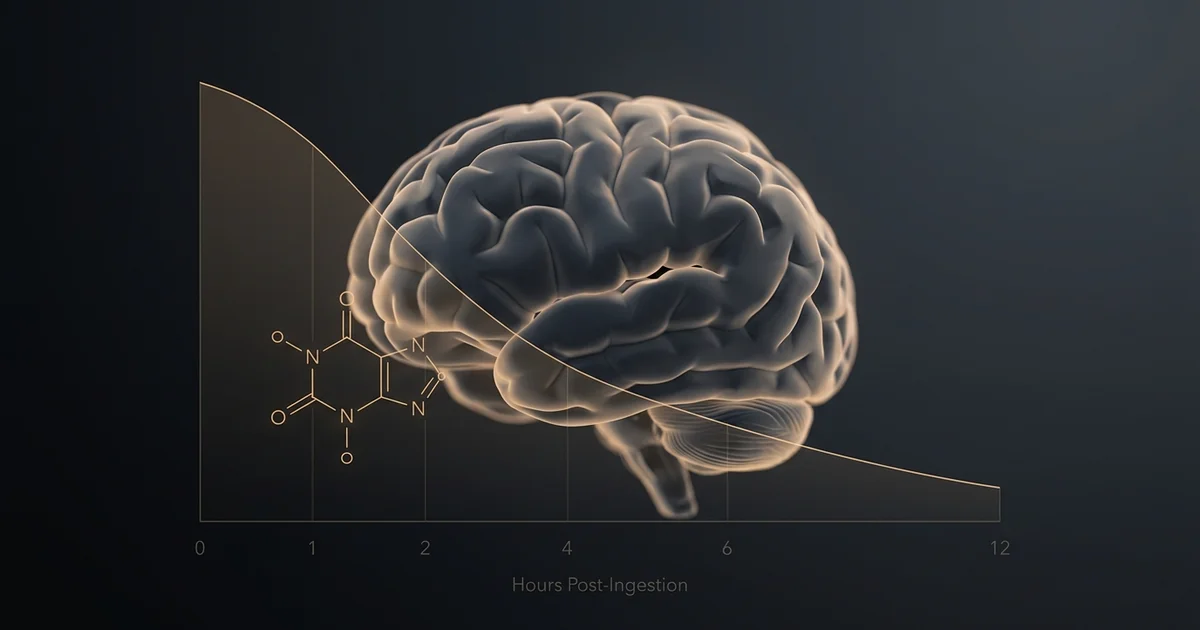
The reason this matters is that decay is exponential, not linear. You do not lose a fixed number of milligrams per hour. You lose a fixed percentage. So the drop is steep at first and then flattens into a long, low tail that can stretch past 24 hours before caffeine is functionally gone.
That tail is the part people underestimate. Examine notes that with a 5-hour half-life, you very likely still have caffeine in your blood many hours after your last cup (Examine). The calculator makes that invisible residual visible.
The Worked Example: 200mg at 8 a.m.
Run a standard 200 mg coffee through a 5-hour half-life and the numbers tell the whole story. Here is the hour-by-hour decay for an average metabolizer.
| Time | Hours elapsed | Half-lives | Caffeine remaining |
|---|---|---|---|
| 8:00 a.m. | 0 | 0 | 200 mg |
| 1:00 p.m. | 5 | 1 | 100 mg |
| 6:00 p.m. | 10 | 2 | 50 mg |
| 11:00 p.m. | 15 | 3 | 25 mg |
| 4:00 a.m. | 20 | 4 | 12.5 mg |
At an 11 p.m. bedtime, that morning coffee still leaves about 25 mg in your system, roughly a quarter of the original dose. For a fast metabolizer with a 3-hour half-life, the same dose clears far sooner. For a slow metabolizer near 9 hours, it barely moves by midnight. Same coffee, three different nights.
Why Your Personal Half-Life Varies So Much
Your caffeine half-life is governed mostly by one gene, and the spread between people is large enough to change your entire caffeine strategy. The enzyme CYP1A2 does the heavy lifting in caffeine metabolism, and common genetic variants split the population into fast and slow metabolizers. On top of genetics, a handful of well-documented factors can double, triple, or halve your clearance rate.
| Factor | Effect on half-life | Typical range | Source |
|---|---|---|---|
| CYP1A2 genotype | Sets baseline; "slow" variants clear caffeine markedly slower | ~1.5 to 9.5 hrs across population | NCBI Bookshelf |
| Pregnancy (late) | Slows clearance sharply by third trimester | Up to ~10 to 15 hrs | Sleep Foundation |
| Cigarette smoking | Speeds clearance; roughly halves half-life | ~3 hrs or less | StatPearls, NIH |
| Oral contraceptives | Slow clearance; roughly doubles half-life | ~2x baseline | Frontiers in Pharmacology, PMC |
| Newborn / infant age | Very immature liver enzymes; extremely slow | ~100 hrs in premature infants; up to ~8 hrs in full-term newborns | StatPearls, NIH |
A few of these deserve a plain-language note. Smoking induces the CYP1A2 enzyme, which is why heavy smokers burn through caffeine faster and often drink more of it. Pregnancy and oral contraceptives push the opposite direction by suppressing that same enzyme. And premature infants metabolize caffeine so slowly (around 100 hours half-life, versus up to about 8 hours in full-term newborns) that caffeine is sometimes used clinically in neonatal care under medical supervision, far outside the scope of an everyday coffee question.
Your Practical Last-Call Time
For most adults, the safe last-call for caffeine is 8 to 10 hours before bed, and the Sleep Foundation puts the minimum at eight hours. Their guidance is direct: avoid caffeine at least eight hours before bedtime, and sensitive people may need to stop even earlier (Sleep Foundation).
The data backs the caution. A 2025 randomized crossover trial in the journal SLEEP found that 400 mg of caffeine taken within 12 hours of bedtime delayed sleep onset and altered sleep architecture (Oxford Academic, SLEEP). Caffeine does not just keep you awake. It can degrade the quality of the sleep you do get.
Dose is the lever you control. An 80 mg dose enters the same exponential decay curve as a 200 mg dose, but it starts far lower, so the residual at every hour is proportionally smaller. After two half-lives, 80 mg has fallen to about 20 mg, while 200 mg still sits at 50 mg. If you are caffeine-sensitive or chasing a clean bedtime, a smaller starting number does more for your sleep than any clever timing trick.
How to Estimate Your Own Caffeine Half-Life by Hand
You do not need software to run this estimate. The whole method fits on a napkin, and once you have done it once you can do it in your head.
Start with the default. For a healthy adult, caffeine's half-life averages about 5 hours, and the StatPearls pharmacology monograph puts the typical adult half-life in that range (StatPearls, NIH). Across the population the real spread runs from roughly 1.5 to 9.5 hours (NCBI Bookshelf), so treat 5 hours as a starting point, not a personal fact.
Then halve, and halve again. The rule is simple: every time one half-life passes, the caffeine still in your body drops by half. Write down your dose, then cut it in half once for each 5-hour block that has gone by.
Here is the worked example, using a 200 mg dose taken at 9 a.m. and a 5-hour half-life:
- 9 a.m.: 200 mg on board (your starting dose).
- ~2 p.m. (5 hours later, one half-life): about 100 mg left.
- ~7 p.m. (10 hours later, two half-lives): about 50 mg left.
- ~12 a.m. (15 hours later, three half-lives): about 25 mg left.
For a partial block, estimate between the steps. At three hours past your dose, you are a little over halfway through the first half-life, so you would land somewhere between 200 and 100 mg, in the neighborhood of 130 to 140 mg. You do not need to be exact; the point is the shape of the curve, which falls fast at first and then trails off into a long, low tail.
Now adjust the half-life to fit you. Several well-documented factors shift the 5-hour default up or down:
- Genetics (the CYP1A2 enzyme): the main driver. Common variants make some people fast metabolizers and others slow, which is most of why the population range is so wide (StatPearls, NIH).
- Cigarette smoking: speeds clearance and roughly halves the half-life, often to around 3 hours.
- Pregnancy: slows clearance sharply, especially in the third trimester, stretching the half-life well beyond baseline.
- Oral contraceptives: slow clearance and can roughly double the half-life.
- Liver function: because caffeine is cleared almost entirely by the liver, reduced liver function lengthens the half-life.
To personalize the example, swap 5 for your own estimate and keep halving on that interval. A smoker near a 3-hour half-life clears that 9 a.m. coffee to about 25 mg by early evening, while someone near a 9-hour half-life still has roughly 100 mg on board at the same time. Same dose, very different nights.
A note on what these numbers are: this is a general estimation method, not a lab measurement, and the milligram figures above are illustrative of how the math works rather than a precise readout of your bloodstream. An interactive calculator that runs this same arithmetic on your exact dose and timing may follow on this page, but you can do the estimate yourself with nothing but the 5-hour rule and repeated halving.
Conclusion
Caffeine half-life is the single most useful number for managing how a stimulant fits your day. The average is roughly 5 hours, but the real range runs from 1.5 to 9.5, and your spot on that scale is set mostly by genetics, then nudged by pregnancy, smoking, contraceptives, and age. Once you know your number, the exponential decay curve does the rest of the thinking for you. Plug in your dose and your bedtime, respect the 8-to-10-hour buffer, and you can keep the alertness while protecting your sleep. The smartest variable to control is the one at the very start of the curve: how much you take in the first place.
Frequently Asked Questions
How long does caffeine stay in your system?
Caffeine has an average half-life of about 5 hours in healthy adults, with a range of 1.5 to 9.5 hours (NCBI Bookshelf). It takes roughly five to six half-lives for a dose to be functionally eliminated, so a typical coffee can take more than a day to clear completely. The effects you feel fade well before the molecule is fully gone, but low residual levels can still affect sensitive sleepers late at night.
What is a caffeine half-life calculator?
It is a tool that estimates how many milligrams of caffeine remain in your body at any given hour after a dose. It uses one equation: remaining caffeine equals your dose times 0.5 raised to elapsed hours divided by your personal half-life. You enter your dose, the time you consumed it, and your half-life, and it returns an hour-by-hour decay along with an estimate of how much is left at your bedtime.
How do I know my personal caffeine half-life?
Start with the 5-hour average, then adjust. If you smoke, your half-life is likely closer to 3 hours. If you use oral contraceptives or are pregnant, it can roughly double or stretch to 10 to 15 hours (Sleep Foundation). Genetics, through the CYP1A2 enzyme, set your baseline. The clearest real-world signal is how a 2 p.m. coffee affects your sleep that night.
How many hours before bed should I stop caffeine?
The Sleep Foundation recommends stopping caffeine at least 8 hours before bedtime, and sensitive people may need to cut off earlier (Sleep Foundation). A 2025 trial in SLEEP found that 400 mg within 12 hours of bed disrupted sleep (Oxford Academic). An 8-to-10-hour buffer is a safe default for most adults.
Does a smaller caffeine dose clear faster?
No. Half-life is a percentage, not a fixed amount, so an 80 mg dose and a 200 mg dose both lose half their content over the same time window. What changes is the residual. Because 80 mg starts lower, it sits lower at every hour and leaves a smaller amount in your system at bedtime. Lowering the starting dose, not changing the timing, is the most reliable way to reduce late-night caffeine.
Why does caffeine affect some people more than others?
The main reason is the liver enzyme CYP1A2, which breaks caffeine down. Common genetic variants make some people fast metabolizers and others slow, which is why the same espresso can feel mild for one person and jittery for another (StatPearls, NIH). Medications, smoking, pregnancy, and age then shift that baseline further in either direction.
Does L-theanine change caffeine's half-life?
L-theanine does not meaningfully change how fast your liver clears caffeine. It is an amino acid often paired with caffeine because the two are commonly studied together for focus and a smoother subjective experience. Your half-life is still governed by CYP1A2 and the factors above. L-theanine influences how the caffeine feels, not how long the molecule lingers on the decay curve.
Lower the Dose, and the Whole Curve Drops
The entire point of a half-life calculator is that you cannot speed up your liver, but you can choose your starting number. Every milligram you skip at the top of the curve is a milligram you are not still carrying at bedtime. That is the case for a lower-dose format.
Roon is a zero-nicotine sublingual pouch with 80 mg of caffeine, plus 60 mg L-theanine, 25 mg methylliberine (Dynamine), and 5 mg theacrine (TeaCrine). That 80 mg starting dose sits well below a large coffee or energy drink, so it leaves a smaller residual at every hour on your personal decay curve. The sublingual format also delivers caffeine through the cheek and gum tissue for a fast onset, which you can read about in our buccal-onset explainer.
Roon is not a sleep aid, and it is not a way to cheat your half-life. Caffeine is still caffeine, and the 8-to-10-hour rule still applies. What it is, is a cleaner, lower starting point for people who want focus during the day without dragging a heavy caffeine tail into the night. If a smaller dose fits your curve better, try Roon.
By Roon Team