Alpha Brain vs Gorilla Mind vs Thesis
Roon Team
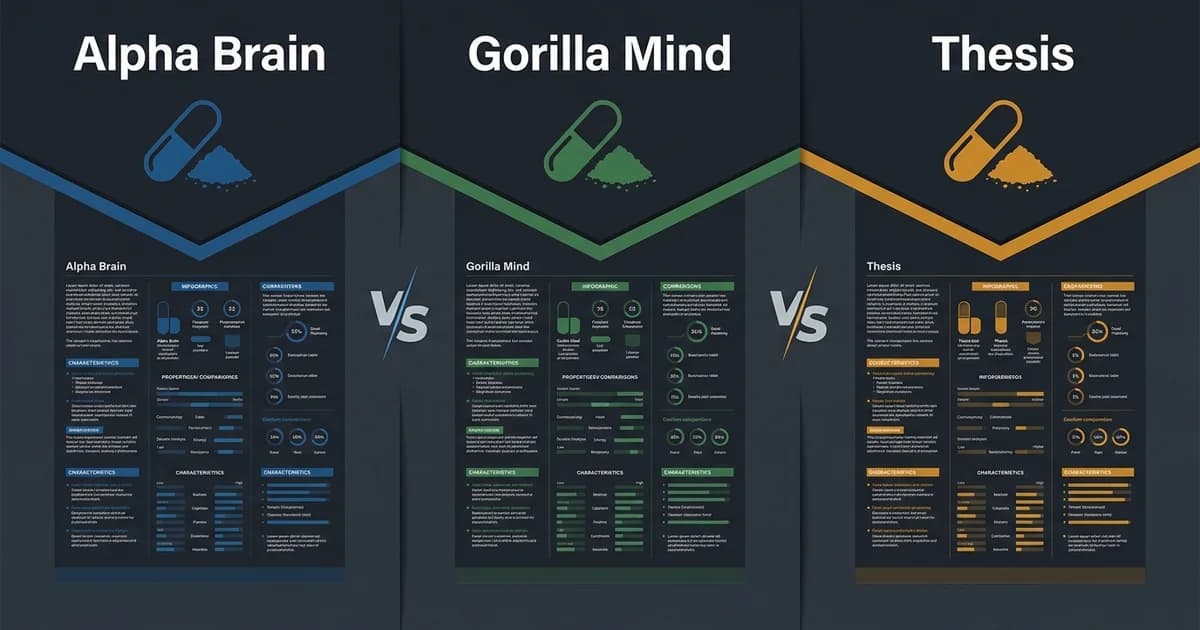
Alpha Brain vs Gorilla Mind vs Thesis: Which Nootropic Supplement Is Actually Worth Your Money?
The Alpha Brain vs Gorilla Mind vs Thesis debate keeps showing up in every best nootropic supplement comparison thread, every Reddit discussion, every "best of" list. All three promise sharper focus and better mental performance. All three charge a premium for it. And all three have very different philosophies about how to get your brain firing on all cylinders.
The problem? Most reviews just rehash marketing copy. They don't tell you what's actually in each formula, what the doses look like, or where the real trade-offs are.
This Alpha Brain vs Gorilla Mind vs Thesis breakdown will.
Key Takeaways:
- Alpha Brain is a caffeine-free, proprietary blend with clinical trial backing but limited ingredient transparency.
- Gorilla Mind offers two distinct formulas (Rush and Smooth), with full label transparency and aggressive stimulant dosing in Rush.
- Thesis takes a personalized approach with six targeted blends, but at nearly double the price of the other two.
- All three are capsule-based, require 30-60 minutes to kick in, and lock you into a daily pill routine.
Alpha Brain Review: The OG Nootropic
Any Alpha Brain review has to start with context, including how it stacks up in the Alpha Brain vs other nootropic heavyweights debates that dominate supplement forums. Onnit's Alpha Brain is the most recognizable name in the nootropic space, largely because Joe Rogan has been talking about it for over a decade. It's positioned as a caffeine-free cognitive support supplement, and it's one of the few nootropics with an actual published clinical trial behind it.
A randomized, double-blind, placebo-controlled study published in Human Psychopharmacology found that Alpha Brain improved delayed verbal recall and executive function in healthy adults over a six-week period. That's more clinical evidence than most nootropics can claim. The study was conducted with researchers from Boston University School of Medicine, which adds credibility. In the Alpha Brain vs Gorilla Mind vs Thesis matchup, this clinical backing gives Alpha Brain a unique edge.
But here's where it gets complicated.
What's Inside Alpha Brain
Alpha Brain uses proprietary blends, which means you can see the ingredients but not the individual doses. The formula is split into three blends:
- Onnit Flow Blend: L-Tyrosine, L-Theanine, Oat Straw Extract, Phosphatidylserine
- Onnit Focus Blend: Alpha-GPC, Bacopa Monnieri, Toothed Clubmoss (Huperzia Serrata)
- Onnit Fuel Blend: L-Leucine, Pterostilbene
Onnit publishes no Supplement Facts panel on its own product page, so each of these is listed as a blend name and a set of ingredients, with no milligram total to work from. Alpha-GPC alone is typically dosed at 300-600mg in research, and there is no way to check what share of the Focus Blend it gets, or how much is left for the Bacopa and Huperzia. You simply can't tell. That's the fundamental problem with proprietary blends, and it's a key factor in any Alpha Brain review.
Alpha Brain Pricing
A 30-count bottle (15 servings at the recommended 2-capsule dose) runs about $35. The 90-count bottle is around $80, which works out to roughly $1.75 per serving. For a caffeine-free formula, that's a steep ask when the dosing transparency is this limited.
The Proprietary Blend Problem
This is the single biggest criticism of Alpha Brain in the nootropic community, and a key reason many users go looking for proprietary blend alternatives to Alpha Brain. Bacopa Monnieri, one of the most well-researched memory-support compounds available, is typically studied at doses of 300mg. Alpha-GPC shows cognitive benefits in studies using 300-600mg. But when both of these share one undisclosed blend with Huperzia Serrata, there is no way to tell whether either reaches its studied dose.
Onnit's counter-argument is that the overall formula was validated in their clinical trial, so individual ingredient doses matter less than the total effect. That's a fair point, but it makes it impossible for consumers to compare the formula against the existing research on each ingredient. This transparency issue is central to the Alpha Brain vs Gorilla Mind vs Thesis conversation.
Best for: People who want a stimulant-free nootropic and value the clinical trial backing. If you're caffeine-sensitive, Alpha Brain is the most obvious pick of the three.
Gorilla Mind Review: The Stimulant-Heavy Approach
A thorough Gorilla Mind review reveals the opposite philosophy from Alpha Brain. Where Onnit keeps things gentle and caffeine-free, Gorilla Mind leans hard into stimulant-driven focus. The brand offers two main nootropic products: Gorilla Mind Rush and Gorilla Mind Smooth.
Gorilla Mind Rush
Rush is the flagship stimulant formula. It's designed for what the brand calls "tunnel vision focus" and targets dopaminergic, cholinergic, and adrenergic pathways. The 2025 relaunch brought back a fan-favorite formula with a massive 1.2g dose of Alpha-GPC, plus Huperzine A, and a full stimulant stack.
Rush is not subtle. In the Alpha Brain vs Gorilla Mind vs Thesis comparison, Rush stands out as the most aggressive option by far. It's built for people who want to feel something immediately and don't mind a strong stimulant hit.
Gorilla Mind Smooth
Gorilla Mind Smooth is the stimulant-free alternative. It includes DMAE, Alpha-GPC, L-Theanine, Bacopa Monnieri, Ginkgo Biloba, and L-Tyrosine. The key difference from Alpha Brain: Gorilla Mind uses a fully transparent label. Every ingredient dose is listed on the bottle.
According to a review on More Plates More Dates, the caffeine + L-Theanine stack in the broader Gorilla Mind system is one of the most well-validated nootropic combinations available. Smooth strips out the caffeine for a cleaner cognitive boost without the stimulant edge. Any honest Gorilla Mind review should note this transparency advantage.
Gorilla Mind Pricing
Gorilla Mind Smooth runs about $39 for 90 capsules (a 30-day supply at the standard 3-capsule serving). Rush is similarly priced. Compared to Alpha Brain, you're getting more ingredient transparency for roughly the same cost, which matters in a best nootropic supplement comparison.
The Two-Product Dilemma
Gorilla Mind's split between Rush and Smooth creates an interesting choice. Rush is potent, but the heavy stimulant load means it's not something most people should take daily without cycling. Smooth is gentler, but without any stimulant at all, some users report it feels too subtle for high-stakes focus sessions.
There's no middle ground in the lineup. You're either going full throttle with Rush or coasting with Smooth. If you want moderate, controlled stimulation paired with nootropic support, you'd need to mix and match capsules from both bottles, which gets complicated fast.
Best for: People who want full label transparency and either a strong stimulant push (Rush) or a clean caffeine-free option (Smooth). The brand skews toward a fitness-focused audience interested in nootropic pre-workout options.
Thesis Nootropics Review: The Personalized Play
Any Thesis nootropics review has to address the brand's completely different approach. Instead of one formula, Thesis offers six targeted blends: Energy, Clarity, Creativity, Logic, Focus, and Confidence. You take a quiz on their website, and they recommend specific blends based on your goals.
According to a review on Hone Health, Thesis costs $79 per month on a subscription, or about $3.29 per serving. That's the highest price point of the three by a wide margin, making it the premium option in the Alpha Brain vs Gorilla Mind vs Thesis lineup.
What's Inside Thesis
Each blend uses different active ingredients. Here's a snapshot based on the Thesis Starter Kit listing on Amazon:
- Energy: N-Acetyl-L-Tyrosine, Choline
- Clarity: Lion's Mane, Alpha-GPC, CDP Citicoline
- Logic: Bacopa Monnieri, Ginkgo Biloba
- Confidence: Shoden Ashwagandha, Saffron Extract
A review from Sleep and Hypnosis noted that every Thesis blend contains caffeine and L-Theanine as a base, which means none of the six options work for people who want to avoid caffeine entirely. This is a detail that every Thesis nootropics review should highlight.
The "personalized" angle is the main selling point, but it's worth understanding what that actually means. You're not getting a custom formula mixed for you. You're getting one of six pre-made blends selected based on a quiz. The personalization is in the recommendation, not the formulation.
Thesis Pricing
The starter kit on Amazon runs about $140 for 24 servings across four blends. The subscription model is $79/month. Either way, you're paying roughly double what Alpha Brain or Gorilla Mind costs.
The Price vs. Value Question
At $79/month, Thesis costs more than Alpha Brain and Gorilla Mind combined, which raises the question of whether personalized nootropics justify the price for most people. The brand justifies this with the personalization angle and premium ingredient sourcing. But the quiz-based system, while a nice touch, doesn't change the fact that you're choosing from a fixed menu of six blends.
If you happen to need something between "Clarity" and "Logic," there's no option for that. And if you want to try all six blends to find your best fit, the starter kit at $140 makes the experimentation phase expensive.
Reviews on Thingtesting reflect this tension. Users who find their ideal blend tend to love it. Those who don't connect with any of the six options are left with an expensive subscription and no clear path forward. This is the core tension in any Thesis nootropics review.
Best for: People who like the idea of targeted formulas for different cognitive goals and don't mind paying a premium for the curation experience.
Alpha Brain vs Gorilla Mind vs Thesis: Side-by-Side Comparison
This best nootropic supplement comparison table breaks down the key differences at a glance:
| Feature | Alpha Brain | Gorilla Mind (Smooth) | Thesis |
|---|---|---|---|
| Price | ~$39/90ct | ~$79/month (subscription) | |
| Cost Per Serving | ~$1.75 | ~$1.30 | ~$3.29 |
| Contains Caffeine | No | No (Smooth) / Yes (Rush) | Yes (all blends) |
| Label Transparency | Proprietary blends | Fully transparent | Partially transparent |
| Clinical Trial | Yes (1 published RCT) | No | No |
| Delivery Format | Capsules | Capsules | Capsules |
| Time to Effect | 30-60 min | 30-60 min | 30-60 min |
| Key Ingredients | Alpha-GPC, Bacopa, L-Theanine, Huperzia Serrata | Alpha-GPC, DMAE, L-Theanine, Bacopa, Ginkgo | Varies by blend (Lion's Mane, Ashwagandha, Bacopa, Alpha-GPC) |
| Personalization | None | None | Quiz-based blend selection |
Looking at the Alpha Brain vs Gorilla Mind vs Thesis data side by side, each product has clear strengths and clear weaknesses. No single option dominates across every category.
What's Missing From the Alpha Brain vs Gorilla Mind vs Thesis Comparison
After stacking these products against each other, a few gaps become obvious. These aren't minor complaints. They're structural limitations baked into how each product works.
1. The Capsule Problem
All three products in this Alpha Brain vs Gorilla Mind vs Thesis matchup are capsule-based. That means you swallow pills, wait 30-60 minutes for your digestive system to break them down, and hope the timing lines up with when you actually need to focus. If your important meeting is in 10 minutes, none of these help. Oral capsules also lose a percentage of their active compounds to first-pass metabolism in the liver before they ever reach your brain.
Sublingual delivery bypasses the digestive tract entirely, sending compounds directly into the bloodstream through the tissue under your tongue. It's faster onset and better bioavailability. None of these three products offer it.
2. The Tolerance Question
Gorilla Mind Rush leans heavily on caffeine. Thesis includes caffeine in every blend. Your body builds tolerance to caffeine within about a week of daily use, which means the same dose produces a weaker effect over time. You end up needing more to get the same result, or cycling off entirely. This tolerance issue affects two of the three options in the Alpha Brain vs Gorilla Mind vs Thesis comparison.
Research on theacrine, a purine alkaloid structurally related to caffeine, tells a different story. A study published in the Journal of the International Society of Sports Nutrition found that theacrine did not produce habituation effects over eight weeks of continuous use. That's a meaningful distinction. Caffeine gives you a boost that fades. Theacrine appears to sustain its effects without requiring dose escalation.
None of the three products compared here include theacrine or its cousin methylliberine.
3. The On-Demand Gap
Alpha Brain is designed as a daily supplement. Thesis operates on a monthly subscription model. Gorilla Mind is a bottle you keep on your desk. All three assume you'll take them every day as part of a routine.
But focus isn't always a scheduled event. Sometimes you need to lock in at 3pm when your energy craters. Sometimes it's before a late-night work session you didn't plan for. A daily pill regimen doesn't flex with your actual life. This rigidity is a shared weakness across the Alpha Brain vs Gorilla Mind vs Thesis field.
4. The Stack Simplicity Problem
Alpha Brain hides its doses behind proprietary blends. Thesis spreads its ingredients across six different products, making it hard to know exactly what you're taking on any given day. Gorilla Mind is the most transparent of the three, but Rush packs so many stimulants that the experience can be overwhelming for people who just want clean, sustained focus.
What none of them offer is a simple, well-dosed stack of complementary compounds in a single format that you can use exactly when you need it. That's the biggest takeaway from this best nootropic supplement comparison.
A Different Approach to the Alpha Brain vs Gorilla Mind vs Thesis Problem
The gaps above aren't theoretical. They describe real friction points: slow onset, tolerance buildup, rigid daily routines, and complicated or opaque formulas.
Roon was built around those specific problems. It's a zero-nicotine sublingual pouch containing four active ingredients: 80mg Caffeine, 60mg L-Theanine, 25mg Methylliberine, and 5mg Theacrine.
Here's why that stack matters in the context of Alpha Brain vs Gorilla Mind vs Thesis:
The caffeine + L-Theanine combination is one of the most studied nootropic pairings in existence. A study published on PubMed found that 40mg of caffeine combined with 97mg of L-Theanine improved focus during demanding cognitive tasks. Roon uses 80mg of caffeine, comparable to a cup of coffee, but the advantage isn't a lower dose. It's the stack and the curve: L-Theanine smooths the caffeine, while methylliberine and theacrine extend it to 6-8 hours of sustained focus with no jitters, no crash, and no tolerance buildup. That's a very different profile from the 200mg+ you'll find in Gorilla Mind Rush or a typical energy drink.
Theacrine extends the duration of focus without the tolerance curve that caffeine creates on its own. Methylliberine complements both compounds by promoting alertness and mood without overstimulation. Together, these four ingredients work as a single, targeted stack designed for 6-8 hours of sustained focus with no jitters and no crash.
Because it's sublingual, Roon bypasses your digestive system entirely. You don't swallow a capsule and wait. You place the pouch under your lip and the active compounds absorb directly into your bloodstream within minutes.
No pill bottle. No subscription box. No 45-minute wait. Just on-demand focus when your brain actually needs it.