Mind Lab Pro vs Alpha Brain
Roon Team
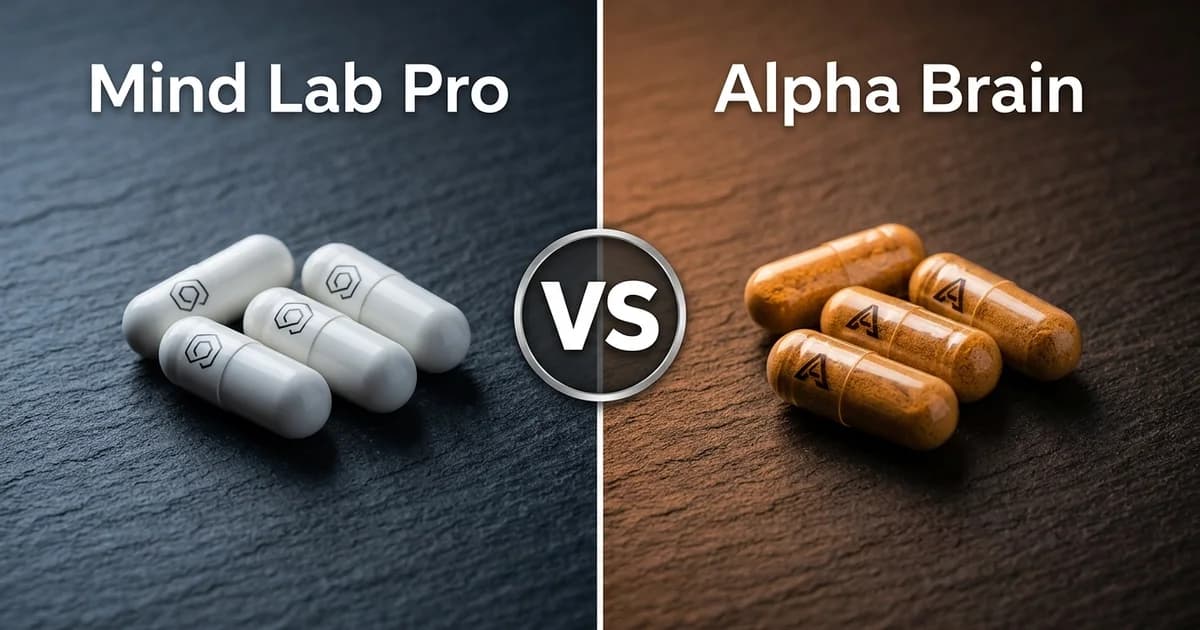
Mind Lab Pro vs Alpha Brain: Which Nootropic Actually Wins in 2025?
You've narrowed your nootropic search to two heavyweights. The mind lab pro vs roon debate sits at the top of nearly every "best nootropic supplement" list, and for good reason. Both have loyal followings. Both promise sharper focus and better memory. But the mind lab pro vs alpha brain comparison isn't as close as the marketing makes it seem.
One uses fully transparent dosing. The other hides behind proprietary blends. One contains 11 individually listed ingredients. The other groups its formula into three mystery blends where you can't verify a single dose.
Here's what the ingredients, pricing, and science actually say about mind lab pro vs alpha brain.
Key Takeaways
- Mind Lab Pro uses full-disclosure labeling with 11 nootropic ingredients at verified doses. Alpha Brain uses three proprietary blends that obscure individual ingredient amounts.
- Mind Lab Pro costs about $69 per bottle (60 capsules, 30 servings). Alpha Brain runs $34.95 for 30 capsules or $79.95 for 90 capsules (also 30 servings per bottle at the 90-count).
- Both products are caffeine-free, which means neither delivers immediate, noticeable energy or focus on demand.
- Alpha Brain has one published clinical trial. Mind Lab Pro has multiple studies conducted through the University of Leeds.
- Neither product solves the core problem most people actually have: they need focus right now, not a slow build over weeks.
The Ingredients: Mind Lab Pro vs Alpha Brain
This is where the mind lab pro vs alpha brain comparison gets interesting. The formulas overlap in a few places but diverge sharply in philosophy.
Mind Lab Pro's Formula (v4)
Mind Lab Pro lists every ingredient with its exact dose per two-capsule serving:
| Ingredient | Dose | Primary Role |
|---|---|---|
| Citicoline (Cognizin) | 250 mg | Brain energy, focus |
| Phosphatidylserine (Sharp-PS) | 100 mg | Cell membrane support |
| Bacopa Monnieri | 150 mg | Memory, learning |
| Organic Lion's Mane Mushroom | 500 mg | Nerve growth factor support |
| Rhodiola Rosea | 50 mg | Stress resistance |
| L-Theanine | 100 mg | Calm focus |
| N-Acetyl L-Tyrosine | 175 mg | Dopamine precursor |
| Maritime Pine Bark Extract | 75 mg | Antioxidant, blood flow |
| Vitamin B6 | 2.5 mg | Neurotransmitter synthesis |
| Vitamin B9 | 100 mcg | Brain maintenance |
| Vitamin B12 | 7.5 mcg | Brain maintenance |
The key advantage here is transparency. You know exactly how much Bacopa, Lion's Mane, and Citicoline you're getting, which means you can cross-reference those doses against published research to see if they're clinically relevant. This transparency is a major reason Mind Lab Pro wins the mind lab pro vs alpha brain label comparison.
Alpha Brain's Formula
Alpha Brain groups its ingredients into three proprietary blends:
| Blend | Total Dose | Key Ingredients |
|---|---|---|
| Onnit Flow Blend | Not published | L-Tyrosine, L-Theanine, Oat Straw Extract, Phosphatidylserine |
| Onnit Focus Blend | Not published | Alpha GPC, Bacopa Monnieri, Huperzia Serrata (Huperzine A) |
| Onnit Fuel Blend | Not published | L-Leucine, Pterostilbene |
The problem is obvious. Onnit does not publish a Supplement Facts panel for Alpha Brain on onnit.com, so the Flow Blend's four ingredients arrive as a single undisclosed total. L-Tyrosine alone needs 300-500 mg to be effective in most research. L-Theanine typically requires 100-200 mg. Whether either is dosed at that level is something you cannot check. This dosing uncertainty is a recurring theme in the alpha brain vs mind lab pro discussion.
Bacopa's dose in the Focus Blend is not disclosed, so there is no way to check it against the 150-300 mg range used in most clinical research on memory. Alpha GPC, one of the more expensive ingredients in the formula, shares that same undisclosed blend with Bacopa and Huperzine A.
The Science: Mind Lab Pro vs Alpha Brain
Mind Lab Pro's Clinical Evidence
Mind Lab Pro has invested in clinical validation through the University of Leeds. The brand cites a series of double-blind, placebo-controlled trials showing improvements in information processing and concentration. A third study used EEG brain-mapping to measure enhanced connectivity between brain regions during decision-making tasks.
These are company-funded studies, which is worth noting. But the fact that they were conducted at an independent university and used standard clinical methodology (double-blind, placebo-controlled) puts them ahead of most supplement brands that rely on ingredient-level research alone.
Alpha Brain's Clinical Evidence
Alpha Brain has one published randomized controlled trial, conducted at the Boston University School of Medicine in 2016, which is one reason many buyers explore alternatives to Alpha Brain. The study found that Alpha Brain improved delayed verbal recall and executive function compared to placebo over a six-week period. That's a real clinical trial with real results.
The limitation: it's a single study, it was funded by Onnit, and the sample size was relatively small. The results were statistically meaningful but modest.
The Verdict on Science
Both products have more clinical backing than 95% of nootropic supplements on the market. In the mind lab pro vs alpha brain research comparison, Mind Lab Pro has a slight edge with multiple trials, but neither product's evidence is overwhelming. Anyone searching for the best nootropic supplement should weigh this clinical data carefully.
Pricing Comparison
| Mind Lab Pro | Alpha Brain | |
|---|---|---|
| Price (one-time) | $69 / 60 capsules | $79.95 / 90 capsules |
| Servings per bottle | 30 | 30 |
| Cost per serving | ~$2.30 | ~$2.67 |
| Subscription discount | ~25% off | ~15% off |
| Caffeine | No | No |
| Dosing transparency | Full disclosure | Proprietary blends |
On price, mind lab pro vs alpha brain favors Mind Lab Pro. It's slightly cheaper per serving and gives you full ingredient transparency. Alpha Brain is widely available on Amazon and in retail stores like GNC, which makes it more accessible for impulse purchases.
Who Should Choose Mind Lab Pro?
If the mind lab pro vs alpha brain decision comes down to trust, Mind Lab Pro is the better pick. The fully transparent label, the use of branded ingredient forms (Cognizin, Sharp-PS, NutriGenesis vitamins), and the multiple clinical trials make it the more trustworthy option on paper.
It's also the better long-term nootropic. Ingredients like Lion's Mane (500 mg) and Bacopa Monnieri (150 mg) are dosed at levels where research suggests real benefits for memory and nerve growth factor support, but those benefits take weeks to build. If you're willing to be patient and consistent, Mind Lab Pro gives you more confidence that each ingredient is pulling its weight. For anyone looking for the best nootropic supplement with full label transparency, Mind Lab Pro is the stronger choice.
Who Should Choose Alpha Brain?
Alpha Brain works for people who want a well-known, widely available nootropic and don't mind proprietary blends. Its inclusion of Huperzine A (for acetylcholine support) and Alpha GPC gives it a slightly different mechanism than Mind Lab Pro, targeting the cholinergic system more directly.
It also has strong brand recognition, thanks to endorsements from Joe Rogan and other public figures. If social proof matters to you more than label transparency in the alpha brain vs mind lab pro matchup, Alpha Brain has it.
The retail availability is a real advantage, too. You can grab Alpha Brain at GNC, Whole Foods, or Amazon with next-day delivery. Mind Lab Pro sells exclusively through its own website, which means planning ahead.
What's Missing From Both: The Mind Lab Pro vs Alpha Brain Blind Spot
Here's the part most comparison articles skip. Both Mind Lab Pro and Alpha Brain share the same fundamental limitation: neither product gives you focus when you actually need it.
Both are daily-driver capsules designed to build up over weeks. That's fine for long-term brain health. But if you're staring down a four-hour work block, a deadline, or a critical meeting, neither product delivers on-demand cognitive performance. This is the gap that the mind lab pro vs alpha brain debate rarely addresses, and it is where Roon vs Alpha Brain tells a different story.
Here's why:
No immediate-onset energy. Both products are caffeine-free. That's marketed as a feature, but it means neither formula provides the acute alertness that most people are actually looking for when they search for a best nootropic supplement. L-Theanine and Bacopa are excellent compounds, but they don't produce a noticeable effect within 15 minutes.
Capsule delivery is slow. Oral capsules need to pass through your digestive system before anything reaches your bloodstream. That means 30-60 minutes before you feel anything, assuming the dose is high enough to feel at all. For a supplement you're taking daily for cumulative benefits, that's fine. For acute performance, it's a bottleneck.
No tolerance management. Both products contain ingredients that your body can adapt to over time. Neither formula includes compounds specifically chosen to resist tolerance buildup. Many users report a honeymoon period where the effects feel strong, followed by a gradual fade. That's the nature of most single-mechanism nootropic stacks.
The dosing question with Alpha Brain remains unanswered. Proprietary blends make it impossible to know if you're getting clinically relevant amounts of each ingredient. Mind Lab Pro solves this problem, but it still shares the other limitations. This is why the mind lab pro vs alpha brain comparison often leaves buyers unsatisfied with both options.
A Different Approach to Cognitive Performance
If what you actually need is reliable, on-demand focus that works in minutes (not weeks), the delivery method matters as much as the ingredients.
Roon was designed around this exact problem. It's a sublingual pouch, not a capsule, which means the active ingredients absorb through the tissue under your lip and enter your bloodstream directly. No waiting for digestion. No 45-minute delay.
The formula pairs 80 mg of caffeine (comparable to a cup of coffee) with L-Theanine to smooth out the stimulation, plus Theacrine and Methylliberine, two compounds structurally related to caffeine that research suggests do not produce tolerance with repeated use. That's a specific answer to a specific gap that both Mind Lab Pro and Alpha Brain leave open.
It's not a replacement for a well-designed daily nootropic stack. It won't give you the long-term nerve growth factor support of Lion's Mane or the memory benefits of Bacopa over months of use. What it does is fill the gap that capsule-based nootropics can't: 6-8 hours of clean, sustained focus that starts in minutes, with no jitters, no crash, and no tolerance buildup.
If you've been going back and forth on mind lab pro vs alpha brain and realized that neither quite fits the way you actually work, Roon is worth a look.