Why Can't I Concentrate When I'm Stressed? The Prefrontal Answer
Why Can't I Concentrate When I'm Stressed? The Prefrontal Answer
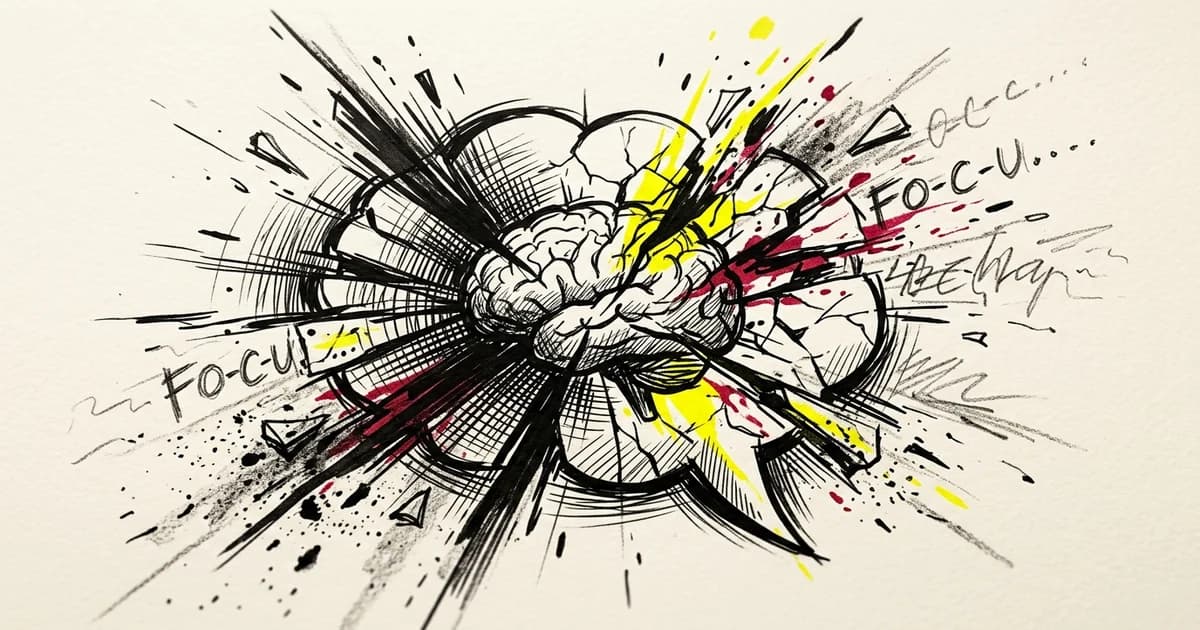
Why can't you concentrate when stressed? Because the brain region responsible for planning, holding information, and filtering distractions is the single region most sensitive to stress chemistry. The prefrontal cortex loses function rapidly, even under mild uncontrollable stress, while faster circuits for habits and emotional reactions get stronger. Nothing is broken. The control has shifted.
This is not a willpower problem. It is a documented neurochemical switch, described most clearly in a 2009 review by Amy Arnsten in Nature Reviews Neuroscience, and virtually no consumer-facing resource has explained it in plain language. That changes here.
Key Takeaways
- Moderate stress sharpens focus; high or uncontrollable stress shuts down prefrontal function and hands control to faster, less precise brain circuits.
- The difference between helpful pressure and destructive pressure is largely about whether you can act on the stressor or only wait it out.
- Four evidence-backed responses work: take a real break outdoors, slow your exhale, reduce open decisions, and stop trying harder at the same task.
- A bad afternoon and a bad year are not the same situation physiologically. If concentration problems persist beyond two weeks, talk to someone.
What the "Planning Brain" Does When It Works
The prefrontal cortex sits behind your forehead and runs the operations that feel most like you thinking. It holds a goal in mind while you work toward it. It keeps a phone number active for the six seconds between hearing it and typing it. It lets you ignore the notification that just lit up your screen. It chooses the harder correct action (finishing the paragraph) over the easier automatic one (checking your inbox again).
This is working memory, and stress takes it first.
Every complex task you do at work, from writing a strategy document to following a meeting while someone keeps interrupting, depends on these prefrontal networks staying connected. When they disconnect, you do not lose intelligence. You lose the ability to direct it.
The Switch: Why Stress Makes It Hard to Think
The Arnsten lab at Yale has spent decades mapping exactly what happens. The short version: moderate amounts of norepinephrine and dopamine support optimal prefrontal function. High levels of the same chemicals rapidly weaken it while strengthening more primitive emotional responses and habits mediated by the amygdala and striatum.
| Arousal Level | Norepinephrine / Dopamine | Prefrontal Cortex | Amygdala / Striatum | What You Experience |
|---|---|---|---|---|
| Too low | Insufficient release | Sluggish, unfocused | Quiet | Bored, drifting |
| Moderate | Optimal release | Strong connectivity | Balanced | Sharp, deliberate, "in the zone" |
| High (uncontrollable stress) | Excessive release | Networks disconnect | Strengthened | Reactive, habitual, scattered |
So under pressure you get faster and more automatic, but less deliberate. You react instead of choosing. You default to the easy, familiar action instead of the planned one. This is the moment you realize you have read the same paragraph four times.
The trade-off is honest: that switch is adaptive when something is chasing you. Speed and habit keep you alive. They are terrible for writing a quarterly report. The catecholamine shifts under sustained load are well documented, and the problem is not that the system fails. The problem is that it succeeds at the wrong task.
The Inverted U: Why a Little Pressure Helps and a Lot Destroys
Both too little and too much arousal impair performance, a pattern described by the inverted-U curve (Arnsten, 2009). This explains something you have already noticed: a Monday deadline sharpens you, and the same deadline on Thursday after three bad nights flattens you.
The flattening is not gradual. Prefrontal networks do not dim like a slow-turning dial. They disconnect, more like a circuit breaker tripping. Once catecholamine levels cross a threshold, signaling cascades open ion channels that effectively disconnect the network. The firing pattern changes from sustained (holding information) to erratic (losing it).
That is why "just push through" fails. You are not lazy. The circuit is offline.
Why Controllability Is the Hinge
The word "uncontrollable" appears throughout Arnsten's review and across the lab's description for a reason. Stress you can act on behaves differently from stress you can only wait out.
When you can do something about a problem, the prefrontal cortex stays engaged. It has a plan to execute. When the stressor is unbounded, when you do not know when it ends or what you can do about it, the system floods. The same chemistry that sharpens you under controllable pressure dismantles you under uncontrollable pressure.
Practical translation: converting an open-ended worry into a bounded next action is not just a productivity trick. It changes the neurochemical input. Writing down "email the client by 2pm to ask for the extension" is a different physiological event than looping on "this project might fall apart." One engages the prefrontal cortex. The other bypasses it.
What Cortisol Adds
The catecholamine response (norepinephrine and dopamine) is fast, hitting the prefrontal cortex within seconds. Cortisol is slower. It arrives over minutes to hours via the HPA axis and accentuates the prefrontal impairment the catecholamines already started (Arnsten, 2009).
Think of it as a one-two sequence. The fast chemicals pull the plug on prefrontal networks. Cortisol walks in later and makes sure they stay unplugged longer. This is why a stressful morning can leave you foggy well into the afternoon even after the stressor resolves.
When Stress Lasts Weeks Instead of Hours
A bad afternoon and a bad year are not the same physiological event. In animal studies, chronic uncontrollable stress causes loss of prefrontal pyramidal cell spines and atrophy of dendrites that correlates with impaired working memory (Arnsten lab, Yale; Hains et al., 2009). The physical structure of the neurons changes.
Two caveats. These findings are from animal models under sustained restraint stress, not from humans having a rough quarter at work. And some of the structural changes appear reversible once the stressor ends. The point is not to alarm you. The point is that weeks of uncontrollable stress are qualitatively different from a single hard day, and the "I'll just power through it" strategy has a shelf life.
What Actually Helps (Four Things, Each Tied to Evidence)
This is not a ten-hack listicle. Four interventions have direct research support for the specific problem this article describes: an overstressed prefrontal cortex.
1. Take a real break, outside. A 2008 study by Berman, Jonides, and Kaplan found that a roughly 50-minute walk through an arboretum improved backward digit span (a direct test of working memory) by about 20%. A downtown walk of the same length produced no comparable improvement. The difference is that natural environments provide what attention restoration theory calls "soft fascination," holding attention gently enough to let the prefrontal system recover.
2. Get outside in daylight, even for 20 minutes. In a 2019 study by Hunter, Gillespie, and Chen, spending time in nature produced a 21.3% per hour drop in salivary cortisol beyond the normal 11.7% per hour diurnal decline, with the best efficiency per minute at 20 to 30 minutes. The sample was small (36 participants, 92% female) and self-selected, so hold the number lightly. But the direction is consistent across studies.
3. Slow the exhale. A 2023 randomized controlled trial by Balban et al. (108 participants, one month) found that five minutes a day of cyclic sighing, a technique built around extended exhalation, produced greater improvement in mood and a greater reduction in resting respiratory rate than mindfulness meditation. No significant changes in heart rate variability were found in any group. Five minutes. Not an hour.
4. Reduce the number of open, unresolved decisions. This is the controllability lever from the section above. Every unbounded decision sitting in your head is an uncontrollable stressor. Write it down, define the next action, or decide it is not yours to solve. The goal is not productivity optimization. The goal is to stop flooding the system that you need online.
What Does Not Help
Trying harder at the same task. If the prefrontal circuit has tripped, forcing more effort through the same pathway is pushing against physics. Walk away. Come back.
More caffeine on top of high arousal. If you are already on the high side of the inverted U, adding more stimulation pushes you further from the peak, not back toward it. The problem is too much arousal, not too little.
Scrolling as a "break." Social media and news feeds provide what Kaplan's attention restoration theory calls "hard fascination," stimuli that absorb attention completely without leaving room to reflect. Hard fascination is entertaining. It is not restorative. The system you drained needs soft fascination or genuine rest, not more input.
The Concentration Problem Is Mechanical, Not Personal
Stress does not impair your concentration because you lack discipline. It impairs your concentration because the prefrontal cortex is, by design, the brain region most sensitive to stress chemistry. Moderate arousal supports it. Excessive, uncontrollable arousal disconnects it. The same neurochemicals that make you sharp under manageable pressure make you scattered under unmanageable pressure. Understanding the mechanism does not fix the stress, but it removes the additional burden of thinking something is wrong with you for reacting exactly the way the system was built to react.
Frequently Asked Questions
Why does stress make it hard to concentrate?
Stress triggers high levels of norepinephrine and dopamine that rapidly weaken prefrontal cortex networks. These networks handle working memory, attention filtering, and goal maintenance. When they go offline, faster but less precise circuits (the amygdala and striatum) take over, which is why you feel reactive and scattered instead of deliberate. The effect is chemical and structural, not motivational.
Is it normal to blank out under pressure?
Yes. Even mild uncontrollable stress can cause rapid loss of prefrontal cognitive abilities, according to Arnsten's 2009 review. Blanking, rereading the same sentence, and losing your train of thought mid-sentence are all consistent with prefrontal networks disconnecting under excessive catecholamine release. It does not mean something is wrong with you. It means the system is doing what it was built to do under threat.
Does cortisol cause brain fog?
Cortisol contributes to it but does not act alone. The fast-acting catecholamines (norepinephrine and dopamine) disconnect prefrontal networks within seconds. Cortisol arrives later and extends the impairment. The fog you feel hours after a stressful event, when the stressor itself has passed, is partly cortisol keeping those prefrontal networks suppressed.
Why does a little pressure help and a lot of pressure hurt?
This follows the inverted-U relationship between arousal and performance. At moderate levels, norepinephrine and dopamine optimize prefrontal function. Past a certain point, the same chemicals actively disconnect the networks. The curve is not linear, which is why the shift from "sharp" to "useless" can feel sudden rather than gradual.
Does more coffee help when I'm stressed and can't focus?
Usually not. If you are already on the high-arousal side of the inverted U, adding a stimulant pushes you further from the performance peak. The problem is excessive arousal, and caffeine increases it. A better move is to lower arousal first through a break, slow breathing, or reducing the number of open stressors, and return to the task when the prefrontal system has recovered.
How long does it take to think clearly again after a stressful stretch?
There is no single number. After acute stress, prefrontal function can begin recovering within minutes once the stressor ends and arousal drops. After weeks of chronic uncontrollable stress, animal studies show structural changes in prefrontal neurons that take longer to reverse. For most people, a genuine break of 20 to 50 minutes, especially outdoors, measurably improves working memory and lowers cortisol.
If This Has Lasted More Than Two Weeks
If your concentration has not come back, if the fog has been there for weeks and the strategies above are not enough, talk to someone. That can be a doctor, a therapist, or a person you trust. You do not need a reason more specific than "I can't think straight and it's not getting better." In the US, you can call or text 988.
When Arousal Is Already High, Duration Matters More Than Dose
The inverted-U logic in this article makes one thing clear: if you are already on the high-arousal side, piling on more caffeine pushes you further from the performance peak. The better move is a lower dose that lasts longer, keeping you in the productive range of the curve instead of overshooting it.
Roon carries 80 mg caffeine, 60 mg L-theanine, 25 mg methylliberine (Dynamine), and 5 mg theacrine (TeaCrine) in a sublingual pouch. The design prioritizes duration over intensity. Dynamine slows caffeine's clearance: a randomized double-blind crossover PK study (n=12) with 150 mg caffeine cut oral clearance from 41.9 to 17.1 L/hr and extended half-life from 7.2 to 15 hours with no increase in peak concentration. That study used roughly 4x the methylliberine and 1.9x the caffeine Roon carries, so the mechanism is directionally the same but the study did not measure Roon. The practical window is 6 to 8 hours. A longer tail means stopping at least 8 hours before bed, especially when stress is already disrupting your sleep.
Roon is not a substitute for addressing the stressor itself, for sleep, or for professional support if concentration problems have lasted more than two weeks. Zero sugar, as little as $0.61 per pouch. Try Roon on a lower-stress day first to learn your response.
Written by Roon Team