The Science of Catecholamine Depletion
Roon Team
The Science of Catecholamine Depletion: Why Your Brain Runs Low on Dopamine Under Pressure
You sit down for the meeting that decides your quarter, and your sharpest thinking goes quiet. The words you need are right there, just out of reach. This is catecholamine depletion stress at work, and it is one of the most studied failures in human cognition.
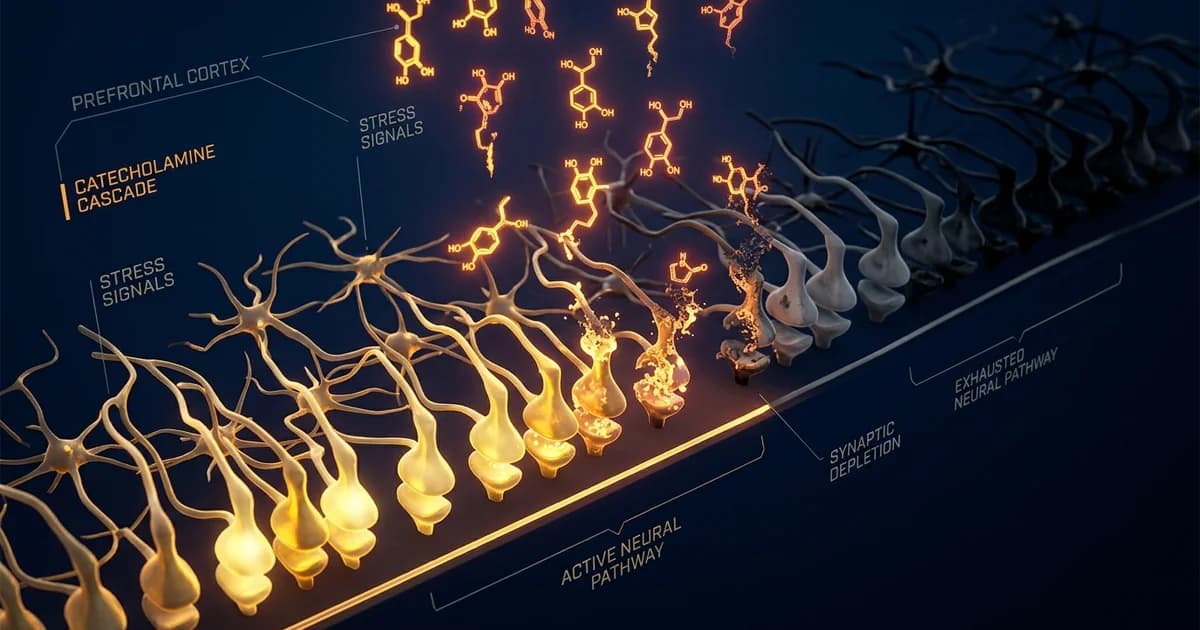
Catecholamines are a family of signaling molecules: dopamine, norepinephrine, and epinephrine. Your prefrontal cortex, the part of the brain that handles planning, working memory, and self-control, depends on a narrow, precise level of them. Push that level too high or drain it too low, and the smartest region of your brain goes offline first.
Here is what actually happens to your neurochemistry when the pressure climbs, and why "try harder" is the worst possible advice in that moment.
Key Takeaways
- Your prefrontal cortex needs an optimal, not maximal, level of dopamine and norepinephrine to function. This is the inverted-U rule.
- Acute stress floods the brain with catecholamines, pushing the system past its peak and shutting down higher-order thinking.
- Sustained mental effort also draws down the raw materials your brain uses to make dopamine, contributing to dopamine depletion under stress.
- Tyrosine, the amino acid precursor to catecholamines, has been shown to restore some cognitive performance when supplies run low.
- Smarter stimulant strategies aim for steady catecholamine signaling, not a spike followed by a crash.
What Catecholamines Actually Do in Your Brain
Catecholamines are the chemical messengers that tune attention and motivation. Dopamine drives reward, focus, and the sense that a task is worth pursuing. Norepinephrine sets your level of alertness and how strongly your brain reacts to what matters.
The prefrontal cortex is unusually dependent on both. According to research from the Arnsten Lab at Yale, prefrontal function follows an inverted-U curve: too little catecholamine release leaves you drowsy and unfocused, the right amount produces sharp, flexible thinking, and too much shuts the region down.
That last part is the trap. Most people assume more arousal means more focus. The neuroscience says the opposite once you pass the peak.
Why Focus Drops Under Pressure: The Stress Spike
Stress does not gently nudge your catecholamines upward. It floods them. The work of neuroscientist Amy Arnsten, published in Nature Reviews Neuroscience, describes how stress exposure triggers high levels of norepinephrine and dopamine release that rapidly weaken prefrontal cortex function.
In that high-stress state, control shifts away from the slow, deliberate prefrontal cortex toward older, faster brain circuits like the amygdala. Useful if a predator is chasing you. Useless when the threat is a hostile question in a boardroom.
This is the direct answer to why focus drops under pressure: the same molecules that sharpen you at moderate levels disable your higher reasoning when they surge. Your IQ does not fall. Your access to it does.
The relationship between norepinephrine and stress is the engine here. As Arnsten's review of catecholamine influences on prefrontal networks explains, high norepinephrine acting on certain receptors degrades the precise neural firing that working memory relies on. The result feels like a mental blank.
The Second Problem: Running Out of Raw Material
There is a slower form of depletion that has nothing to do with a sudden spike. Your brain manufactures catecholamines on demand, and sustained, intense mental work draws down the supply chain.
Dopamine and norepinephrine are both built from the amino acid tyrosine. Under heavy cognitive load or prolonged stress, the rate of catecholamine release can outpace synthesis, leaving neurons short on the precursor they need to keep up.
This is where the link between stress and neurotransmitters becomes practical. A review of tyrosine supplementation in people under stress or cognitive demand found that the amino acid tends to help most precisely when the brain's catecholamine system is being taxed, and does little when conditions are easy.
A controlled study published in Frontiers in Behavioral Neuroscience tested this directly. Tyrosine improved performance on a demanding working memory task, supporting the idea that topping up the precursor helps replenish catecholamines when they are being depleted faster than the brain can make them.
So you face two distinct problems under pressure. A short-term spike that overshoots the inverted-U peak, and a longer-term draw-down of the raw material. Dopamine depletion under stress is really both of these at once.
Acute Spike vs. Slow Drain: Two Faces of the Same Problem
| Feature | Acute Stress Spike | Slow Catecholamine Drain |
|---|---|---|
| Timescale | Seconds to minutes | Hours of sustained effort |
| Mechanism | Overshoots the inverted-U peak | Synthesis can't keep pace with release |
| What it feels like | Mind goes blank, can't think clearly | Fatigue, fading motivation, errors creep in |
| Brain region hit | Prefrontal cortex goes offline | Prefrontal cortex underpowered |
| Practical lever | Lower arousal, regain composure | Replenish precursors, pace the load |
Most "I lost my focus" experiences are a blend of the two. The morning starts with a stress spike, and by mid-afternoon the slow drain takes over. Understanding which one you are fighting changes how you respond.
What Actually Helps When Catecholamines Run Low
The goal is not to crank arousal as high as possible. The goal is to sit at the top of the inverted-U for as long as possible. A few evidence-aligned levers:
- Lower the spike before a high-stakes moment. Slow breathing and brief reframing reduce the norepinephrine surge so your prefrontal cortex stays in charge.
- Pace cognitive load. Working in focused blocks with real recovery slows the rate of catecholamine draw-down.
- Protect sleep. Sleep restores the synthesis machinery and receptor sensitivity that mental work depletes.
- Manage your stimulant curve. A sharp caffeine spike can push arousal past the peak, then leave you below it during the crash. Steadier is better.
That last point matters more than most people realize. The shape of your stimulant curve maps almost directly onto the inverted-U. A jittery peak followed by a crash is the exact pattern you want to avoid.
If you want the deeper background on the stimulant side, our explainer on why caffeine causes a crash and how to avoid it breaks down the mechanism.
Conclusion
Your brain does not run out of intelligence under pressure. It runs out of the precise chemical conditions that intelligence needs. The prefrontal cortex sits at the top of a narrow curve, and both a stress spike and a slow precursor drain knock it off that peak.
Once you see focus as a question of catecholamine balance rather than willpower, the strategy becomes obvious. Keep arousal in the productive zone, protect the raw materials your brain uses to build dopamine and norepinephrine, and never confuse a stimulant spike for sustained clarity. The brain that performs under pressure is the one held steady at the top of the curve.
Frequently Asked Questions
What is catecholamine depletion?
Catecholamine depletion describes a state where your brain's supply of dopamine and norepinephrine cannot meet demand. It happens two ways: a stress spike that overshoots the prefrontal cortex's optimal range, or sustained mental effort that draws down the raw materials faster than the brain can rebuild them. Both leave the prefrontal cortex underpowered, which feels like fading focus, mental blanks, and slipping motivation.
Why does my focus disappear during stressful moments?
A stress response floods your brain with norepinephrine and dopamine. Research from Yale neuroscientist Amy Arnsten shows that high levels of these molecules weaken prefrontal cortex function, shifting control to faster, more reflexive brain circuits. Your reasoning ability is intact, but your access to it drops sharply. This is why a high-pressure moment can make a normally articulate person go blank.
Is dopamine depletion under stress permanent?
No. The effects described in this article are functional and reversible. Once the stressor passes and arousal returns to a moderate level, prefrontal function typically recovers. Sleep, recovery between demanding tasks, and adequate precursor intake all help restore normal catecholamine signaling. Chronic, unmanaged stress is a separate concern worth discussing with a clinician.
Can tyrosine restore depleted catecholamines?
Tyrosine is the amino acid your body uses to build dopamine and norepinephrine. Controlled studies suggest it can support cognitive performance specifically when the catecholamine system is being taxed by stress or heavy mental load, and offers little benefit when demands are low. It is a precursor that helps the brain keep pace with release, not a direct stimulant.
How are norepinephrine and stress connected?
Norepinephrine is the brain's main alertness signal, and stress sharply increases its release. At moderate levels it improves attention. At high levels it disrupts the precise neural firing that working memory depends on. This is the core of why focus drops under pressure: the same chemical that sharpens you in small amounts overwhelms your reasoning when it surges.
Does caffeine make catecholamine depletion worse?
It depends on the curve. A large, fast caffeine dose can push arousal past the productive peak and then drop you below it during the crash, mimicking the spike-then-drain pattern. A steadier delivery that keeps you in the optimal range is friendlier to prefrontal function. The dose and the speed of onset matter as much as the total amount.
What is the inverted-U and why does it matter for focus?
The inverted-U describes how prefrontal performance relates to catecholamine levels. Too little and you are drowsy and unfocused. The right amount produces sharp thinking. Too much shuts the region down. The practical lesson is that more stimulation is not always better. Peak focus lives at the middle of the curve, not the extreme.
Holding the Top of the Curve, Without the Crash
The whole point of the inverted-U is that focus is a balancing act, not a throttle you pin to the floor. A stimulant that spikes hard and crashes fast does the opposite of what your prefrontal cortex needs. It overshoots the peak, then drops you below it.
Roon was built around that curve. It is a zero-nicotine sublingual pouch with a four-ingredient stack: 80 mg caffeine, 60 mg L-theanine, 25 mg methylliberine (Dynamine), and 5 mg theacrine (TeaCrine). The L-theanine smooths the caffeine, and the slower-acting compounds extend the active window, which is why Roon is designed for 6 to 8 hours of steady focus with no jitters, no crash, and no tolerance buildup.
To be clear about what it is not: Roon is not a treatment for chronic stress, and it cannot replace sleep, recovery, or composure under pressure. It is a tool for staying near the top of the curve during the hours you need it most. If you want focus that holds instead of spiking and fading, try Roon on your next demanding day.
Written by Roon Team