How Long Does Caffeine Take to Kick In? By Format
How Long Does Caffeine Take to Kick In? By Format
How long does caffeine take to kick in? Most people feel it within about 10 to 20 minutes, but blood levels keep rising well past that point. In human studies, caffeine dissolved in water peaked at about 30 minutes, coffee and cola at roughly 40 minutes, and capsules at 1 to 2 hours. Food, the delivery format and your own metabolism all shift the timing.
Felt Effect vs. Peak Level: Two Different Clocks
These are separate numbers that get confused constantly. Adan et al. (2008) gave 688 students either 100 mg of caffeine or decaf, then measured sleepiness and activation at 10, 20 and 30 minutes. Caffeine improved scores at every time point. Decaf also showed an effect at 10 minutes before fading, suggesting some of the very early lift is expectation.
Blanchard and Sawers (1983) measured plasma caffeine in 10 men after an oral solution and found a mean peak at 29.8 minutes. So you can feel something well before blood levels top out, and the peak comes later still for drinks and pills.
Caffeine Onset by Format
| Format | Study | Dose | n | Measured in | Mean time to peak |
|---|---|---|---|---|---|
| Caffeine in water | Blanchard & Sawers 1983 | 5 mg/kg | 10 men | Plasma | 29.8 min |
| Sugar-free cola | Liguori et al. 1997 | 400 mg | 13 adults | Saliva | 39 min |
| Coffee (unsweetened) | Liguori et al. 1997 | 400 mg | 13 adults | Saliva | 42 min |
| Capsules | Liguori et al. 1997 | 400 mg | 13 adults | Saliva | 67 min |
| Coffee (hot or cold) and sugar-free energy drink | White et al. 2016 | 160 mg | 24 adults | Plasma | 59 to 82 min (no sig. difference across 5 conditions) |
| Caffeine gum | Kamimori et al. 2002 | 50, 100, 200 mg | 12 men/group | Plasma | 44.2 to 80.4 min |
| Caffeine capsules | Kamimori et al. 2002 | 50, 100, 200 mg | 12 men/group | Plasma | 84.0 to 120.0 min |
| Caffeine pouch | No published PK study found | n/a | n/a | n/a | Not published (Roon states 5 to 10 min onset, brand-stated) |
| First felt effects (coffee) | Adan et al. 2008 | 100 mg | 688 students | Self-rated sleepiness and activation | Measurable at 10 min (first time point) |
Source: the human studies listed; times are means from small trials and vary from person to person.
Coffee and Energy Drinks
Liguori et al. (1997) found coffee peaked at 42 ± 5 minutes in saliva and cola at 39 ± 5 minutes, with no difference in self-reported effects. White et al. (2016) tested 160 mg from hot coffee, cold coffee (sipped or gulped) and a sugar-free energy drink. Mean peak times ranged from 59 to 82 minutes with no significant difference across five arms. Temperature and drinking speed did not change absorption, and the energy drink did not kick in faster than coffee in that trial.
Caffeine Pills
Capsules consistently peak later than drinks. Liguori et al. measured capsule Tmax at 67 ± 7 minutes, later than coffee (p = 0.004). Kamimori et al. (2002) found capsule Tmax at 84 to 120 minutes. If you are comparing pills against coffee or pouches, note that capsule peaks in these trials came as late as two hours after the dose.
Gum and Pouches: Absorbed Partly Through the Mouth
Caffeine gum peaked faster than capsules in the Kamimori et al. (2002) study: Tmax of 44.2 to 80.4 minutes for gum versus 84.0 to 120.0 minutes for capsules. The authors noted this "may indicate absorption via the buccal mucosa." About 85% of the caffeine was released from the gum, and total systemic exposure was comparable at 100 and 200 mg.
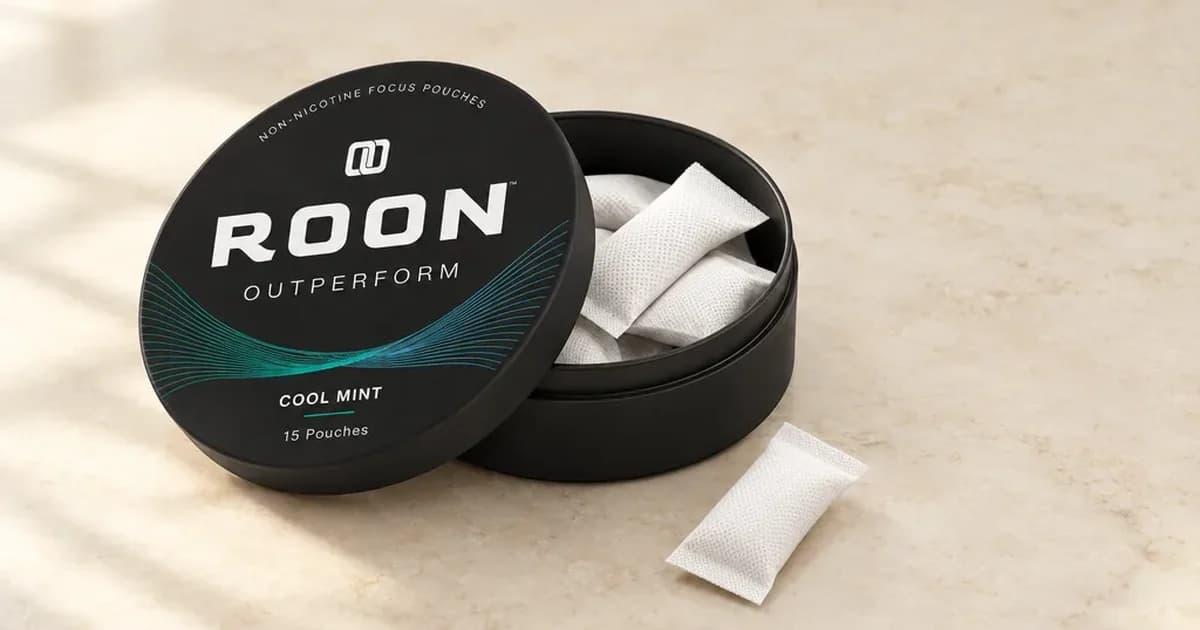
We could not find a published PK study from any caffeine pouch brand. Roon states 5 to 10 minute onset; that is a brand claim, not a measured Tmax. More on how caffeine pouches deliver their dose, or see our caffeine gummies and energy chews guide for chewable formats.
What Makes Caffeine Kick In Slower or Faster
Format is the biggest variable (see the table). Gum, absorbed partly through the mouth, peaked earlier than capsules in the Kamimori trial.
A full stomach delays the rise. Researchers use caffeine as a marker for gastric emptying speed in fasted versus fed states (Tzakri et al. 2023). That means a full stomach can slow the arrival; the studies give no fixed number of minutes.
Individual genetics matter. CYP1A2 metabolizes about 95% of ingested caffeine, and its activity varies widely (Nehlig 2018). This mostly shapes how long caffeine lasts rather than onset, but the FDA notes wide variation in sensitivity too. See caffeine genetics and CYP1A2 for more.
Expectation can create an early signal: the Adan et al. decaf finding suggests some of the first few minutes are anticipation, not pharmacology.
Timing Caffeine Around a Task or a Nap
The arithmetic from the study means: coffee and energy drinks peaked 40 to 80 minutes after drinking, so a cup that long before a task puts the peak near it. Capsules peaked later, 1 to 2 hours in the Kamimori and Liguori data. A caffeine nap uses the gap between drinking and the rise; our caffeine nap guide covers how. For how late in the day to stop, see how long caffeine stays in your system.
When Fast Caffeine Becomes a Problem
The FDA cites 400 mg per day as the amount not generally linked to negative effects for most healthy adults. Rapid intake of around 1,200 mg has been tied to toxic effects like seizures.
Do not stack a second dose because the first one "hasn't kicked in." Capsules can take up to two hours to peak; taking more before the first dose crests is how people overshoot. If you are pregnant, breastfeeding, trying to conceive, or have a medical condition or take medications that interact with caffeine, talk to your doctor. For more on upper limits, see how much caffeine is too much.
Related from Roon
- How long does caffeine stay in your system?
- How fast do caffeine pouches work?
- How long do energy drinks last?
Frequently Asked Questions
Why don't I feel caffeine at all?
The FDA acknowledges wide variation in caffeine sensitivity. If you take capsules, peak levels can take up to two hours; you may be checking too early. Expectation also colors the first minutes, as the Adan decaf result shows, and CYP1A2 variation adds another layer. If caffeine consistently does nothing at moderate doses, mention it to a doctor.
Does hot or iced coffee kick in faster?
In the White et al. (2016) trial, hot coffee and cold coffee reached similar peak plasma levels at similar times. Temperature did not produce a statistically significant difference.
Does chugging coffee make it hit faster?
Same trial. Cold coffee consumed in 2 minutes versus sipped over 20 minutes showed no significant difference in time to peak, so gulping did not speed things up.
Is decaf producing a placebo boost?
Briefly, yes. Adan et al. (2008) found decaf reduced sleepiness and raised activation at 10 minutes, but the effect disappeared by 20 minutes. Regular coffee kept improving at every time point. The 10-minute decaf effect looks like expectation.
Fast to Start, Slow to Fade
Drinks and pills in these studies took 30 to 120 minutes to peak, and how long the lift holds after that depends on clearance. Onset and duration run on separate clocks.
Roon addresses both from a pouch held in the lip. Its brand-stated onset is 5 to 10 minutes. Each pouch pairs a modest 80 mg of caffeine with 25 mg methylliberine, which slowed caffeine clearance in a randomized, double-blind crossover PK study (n=12): caffeine's half-life rose from 7.2 to 15 hours and oral clearance fell from 41.9 to 17.1 L/hr, with no higher peak. That study used 100 mg methylliberine with 150 mg caffeine, about 4x the methylliberine and 1.9x the caffeine in one Roon pouch, so Roon relies on the same mechanism directionally rather than repeating the study's result. A 15-hour half-life is not 15 hours of energy; most people feel a Roon pouch for something like 6 to 8 hours. The pouch also carries 60 mg L-theanine and 5 mg theacrine. No jitters, no crash.
Because the caffeine lingers, finish your last pouch at least eight hours before bed, and count each one toward 400 mg of caffeine a day from all sources. Roon costs from $9.16 per tin.
Sources
- Blanchard & Sawers 1983, PMID 6832208
- Liguori et al. 1997, PMID 9329065
- Kamimori et al. 2002, PMID 11839447
- White et al. 2016, PMC4898153
- Adan et al. 2008, PMID 18675877
- Nehlig 2018, PMID 29514871
- Tzakri et al. 2023, PMID 38004563
- FDA: Spilling the Beans
- Methylliberine and caffeine PK study, Journal of Exercise and Nutrition
Written by Roon Team