Nature and Focus: How a Walk Outside Restores Your Attention
Roon Team
Nature and Focus: How a Walk Outside Restores Your Attention
Your brain has a focus battery, and by 2 p.m. it is usually dead. You read the same email three times. You open a tab and forget why. The fix most people reach for is more coffee, but a growing body of research says nature improves focus in a way caffeine cannot: it recharges the exact mental system that hard concentration drains.
The framework behind this is called Attention Restoration Theory. It explains why a short walk among trees can leave you sharper than an hour of pushing through fatigue at your desk.
This is not soft wellness advice. It is one of the most replicated findings in cognitive psychology.
Key Takeaways
- Directed attention is the effortful focus you use for deep work, and it fatigues with use.
- Attention restoration theory argues that natural settings let that system rest by pulling on a different, effortless kind of attention.
- A landmark experiment found that a nature walk measurably improved attention and working memory, while an equivalent city walk did not.
- You do not need a national park. A tree-lined street, a park bench, or even photos of nature can help.
- Nature restores your attention system. A focus aid like caffeine plus L-theanine supports performance during the work block. They solve different problems.
What Directed Attention Fatigue Actually Is
Directed attention fatigue is the mental exhaustion that builds when you force your brain to concentrate on something that is not naturally interesting. It is why a long stretch of spreadsheets feels heavier than a long movie.
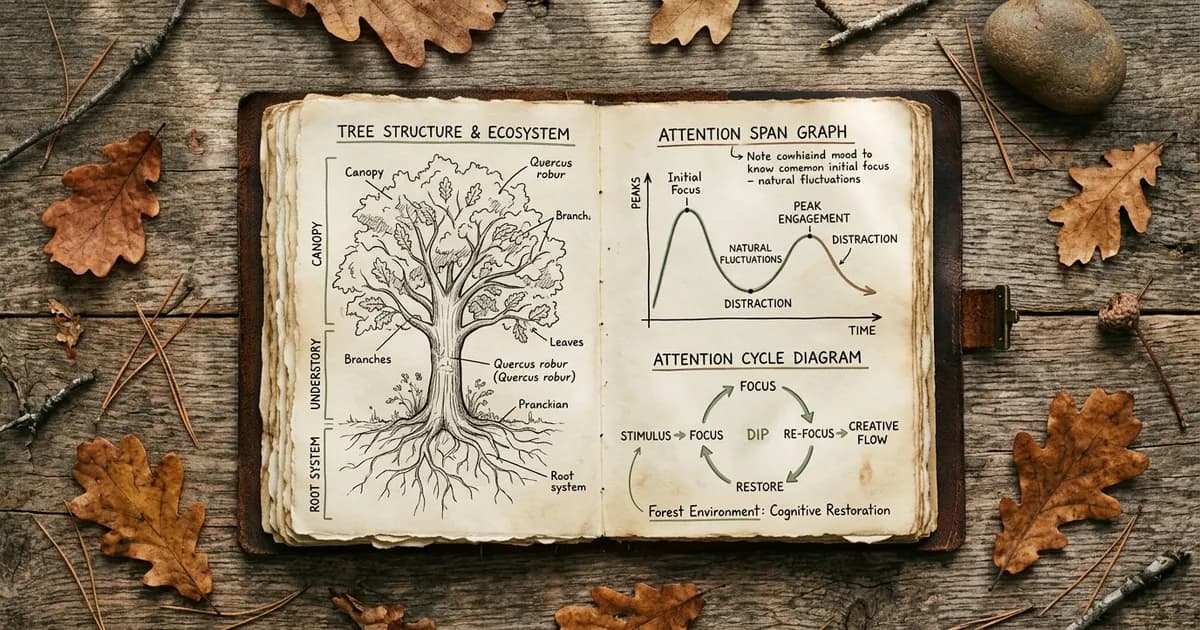
Psychologists Rachel and Stephen Kaplan built Attention Restoration Theory around two distinct kinds of attention. Attention Restoration Theory identifies two types of attention, directed (effortful, depletes) and involuntary (effortless, restores), and shows that nature environments preferentially engage involuntary attention.
Directed attention is the costly one. You burn it every time you block out distractions, resist your phone, or push through a boring task. The supply is finite, and once it runs low, your mistakes climb and your willpower drops.
Involuntary attention is the cheap one. A hawk overhead or light moving through leaves grabs your focus without any effort from you. That is the loophole nature exploits.
How Nature Improves Focus: The Science of Restoration
Nature improves focus because natural environments hold your attention gently, giving the effortful, directed-attention system time to refill. The Kaplans called this quality "soft fascination," and it is the heart of attention restoration theory.
A city street does the opposite. The urban environment, with its traffic, advertising, crowds, and constructed complexity, engages directed attention, which is why a walk through downtown can feel as draining as the work you were trying to escape.
The most cited evidence comes from Marc Berman and colleagues. In Berman, Jonides, and Kaplan (2008), Psychological Science, participants who walked in a natural setting performed better on a backward digit-span memory task than those who walked in an urban setting.
Here is the part that surprises people. Berman's team showed the effect did not even require going outside. In the same study, simply viewing pictures of nature also improved directed-attention performance, consistent with attention restoration theory.
So the question "does being outside improve concentration" has a clear answer: yes, and even a window view or a photo of a forest moves the needle.
The Four Ingredients of a Restorative Break
Not every break restores attention. Scrolling your phone on a park bench mostly trades one demand for another. Attention Restoration Theory describes four qualities that make an environment genuinely restorative.
| Quality | What it means | Everyday example |
|---|---|---|
| Being away | A break from your usual mental demands | Leaving your desk and the screen behind |
| Soft fascination | Effortless interest that does not tax focus | Watching clouds, water, or wind in trees |
| Extent | A setting rich enough to feel immersive | A park or trail, not a single potted plant |
| Compatibility | A place that fits what you want to do | A quiet green space for a reflective walk |
Nature scores high on all four at once. That combination is why the peer-reviewed literature on PMC treats it as the classic restorative experience. A walk through a nature park or garden is perhaps the classic brief restorative experience, though longer experiences such as a vacation in nature can be even better.
Green Space Cognition: Why You Do Not Need Wilderness
Green space cognition is the study of how access to parks and trees shapes mental performance, and the practical takeaway is simple. You need a deliberate dose of nature most days, not a remote trail.
A tree-lined block on your lunch break counts. A few minutes by a window with a view of a park counts. Even nature sounds through headphones help when you are stuck inside.
The point of a nature walk for attention is not exercise. It is the soft fascination, the visual rest, the absence of demands competing for your directed focus. Walk slowly. Leave the podcast off.
How to Use Nature for Real Focus Gains
Treat restoration like a scheduled input, not an accident. A few rules make it work.
- Take the break before you are wrecked, not after. A short reset every 90 minutes beats one collapse at 4 p.m.
- Go green, not gray. A park beats a busy sidewalk. The setting matters as much as the movement.
- Drop the inputs. No email, no feeds. The goal is to rest directed attention, not redirect it.
- Keep it short and frequent. Even 10 to 20 minutes shifts attention scores, based on the experimental work above.
Nature handles recovery. Your work blocks handle output. Pairing restorative breaks with structured deep-work sessions is the closest thing to a sustainable attention system most people will find. It also explains why your best ideas tend to arrive mid-walk, when the brain's default mode network quietly takes over and connects loose threads.
Conclusion
The science here is unusually clean. Hard focus draws down a limited resource, directed attention, and natural settings refill it by engaging effortless involuntary attention instead. A short, screen-free walk in green space is not a luxury. It is maintenance for the part of your brain you rely on most.
You will not out-coffee directed attention fatigue. You can rest it, and the cheapest place to do that is outside, among trees, doing nothing in particular. Then you return to the work with a tank that is actually full.
Frequently Asked Questions
Does being outside improve concentration?
Yes. Controlled experiments show that time in natural settings improves performance on attention and working memory tasks, while equivalent time in urban environments does not produce the same gain. The leading explanation is attention restoration theory: nature engages effortless involuntary attention and lets your effortful, directed attention recover. Even brief exposure, including views or images of nature, has shown measurable effects in the research.
How long does a nature walk need to be to help focus?
Shorter than you think. The experimental work behind attention restoration theory found benefits from walks in the range of roughly 50 minutes, but later studies suggest even 10 to 20 minutes of green space can shift attention scores. Frequency matters as much as duration. A brief daily reset is more useful for sustained focus than one long walk a week.
What is directed attention fatigue?
Directed attention fatigue is the mental exhaustion that builds when you force your brain to concentrate on tasks that are not naturally engaging. It is the cognitive cost of blocking out distractions and pushing through boring work. As it accumulates, you make more errors, feel irritable, and lose self-control. Rest, sleep, and exposure to nature are the main ways to recover it.
Do I need real nature, or do photos and views work?
Real nature is the strongest dose, but it is not the only one. Research on attention restoration theory found that even viewing images of natural environments improved attention on simple cognitive tasks. A window with a view of trees, nature sounds, or a few minutes in a courtyard all help when you cannot get to a park. The effect scales with how immersive and demand-free the experience is.
Why does a walk in the city not work the same way?
City environments are full of stimuli that demand your directed attention: traffic, signage, crowds, and the need to stay alert. That keeps draining the same system you are trying to rest. Nature, by contrast, offers soft fascination that holds your attention without effort. This is the core distinction in attention restoration theory and why a green setting beats a gray one for restoration.
Can nature replace caffeine for focus?
No, because they do different jobs. Nature restores a depleted attention system during a break. Caffeine and similar focus aids support performance while you are actually working. Think of them as complementary levers rather than substitutes. The best results come from resting your attention regularly and supporting it during demanding work blocks, not from leaning on one alone.
Two Levers for Sustained Attention, Not One
Everything above points to a single idea: your attention is a resource you spend and refill, not a switch you flip. Nature handles the refill. A walk in green space restores the directed-attention system that deep work runs down, and no amount of caffeine does that specific job.
The other lever is what you use during the work block itself. That is where Roon fits. It is a zero-nicotine sublingual pouch with a four-ingredient stack, 80 mg caffeine, 60 mg L-theanine, 25 mg methylliberine (Dynamine), and 5 mg theacrine (TeaCrine), built for a 5 to 10 minute onset and 6 to 8 hours of focus with no jitters, no crash, and no tolerance buildup.
Roon is not a replacement for rest, sleep, or a walk outside. It supports concentration while you are working, the same way a nature break supports recovery while you are not. Used together, they cover both sides of sustained attention. If you want to see how a focus pouch fits a recovery-aware routine alongside your deep-work blocks, try Roon.
Written by Roon Team