Chronic Stress and Memory: How Cortisol Reshapes the Hippocampus
You forget why you walked into a room. A name sits on the tip of your tongue and refuses to come. You read the same paragraph three times and retain nothing. If this sounds familiar during a stretch of nonstop pressure, your biology is not betraying you. It is doing exactly what it evolved to do.
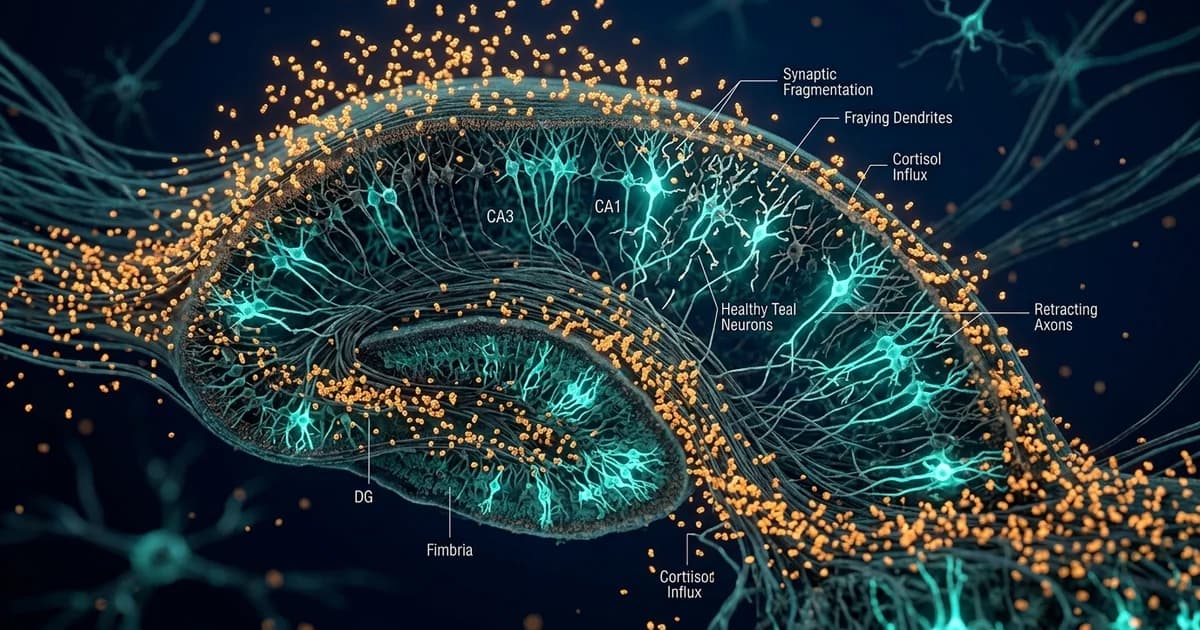
The link between chronic stress and memory runs through a single hormone and a seahorse-shaped structure deep in your brain. The hormone is cortisol. The structure is the hippocampus, your brain's filing system for new memories. When stress stops being a brief alarm and becomes a permanent background hum, cortisol starts physically remodeling that filing system.
Here is what is happening inside your skull, why it matters, and what the science says you can do about it.
Key Takeaways
- Cortisol is helpful in short bursts and damaging in long ones. The same hormone that sharpens a brief crisis erodes memory when it never switches off.
- The hippocampus is densely packed with cortisol receptors, which makes it one of the most stress-vulnerable regions in the brain.
- Prolonged high cortisol shrinks hippocampal neurons and slows the birth of new ones, which shows up as forgetfulness.
- Higher cortisol in midlife is linked to lower brain volume and worse memory, even in people with no symptoms.
- Much of this damage appears reversible. Sleep, exercise, and stress reduction can help restore hippocampal function.
How Stress Affects the Brain: The Cortisol Cascade
Stress begins as a survival tool. When your brain detects a threat, it fires up the hypothalamic-pituitary-adrenal axis, which floods your bloodstream with glucocorticoids, the family of stress hormones led by cortisol. In a true emergency this is exactly what you want. Cortisol mobilizes glucose, sharpens attention, and tags emotionally charged events so you remember them later.
The problem is duration. Cortisol was built to spike and then fall, not to stay raised for months. Modern stressors rarely resolve in minutes, and your body keeps the tap open.
This matters because stress is common. Roughly 75% of U.S. adults report experiencing stress, and most say it now shows up as physical symptoms like fatigue and headaches. When that pressure becomes constant, the same hormone that once saved your ancestors from predators starts working against the part of your brain you rely on to learn and remember.
Why the Hippocampus Takes the Hit
The hippocampus is unusually sensitive to cortisol because it is studded with glucocorticoid receptors. That density is part of its job. The hippocampus helps shut off the stress response once a threat passes, acting like a brake pedal on the HPA axis.
But the same receptors that let it sense cortisol also make it the first casualty when cortisol stays high. Think of it as a smoke detector wired directly into the fire.
When the brake itself starts to wear down, the stress response loses its off switch. Cortisol stays raised, the hippocampus takes more damage, and the damage weakens its ability to apply the brake. That feedback loop is one reason chronic stress is so hard to climb out of.
Cortisol and Memory: What Actually Changes Inside the Neuron
Chronic stress reshapes the hippocampus through three distinct mechanisms. None of them require a stroke or an injury. They happen quietly, through ordinary biology pushed past its limits.
1. Dendrites retract
Neurons communicate through branching arms called dendrites. Decades of work, much of it from neuroscientist Bruce McEwen's lab, showed that repeated stress causes these branches to shrink back. Research published in the Journal of Neuroscience found that repeated restraint stress produces a reversible shortening and debranching of apical dendrites in the CA3 region of the hippocampus, driven by high glucocorticoid secretion and excess glutamate release.
Fewer branches mean fewer connections. Fewer connections mean a thinner network for storing and retrieving memories.
2. Neurogenesis slows
Your hippocampus is one of the few brain regions that keeps making new neurons in adulthood, in a zone called the dentate gyrus. Chronic stress throttles that production. As one overview of the research explains, glucocorticoid receptor activation in neural progenitor cells reduces their proliferation rate, suppressing the birth of new neurons in the dentate gyrus.
Those new neurons help you tell similar memories apart, like remembering where you parked today versus yesterday. Stifle their production and that fine-grained sorting gets blurry.
3. Retrieval gets blocked in the moment
Even when a memory is safely stored, a cortisol surge can stop you from pulling it up. Human studies show that acute stress impairs memory retrieval, with the effect tied directly to cortisol reactivity, and it holds up regardless of the time of day. This is the blank-mind feeling in a high-pressure exam or interview. The memory is there. The stress is jamming the signal.
Stress and Forgetfulness in Real Life: The Midlife Evidence
The most striking human data comes from the Framingham Heart Study. Researchers measured cortisol and ran brain scans and memory tests on healthy, asymptomatic adults in their 40s.
The results, published in Neurology, found that higher serum cortisol was associated with lower brain volumes and impaired memory in younger to middle-aged adults, with the association being especially evident in women. The effect on total cerebral brain volume held for women but not men, for reasons the researchers could not fully explain.
Read that again. These were people with no symptoms and no diagnosis. The structural changes showed up first, quietly, years before anyone would call it a problem. That is what makes the connection between stress and forgetfulness worth taking seriously well before midlife.
Acute vs. Chronic: Stress Is Not Always the Enemy
The story is not that all stress harms memory. The dose and the timing decide everything.
| Stress type | Cortisol pattern | Effect on memory |
|---|---|---|
| Acute, brief | Sharp spike, fast return to baseline | Can sharpen attention and lock in emotional memories |
| Acute, during recall | Surge at the wrong moment | Temporarily blocks retrieval (the "blank mind") |
| Chronic, sustained | Stays raised for weeks or months | Dendrite retraction, slowed neurogenesis, lower hippocampal volume |
A short jolt of stress before learning something emotionally vivid can actually help you encode it. The damage comes when cortisol never returns to baseline. That is the line between a useful stress response and a corrosive one.
The Good News: The Hippocampus Can Recover
The hippocampus is plastic, which is the same reason stress can damage it and the same reason it can heal. The dendritic shrinkage seen in animal studies was described as reversible from the start, not permanent scarring.
Neurogenesis can also bounce back. In one study published in Scientific Reports, mice with hippocampal injury that ran on a wheel for 21 days almost completely recovered their spatial learning, while sedentary mice showed no improvement, an effect the authors attribute to exercise-driven neurogenesis.
The levers that help are unglamorous and well established:
- Sleep, which clears metabolic waste and consolidates the day's memories.
- Aerobic exercise, which raises BDNF, a protein that supports the survival and birth of neurons.
- Genuine recovery, meaning periods where the HPA axis actually switches off rather than idling.
None of these are quick fixes. They are the slow, real work of giving your brain its off switch back.
The Bottom Line on Stress and Your Memory
Memory loss under chronic stress is not a character flaw or a sign of weakness. It is cortisol doing measurable, physical work on the hippocampus, shrinking neural branches, slowing the birth of new cells, and jamming retrieval in the moment.
The encouraging part is that the same plasticity that makes the hippocampus vulnerable also makes it resilient. Lower the cortisol load over time and the structure can recover much of what it lost. Your brain is not a fixed machine running down. It is a living system that responds to how you treat it, especially how you rest, move, and let the pressure off.
Frequently Asked Questions
Does chronic stress cause permanent memory loss?
Usually not. The hippocampal changes from chronic stress, including dendrite retraction and slowed neurogenesis, are largely reversible in animal and human studies once cortisol levels come down. Sleep, exercise, and reduced stress exposure can help restore function. Permanent damage is more likely when extreme stress is sustained for years without recovery, so the priority is breaking the cycle early rather than assuming the loss is locked in.
How long does it take for stress to affect the brain?
Acute stress can block memory retrieval within minutes through a cortisol surge, which is the blank-mind feeling under pressure. Structural changes like dendrite shrinkage develop over weeks of sustained stress in animal models. The Framingham data showed measurable differences in brain volume and memory in midlife adults, suggesting that years of raised cortisol leave a footprint long before symptoms appear.
Why do I forget things when I am stressed?
A cortisol surge can interrupt the hippocampus and prefrontal cortex while you try to recall stored information, which is why a name or fact vanishes right when you need it. The memory is still there. Stress is temporarily blocking the retrieval pathway. Over the long term, sustained cortisol also weakens the hippocampal network that stores new memories, compounding everyday forgetfulness.
Are women more affected by cortisol and memory loss?
The evidence suggests they may be. In the Framingham Heart Study, higher cortisol was tied to lower brain volume in women but not men, though researchers could not fully explain why. This points to sex differences in how the brain responds to glucocorticoids. More research is needed before drawing firm conclusions about why women showed a stronger association in that dataset.
Can exercise reverse stress-related brain changes?
Exercise is one of the best-supported tools. Aerobic activity raises BDNF, a protein that supports neuron survival and the birth of new cells in the hippocampus. In one Scientific Reports study, mice with hippocampal injury nearly fully recovered their learning ability after three weeks of running, while inactive mice did not. Human evidence consistently links regular aerobic exercise to better hippocampal health and memory.
Is some stress good for memory?
Yes. A brief stress response before or during learning can sharpen attention and help lock in emotionally important memories. Cortisol evolved to tag marked events. The harm comes from chronic increase, when the hormone never returns to baseline and starts remodeling the hippocampus. The difference between helpful and harmful stress is mostly about duration and recovery.
How a Calmer Baseline Protects Your Memory
If there is one practical idea to take from the biology above, it is this: protecting your memory is mostly about lowering the cortisol load your hippocampus carries day after day. No pill, supplement, or pouch substitutes for that. Sleep, movement, and real recovery are the work, and nothing on the market replaces them.
That honest framing is the foundation we build Roon on. Roon is a zero-nicotine sublingual pouch with a simple 4-ingredient stack: 80 mg caffeine, 60 mg L-theanine, 25 mg methylliberine (Dynamine), and 5 mg theacrine (TeaCrine). It is built for focused, jitter-free work for 6 to 8 hours with no crash. It is a tool for the hours you choose to be sharp, not a treatment for stress and not a fix for an overloaded HPA axis.
We write about the brain because understanding the machinery makes you better at running it. If that is the kind of thing you want more of, Roon is where the science and the product live in the same place.
Written by Roon Team