Norepinephrine and Attention: The Inverted-U Behind Being "Dialed In"
Roon Team
Norepinephrine and Attention: The Inverted-U Behind Being "Dialed In"
There's a window where work feels easy. Your attention locks on, distractions fade, and the right idea shows up at the right second. Then you have a second coffee, and twenty minutes later you're refreshing your inbox and rereading the same sentence four times.
That swing is the story of norepinephrine and attention. The chemical that sharpens your focus is the same one that, in excess, scatters it. The difference between "dialed in" and "wired" is mostly a question of dose.
Scientists have a name for the shape of that relationship. It's an inverted U, and it explains more about your good and bad focus days than almost anything else in your brain.
Key Takeaways
- Norepinephrine (also called noradrenaline) is the brain's main alertness signal, and attention follows an inverted-U curve as levels rise.
- Too little norepinephrine leaves you drowsy and distractible. Too much leaves you anxious and scattered. The peak in between is where focus lives.
- This curve maps onto the Yerkes-Dodson law, the century-old observation that performance climbs with arousal, then falls.
- The goal of any focus tool, caffeine included, is to move you toward the peak without overshooting it.
What Norepinephrine Actually Does in the Brain
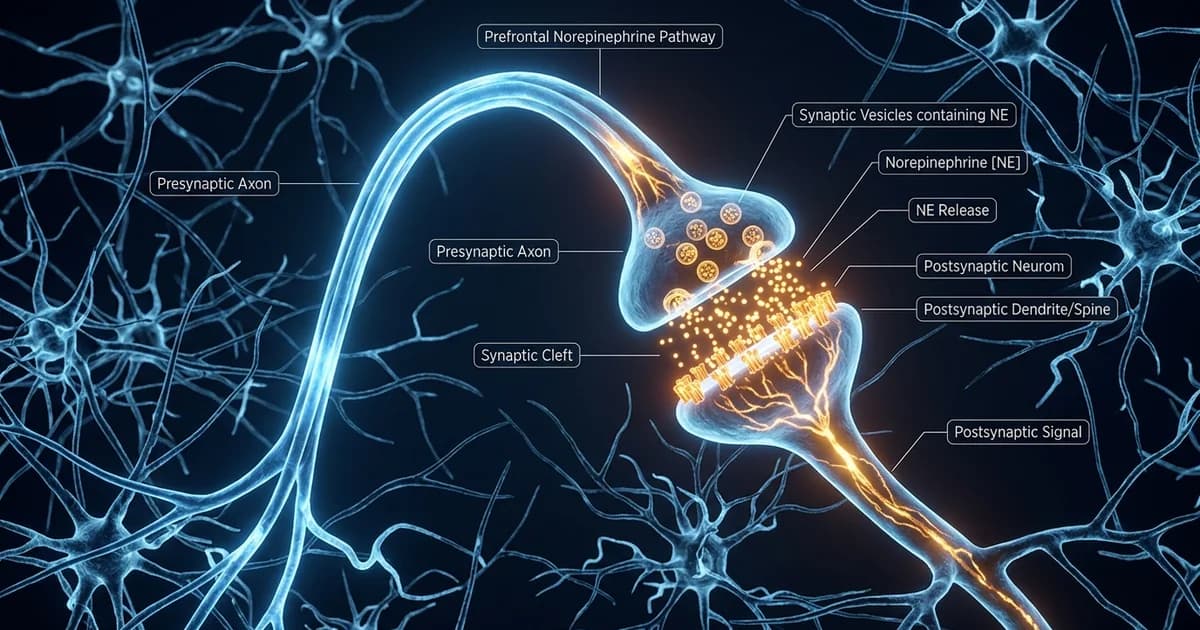
Norepinephrine is the signal that tells your brain to pay attention now. It's a neurotransmitter produced mainly in a tiny brainstem region called the locus coeruleus, a cluster of cells no bigger than a grain of rice that sends projections almost everywhere in the cortex.
When something matters, a deadline, a threat, a hard problem, the locus coeruleus releases norepinephrine across the brain. That release raises arousal, sharpens sensory processing, and biases your prefrontal cortex toward the task in front of you.
The prefrontal cortex is the part that handles working memory and goal-directed focus. It's also exquisitely sensitive to its chemical environment. Research from the Arnsten Lab at Yale shows that moderate norepinephrine release stimulates a specific receptor, the a2A-adrenoceptor, which strengthens the prefrontal connections that hold your goals in mind.
That's the upside. The catch is that the relationship isn't linear. More is not always better.
Norepinephrine and Attention Follow an Inverted-U Curve
Attention rises with norepinephrine up to a point, then collapses. Plot focus on the vertical axis and arousal on the horizontal, and you get a hump: low on the left, high in the middle, low again on the right. That's the inverted U, and it's one of the most reproduced patterns in cognitive neuroscience.
The Arnsten group has spent decades mapping it. Their work shows that the prefrontal cortex needs an optimal amount of norepinephrine, and that both too little and too much impair its function. At low arousal you're underpowered. At high arousal a different, lower-affinity receptor (the a1-adrenoceptor) takes over and actively weakens prefrontal control.
A 2025 paper in Nature Communications pushed this from receptors up to whole-brain networks. Across species, the authors found that locus coeruleus norepinephrine drives an inverted U-shaped pattern of global brain connectivity, and they framed it as a network-level basis for the classic arousal-performance curve.
So the inverted U isn't a metaphor. It shows up in receptors, in single neurons, and in the way large brain networks talk to each other.
The Three Zones of the Curve
Picture your attention sitting somewhere on that hump at any given moment.
- Under-aroused (left side): Low norepinephrine. You feel foggy, bored, sluggish. Your mind wanders because nothing is recruiting your focus. This is the 3 p.m. slump.
- Optimal (the peak): Balanced norepinephrine. Alert but calm. You filter out noise, hold your goal in mind, and lose track of time in the good way. This is "dialed in."
- Over-aroused (right side): Excess norepinephrine. Racing thoughts, restlessness, a narrowed and jumpy attention that can't settle. This is the jitter zone.
The art of focus is mostly the art of staying near that middle peak.
Yerkes-Dodson: The Law Behind the Curve
The inverted U has a much older name. In 1908, psychologists Robert Yerkes and John Dodson noticed that performance improved as arousal increased, but only up to a threshold, after which more pressure made performance worse. That observation became the Yerkes-Dodson law, and you can read the overview on Simply Psychology.
For over a century it was a behavioral observation without a clear mechanism. We could measure the curve, but we couldn't point to the thing producing it.
Norepinephrine is a large part of that missing mechanism. The arousal axis in Yerkes-Dodson is, in good measure, a norepinephrine axis. Noradrenaline focus is Yerkes-Dodson at the level of a single neurotransmitter.
One more wrinkle the original law captured: the peak shifts with task difficulty. Simple, well-practiced tasks tolerate high arousal. Complex tasks that lean on the prefrontal cortex have a much lower optimum, which is why you can answer emails while stressed but can't write the hard report.
How the Locus Coeruleus Switches Modes
The locus coeruleus doesn't just turn norepinephrine up and down like a single dial. It runs in two firing patterns, and the balance between them shapes what kind of attention you get.
In phasic mode, the locus coeruleus fires in tight bursts locked to relevant events. This is the focused, task-engaged state, where you exploit the task in front of you and tune out everything else.
In tonic mode, it fires at a steady, raised background rate. High tonic firing pushes you toward the over-aroused right side of the curve. Attention becomes distractible and exploratory, scanning for something else to do.
Most "I can't focus" moments are a tonic problem. You're not low on alertness. You're flooded with it, stuck in scan mode instead of lock-on mode.
Where Caffeine Lands on the Curve
Caffeine is the most common way people deliberately move along their arousal curve. It works mostly by blocking adenosine, the molecule that builds up through the day and makes you feel tired. Take away the brake, and arousal climbs, which is why coffee lifts you off the foggy left side of the curve.
The problem is overshoot. Caffeine raises arousal but gives you no steering. Push the dose, drink it on an empty stomach, or stack it late in the day, and you sail past the focus peak into the over-aroused zone. That's the jitter, the racing heart, the scattered attention that feels like the opposite of focus.
In other words, caffeine can put you anywhere on the inverted U, including the wrong side of it.
Caffeine and Attention Tools Compared
Here's how common approaches map onto the curve. The honest question for any of them is not "does it raise arousal" but "does it keep you near the peak."
| Approach | Effect on arousal | Risk of overshoot | Best use |
|---|---|---|---|
| Black coffee / energy drinks | Sharp rise | High (jitter, crash) | Quick lift when under-aroused |
| Pure caffeine pills | Sharp rise, no buffer | High | Precise dosing for the experienced |
| Caffeine + L-theanine | Moderate rise, smoothed | Low | Sustained focus near the peak |
| Roon sublingual pouch | Fast, balanced rise | Low | Locking onto the peak for hours |
| Movement / sunlight / a short walk | Gentle rise | Very low | Nudging up the left side naturally |
Notice the pattern. The tools that pair a stimulant with something calming tend to hold you near the optimum, instead of flinging you past it.
L-Theanine: The Counterweight to Over-Arousal
L-theanine, an amino acid found in tea, is the most studied way to blunt caffeine's overshoot. It raises calm without sedating you, which is exactly what you want if your problem is sitting too far right on the curve.
The combination is well documented. A frequently cited study reported by ResearchGate found that L-theanine and caffeine together improved accuracy on demanding task-switching and raised self-reported alertness, while reducing tiredness.
Other work found the two have opposing effects on arousal specifically. Caffeine accentuates the physical stress response while theanine mitigates it, according to research in the Canadian Journal of Physiology and Pharmacology. Together, they get you the alertness without as much of the edge.
That is the inverted U made practical. One ingredient moves you up the curve. The other keeps you from rolling off the top.
Conclusion
Attention is not about maximizing alertness. It's about hitting a target. Norepinephrine and attention follow an inverted U, the same shape Yerkes and Dodson sketched over a century ago, now traced down to specific receptors and whole-brain networks.
Too little arousal and you drift. Too much and you fray. The peak in the middle, alert but calm, is the state everyone is chasing when they say they want to focus.
The useful reframe is this: a good focus day isn't the day you were most stimulated. It's the day you stayed closest to the top of the curve. Anything you do to support your attention, from a walk in the morning sun to what you drink, is worth judging by one question. Does it move you toward the peak, or shove you past it?
Frequently Asked Questions
What is the difference between norepinephrine and noradrenaline?
They are two names for the same molecule. Norepinephrine is the term used most often in the United States, while noradrenaline is more common in Europe. Both refer to the neurotransmitter produced by the locus coeruleus that controls arousal and alertness, and both behave the same way on the inverted-U curve that governs attention and focus.
Can you have too much norepinephrine for focus?
Yes. This is the core point of the inverted-U relationship in norepinephrine cognition. Moderate levels sharpen prefrontal attention by engaging a2A receptors. Excess levels recruit a1 receptors that weaken prefrontal control, which shows up as anxiety, racing thoughts, and a jumpy attention that can't settle. More arousal stops helping once you pass the peak of the curve.
What is the locus coeruleus norepinephrine system?
The locus coeruleus is a small cluster of neurons in the brainstem and the brain's main source of norepinephrine. It projects widely across the cortex and acts as a master alertness controller. It fires in brief task-locked bursts during focused work and at a steady background rate during restless, distractible states, which is why it sits at the center of attention research.
How does the Yerkes-Dodson law relate to norepinephrine?
The Yerkes-Dodson law describes how performance rises with arousal, then falls past an optimal point. For a long time it was a behavioral pattern without a mechanism. Norepinephrine supplies much of that mechanism, since the arousal axis tracks norepinephrine levels. The arousal performance inverted U and the norepinephrine dose-response curve are essentially the same shape.
Why does caffeine sometimes hurt my focus instead of helping?
Caffeine raises arousal but offers no control over how far. If you start near your peak, more caffeine can push you past it into the over-aroused zone, where attention narrows and scatters. That's the jitter. The fix is not always less caffeine. Often it's pairing it with something calming, like L-theanine, that holds you near the optimum.
Does the optimal arousal level change with the task?
Yes. Yerkes and Dodson noticed this in 1908. Simple, well-practiced tasks tolerate high arousal and can even benefit from it. Complex tasks that depend on the prefrontal cortex have a much lower optimal point. This is why pressure can speed up routine work but wreck performance on a hard, novel problem.
How can I tell if I'm over-aroused or under-aroused?
Under-arousal feels like fog, boredom, and a wandering mind that won't engage. Over-arousal feels like restlessness, a racing pulse, and an attention that jumps from thing to thing. Both look like "I can't focus," but they sit on opposite sides of the curve and call for opposite fixes: a lift on one side, a calming counterweight on the other.
Staying Near the Peak, Not Past It
If the inverted U is real, and the evidence says it is, then the goal of a focus tool isn't raw stimulation. It's precision. Pure caffeine is a blunt instrument: it can lift you off the foggy left side of the curve, but it just as easily launches you past the peak into jitter and scatter.
This is the problem Roon is built around. Each sublingual pouch pairs 80 mg of caffeine with 60 mg of L-theanine, plus 25 mg of methylliberine (Dynamine) and 5 mg of theacrine (TeaCrine), so you climb toward the focus peak without sailing over it. The caffeine moves you up the arousal curve. The theanine acts as the counterweight that keeps you near the top, alert and not over-aroused, for 6 to 8 hours with no jitters and no crash.
Roon won't fix sleep debt, and it isn't a substitute for the basics that set your baseline arousal: rest, food, daylight, movement. What it does is give you a faster, more controlled way to find the sweet spot of the inverted U. If your focus problem is overshoot, try Roon as the steering, not just the gas.
Written by Roon Team