The HPA Axis Explained: How Stress Hormones Steal Your Focus
Roon Team
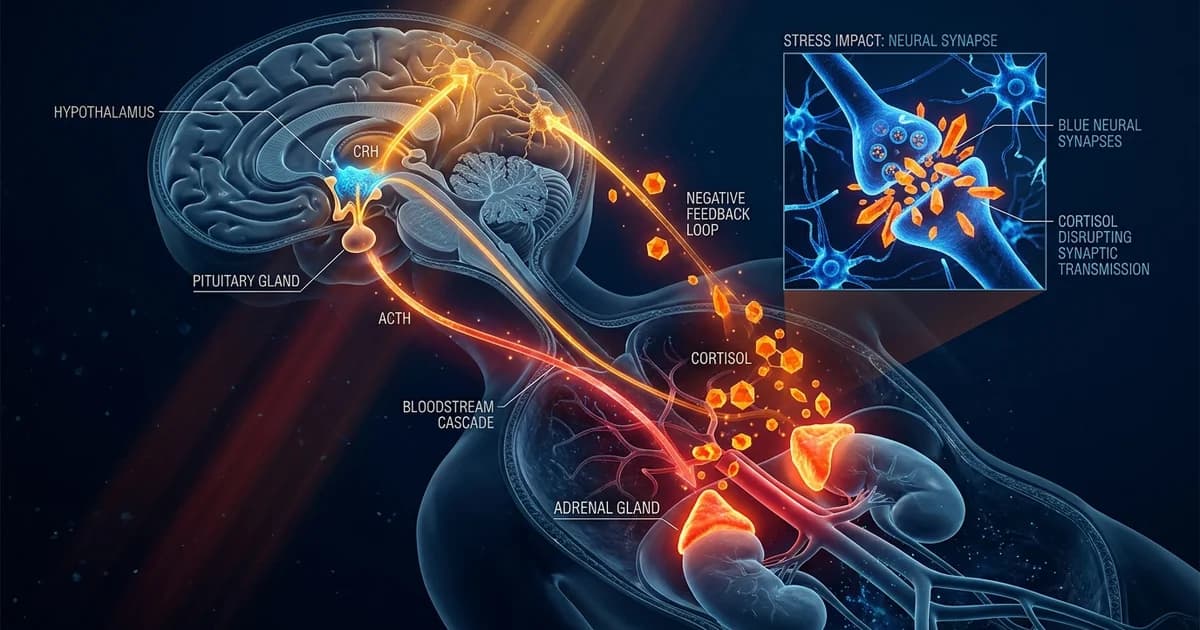
The HPA Axis Explained: How Stress Hormones Steal Your Focus
You sit down to work, open the document, and your mind scatters. You reread the same sentence four times. The thinking part of your brain feels like it went offline, and no amount of willpower brings it back.
That fog has a mechanism, and most of it runs through the HPA axis and stress chemistry it controls. The hypothalamic-pituitary-adrenal axis is your body's central stress response system, and when it fires, it pulls resources away from the exact brain region you need for deep focus.
This is not a character flaw. It is biology working as designed, just in a context your design never expected.
Key Takeaways
- The HPA axis is a three-organ hormone loop that releases cortisol during stress.
- Short bursts of cortisol can sharpen attention. Chronic increase does the opposite.
- High cortisol shifts brain control from the prefrontal cortex (planning, focus) to the amygdala (threat, reaction).
- The relationship between stress hormones and performance follows an inverted-U curve: too little or too much both hurt.
- L-theanine has human evidence for blunting the stress response, which supports calm focus.
What Is the HPA Axis?
The HPA axis is the communication line between three structures: the hypothalamus in your brain, the pituitary gland just below it, and the adrenal glands that sit atop your kidneys. Think of it as a chain of command for stress.
When your brain perceives a threat, the hypothalamus releases a signaling hormone (CRH). That tells the pituitary to release another hormone (ACTH). ACTH travels through the blood and tells the adrenal glands to pump out cortisol, your primary stress hormone.
Cortisol then loops back to the brain and tells the hypothalamus to ease off. That feedback brake is what keeps a normal stress response short and self-limiting. The trouble starts when the brake wears out.
Cortisol and the Brain: The Inverted-U Problem
Cortisol is not the villain. You need it. It mobilizes glucose, raises alertness, and helps you respond to a real challenge. A morning rise in cortisol is part of why you wake up and feel ready to move.
The problem is the dose-response curve. Stress hormone cognition follows an inverted-U shape, often linked to the Yerkes-Dodson principle: a little arousal improves performance, and too much collapses it.
Some short-term cortisol can actually help certain memory tasks. One study published in PMC found that acute increases in cortisol were positively associated with gains in encoding and maintenance working memory performance in young men. That is the left side of the curve.
Push past the peak, though, and the same hormone that sharpened you starts to dull you. A meta-analysis on ScienceDirect examined how acute cortisol administration affects core executive functions like working memory, inhibition, and set-shifting, the mental machinery you rely on for focused work.
Stress and the Prefrontal Cortex: Where Focus Lives and Dies
Your prefrontal cortex is the seat of focus, planning, and self-control. It is also one of the first regions to buckle under stress chemistry.
Research from Amy Arnsten's lab at Yale describes how stress signaling pathways impair prefrontal cortex structure and function. A 2021 review in Chronic Stress (SAGE) details how chronic stress weakens connectivity in the prefrontal cortex through both architectural and molecular changes, meaning the wiring that holds your attention together gets physically degraded over time.
Under acute stress, high levels of stress chemicals rapidly reduce prefrontal firing while strengthening the amygdala, the brain's threat detector. The practical result is a control handoff. Your reflective, goal-directed brain steps back, and your reactive, emotional brain takes the wheel.
That is why a stressful inbox makes you impulsive instead of strategic. Your hardware for strategy got temporarily downgraded.
The Hippocampus Pays Too
The hippocampus, central to memory, is dense with cortisol receptors, which makes it sensitive to prolonged stress hormone exposure. When cortisol stays high for too long, memory formation and recall suffer alongside attention.
This is the cruel loop of HPA axis cortisol overdrive. You feel scattered, you can't recall what you just read, and the frustration itself becomes another stressor that keeps the axis firing.
Acute vs. Chronic: Two Very Different Stories
The single most useful distinction here is timing. Your HPA axis is built for acute stress, sharp, brief, and then over. It is not built for the low-grade, all-day version most people now live in.
| Feature | Acute (Healthy) HPA Response | Chronic HPA Activation |
|---|---|---|
| Duration | Minutes to an hour | Days, weeks, months |
| Cortisol pattern | Spike, then quick return to baseline | Persistently raised or dysregulated |
| Effect on focus | Can sharpen attention | Erodes attention and working memory |
| Prefrontal cortex | Briefly tuned, then restored | Connectivity weakened over time |
| Amygdala | Activated, then settles | Stays reactive |
| Recovery | Full | Incomplete; baseline drifts |
The goal is not to eliminate cortisol. The goal is to keep its peaks short and let the recovery curve complete. A clean return to baseline is what protects your prefrontal cortex.
How Stimulants Make This Worse (or Better)
Caffeine raises cortisol. That is well documented, and it is part of why a third or fourth coffee can tip you from alert into anxious. You add a stimulant on top of an already active HPA axis, and you stack arousal past the top of the inverted-U.
The wired-but-foggy feeling is that exact overshoot. You have plenty of arousal and almost no usable focus.
This is where the pairing of caffeine with L-theanine matters. L-theanine, an amino acid found in tea, appears to soften the sharp edges of the stress response rather than block alertness.
A randomized, double-blind, placebo-controlled trial published on PMC reported anti-stress effects from an L-theanine-based nutrient drink, measured through both behavioral and brain-activity outcomes. A separate ScienceDirect review examines how tea-derived L-theanine may buffer stress and anxiety. The pattern across this work points the same direction: calmer arousal without sedation.
Practical Ways to Protect Your Focus From Stress Hormones
You cannot delete the HPA axis, but you can manage how hard and how often it fires. A few of these are mechanical, not motivational.
- Slow your exhale. A longer exhale than inhale activates the parasympathetic brake and shortens the cortisol peak.
- Get morning light. A natural cortisol rise in the morning is healthy. Anchoring it with daylight helps your rhythm stay clean for the rest of the day.
- Cap your caffeine ceiling. More is not more. Past your personal threshold, you are buying anxiety, not focus.
- Pair stimulants with L-theanine. This is the most direct lever for keeping caffeine's arousal on the useful side of the curve.
- Protect sleep. Sleep debt is a chronic HPA stressor. A wrecked night raises next-day cortisol before anything has even gone wrong.
- Move daily. Exercise is a short, self-limiting stressor that trains a faster recovery curve.
If you want to go deeper on the caffeine side of this, read our breakdown of why caffeine and L-theanine work better together and how to time your stack for sustained focus without a crash.
Conclusion
The HPA axis is not your enemy. It is a brilliant short-term survival system being asked to run a marathon it was never built for. Brief cortisol spikes can sharpen you. The slow, constant drip is what quietly steals your focus by pulling control away from your prefrontal cortex and handing it to your threat-detecting amygdala.
Once you understand the inverted-U, the fix stops being "eliminate stress" and becomes "keep the peaks short and the recovery clean." Calm arousal beats raw arousal almost every time. The most focused version of you is not the most stimulated one, it is the one whose stress chemistry settles back to baseline quickly enough to think.
Frequently Asked Questions
What is the HPA axis in simple terms?
The HPA axis is your body's central stress response system, made of three parts: the hypothalamus and pituitary gland in your brain, and the adrenal glands near your kidneys. When you face a threat, this chain releases cortisol, your main stress hormone. Cortisol raises alertness and mobilizes energy, then signals the system to switch off. In a healthy response, this whole loop is brief and self-limiting.
Does cortisol always hurt focus?
No. Cortisol's effect on the brain follows an inverted-U curve. A short, moderate rise can actually sharpen attention and even support some types of working memory, which is why a morning cortisol bump helps you feel ready. The damage comes from chronic increase. When cortisol stays high for hours or days, it weakens prefrontal cortex function and erodes the focus and memory you were trying to protect.
How does stress affect the prefrontal cortex?
Under stress, high levels of stress chemicals rapidly reduce activity in the prefrontal cortex, the region responsible for focus, planning, and self-control. At the same time, the amygdala, your threat detector, becomes more active. Control effectively shifts from your reflective brain to your reactive one. Research on chronic stress shows it can weaken prefrontal connectivity over time through real structural and molecular changes, not just temporary fatigue.
What is the link between cortisol and the brain's memory systems?
The hippocampus, central to forming and recalling memories, is rich in cortisol receptors. That makes it sensitive to stress hormones. Short cortisol exposure can aid certain memory processes, but prolonged high cortisol is associated with impaired memory formation and recall. This is part of why chronic stress leaves you feeling forgetful and scattered at the same time.
Does caffeine raise cortisol?
Yes, caffeine can raise cortisol, which is one reason heavy doses can push you from alert into anxious. You are stacking stimulant arousal on top of an already active HPA axis, sending you past the peak of the performance curve. Pairing caffeine with L-theanine is a common way to keep alertness on the useful side without amplifying the jittery, wired-but-foggy overshoot.
Can L-theanine lower cortisol?
L-theanine is not a cortisol-lowering drug, and it would be inaccurate to frame it that way. What human studies suggest is that L-theanine can blunt the subjective and physiological stress response, supporting calmer arousal without sedation. Trials have reported anti-stress effects on both behavior and brain activity. The practical takeaway is calmer focus, not a clinical reduction in any hormone.
How long does a cortisol spike last?
In a healthy acute stress response, cortisol rises within minutes and returns toward baseline within roughly an hour after the stressor ends. The exact timing varies by person and situation. The real problem is not the spike itself but a baseline that never fully resets, which happens with poor sleep, constant low-grade stress, or stimulant overload that keeps the system from completing its recovery curve.
Calm Arousal Beats Raw Arousal: Where Roon Fits
Everything above points to one practical conclusion: stress chemistry is the enemy of focus, and the fix is keeping arousal on the calm side of the curve. That is the exact problem Roon was built around.
Each sublingual Roon pouch pairs 80 mg of caffeine with 60 mg of L-theanine, plus 25 mg methylliberine (Dynamine) and 5 mg theacrine (TeaCrine). The L-theanine is there for a specific reason: it has human evidence for blunting stress reactivity, which is part of why the caffeine tends to feel calm rather than anxious. You get a 5 to 10 minute onset and a 6 to 8 hour window of focus designed to land without jitters, a crash, or tolerance creep.
To be clear about what this is and isn't: Roon supports calm, sustained focus. It does not "lower cortisol," and it is not a treatment for chronic stress, poor sleep, or anything a doctor should be managing. If your HPA axis is running hot all day, the foundations still matter most. Try Roon when you want your caffeine to feel like focus instead of fight-or-flight.
Written by Roon Team