Spearmint vs Peppermint: Why One Feels Cold and the Other Tastes Sweet
Roon Team
Spearmint vs Peppermint: Why One Feels Cold and the Other Tastes Sweet
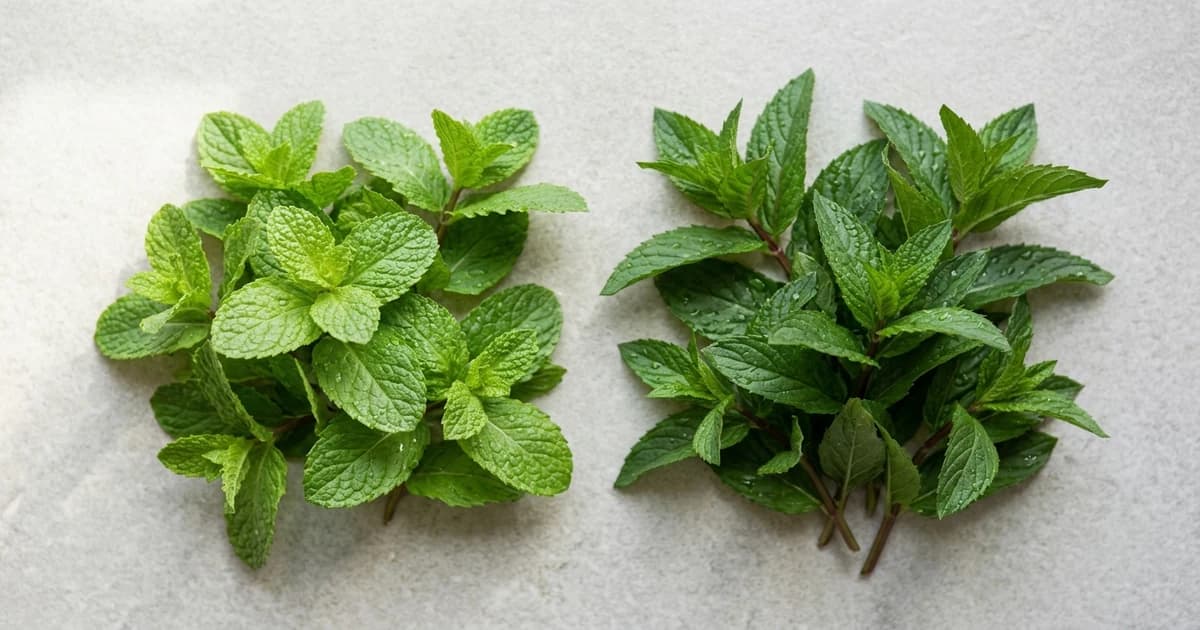
The difference between spearmint and peppermint comes down to two molecules. Peppermint oil typically contains around 40% menthol, the compound that triggers cold-sensing receptors on your tongue and skin. Spearmint oil contains less than 1% menthol and instead runs over 55% carvone, a compound that reads as sweet and warm rather than icy. Same plant family, completely different chemical signature, completely different sensation in your mouth.
Most "spearmint vs peppermint" explainers stop at "one is stronger." That is technically true but tells you nothing useful. The real question is why, and the answer is receptor biology.
Key Takeaways
- Peppermint's cooling sensation comes from menthol activating TRPM8, a cold-sensing ion channel in your sensory neurons.
- Spearmint's sweetness comes from carvone, which does not activate TRPM8 and produces only a faint cooling sensation at best.
- Peppermint is not a distinct wild species. It is a sterile hybrid of spearmint and watermint.
- "Stronger" is the wrong framing. Peppermint is more intensely cooling; spearmint is more intensely sweet. They are different axes, not different points on the same scale.
Spearmint vs Peppermint: The Chemistry
The flavor gap between these two mints traces directly to their essential oil profiles. Here are the compounds that matter:
| Compound | Peppermint Oil | Spearmint Oil | What It Does |
|---|---|---|---|
| Menthol | 29-55% (typically ~41%) | Trace to 1% | Activates TRPM8 cold receptor; produces cooling sensation |
| Menthone | 10-40% | Trace | Minty aroma, slight cooling |
| Carvone | Trace | 55-70% | Sweet, warm, herbal mint flavor |
| Limonene | 0.2-6% | 2-25% | Citrus note |
| 1,8-Cineole | 3-6% | Less than 2.5% | Eucalyptus-like sharpness |
| Menthyl acetate | 3-10% | Trace | Fruity-mint undertone |
Sources: Peppermint composition from pharmacopeia-grade specifications (USP/BP/EP ranges). Spearmint composition from published essential oil analyses and ISO specifications.
The ratio tells the story. Peppermint is a menthol-delivery system. Spearmint is a carvone-delivery system. Everything else follows from that split.
Why Peppermint Feels Cold: Menthol and the TRPM8 Receptor
Peppermint does not lower the temperature of your mouth. It fools the nerve that reports temperature.
In 2002, two independent research groups (McKemy et al. in Nature and Peier et al. in Cell) identified TRPM8, an ion channel expressed in sensory neurons that responds to cold temperatures below roughly 26 degrees Celsius. The same channel responds to menthol. When menthol binds TRPM8, the channel opens and sends a "cold" signal to the brain, even though nothing actually got colder.
This is why a peppermint candy makes water feel ice-cold. The menthol has already primed your TRPM8 channels, so the mild coolness of room-temperature water registers as freezing.
Menthol also interacts with a second receptor, TRPA1. A 2007 study by Karashima et al. in the Journal of Neuroscience showed that menthol has a bimodal effect on TRPA1: it activates the channel at low concentrations and inhibits it at higher ones. TRPA1 activation is linked to the sharp, slightly irritant "bite" that concentrated peppermint produces, distinct from the pure cool of TRPM8. That two-channel interaction is why strong peppermint oil feels both cold and sharp at the same time.
Why Spearmint Tastes Sweet: Carvone
Carvone, the dominant compound in spearmint oil, does not trigger TRPM8 the way menthol does. A 2025 study published in FEBS Open Bio tested several menthol-related terpenes for TRPM8 activation and found that (R)-(-)-carvone was the only compound tested that did not induce a strong TRPM8 response, while menthol produced the strongest activation. Every other compound tested, including menthone, pulegone, and 1,8-cineole, activated TRPM8 more strongly than carvone did.
That absence of cold-receptor activation is the entire explanation. Spearmint does not taste "warm" because it contains a warming agent. It tastes warm by default because it lacks the cooling one. Carvone registers as sweet and herbaceous through standard olfactory and taste pathways without hijacking your thermosensory system.
This is also why spearmint flavor is more stable across temperatures. A hot cup of peppermint tea still triggers some TRPM8 cooling (menthol is menthol regardless of the liquid's temperature), creating a perceptual conflict. Spearmint tea just tastes like spearmint.
Are Peppermint and Spearmint the Same Plant?
No, but they are closely related. Peppermint (Mentha x piperita) is a naturally occurring sterile hybrid of spearmint (Mentha spicata) and watermint (Mentha aquatica). The "x" in the Latin name signals hybrid origin. Washington State University's research program describes it more precisely as a "sterile allohexaploid" with genetic contributions from three Mentha species (spearmint is itself a hybrid of M. longifolia and M. suaveolens).
Because peppermint is sterile, it cannot reproduce from seed. Every peppermint plant in the world is a clone, propagated through root cuttings and runners. This matters commercially because it means peppermint crops are genetically uniform, which keeps the menthol content consistent from field to field.
Spearmint, by contrast, can reproduce sexually. That genetic diversity is one reason spearmint chemotypes vary more widely. Some spearmint cultivars run as high as 70% carvone while others sit closer to 55%.
Which Mint Is Stronger: Peppermint or Spearmint?
This question assumes "strong" is one thing. It is not.
Peppermint is more intensely cooling. That is a direct function of menthol content and TRPM8 activation. If you define strength as "hits harder on first contact," peppermint wins easily. The trigeminal nerve response to menthol is rapid and unmistakable.
Spearmint is more intensely sweet. Carvone delivers a rounder, more aromatic mint flavor with no icy bite. If strength means "more complex flavor," spearmint has a case.
In practical terms, peppermint dominates applications where a sharp, clean, cooling sensation matters: breath fresheners, mentholated products, and cold-relief formulations. Spearmint dominates where people want mint flavor without the freeze. Spearmint dominates mint gum sales in the United States, precisely because most people chewing gum want flavor, not a TRPM8 assault.
Where You Actually Taste This Difference
The spearmint-vs-peppermint split shows up in nearly every mint product you buy:
- Gum: Wrigley's Spearmint vs Wrigley's Doublemint (the latter uses a peppermint-spearmint blend for more cooling). Most "original" or "sweet" mint gums are spearmint-forward.
- Toothpaste: Peppermint-based toothpastes feel "cleaner" because menthol triggers TRPM8 and creates a perceptual association with freshness. Spearmint toothpastes exist for people who find that cooling sensation overwhelming.
- Tea: Peppermint tea has that characteristic icy quality even when hot. Spearmint tea is milder and slightly sweet.
- Oral pouches: Nicotine pouches overwhelmingly use mint flavoring for the same reason toothpaste does: the cooling trigeminal sensation reinforces perceived freshness. You can see how mint flavors show up across pouch brands in the broader pouch market.
- Candy: Peppermint patties, candy canes, Altoids. The candy aisle is heavily peppermint because menthol-driven cooling creates a more distinct sensory event.
The chemistry dictates the product design. When formulators want a cooling hit, they reach for peppermint-derived menthol. When they want flavor complexity without the cold shock, they reach for spearmint-derived carvone.
The Chemistry of Cool, Explained
Two plants, two dominant molecules, two completely different receptor interactions. Peppermint's menthol activates TRPM8 and TRPA1, creating a cold-and-sharp signal the brain interprets as icy freshness. Spearmint's carvone largely bypasses both channels, registering as sweet and herbal through conventional flavor pathways. The "strength" comparison is a category error. They are doing different things to different receptors.
The next time someone tells you peppermint is "just stronger spearmint," you now know the correct response: it is not stronger, it is colder. And the reason traces to a single hydroxyl group on a monoterpene.
Frequently Asked Questions
Is peppermint or spearmint better for you?
Neither is meaningfully "better" from a health standpoint in typical dietary amounts. Peppermint oil has more clinical research behind it (particularly for digestive comfort), but that research involves concentrated enteric-coated capsules, not tea or gum. Spearmint has some early-stage research on antioxidant content. For general use in food and flavor products, the choice is about taste preference, not health outcomes.
Can you substitute spearmint for peppermint in a recipe?
You can, but expect a flavor shift. Spearmint will taste milder and sweeter. If the recipe depends on a cooling or sharp sensation (like a peppermint patty or candy cane), spearmint will not deliver the same effect. For savory dishes, salads, and cocktails (mojitos, tabbouleh), spearmint is usually the default, and peppermint would overpower those dishes.
Which mint is in most chewing gum?
Spearmint. It dominates the mint gum market because its sweet, herbaceous flavor holds up well over extended chewing without the intensity fatigue that peppermint can cause. Peppermint gums exist, but they tend to occupy the "ice" or "intense" subcategory.
Why does peppermint feel cold but spearmint does not?
Menthol. Peppermint oil contains 29-55% menthol, which activates the TRPM8 cold-sensing ion channel in your sensory neurons. Spearmint oil contains less than 1% menthol, nowhere near enough to trigger a meaningful cold response. Spearmint's dominant compound, carvone, does not activate TRPM8 effectively.
Is peppermint a type of spearmint?
Not exactly. Peppermint is a hybrid of spearmint and watermint. So spearmint is one of its parent species, but peppermint is its own distinct (and sterile) hybrid, not a cultivar or variety of spearmint.
What makes menthol feel cold if it does not change the temperature?
Menthol binds to TRPM8, the same ion channel that opens in response to actual cold temperatures (below roughly 26 degrees Celsius). When menthol opens the channel chemically, the nerve sends the same "cold" signal to the brain that real cold would produce. Your brain cannot tell the difference.
Does spearmint contain any menthol at all?
Technically yes, but in trace amounts, typically less than 1% of the essential oil. That is 40 to 50 times less than peppermint, and far below the threshold needed to produce a noticeable cooling sensation.
Cool Mint, Without the Guesswork
If you have spent any time in the oral pouch or functional mint space, you have noticed that nearly every product leans on some version of "cool mint" or "spearmint" flavoring. The chemistry above explains why: menthol-style cooling creates a fast, recognizable sensory signal, while carvone-style sweetness fills in the flavor.
Roon uses a cool mint flavoring (plus sucralose for sweetness) as the delivery vehicle for its four-ingredient nootropic stack: caffeine, L-theanine, Dynamine, and TeaCrine. Full per-pouch dosages are on the product page. It is not a peppermint oil product or a spearmint oil product. It is a formulated flavor designed to pair with the pouch format and a 6-to-8-hour focus window.
Roon is not a mint. It is not a candy. It is a zero-nicotine, zero-sugar, zero-calorie sublingual pouch that happens to taste like cool mint because, as the chemistry above shows, that is the flavor profile your trigeminal nerve responds to most quickly. Tins start from $9.16 for a 12-tin subscription ($0.61 per pouch). If you want to understand how that stack works beyond the flavor, the L-theanine mints guide is a good next read.
Related from Roon
Written by Roon Team