Does Mint Help You Focus? What the Peppermint Aroma Studies Actually Show
Does Mint Help You Focus? What the Peppermint Aroma Studies Actually Show
Yes, several controlled studies link peppermint aroma to increased alertness and modest improvements in memory and reaction time. But the research has limits that most articles skip over: effects are small, sample sizes are small (25 to 144 participants), and most of the evidence comes from smelling peppermint essential oil, not eating or chewing something mint-flavored. The delivery route matters, and lumping them together is where the internet goes wrong.
Here is what the actual studies found, organized by how participants were exposed to peppermint, and where the evidence gets thin.
Key Takeaways
- Inhaling peppermint essential oil aroma improved alertness and some memory measures across multiple small studies (n = 25 to 144).
- Drinking peppermint tea also improved short-term cognitive performance in one 2025 trial, but researchers could not fully explain why.
- No published study has tested whether chewing a mint-flavored gum or pouch produces the same cognitive effects as ambient peppermint aroma.
- Peppermint's proposed mechanism (trigeminal nerve stimulation and possible cerebral blood flow changes) is separate from caffeine's adenosine-receptor blockade, so the two are not substitutes for each other.
What the Peppermint and Focus Studies Actually Show
Four studies form the core of the peppermint-cognition literature. They span 17 years, three different delivery routes, and four different outcome measures. The table below gives you the full picture in 30 seconds.
| Study | Year | Design | Delivery Route | n | Key Finding |
|---|---|---|---|---|---|
| Moss et al. | 2008 | Randomized, 3-group | Ambient aroma | 144 | Peppermint aroma enhanced memory and increased subjective alertness vs. no-aroma control |
| Raudenbush et al. | 2009 | 3-condition (peppermint, cinnamon, control) | Inhaled during task | Not disclosed in abstract | Both odors increased alertness ratings, decreased frustration and temporal demand during simulated driving |
| Moss et al. | 2023 | Randomized, 2-group | Ambient aroma | 50 | Peppermint aroma reduced aggressive driving behavior and improved reaction times in a VR driving simulator |
| Netzler & Lovell | 2025 | Randomized, placebo-controlled | Ingested tea (200 mL) | 25 | Peppermint tea improved short-term cognition and increased prefrontal blood flow, but blood flow did not fully mediate the cognitive effect |
Notice the pattern: three of the four studies tested ambient aroma, one tested ingested tea, and none tested a mint-flavored product you chew or hold in your mouth. That distinction matters for anyone wondering whether a stick of mint gum will do the same thing.
Peppermint Aroma and Cognitive Performance: The Original Study
The most-cited study in this space is Moss et al. (2008), published in the International Journal of Neuroscience. Researchers at Northumbria University randomly assigned 144 healthy volunteers to one of three conditions: peppermint aroma, ylang-ylang aroma, or no aroma. Participants then completed a battery of cognitive tests.
The peppermint group showed enhanced memory and higher self-rated alertness compared to the no-aroma control. The ylang-ylang group went the other direction: impaired memory, slower processing speed, and lower alertness. That contrast is useful because it argues against a simple novelty effect. If any pleasant smell boosted performance, ylang-ylang should have helped too. It didn't.
Still, 144 participants split three ways means roughly 48 people per condition. That is enough to detect a medium-sized effect, but not enough to call the question settled.
Peppermint Aroma and Driving Alertness
Two later studies moved the question from a lab desk to a driving simulator.
Raudenbush et al. (2009) administered peppermint and cinnamon odors to participants during a simulated driving task. Both scents increased self-reported alertness ratings and decreased frustration and temporal demand compared to a no-odor control. Peppermint also reduced anxiety and fatigue.
More recently, Moss et al. (2023) exposed 50 healthy volunteers to peppermint essential oil aroma (or no aroma) during a virtual-reality driving scenario. The peppermint group showed reduced aggressive driving behavior and improved reaction times to unexpected events. The effect sizes on aggression were medium, not large.
Both studies point the same direction: peppermint aroma seems to help people stay alert and reactive during monotonous or frustrating tasks. Whether that translates to "better focus while studying" is a reasonable inference, but it is an inference, not a direct finding from a study-hall experiment.
Peppermint Tea and Cognition: A Different Route
The newest entry is Netzler & Lovell (2025), published in Human Psychopharmacology. This one is different: participants drank 200 mL of peppermint tea instead of smelling aroma. It was randomized and placebo-controlled, with 25 adults.
The peppermint group performed better on short-term cognitive tasks. They also showed greater increases in prefrontal oxygenated and total hemoglobin, measured by functional near-infrared spectroscopy (fNIRS), suggesting more blood flow to the prefrontal cortex. But here is the catch: a mediation analysis found the blood-flow changes did not fully explain the cognitive improvement. Something else is going on, and the researchers said so plainly.
This matters because the "more blood to the brain" explanation you see on wellness blogs is, at best, incomplete. The mechanism behind peppermint's cognitive effects is not settled, even as of 2025.
Does Chewing Mint-Flavored Gum Help Focus the Same Way?
Short answer: we do not know, because no study in the peppermint-cognition literature tested it.
The studies above used either ambient essential oil vapor or brewed tea. A mint-flavored gum, pouch, or candy delivers the flavor chemistry behind peppermint differently: lower-concentration volatile compounds, released intermittently in the mouth rather than diffused through a room.
There is a separate body of research on chewing gum and cognition, but those studies generally find that the mechanical act of chewing is the primary driver of any cognitive benefit, not the flavor. The gum literature points to increased cerebral blood flow from jaw movement and possible cortisol reduction, not olfactory stimulation. For a deeper look at that angle, see the chewing-action side of this question.
Claiming "mint gum boosts focus because peppermint aroma boosts focus" stitches together two separate literatures that have not been tested together. It might be true. It has not been shown.
How Strong Is This Evidence, Really?
Honest assessment: directionally promising, not definitive.
What the research supports:
- Peppermint essential oil aroma can increase self-reported alertness and improve some objective measures of memory and reaction time in controlled settings.
- Peppermint tea may improve short-term cognition, though the mechanism is unresolved.
- Effects appear across multiple labs and study designs, which adds credibility.
What remains weak or unknown:
- Sample sizes are small. The largest study had 144 participants; the smallest had 25.
- No long-term studies exist. Every finding is acute, measured minutes to hours after exposure.
- The proposed mechanism, trigeminal nerve stimulation leading to brainstem arousal, is plausible but not proven. Some researchers have also proposed cerebral oxygen availability as a factor, but again, the Netzler 2025 mediation analysis suggests blood flow alone does not explain the cognitive effects.
- Nobody has tested whether the formulated "cool mint" or "spearmint" flavorings in commercial products produce the same olfactory signal as diffused peppermint essential oil.
Peppermint aroma is not a substitute for sleep, exercise, or an actual stimulant. It is a mild sensory signal that may nudge alertness upward in some contexts.
Where Caffeine Fits In
Caffeine works through an entirely different mechanism. It blocks adenosine receptors in the brain, preventing the "time to sleep" signal from accumulating. That is a pharmacological effect with decades of large-scale evidence behind it, not a sensory one.
Peppermint aroma, by contrast, appears to work through the olfactory and trigeminal pathways: menthol activates cold-sensitive receptors and stimulates brainstem arousal centers. If both pathways are real, they operate independently. A product that combines caffeine with a mint flavor is not "stacking" the same effect twice. It is doing two different things through two different systems.
That distinction also means peppermint aroma is not a caffeine replacement. The effect sizes in the peppermint studies are modest and short-lived. Caffeine's effects on sustained attention are larger, longer, and far more replicated.
The Honest Summary on Mint and Focus
Peppermint aroma probably does something real to alertness and short-term cognitive performance. The evidence is consistent across multiple small studies, and the proposed mechanism through trigeminal nerve stimulation is biologically plausible. But "probably does something modest" is where the science stops. The samples are small. The mechanisms are unresolved. And the leap from "ambient essential oil diffused in a room" to "mint-flavored thing in your mouth" has not been tested.
If you want to try peppermint aroma while you study or work, there is little downside. A few drops of peppermint essential oil on a cotton ball near your desk costs almost nothing and carries minimal risk. Just do not expect it to replace sleep, caffeine, or focused work habits.
Frequently Asked Questions
Does smelling peppermint really wake you up?
Multiple controlled studies suggest yes, modestly. Moss et al. (2008) found peppermint aroma increased subjective alertness in 144 volunteers, and Raudenbush et al. (2009) found it increased alertness during simulated driving. The effect appears to be real but small, and the proposed mechanism involves trigeminal nerve stimulation rather than a pharmacological pathway like caffeine uses.
Can mint gum help you study?
The honest answer is that no study has directly tested this. The peppermint-cognition studies used ambient aroma or brewed tea, not gum. A separate literature on chewing gum suggests the chewing motion itself may help attention, but that is a jaw-movement effect, not a mint-flavor effect. You can read more about the chewing-action side of this question.
Is peppermint tea good for brain fog?
Netzler & Lovell (2025) found peppermint tea improved short-term cognitive performance in a small placebo-controlled trial of 25 adults. That is one study with a small sample, so "good for brain fog" overstates the evidence. It may help mildly with short-term alertness and memory. It is not a treatment for any medical condition.
Does peppermint improve memory?
In the Moss et al. (2008) study, peppermint aroma enhanced memory performance compared to no-aroma and ylang-ylang conditions. This was measured on a cognitive test battery, not real-world recall. The finding has not been replicated at scale, so "improve memory" should be read as "improved performance on memory tests in one well-designed but small study."
How long do peppermint's focus effects last?
The studies measured effects within a single testing session, typically 20 to 40 minutes of cognitive tasks performed shortly after aroma exposure. No study has tracked whether the alertness effect persists for hours. This is an acute, short-lived phenomenon as far as the published evidence goes.
Is mint smell or mint flavor more effective for focus?
The research has only tested ambient aroma (essential oil diffused in a room) and ingested tea. Nobody has compared smell versus flavor head-to-head, so there is no evidence-based answer. The olfactory pathway (smell) has more published support than any oral delivery route.
Does spearmint have the same focus effects as peppermint?
The studies above all used peppermint (Mentha piperita), which has a higher menthol content than spearmint (Mentha spicata). Spearmint's dominant compound is carvone, not menthol. Since the proposed mechanism involves menthol activating trigeminal receptors, the two mints may not behave identically. For a comparison of their chemistry, see spearmint vs. peppermint.
A Mint Format That Actually Carries Active Ingredients
Peppermint aroma is an interesting sensory signal, but the research is clear on its limits: small effects, small samples, and no evidence that a mint flavor in your mouth replicates what ambient essential oil does in a room.
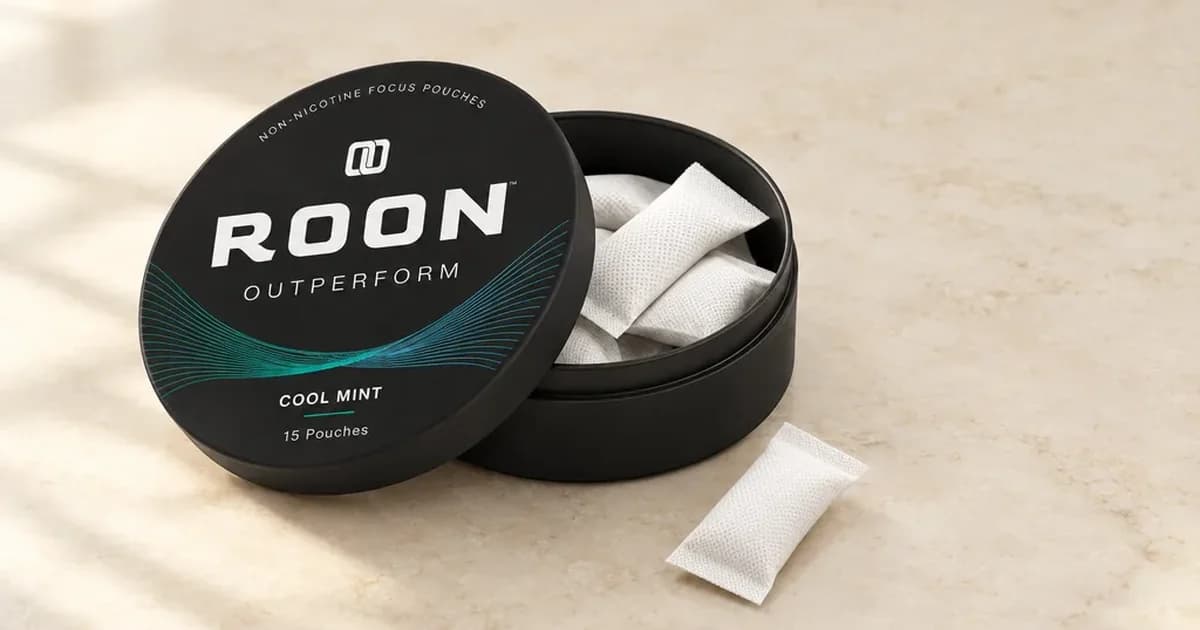
If you are looking for sustained focus rather than a mild sensory nudge, the active ingredients matter more than the flavor. Roon is a zero-nicotine oral pouch with a cool mint flavor, but its cognitive effects come from 80 mg caffeine, 60 mg L-theanine, 25 mg methylliberine (Dynamine), and 5 mg theacrine (TeaCrine), not from the mint. Caffeine blocks adenosine receptors. Methylliberine slows caffeine's clearance, extending the felt window to 6 to 8 hours instead of coffee's typical 3 to 4. (That mechanism was demonstrated in a randomized PK study, though at higher doses: 100 mg methylliberine + 150 mg caffeine, versus Roon's 25 mg + 80 mg. The direction of the effect is the same; the magnitude at Roon's dose has not been independently measured.) L-theanine smooths the response. The trade-off: a longer half-life means you should stop at least 8 hours before bed.
Roon is not a peppermint aroma product and makes no aroma-based focus claims. It is a mint format that also carries actives, starting from $9.16 per tin. If the flavor happens to nudge your trigeminal nerve a little, consider that a bonus, not the mechanism.
Related from Roon
- Spearmint vs. Peppermint
- Does Chewing Gum Help You Focus?
- L-Theanine Mints: The Complete Guide
- Flavor Fatigue, Explained
Written by Roon Team