How Much Caffeine Is in Dark Chocolate? By Cacao Percent
How Much Caffeine Is in Dark Chocolate? By Cacao Percent
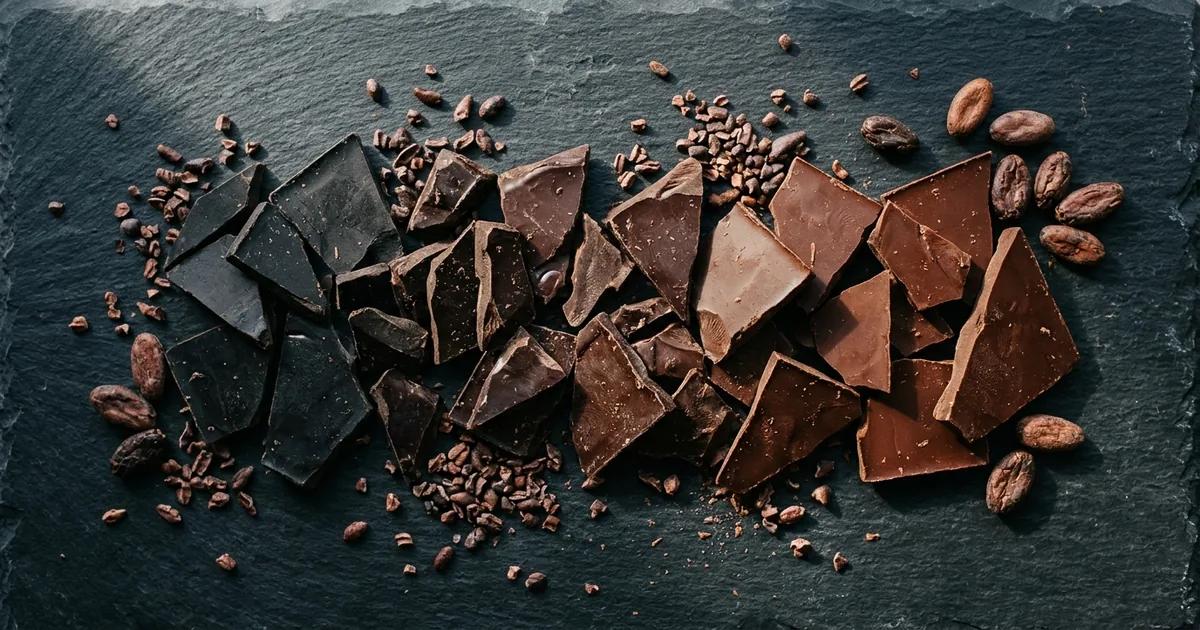
Dark chocolate with 70 to 85% cacao contains about 80 mg of caffeine per 100 g, or roughly 23 mg per ounce, per USDA FoodData Central. The 60 to 69% cacao category actually tests higher at 86 mg per 100 g. Even a full 100 g bar of 70 to 85% dark has less caffeine than a cup of coffee: the FDA puts roughly 400 mg across two to three 12 oz cups.
Caffeine in Dark Chocolate by Cacao Percent
| Chocolate type (USDA FDC ID) | Caffeine per 100 g | Per 10 g | Per 1 oz (28.35 g) | Theobromine per 100 g |
|---|---|---|---|---|
| Dark, 70-85% cacao (170273) | 80 mg | 8.0 mg | 22.7 mg | 802 mg |
| Dark, 60-69% cacao (170272) | 86 mg | 8.6 mg | 24.4 mg | 632 mg |
| Dark, 45-59% cacao (170271) | 43 mg | 4.3 mg | 12.2 mg | 493 mg |
| Semisweet (167976) | 62 mg | 6.2 mg | 17.6 mg | 486 mg |
| Baking, unsweetened squares (167568) | 80 mg | 8.0 mg | 22.7 mg | 1,300 mg |
| Milk chocolate (167587) | 20 mg | 2.0 mg | 5.7 mg | 205 mg |
| White chocolate (167571) | 0 mg | 0 mg | 0 mg | 0 mg |
| Cocoa powder, unsweetened (169593) | 230 mg | 23.0 mg | 65.2 mg | 2,060 mg |
| Cocoa powder, Dutch-processed (169594) | 78 mg | 7.8 mg | 22.1 mg | 2,630 mg |
Source: USDA FoodData Central (SR Legacy), per 100 g values; per-serving columns computed: mg per 100 g × grams ÷ 100. Checked Oct 2026.
Does a Higher Cacao Percentage Mean More Caffeine?
Usually, but not always. USDA's 60 to 69% cacao samples average 86 mg per 100 g, above the 70 to 85% category's 80 mg. Each USDA category rests on just 2 to 3 lab samples: the 60 to 69% range spans 70 to 100 mg across 3 samples, while 45 to 59% spans 40 to 50 mg.
Bean origin and processing vary from bar to bar, so use the cacao percentage as a rough guide, not a precise predictor. For tracking total intake, the USDA figures above are the best public numbers; see also how long caffeine stays in your system.
Why Chocolate Wrappers Rarely List Caffeine
The FDA notes that when a packaged food contains an ingredient that inherently has caffeine, like chocolate, caffeine does not have to appear on the ingredient list. The caffeine-containing ingredient is listed instead. Some brands have voluntarily disclosed caffeine in the past, but few still do. USDA lab data remains the best public reference.
Caffeine in Milk Chocolate, White Chocolate, and Cocoa Powder
Milk chocolate contains roughly 20 mg of caffeine per 100 g, about a quarter of 70 to 85% dark. White chocolate contains 0 mg: it is cocoa butter, not cocoa solids, and the caffeine lives in the solids.
Unsweetened cocoa powder is the outlier at 230 mg per 100 g. Dutch-processed (alkalized) cocoa drops to 78 mg per 100 g in USDA data. For hot chocolate math, see does hot chocolate have caffeine.
Theobromine: The Bigger Stimulant in Dark Chocolate
Caffeine is not the dominant methylxanthine in dark chocolate. USDA lists 802 mg of theobromine per 100 g in 70 to 85% dark chocolate (range: 710 to 940 mg, 2 samples), roughly 10 times its caffeine.
Theobromine is a weaker, slower-acting methylxanthine than caffeine. For more on how the two compounds differ, see theobromine vs caffeine and theobromine as chocolate's real stimulant.
How Much Dark Chocolate Equals a Cup of Coffee?
To reach the FDA's 400 mg guideline from 70 to 85% dark chocolate alone, you would need about 500 g (17.6 oz): five full 100 g bars. Formula: grams = target mg ÷ mg per 100 g × 100.
A generous after-dinner portion (40 to 50 g) delivers 32 to 40 mg. That is a real amount, and it adds to whatever coffee or tea you had earlier. For a cup of coffee, the FDA's only framing is that 400 mg is about two to three 12 oz cups.
Dark Chocolate at Night and Other Caffeine Limits
The FDA cites 400 mg of caffeine per day as an amount not generally associated with negative effects for most healthy adults. Caffeine stacks: coffee, tea, chocolate, and pre-workouts all count toward that total.
If you are pregnant, trying to conceive, breastfeeding, or on medications that interact with caffeine, ask your healthcare provider about limits. Dark chocolate also delivers theobromine, which has its own stimulant activity and is still active at bedtime. A large serving before bed may keep sensitive people awake. Account for all your daily caffeine sources.
Related from Roon
- Does Hot Chocolate Have Caffeine?
- Theobromine vs Caffeine
- How Long Does Caffeine Stay in Your System?
Frequently Asked Questions
Does 85% dark chocolate have more caffeine than 70%?
USDA FoodData Central groups 70 to 85% cacao into one category at 80 mg of caffeine per 100 g. There is no separate entry for 85%, so USDA data cannot tell you whether an 85% bar has more caffeine than a 70% bar.
How much caffeine is in one square of dark chocolate?
A single square is roughly 10 g, though sizes vary by brand. At 70 to 85% cacao, that is about 8 mg of caffeine (USDA's 80 mg per 100 g). Three squares: about 24 mg, roughly what 1 oz delivers.
Is there caffeine in cacao nibs?
USDA's SR Legacy database has no standalone cacao-nib entry. Nibs are crushed cocoa solids, so expect caffeine, but there is no USDA figure to quote for them.
Does dark chocolate keep you awake?
It can. A 1 oz serving of 70 to 85% dark delivers about 23 mg of caffeine plus roughly 227 mg of theobromine. Sensitivity to caffeine varies a lot from person to person. If evening chocolate seems to keep you up, finish it earlier in the day.
When You Want Caffeine You Can Count
Dark chocolate is real caffeine, but it is hard to dose: no number on the wrapper, wide sample-to-sample variation, and theobromine on top. If you want a known caffeine intake you can plan around, Roon takes a different approach.
Each pouch delivers 80 mg caffeine with 60 mg L-theanine, 25 mg methylliberine (Dynamine), and 5 mg theacrine (TeaCrine), placed under the lip. Onset is 5 to 10 minutes. Methylliberine slows caffeine's clearance: a randomized crossover PK study (n=12) found caffeine's half-life extended from 7.2 to 15 hours with no higher peak, though that study used 100 mg methylliberine and 150 mg caffeine (about 4x the methylliberine and 1.9x the caffeine in one Roon pouch), so the direction applies but the magnitudes do not transfer. A 15-hour half-life is not 15 hours of felt energy: most people feel a pouch for 6 to 8 hours, and because the clearance tail is longer, leave at least 8 hours between your last pouch and sleep.
Zero nicotine, zero sugar (contains sucralose). From $9.16 per tin, as little as $0.61 per pouch on the 12-tin subscription. Not a replacement for after-dinner chocolate, but a caffeine number you can plan around.
Sources
- USDA FoodData Central: Chocolate, dark, 70-85% cacao solids (FDC 170273)
- USDA FoodData Central: Chocolate, dark, 60-69% cacao solids (FDC 170272)
- USDA FoodData Central: Chocolate, dark, 45-59% cacao solids (FDC 170271)
- USDA FoodData Central: Cocoa, dry powder, unsweetened (FDC 169593)
- USDA FoodData Central: Cocoa, dry powder, processed with alkali (FDC 169594)
- FDA: Spilling the Beans: How Much Caffeine Is Too Much?
- Caffeine and Methylliberine: A Human Pharmacokinetic Interaction Study
Written by Roon Team